
In the fast-moving world of customer relationship management (CRM), businesses face a critical challenge: ensuring their Salesforce applications remain compatible with an ever-evolving platform. Salesforce, a cornerstone of modern sales and marketing operations, undergoes major updates three times a year, rolling out new features and API changes that can impact app functionality. As companies invest heavily in customizing their CRM to drive revenue, compatibility issues can lead to integration setbacks, data inconsistencies, and disrupted workflows, costing time and resources. The stakes are high, with the global CRM market projected to grow significantly, reflecting the increasing reliance on platforms like Salesforce to maintain competitive edges in diverse industries.
This dynamic landscape underscores the need for a strategic approach to app selection and maintenance. Compatibility isn’t just a technical requirement; it ties directly to operational efficiency and long-term business success. Rapid innovation, including the integration of AI and advanced data tools, means that sales teams now depend on interconnected systems for everything from lead generation to pipeline management. A single incompatible app can create ripple effects, stalling sales cycles and frustrating teams. This guide offers seven actionable checks to help you navigate Salesforce compatibility, ensuring your applications support your goals without becoming liabilities as the platform evolves.
Understanding the Salesforce Ecosystem: Compatibility as a Core Concern
Salesforce has grown far beyond its origins as a basic CRM tool over the past 25 years. It now serves as a comprehensive platform encompassing sales, marketing, service, and analytics, powered by AI and bolstered through key acquisitions like Vlocity and MuleSoft that enhance data integration and industry-specific solutions. This expansion creates a complex environment where app compatibility extends beyond simple connections to APIs, touching multiple layers of functionality.
Today’s sales teams rely on integrated tools for tasks like data enrichment and conversation tracking. When compatibility falters, entire processes can stall. This challenge grows with Salesforce’s focus on automation and integration with platforms like Tableau, which demands that apps keep pace with new capabilities. For leaders in sales and revenue operations, ensuring compatibility becomes a strategic priority, directly affecting team output and bottom-line results.
Coffee: An AI-Driven Solution for Salesforce Compatibility
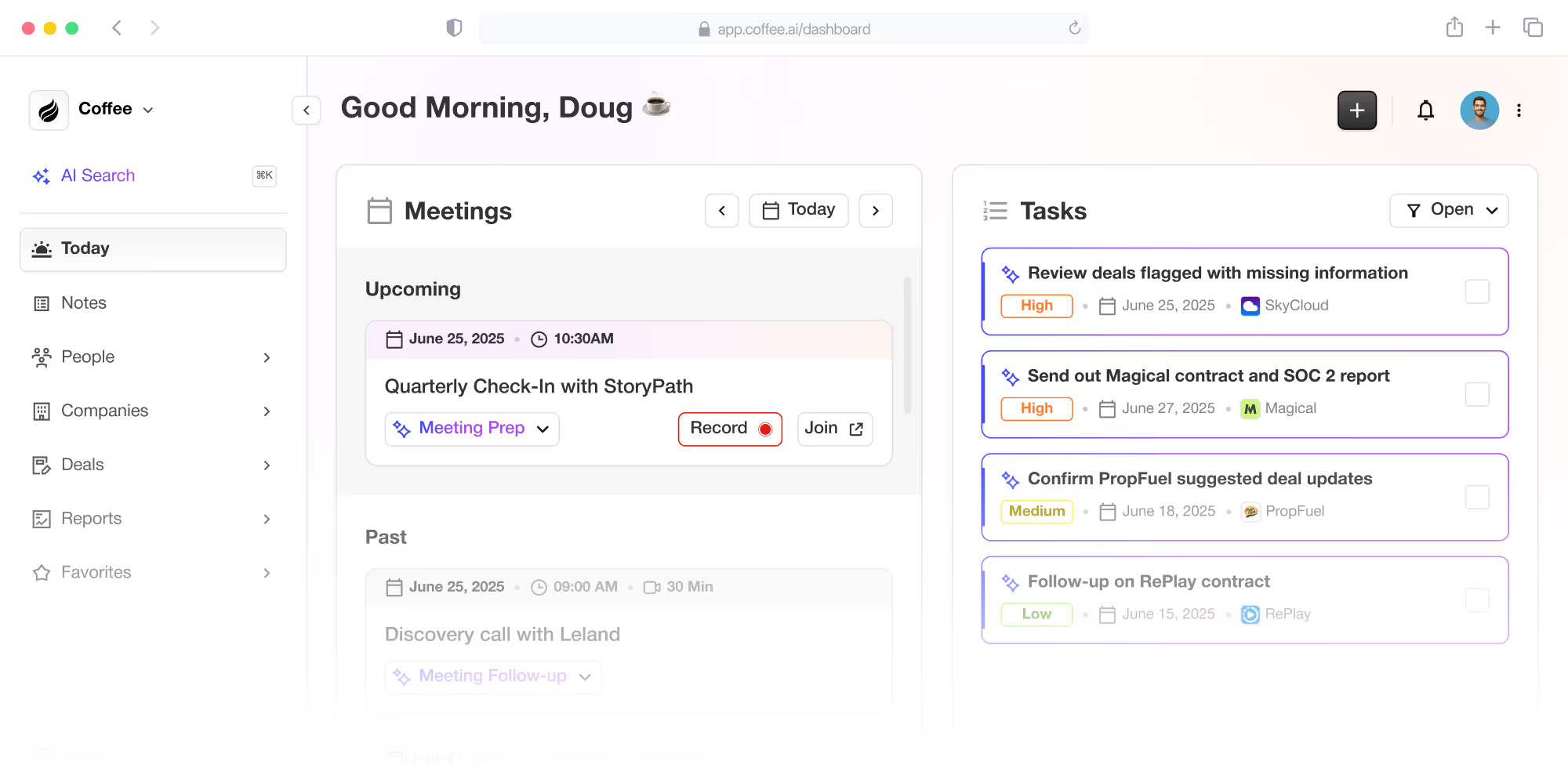
Amid these challenges, tools like Coffee stand out by offering AI-enhanced functionality tailored for Salesforce integration. Coffee’s Companion App works alongside your existing Salesforce setup, providing automation for tasks such as contact enrichment, activity tracking, and meeting management. It aims to reduce manual workload and improve pipeline visibility while maintaining data sync with your CRM.
This design reflects a broader shift toward solutions that enhance, rather than replace, core systems. Coffee addresses common CRM frustrations like fragmented tools and low user adoption by embedding AI capabilities directly into familiar workflows. If you’re looking to augment your Salesforce setup with intelligent automation, request access to explore Coffee’s features.
7 Key Checks to Ensure Salesforce App Compatibility
1. Track Salesforce Release Cycles and API Updates
Salesforce follows a structured update schedule with three major releases annually, named Spring, Summer, and Winter, each tied to the respective year. These updates often include API revisions that can affect app performance. Knowing this cycle helps you anticipate potential compatibility issues.
API versioning is central to maintaining app functionality. While older API versions aren’t immediately outdated, they enter deprecation phases over time. Reliable vendors support multiple API versions and update their apps to align with newer releases for better security and features. When reviewing apps, ask vendors about their API support timeline and adaptation speed to avoid gaps in functionality. Coffee, for instance, focuses on straightforward authentication to sync data with Salesforce, ensuring access to platform updates without compromising stability.
2. Look for Apps with Strong Automated Testing Processes
Manual testing can’t keep up with Salesforce’s update frequency. Automated testing plays a vital role in catching compatibility issues early, especially through sandbox simulations that mimic live environments. Vendors with robust DevOps practices, including continuous integration and deployment, are better equipped to handle updates. Check if potential apps undergo regular regression testing and compatibility checks across Salesforce editions. Coffee prioritizes data sync and user experience to limit disruptions, aligning its testing with Salesforce’s framework.
3. Assess Integration Depth with Salesforce Features
Effective apps go beyond basic API access to support Salesforce’s advanced capabilities. With expanding data and AI services, apps need to handle custom fields, automated processes via Flow, and multi-currency configurations. Look for solutions that align with your specific setup, including security models and sharing rules. Coffee’s approach involves syncing selected data back to Salesforce, providing flexibility to integrate enriched insights into your existing CRM structure.
4. Confirm Vendor Dedication to Updates and Support
Compatibility requires ongoing effort from vendors. Keeping up with platform changes is essential as Salesforce shifts toward more complex integrations. Gauge a vendor’s reliability by their update frequency after Salesforce releases and the clarity of their communication about impacts. Larger teams with Salesforce expertise often handle changes better than smaller ones. Coffee emphasizes integration support, and you can request access to see their commitment firsthand.
5. Verify Data Integrity and Security Standards
Data consistency is critical during platform updates. Apps should protect against record loss or sync errors while supporting analytics with reliable historical data. Security alignment is equally important, ensuring compliance with Salesforce’s evolving standards and regulations like GDPR. Check how apps manage field security and permissions. Coffee incorporates a data warehouse for pipeline snapshots and maintains SOC 2 Type 2 and GDPR compliance to safeguard information.
6. Evaluate Impact on User Experience and Adoption
Even compatible apps can fail if they disrupt user workflows. Apps should match Salesforce’s Lightning Experience updates and mobile interfaces, avoiding outdated designs. A steep learning curve can hinder adoption, so opt for tools that fit naturally into existing habits. Coffee focuses on embedding AI automation in a way that feels intuitive for Salesforce users, aiming to boost engagement by reducing manual tasks.
7. Test Compatibility Before Deployment
Thorough pre-deployment testing in a sandbox mirroring your live setup is essential. Proactive testing before seasonal updates prevents outages by validating functionality and data handling. Consider interactions with other tools like marketing platforms. Pair testing with change management, involving key users for feedback and preparing training. Coffee’s implementation emphasizes minimal workflow disruption during integration with Salesforce.
Comparing Salesforce Companion Apps to Traditional Add-ons
Modern companion apps differ from older add-ons in how they integrate with Salesforce, affecting compatibility and value. Here’s a breakdown:
- Architecture: Traditional add-ons often use outdated frameworks, while companion apps adopt cloud-native, API-first designs. Coffee builds specifically for Salesforce integration.
- Update Approach: Add-ons tend to react slowly with patches. Companion apps align proactively with updates. Coffee focuses on consistent data sync.
- Data Management: Add-ons may directly alter databases, risking errors. Companion apps use API syncing. Coffee stores historical data snapshots.
- User Interface: Add-ons often have separate workflows. Companion apps blend into Salesforce’s UI. Coffee automates within familiar processes.
This shift highlights a trend toward flexible, AI-enabled tools that complement core CRMs. Coffee exemplifies this by enhancing Salesforce with automation. Request access to see its impact.
Common Questions on Salesforce App Compatibility
How Frequently Should Compatibility Be Reviewed?
Plan to review compatibility at least twice yearly, aligning with Salesforce’s major updates. Continuous monitoring through automated tools for performance and integration issues offers added protection. Quarterly discussions with vendors about upcoming changes can also help stay ahead of potential conflicts.
What Signals Potential Compatibility Issues?
Watch for apps not updated in over six months, vendors lacking clear API strategies, or frequent errors like timeouts. Delays in compatibility patches after Salesforce updates or unclear plans for supporting new features also indicate risks that could affect performance.
How to Check Integration with Custom Salesforce Setups?
Document your custom objects, workflows, and rules. Request vendor documentation on handling customizations and conduct sandbox testing to replicate your environment. Focus on field mapping and automation integration to ensure smooth operation with your unique setup.
What to Do if an App Becomes Incompatible?
Contact the vendor immediately to assess the issue and timeline for a fix. Use manual processes temporarily if needed, documenting workarounds to reduce impact. Long-term, reassess vendor criteria to prioritize compatibility in future selections.
How to Maintain Team Adoption During Updates?
Support adoption by involving key users early for feedback, creating training that shows workflow benefits, and rolling out changes gradually. Tools like Coffee, which focus on minimal disruption, ease transitions by aligning with familiar Salesforce interfaces.
Strengthen Your Salesforce Setup with Coffee
These seven compatibility checks provide a practical roadmap for choosing Salesforce apps that support your operations as the platform grows. Managing these evaluations, however, can demand significant effort and technical know-how. Coffee offers an AI-driven companion app that simplifies this by focusing on seamless integration, automating tasks like data entry and pipeline analysis within your existing Salesforce framework.
By opting for solutions that prioritize compatibility and user experience, you can shift focus from technical hurdles to sales growth. Coffee’s design aims to unlock Salesforce’s full potential through intelligent features. Request access today to discover how it can enhance your CRM investment.