
In today’s competitive sales landscape, efficiency and data accuracy are vital for success. Sales teams face increasing pressure to close deals faster while managing growing administrative burdens, particularly with CRM systems like Salesforce. Manual data entry, fragmented meeting notes, and inconsistent processes often hinder productivity, costing valuable time and missing critical insights. The market has responded with AI-driven tools that aim to automate these tasks, integrating directly with platforms like Salesforce to streamline workflows. This article explores the challenges of traditional methods, evaluates the benefits and trade-offs of AI solutions, and highlights how tools like Coffee’s Companion App exemplify this trend toward smarter, more connected sales enablement.
Why Manual Meeting Notes Hurt Sales Efficiency
Manual note-taking and data entry consume significant time that sales reps could spend on closing deals. Studies estimate that sales professionals dedicate a substantial portion of their week to administrative tasks, pulling focus away from customer interactions. This repetitive work not only delays progress but also increases the risk of errors in Salesforce records.
During meetings, reps often struggle to balance active listening with capturing detailed notes. Splitting attention between engaging prospects and documenting conversations frequently results in incomplete or inaccurate information. After meetings, recalling details for entry into Salesforce becomes even harder, leading to gaps in data that affect follow-ups and deal tracking.
Key Drawbacks of Manual Processes
- Time lost on repetitive administrative tasks reduces selling opportunities.
- Incomplete notes miss critical details, requiring additional clarification from prospects.
- Delayed data entry leads to outdated or incorrect CRM records, impacting team coordination.
How Fragmented Data Blocks Sales Progress
When meeting notes are scattered across notebooks, apps, or emails instead of centralized in Salesforce, teams lose access to vital customer context. This fragmentation creates silos, making it difficult for account managers or sales leaders to follow deal histories. As a result, prospects face repetitive questions, and managers lack the visibility needed for accurate forecasting.
Buried insights from unstructured notes also mean missed chances to spot trends or replicate successful strategies. Without a unified system, valuable data on pain points or competitive positioning remains inaccessible, stalling sales cycles.
Why CRM Adoption and Data Quality Suffer
Inconsistent use of Salesforce for note-taking often stems from reps viewing data entry as a burden rather than a benefit. Even with Salesforce’s built-in automation features, adoption varies, leaving records incomplete. This impacts marketing, customer success, and revenue operations teams, who rely on accurate data for lead nurturing, onboarding, and analytics.
Poor data quality creates a ripple effect, undermining forecasting and strategic decisions across the organization. Addressing this requires tools that reduce friction and automate input without sacrificing detail.
Coffee’s AI Solution: Streamlining Salesforce Workflows
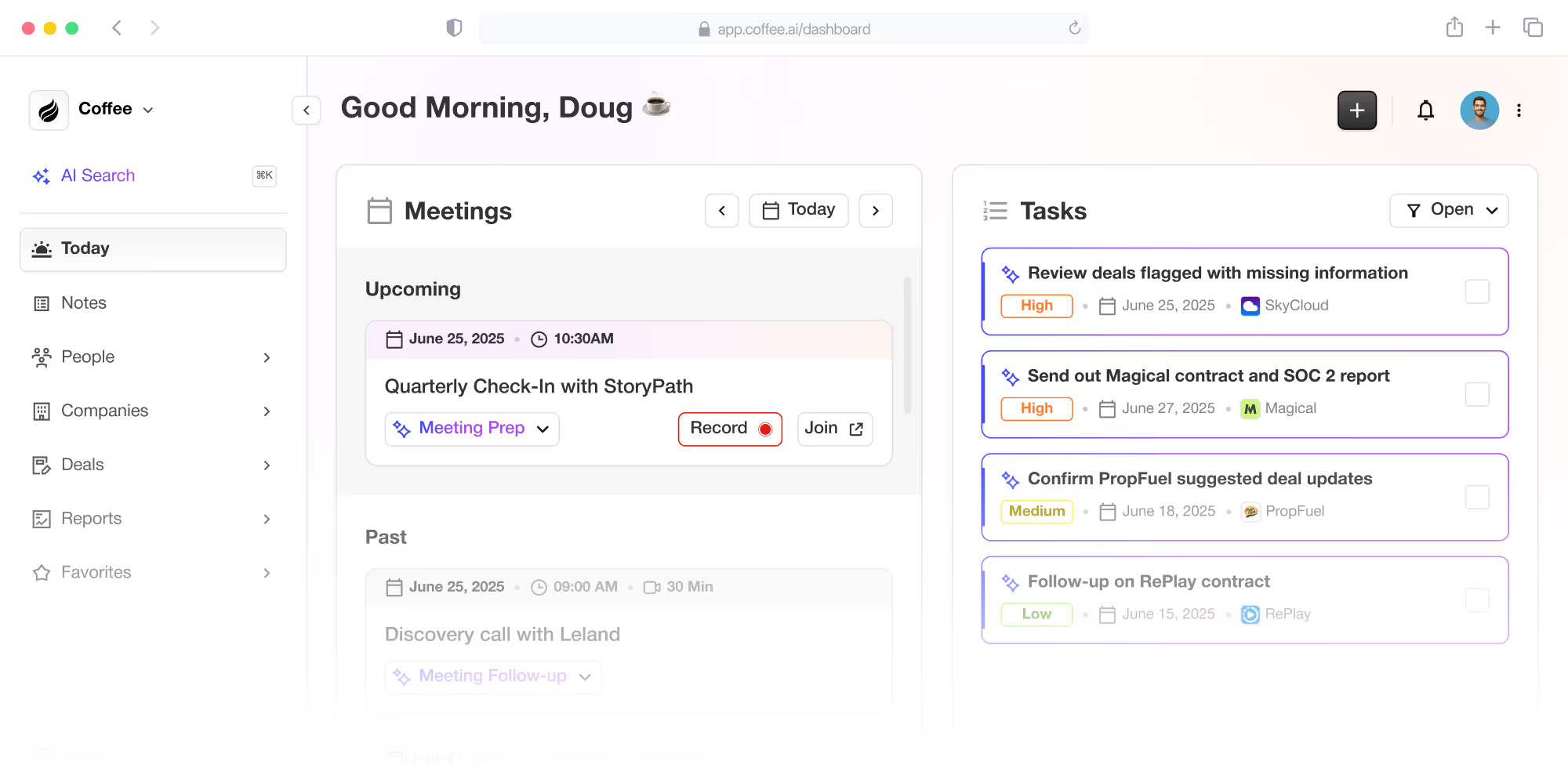
As part of the broader trend toward AI-driven sales tools, Coffee’s Companion App offers a practical approach to automating meeting notes within Salesforce. This platform focuses on eliminating manual tasks, unifying data, and delivering actionable insights directly into existing CRM workflows. Unlike standalone solutions, Coffee integrates with Salesforce to enhance rather than replace current systems, ensuring teams retain familiarity while gaining efficiency.
Coffee uses AI to capture and structure meeting content, syncing it with Salesforce records. This automation frees reps from note-taking, allowing deeper focus on customer conversations and faster action on next steps. Among competing tools, Coffee stands out for its emphasis on seamless integration and structured data output, aligning with the needs of sales teams aiming to maximize CRM value.
Core Features of Coffee for Salesforce Users
Coffee provides specific capabilities that address common pain points in sales workflows. Here’s how these features support integration and productivity.
- AI Meeting Bot and Transcription: The bot joins calls on platforms like Google Meet, Microsoft Teams, and Zoom, recording and transcribing discussions without manual input.
- Structured Summaries and Action Items: Coffee condenses conversations into clear summaries, identifying key points and tasks for immediate follow-up.
- Direct Sync with Salesforce: Data and insights flow into Salesforce, ensuring accessibility across teams without extra effort.
Request access to Coffee and simplify your Salesforce data management.
Steps to Prepare Salesforce for AI Meeting Notes
Ensuring Proper Administrative Access
Before integrating any AI tool, verify that your Salesforce administrator has the necessary permissions for API access. Confirm that your team can modify configurations without conflicts, and document existing setups like custom fields or workflows to avoid disruptions during implementation.
Selecting a Compatible AI Tool
Choose an AI meeting notes tool built for Salesforce compatibility. Coffee’s Companion App integrates smoothly, offering structured data output and security compliance. Evaluate options based on integration ease, output quality, and alignment with your sales processes to avoid added complexity.
Planning Data Mapping
Map out how meeting data, such as transcripts and tasks, will align with Salesforce objects and fields. Decide where summaries fit, like in Event records, and how action items translate into Tasks. Consider custom fields for unique insights, ensuring data supports deal strategies and reporting needs.
How to Integrate Coffee with Salesforce: A Clear Guide
Follow these steps to connect Coffee’s AI meeting notes with your Salesforce instance for efficient data flow.
Step 1: Establish a Secure Connection
Start by linking Coffee to Salesforce through secure authentication. In Coffee’s settings, select Salesforce as your CRM, log in with admin credentials, and grant permissions. This initial sync aligns Coffee with your Salesforce setup, protecting data during transfer.
Step 2: Map Data to Salesforce Fields
Define how Coffee’s outputs connect to Salesforce records. Link participants to Contacts, summaries to relevant records, and tasks to action owners with due dates. Test mappings with sample data to confirm accuracy and adjust for optimal usability.
Step 3: Automate Workflows and Triggers
Set rules for logging meeting notes based on call type, such as external client discussions. Automate task creation and notifications to keep teams informed of insights and follow-ups, reducing manual updates.
Step 4: Tailor Settings to Sales Needs
Customize Coffee to align with sales methodologies like BANT or MEDDIC. Adjust summarization to highlight key topics and set user access levels to protect sensitive data. Configure alerts to match team roles, avoiding information overload.
Step 5: Test the Integration
Run test meetings to ensure data syncs correctly to Salesforce. Check transcription accuracy, task assignments, and access controls. Compare AI summaries to actual content, making adjustments to capture critical details effectively.
Fixing Common Integration Issues
Handling Permission Errors
If permission errors arise, check the connecting user’s Salesforce privileges and API access. Ensure Coffee is authorized in Salesforce’s Connected Apps settings and that the user can edit relevant records.
Correcting Data Sync Problems
For sync issues, review field mappings and Salesforce API limits. Confirm that required fields are populated and validate rules or triggers aren’t blocking data transfer. Adjust configurations to align systems.
Improving Data Logging Accuracy
Incomplete logging often ties to summarization settings. Fine-tune Coffee’s AI for industry terms and audio quality. Adjust triggers to log only relevant meetings, filtering out internal calls if needed.
Adapting to Salesforce Updates
Stay informed on Salesforce API changes through developer updates. Review integration settings during seasonal releases, document configurations, and coordinate with Coffee support for quick resolutions.
Benefits of Automating Meeting Notes in Salesforce
Saving Time for Sales Teams
Automation can save reps an estimated 8 to 12 hours weekly on administrative tasks. This allows more focus on customer interactions, improving engagement and reducing post-meeting workload with automatic task creation.
Enhancing Data Quality
AI ensures consistent, detailed data capture in Salesforce, reducing errors from manual entry. Structured summaries make information searchable, aiding team collaboration and sales coaching.
Speeding Up Follow-Ups
Instant task creation and email drafts from meeting content enable quick responses to prospects. Immediate access to insights supports internal coordination, keeping deal momentum strong.
Improving Pipeline Insights
Detailed meeting data offers clearer views of deal progress for managers. Consistent records help identify sales cycle trends, supporting better forecasting and process optimization.
Request access to Coffee and enhance your Salesforce efficiency.
Comparing Manual, Legacy, and AI-Driven Approaches
|
Feature |
Manual Salesforce Notes |
Legacy CRM Tools |
Coffee’s AI Integration |
|
Data Entry |
Manual, slow |
Partially automated |
Fully automated, real-time |
|
Data Quality |
Inconsistent, incomplete |
Basic, unstructured |
Accurate, structured |
|
Time Impact |
High admin load |
Some savings |
Saves 8-12 hours weekly |
|
Follow-Up |
Delayed, fragmented |
Limited automation |
Instant tasks, summaries |
Tips to Maximize AI Integration with Salesforce
Automate Task Management
Configure Coffee to create Salesforce tasks from meeting action items, assigning them based on roles. This ensures follow-ups are tracked without manual effort, maintaining accountability.
Optimize Performance Regularly
Monitor data accuracy and user feedback on Coffee’s summaries. Adjust AI settings for evolving needs and train teams to leverage new features, ensuring consistent value.
Common Questions About AI Meeting Notes in Salesforce
Is Data Secure During Integration?
Coffee adheres to strict security standards like SOC 2 Type 2 and GDPR compliance, protecting sales data and customer conversations throughout the process.
How Does Coffee Differ from Manual or Basic Tools?
Unlike manual entry or simple transcription, Coffee delivers structured insights and automatically syncs them to Salesforce, cutting out additional processing steps.
Can Coffee Support Sales Methodologies?
Coffee’s AI can format summaries to match frameworks like BANT or MEDDIC, identifying qualification criteria directly from meeting content for strategic alignment.
What if AI Misinterprets Meeting Details?
Users can review and edit Coffee’s summaries to correct inaccuracies, ensuring critical information remains accurate with human oversight.
How Fast Does Data Sync to Salesforce?
Meeting data typically appears in Salesforce within minutes after a call ends, based on factors like meeting length and system load, enabling prompt action.
Conclusion: Elevate Salesforce with AI Automation
Shifting from manual data entry to AI automation marks a significant improvement in sales productivity. Coffee’s Companion App, as a leading example of this trend, reduces administrative tasks and integrates actionable meeting insights into Salesforce. Expected gains include better data quality, time savings for reps, and stronger pipeline visibility. This structured approach ensures customer insights drive decisions and strengthen relationships.
Request access to Coffee and optimize your Salesforce workflow now.