
In today’s fast-paced sales environment, the ability to leverage AI-driven CRM tools within platforms like Salesforce has become a game-changer for many organizations. As businesses increasingly adopt artificial intelligence to enhance sales processes, the underlying data quality and update frequency in systems like Salesforce have emerged as critical factors for success. The market landscape reveals a growing demand for solutions that address the inefficiencies of manual data management, which often plague legacy CRM systems and hinder sales teams from focusing on high-value tasks. Research indicates that sales reps spend up to 20% of their time on administrative tasks, including data entry, rather than engaging with prospects and closing deals Salesforce data on rep productivity challenges. This guide explores practical steps to optimize Salesforce data update frequency, ensuring your AI CRM tools deliver accurate insights and automation benefits. Among the solutions available, Coffee’s Companion App stands out as a notable example of how automation can support these efforts, reflecting a broader trend toward intelligent data management in sales ecosystems.
Why Outdated Salesforce Data Impacts AI CRM and Sales Outcomes
Outdated data in Salesforce directly affects the performance of AI CRM tools and sales teams. When data isn’t fresh, AI systems struggle to provide reliable insights or accurate forecasting, which can lead to missed opportunities. For Salesforce administrators, RevOps leaders, and sales managers, maintaining current data is essential to support effective sales strategies. Manual data entry, often required in traditional CRM setups, pulls valuable time away from selling. Automating this process, as seen with tools like Coffee, helps sales reps stay focused on closing deals while ensuring data accuracy.
Step 1: Assess Your Salesforce Data Environment
Start by understanding the data within your Salesforce system to prioritize updates effectively. Different data types influence sales outcomes in unique ways, requiring tailored attention.
- Leads and Contacts: Includes emails, phone numbers, job titles, and company details.
- Opportunities: Covers deal stages, values, and expected close dates.
- Activities: Encompasses email exchanges, call records, meeting summaries, and tasks.
- Accounts: Contains company data such as industry type and employee numbers.
Next, review your current data refresh schedules. Many teams depend on manual updates or periodic batch processes, which can leave data stale. Use Salesforce reports to check ‘last updated’ timestamps on key objects. This helps pinpoint areas needing more frequent updates for better AI CRM results.
Step 2: Set Up Effective Data Refresh Schedules in Salesforce
Salesforce offers built-in tools to manage data stream refresh frequencies through API connectors. These settings allow administrators to balance data freshness with system performance by scheduling updates according to business needs.
Different data types require distinct refresh frequencies. High-priority data, like recent activities or open opportunities, benefits from frequent updates. Contact or account information can be refreshed regularly but less urgently. Stable data, such as historical records, needs only occasional updates. To set a refresh schedule, access the Salesforce Data Management console, locate key data streams like opportunity updates, and adjust frequencies based on priority. Avoid updating non-critical data too often, as this can strain system resources unnecessarily.
Step 3: Streamline Syncs and Automate with Tools Like Coffee
Incremental syncs, which update only modified data, offer a more efficient alternative to full syncs. This method reduces system load while keeping Salesforce data current. Focus sync efforts on high-impact data to maintain efficiency.
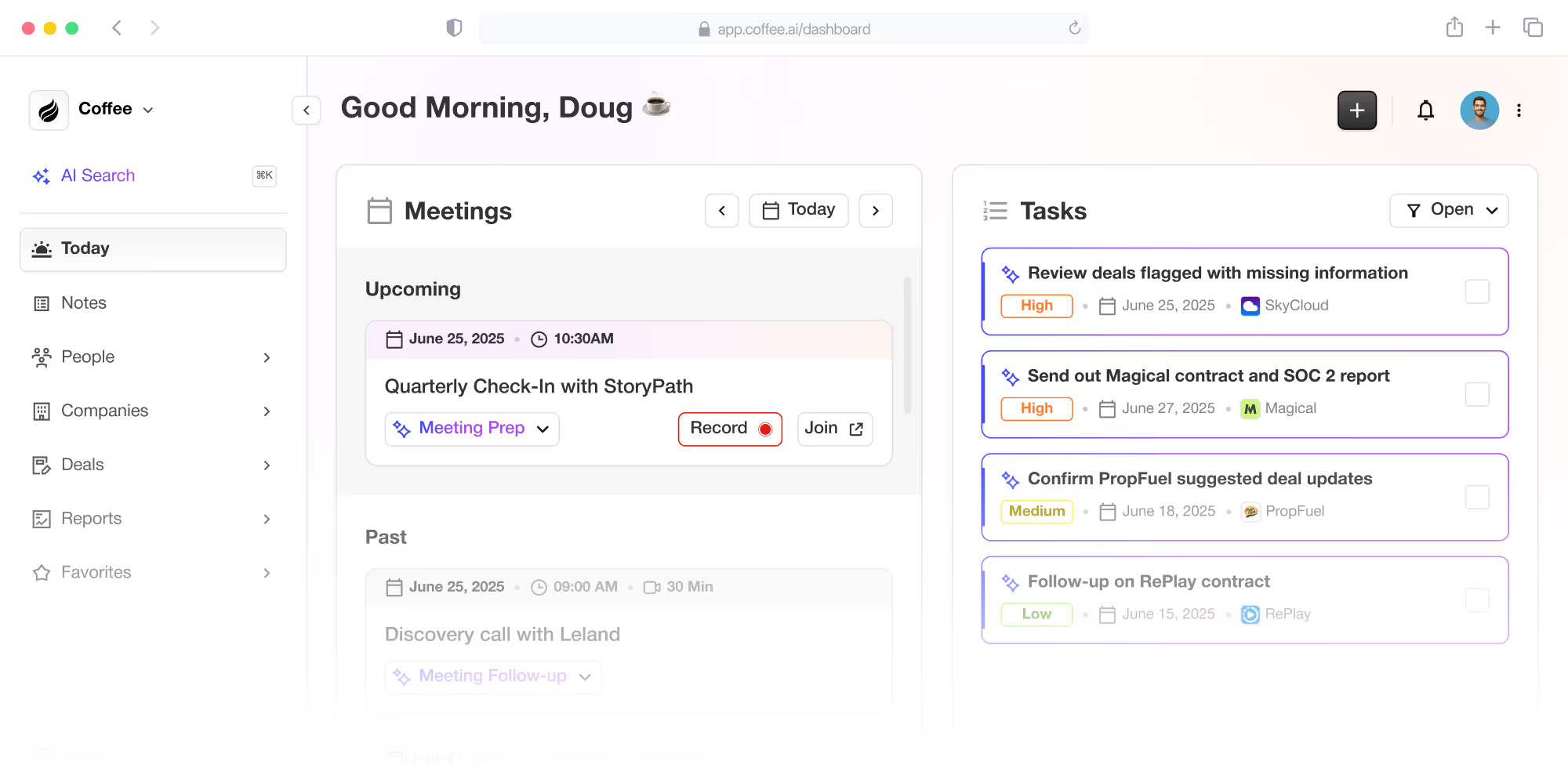
Coffee’s Companion App provides a powerful way to automate data updates within Salesforce. By integrating with email and calendar systems, Coffee logs activities, updates ‘last activity’ and ‘next activity’ fields, and enriches contact and company records without manual input. This automation can save sales reps significant time weekly, allowing them to prioritize customer engagement over data entry. Ready to cut down on manual work in Salesforce? Request access to see how Coffee can help.
Step 4: Use Fresh Data for Better AI Insights and Automation
Current data enhances AI tools’ ability to deliver actionable insights for managing sales pipelines. With reliable data, AI can offer precise recommendations to guide decision-making. Timely updates also support automated workflows in Salesforce, ensuring tasks and alerts trigger efficiently based on real-time developments. Coffee’s ‘Pipeline Compare’ feature, for instance, uses historical data snapshots to track changes in deals, identifying progress or delays. This provides sales leaders with clear visibility into pipeline dynamics, surpassing the limitations of manual Salesforce reporting.
Step 5: Build a Strong Data Governance Framework
Regularly monitor sync logs to catch errors or delays in data updates. Routine checks ensure refresh schedules align with business needs for AI CRM effectiveness. Establish a data governance program with clear roles and update intervals to maintain data quality in Salesforce. A well-structured approach helps sustain long-term data integrity. Success in this area often shows through fewer outdated records and less time spent on manual data entry by sales teams.
Key Approaches for AI-Driven Sales Teams
Integrating data from multiple sources into Salesforce reduces information silos and creates a comprehensive view of customer interactions. Solutions like Coffee facilitate this by ensuring consistent updates across systems, which directly supports AI insights. Fresh data also allows AI models to detect patterns specific to your sales process, enabling customized recommendations and automation that align with business objectives.
Conclusion: Boost Salesforce Performance with Optimized Data Updates
Refining data update frequency in Salesforce is a vital step for sales teams leveraging AI CRM tools. Proper data management turns Salesforce into a powerful asset for productivity. Coffee exemplifies how automation can convert raw data into meaningful insights, minimizing manual tasks and keeping information current. Teams using such tools often experience better pipeline visibility and stronger customer relationships. Ready to improve your sales results with optimized Salesforce data for AI CRM? Request access to schedule a demo with Coffee today.
Common Questions About Salesforce Data Update Frequency
How often should sales data be updated in Salesforce for AI CRM?
Update frequency varies by data type and its impact on sales. High-priority data, such as activities and opportunities, needs frequent updates, while less critical data can be refreshed less often. Coffee automates this process to focus on impactful data, improving AI CRM performance.
Do frequent data updates affect Salesforce performance?
With incremental syncs and strategic scheduling, frequent updates have minimal impact on system performance or API limits. Tools like Coffee manage updates effectively to keep the system running smoothly.
How does Coffee maintain updated Salesforce data without manual effort?
Coffee connects with email and calendar tools to automatically log activities and enrich records, cutting down on manual data entry while ensuring consistent data quality for AI analysis.
Does Coffee work with existing Salesforce setups?
Yes, Coffee’s Companion App integrates seamlessly as an intelligent layer for Salesforce. It syncs data through straightforward authentication, allowing users to choose which insights to update in their primary CRM while maintaining current workflows.
What benefits come from optimizing Salesforce data update frequency?
Optimized updates improve pipeline visibility and reduce manual data tasks, letting sales reps focus on selling. Coffee enhances these advantages through automation, supporting better CRM adoption.
| Feature | Traditional Salesforce Updates | Coffee + Salesforce (Companion App) |
|---|---|---|
| Data Entry (Activities) | Manual logging by reps | Automatic from email/calendar |
| Data Enrichment | Manual or separate tools | Automated, built-in |
| Pipeline Change Tracking | Manual reports/exports | Automated ‘Pipeline Compare’ |
| Update Frequency Control | Admin-configured, some limitations | Enhanced automation, AI-driven |