
Traditional CRM systems often slow mid-sized companies instead of supporting them. A tool meant to drive efficiency can become an operational bottleneck. Legacy platforms make it harder for growing teams to stay agile and productive.
Fragmented Data & Disconnected Systems Hinder a Unified View
Traditional CRMs often push mid-sized companies into a complex web of disconnected tools. Sales teams juggle multiple solutions like ZoomInfo for data enrichment, SalesLoft for outreach, and Fathom for call recording, which creates an expensive, inefficient tech stack that fragments critical customer information. This fragmentation leads to unreliable insights and higher internal effort spent on managing separate systems.
The Burden of Manual Data Entry Drains Sales Productivity
Traditional CRMs rely heavily on manual data entry. Sales representatives spend hours after meetings logging notes, updating opportunity fields, and copying relevant emails instead of focusing on selling. The CRM becomes another task to manage rather than a system that lightens their workload.
Low User Adoption & Complex Designs Increase Frustration
Complex interfaces and workflows in many traditional CRMs reduce adoption in mid-sized companies. Sales representatives often see these systems as tools for management oversight instead of support for their daily work. As a result, data is incomplete and unofficial “shadow CRMs” emerge in tools like documents and spreadsheets where the real tracking happens.
Missed Opportunities Due to Reactive Systems
Many traditional CRMs rely on a reactive model. They wait for users to enter data or manually trigger actions. Without built-in automation or intelligent insights, sales teams struggle to spot risks and opportunities in time, which can reduce engagement quality and limit revenue growth.
High Costs & Lack of Customization for Mid-Sized Needs
Traditional CRM platforms often combine high subscription costs with complex pricing models. Many mid-sized companies pay for capabilities they do not use or cannot tailor to their workflows. The result is lower return on investment and frustration for both leaders and end users.
Mid-sized companies that want to move beyond these limitations can turn to a proactive model. Request access to Coffee’s proactive CRM solution to see how AI can streamline sales work and improve data quality.
The Proactive CRM Solution for Mid-Sized Companies: Introducing Coffee
Coffee is an AI-first CRM built for mid-sized companies. It addresses common pain points in traditional systems. Instead of forcing teams into rigid workflows, Coffee adapts to how modern sales organizations operate and gives sales representatives practical, daily support.
Coffee’s Dual Model
Coffee addresses the diverse needs of mid-sized companies through two distinct approaches.
Standalone AI-First CRM: A complete, modern alternative for small to mid-sized businesses that want a clean start. This platform is well suited for companies with 1 to 20 employees that have outgrown spreadsheets or found traditional CRMs too complex or misaligned with their needs. The standalone CRM provides a unified, AI-powered solution with minimal setup complexity.
Companion App for Existing CRMs: For small to mid-sized companies already invested in existing systems, Coffee’s Companion App enhances those systems by adding an intelligent layer of AI and automation. This approach allows businesses to retain their established system of record while improving data quality and sales productivity through a simple authentication process that syncs data with Coffee.
Key Features of Coffee’s Proactive CRM
- Automated data entry and enrichment: Eliminates manual work by automatically creating and enriching contacts and companies from emails and calendars, saving sales representatives an estimated 8 to 12 hours per week.
- AI-powered meeting management: Automates pre- and post-meeting workflows, providing briefings with attendee and company information, recording and transcribing calls, and generating summaries, action items, and follow-up emails.
- Pipeline intelligence with compare feature: Provides historical snapshots of the sales pipeline with a one-click compare feature to track changes, making pipeline review meetings more focused and efficient.
- Unified data platform: Integrates structured data such as contacts, companies, and deals with unstructured data such as emails, call transcripts, and meeting notes in a single platform, which reduces tech stack complexity.
- Designed for user adoption: Acts as an intelligent co-pilot for sales representatives and encourages higher usage through features that directly improve day-to-day productivity.
Teams that want to modernize their sales process can use Coffee as a central, AI-driven workspace. Request access to Coffee’s proactive CRM and see how AI can enhance your customer relationships.
How Coffee’s Proactive CRM Powers Mid-Sized Business Growth
Coffee’s AI-driven approach changes how mid-sized companies manage sales processes. By automating routine tasks and unifying data, Coffee enables sales teams to focus more time on building relationships and closing deals.
Eliminate Manual Toil with Automated Data
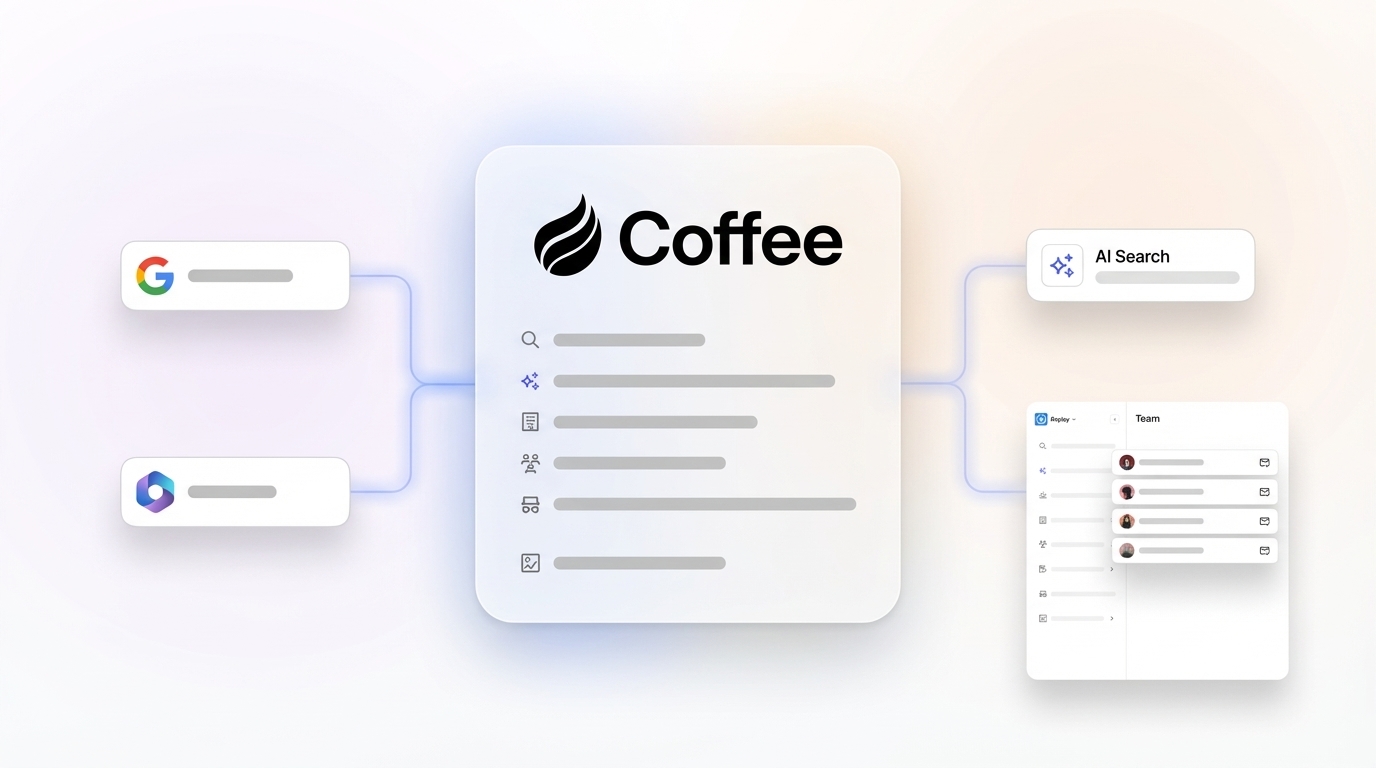
Coffee’s automation tackles one of the biggest productivity drains in traditional CRM systems. After connecting Google Workspace or Microsoft 365 accounts, Coffee scans emails and calendar invites to populate the CRM with contacts and companies. It enriches records with details such as job titles, company information, and LinkedIn profiles. This automation saves sales representatives an estimated 8 to 12 hours per week and allows them to focus on revenue-generating activities.
Enhance Meetings with AI-Driven Assistance
Coffee supports sales representatives before and after meetings through an integrated Today page with briefings that include attendee information, company details, and past interaction summaries. Its AI meeting bot joins calls on Google Meet, Microsoft Teams, and Zoom to record and transcribe conversations, then generates summaries and follow-up email drafts. This reduces preparation and follow-up time while keeping actions organized.
Unify Siloed Data for a Comprehensive View
Coffee’s architecture addresses data fragmentation by integrating structured and unstructured data into a single platform. This unified view helps sales teams make informed decisions with access to complete customer information, so they no longer need to switch between multiple tools.
Streamline Sales Workflows and Boost Productivity
Coffee’s automation extends to everyday sales workflows by generating meeting summaries, identifying action items, and drafting follow-up emails. This reduces administrative work, speeds up deal progression, and supports more consistent customer follow-up, which contributes to revenue growth.
Empower Sales Reps with a CRM They Want to Use
Many traditional CRMs are seen as management tools, not as support for sales representatives. Coffee acts as an intelligent co-pilot that enhances individual productivity. Its intuitive interface and automated workflows create direct value for users, which leads to higher adoption rates and more accurate data in the system.
Proactive CRM for Mid-Sized Companies: Coffee vs. Traditional Solutions
Mid-sized companies need a CRM that supports growth instead of adding complexity. The differences between Coffee’s AI-first approach and traditional CRM systems are clear when comparing key operational areas that affect sales productivity.
|
Feature |
Coffee (Proactive AI-First CRM) |
Traditional CRM |
|
Data Entry |
Automated and AI-driven from communications |
Manual and user reliant |
|
Data Unification |
Single source for structured and unstructured data |
Fragmented and dependent on multiple integrations |
|
User Adoption |
High, with an intuitive experience that acts as a co-pilot |
Often low, and commonly seen as a management tool |
This contrast shows why many mid-sized companies struggle with traditional CRM systems. Coffee’s methodology can deliver better outcomes by providing intelligent assistance and unified data in one place.
Teams that want to evaluate a proactive approach can access Coffee directly. Request access to Coffee’s proactive CRM and assess how AI can support your sales operations.
The Value of Proactive CRM for Mid-Sized Companies
The impact of implementing a proactive CRM like Coffee extends beyond cost savings. Mid-sized companies that adopt AI-driven platforms see improvements across multiple business metrics that contribute to operational efficiency.
Productivity gains are often immediate, with sales representatives saving an estimated 8 to 12 hours per week on manual tasks. This time can be redirected toward revenue-generating activities, effectively increasing selling capacity without adding headcount.
Data quality improvements support better forecasting, territory planning, and decision-making. Unified, enriched customer data reduces time spent on data cleanup and improves the reliability of business insights.
By consolidating the tech stack, Coffee helps reduce costs by combining the capabilities of multiple tools, including CRM, data enrichment, call recording, and forecasting, into one platform. This simplification makes operations easier to manage.
How Mid-Sized Companies Can Implement a Proactive CRM
Implementing a proactive CRM like Coffee involves both technical and organizational steps. Mid-sized companies can access sophisticated automation while remaining agile enough to adapt to new processes.
For companies considering Coffee’s Standalone CRM, implementation includes migrating existing customer data and training team members on AI-powered workflows. The intuitive design and automated data enrichment help shorten the learning curve that often comes with CRM adoption.
Companies choosing Coffee’s Companion App for existing systems can see benefits quickly while maintaining their primary system of record. The integration uses a simple authentication process to sync data into Coffee and allows teams to choose which enriched data and insights to write back to their main CRM.
Change management is more effective when the system provides immediate benefits to end users. Coffee’s value becomes clear to sales representatives who experience reduced administrative work and improved productivity from the start.
Frequently Asked Questions about Proactive CRMs for Mid-Sized Businesses
How does a proactive CRM differ from traditional CRM systems for mid-sized companies?
A proactive CRM like Coffee uses AI to automate tasks and unify data, which reduces manual effort compared to traditional CRMs. It captures and enriches customer data from emails and calendars, providing a more efficient way to manage customer relationships.
Can a proactive CRM help improve sales team adoption in a mid-sized company?
Proactive CRMs like Coffee can improve adoption rates by removing many manual tasks through automation. Coffee acts as an intelligent co-pilot, providing value to sales representatives with features such as meeting briefings and automated follow-ups, which encourages natural adoption without heavy enforcement.
My mid-sized company already uses an existing CRM system. How can Coffee benefit us?
Coffee’s Companion App is designed for companies with existing CRM systems. It adds an intelligent layer that improves data quality, automates processes, and provides AI-driven insights while keeping your current workflows. Capabilities such as automatic contact creation and pipeline intelligence build on top of your existing system of record.
What kind of value can a mid-sized company expect from implementing a proactive CRM?
Mid-sized companies can gain value from proactive CRM implementation through productivity improvements, with many sales representatives saving an estimated 8 to 12 hours per week. Better data quality leads to stronger forecasting, and tech stack consolidation reduces costs by bringing multiple functionalities into one platform.
How quickly can a mid-sized company start seeing results with a proactive CRM?
With Coffee, companies typically see productivity improvements soon after connecting email and calendar systems. Automated contact creation and meeting management begin delivering time savings from the first use. Many mid-sized companies report measurable gains in productivity and data quality within the first 30 days.
Conclusion: Powering Growth with Proactive CRM for Mid-Sized Companies
Traditional CRMs often create operational bottlenecks through fragmented data, manual work, and low user adoption. Coffee’s AI-first approach turns CRM into a growth enabler by automating routine tasks, unifying customer data, and enhancing day-to-day productivity. Sales representatives benefit from tools that support their work, and organizations gain from improved efficiency and data quality.
Coffee offers both standalone and companion solutions, so mid-sized companies can access the benefits of proactive CRM regardless of their current technology investments. To evaluate whether this approach is a fit for your team, request access to Coffee’s proactive CRM and explore how it can support your customer relationships.