
Executive summary:
- Manual CRM data entry reduces selling time, drives up costs, and leads to incomplete and inaccurate records.
- Low CRM adoption and shadow tools create data gaps, security risks, and weak collaboration across sales, marketing, and customer success.
- A proactive, AI-first CRM automates data capture, enrichment, and activity logging so sales teams spend more time with prospects and customers.
- AI-driven workflows support meeting preparation, note-taking, follow-up, and forecasting, improving consistency and data quality.
- Coffee illustrates how a proactive CRM can combine automation, enrichment, call recording, and pipeline intelligence in a single platform.
- Teams that adopt proactive CRMs gain more accurate forecasts, stronger personalization, and a more predictable, efficient sales process.
The Problem: How Manual CRM Data Entry Kills Sales Productivity
Time-Consuming and Costly
Manual CRM data entry takes time away from selling and deal progression. Sales representatives often spend several hours each week on administrative updates instead of prospecting, meetings, or follow-ups.
For a sales team of 10 representatives, this adds up to a large number of hours each year focused on clerical work rather than revenue-generating activity. That time loss directly affects pipeline creation and deal velocity.
The financial impact goes beyond missed selling time. Organizations pay skilled sales professionals to complete routine data tasks, face slower pipeline movement due to delayed updates, and see less reliable forecasts and strategic planning.
Inaccurate and Incomplete Data
Manual entry also introduces error and inconsistency. When sales representatives rush through updates, records may be incomplete, outdated, or incorrectly categorized.
These gaps create practical problems. Incomplete contact information leads to missed outreach. Outdated company details weaken discovery calls. Inconsistent deal stage definitions make pipeline reviews and revenue forecasts less reliable.
Sales leaders may base decisions on partial or inaccurate data, which can lead to misallocated territory coverage, unrealistic targets, and frustration among team members who feel their tools do not reflect reality.
Low CRM Adoption and Shadow CRMs
The tedious nature of manual CRM data entry often lowers adoption. When representatives see the CRM as extra work, they turn to alternative tools that feel faster.
This behavior creates shadow CRMs such as personal spreadsheets, notes apps, and private documentation. These personal systems are convenient for individuals but create organization-wide risks, including fragmented data, weaker security controls, and loss of account history when employees leave.
Organizations invest heavily in CRM platforms but may still see their teams default to basic tools with little integration or reporting. That pattern usually reflects systems that add effort without delivering clear day-to-day value for front-line sellers.
Ready to reduce manual work for your sales team? Request access and see how Coffee’s proactive CRM can remove data entry from your workflow.
Bottlenecks and Missed Opportunities
Repetitive tasks such as data entry create bottlenecks at key points in the sales cycle. When representatives need to choose between updating the CRM and making another call, data often falls behind even as deals move forward.
This lag makes it harder for teams to coordinate. Managers may not see that an opportunity is active, marketing may send misaligned messaging, and customer success may miss important context before onboarding.
Disorganized or outdated data limits collaboration across sales, marketing, and support. Without current information, teams struggle to deliver consistent customer experiences, diagnose pipeline issues, or run targeted campaigns.
Over time, these friction points result in slower growth and weaker competitive positioning, even when the team is working hard.
The Solution: Embracing a Proactive, AI-First CRM (Like Coffee)
A proactive, AI-first CRM changes how sales teams work with customer data. By automating capture and enrichment, it reduces manual entry, improves data accuracy, and turns the CRM into a practical sales co-pilot rather than a reporting system.
Automated Data Capture & Enrichment
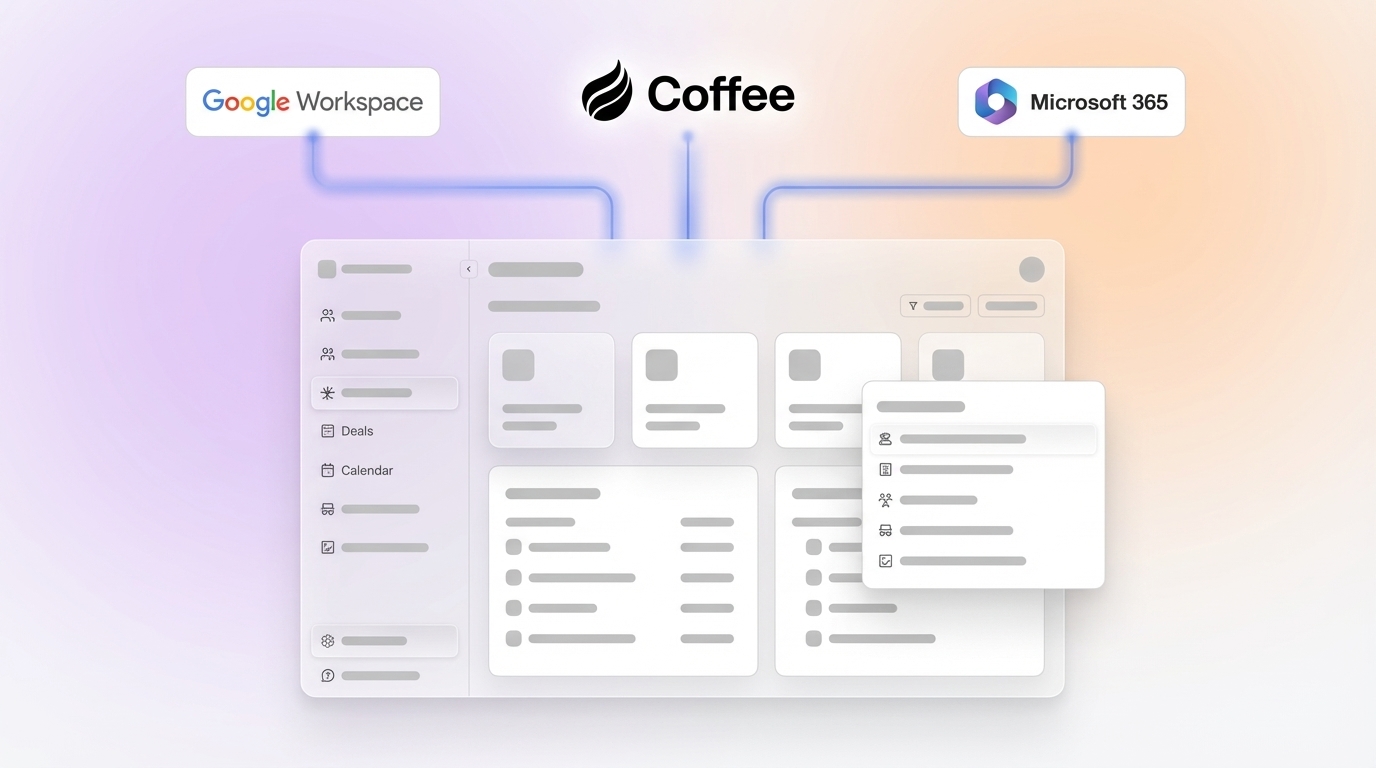
Coffee automates data capture by creating contacts and companies from email and calendar activity as soon as Google Workspace or Microsoft 365 accounts are connected. Representatives no longer need to manually add basic contact details, because the system identifies and records them in the CRM.
Coffee also enriches these records with information such as job titles, company details, funding status, LinkedIn profiles, and locations sourced from licensed data partners. This built-in enrichment can reduce reliance on separate tools such as ZoomInfo or Apollo for many common use cases and provides immediate context for outreach.
Activity logging is also automated. Emails, meetings, and notes are associated with the correct contacts and companies, creating a complete and current interaction history without extra steps for the sales team.
AI-Powered Workflow Automation
Coffee’s AI features support the full sales workflow, from preparation to follow-up. Before each meeting, a Today page offers concise briefings with attendee details, company background, and summaries of previous conversations, accessible in the Coffee interface or through personalized Slack notifications.
During meetings, Coffee’s AI bot joins Google Meet, Microsoft Teams, and Zoom calls to record and transcribe discussions. Afterward, the AI generates summaries, highlights action items, and drafts follow-up emails that representatives can review and send from Gmail with minor edits.
These summaries can follow sales methodologies such as BANT, MEDDIC, MEDDPICC, or SPICED, which helps teams maintain consistent qualification and progression notes across opportunities.
Real-Time Pipeline Intelligence
Coffee’s Pipeline Compare feature provides a clear view of how the pipeline changes over time. A built-in data warehouse stores historical snapshots, and users can click a compare button to see how the pipeline has shifted week over week or across other time periods.
The view highlights deals that progressed, stalled, were added, or closed. This makes pipeline review meetings more efficient and reduces the need for manual spreadsheet exports.
With this real-time insight, sales leaders can spot patterns, identify stalled deals, and adjust plans based on what is actually happening in the pipeline.
Consolidated Tech Stack
Coffee combines CRM functionality, data enrichment, call recording, and forecasting tools into one platform. This consolidation reduces the number of separate tools teams must manage and helps keep data consistent across workflows.
Teams can avoid multiple subscriptions for enrichment, recording, and reporting. Working from a single interface lowers friction, reduces data silos, and simplifies training for new team members.
Exploring the Impact: How Proactive CRMs Drive Sales Success
Eliminating Manual Effort: More Selling, Less Admin
Coffee automates data capture from emails, calendars, and calls, keeping records accurate without extra work. This automation can free up an estimated 8 to 12 hours per representative each week, time that can shift from admin to prospecting and deal work.
The effect on sales productivity is significant. Representatives can use recovered time for outreach, tailored follow-ups, or deeper discovery. With fewer barriers to logging activity, data quality and CRM usage tend to improve as well.
The benefits extend across the organization. Sales managers gain a clearer view of the pipeline, marketing teams receive quicker feedback on lead quality, and customer success teams inherit detailed interaction histories when accounts transition.
Superior Data Quality: The Foundation for AI and Personalization
Coffee’s enrichment capabilities support high-quality records by automatically capturing and enhancing data from emails, calendars, and call transcripts. This creates a consistent structure that aligns well with AI-driven workflows.
Reliable, current data enables more accurate forecasts, targeted outreach, and clearer coaching conversations. Sales leaders can base decisions on real-time information rather than sporadic manual updates, which strengthens both planning and execution.
Intelligent Automation: Streamlining the Entire Sales Cycle
Coffee’s AI agents handle routine sales administration from preparation to follow-up. Before meetings, representatives receive concise briefings with key attendee and account details. After meetings, the AI generates structured summaries that capture important points and next steps, formatted around standard sales methodologies when needed.
Automated follow-up drafts incorporate meeting content and deal stage to create relevant, personalized messages. Representatives stay in control by reviewing and editing these drafts, while still reducing the time required to send timely follow-ups.
See how intelligent automation can support your team from first touch to close. Request access to Coffee’s proactive CRM.
Real-Time Pipeline Visibility: Accurate Forecasting & Agile Management
The Pipeline Compare feature uses historical snapshots and change tracking to make forecasting more precise and less manual. With a few clicks, teams can view how the pipeline has changed, where deals are slowing, and which opportunities are moving forward.
Automated tracking also reveals trends in sales cycles and representative performance. Managers can use these insights to address bottlenecks, refine coaching, and adjust coverage to improve overall conversion rates.
Traditional CRM vs. Proactive AI-First CRM (Coffee): A Comparison
|
Feature |
Traditional CRM |
Proactive AI-First CRM (Coffee) |
|
Data Entry |
Manual, time-consuming, prone to errors |
Automatic capture, AI enrichment, minimal manual effort |
|
Data Quality |
Often incomplete, outdated, inconsistent |
Real-time, accurate, contextually relevant |
|
Sales Rep Experience |
Perceived as a chore, low adoption |
Practical co-pilot that supports selling, higher adoption |
|
Pipeline Visibility |
Manual updates, often delayed, disparate tools |
Real-time insights, instant historical comparisons |
Frequently Asked Questions About Proactive CRMs
How much time can a proactive CRM like Coffee realistically save my sales team by eliminating data entry?
Coffee estimates that automating contact creation, data enrichment, activity logging, and post-meeting tasks can save sales representatives 8 to 12 hours per week. That time can shift toward prospecting, discovery, and closing work instead of admin.
These savings increase when better data quality and higher CRM adoption are factored in. Representatives spend less time searching for information, correcting errors, or recreating notes, and can use AI-powered insights to make faster decisions.
For a sales team of 10 representatives, this change can return the equivalent of several additional selling days each week without adding headcount.
How does Coffee ensure data quality when eliminating manual entry?
Coffee automatically ingests and structures data from emails, calendars, and call transcripts, then enriches those records with information from licensed data partners. This approach improves completeness and consistency while reducing the risk of manual errors that often appear in traditional CRM usage.
Can Coffee integrate with my existing Salesforce or HubSpot instance?
Yes. Coffee offers a Companion App that integrates with Salesforce and HubSpot and adds AI-powered automation and enrichment on top of your current CRM. Teams can choose which enriched fields to write back to the primary system.
The integration setup uses straightforward authentication, syncing existing records into Coffee while preserving current processes. Teams can roll out Coffee gradually and start using AI features without disrupting established workflows.
What security measures does Coffee implement to protect sensitive sales data?
Coffee maintains SOC 2 Type 2 and GDPR compliance, applying controls and policies that align with industry standards for protecting customer and prospect information.
How does Coffee’s approach to CRM differ from other AI-powered sales tools?
Coffee takes an AI-first approach that replaces manual steps across the sales workflow rather than focusing on a single task. It combines automation, enrichment, recording, and reporting in one environment built for AI applications.
The product also emphasizes the daily experience of sales representatives, not just management reporting. By helping front-line sellers with preparation, note-taking, and follow-up, Coffee encourages consistent usage and produces higher-quality data as a result.
Turn your CRM from a data entry system into a practical sales co-pilot. Request access to Coffee and remove most manual data entry from your sales process.
Conclusion: The Future of Sales is Proactive and AI-Powered
Manual CRM data entry slows sales activity and weakens data quality. Proactive CRMs that use AI to automate routine tasks give sales teams more time to sell and provide leaders with more accurate information.
Coffee reflects this shift. By automating capture, enrichment, and administrative work, it helps representatives focus on conversations and relationships while keeping the system of record up to date.
Moving from reactive to proactive CRM changes how sales organizations operate. Teams that adopt AI-first platforms such as Coffee can improve satisfaction, strengthen data quality, and run more predictable sales processes.
Organizations that rely on manual processes may find it harder to compete with AI-enabled teams that work faster and with better information. Adopting proactive CRM technology early helps unlock more of your sales team’s potential.
Stop letting manual data entry limit your sales results. Shift to a proactive CRM and refocus your team on selling. Request access to Coffee today.