
Key takeaways:
- Manual CRM data entry and admin work reduce selling time and weaken pipeline accuracy.
- Fragmented tools and data silos make it difficult to see a complete, reliable view of the pipeline.
- AI-first tools like Coffee automate data capture, meeting workflows, and reporting to free up rep time.
- A unified, AI-driven CRM improves data quality, forecasting, and pipeline reviews for managers.
- Coffee can work as a standalone CRM or as a companion to Salesforce and HubSpot, depending on team needs.
The Problem: Why Sales Pipelines Underperform
The Manual Data Entry Grind: A Productivity Killer
Sales representatives spend a large share of their day on administrative tasks instead of selling. Data shows that 71% of sales reps spend too much time on data entry, and only about 35% of their time on direct selling activities. This reflects a core issue in many traditional CRM systems, which often absorb time instead of amplifying productivity.
After each customer interaction, reps log call notes, update opportunity fields, copy emails into the CRM, and refresh contact records. This repetitive work takes time and can feel disconnected from closing deals. When workloads spike, reps may skip steps or enter partial information, which leads to inconsistent records.
Manual entry also increases the risk of human error. Inaccurate or missing data makes pipeline views less reliable and forecasting less precise. Managers struggle to coach effectively when they cannot trust the CRM, and it becomes harder to understand real deal progression.
A typical sales rep may spend 8 to 12 hours per week entering data that could be captured automatically. That time could instead support qualifying prospects, following up with opportunities, and moving deals forward. In competitive markets where speed matters, this opportunity cost is significant.
Fragmented Data and Limited Pipeline Visibility
Many sales teams work across multiple tools that store different pieces of customer information. Data may live in spreadsheets, emails, notes, and separate platforms, which creates silos and slows down pipeline reviews.
A common tech stack might include HubSpot or Salesforce for CRM, ZoomInfo for data enrichment, SalesLoft for outreach, and Fathom for call recording. Each system holds part of the customer story, but none presents a single, real-time view of interactions and deal stages.
Reps often assemble information from several tools before each call. Contact details may live in the CRM, recent emails in an inbox, call recordings in another app, and meeting notes in yet another place. The time spent gathering this context reduces the time available to understand customer needs and deliver value.
For managers, the lack of unified visibility makes pipeline reviews slow and reactive. When data is scattered, they often export spreadsheets and build manual reports. This adds administrative effort and limits how quickly they can spot stalled deals, risk in the forecast, or changes in deal momentum.
Outdated CRM Architectures Burdening Sales Reps
Some legacy CRM platforms were built for earlier sales processes and have not always been reconfigured around modern workflows. Without careful setup and integration, these systems can feel heavy to use and may require extra clicks or workarounds for everyday tasks.
Certain CRMs also demand extra effort to manage custom data or nonstandard workflows. Teams often add separate tools to fill gaps in usability or reporting. When the interface or processes are not intuitive, some reps avoid entering full information and instead maintain “shadow CRMs” in tools like Notion or spreadsheets.
This dynamic affects more than productivity. When a CRM is seen mainly as a reporting system for managers rather than a tool that helps reps sell, motivation to keep it updated declines. Low adoption and partial data then weaken the value of the entire system.
The Solution: Using AI Tools to Improve Pipeline Efficiency
Introducing Coffee: An AI-First CRM and Sales Agent
Coffee takes an AI-first approach to CRM design to reduce manual work and improve pipeline visibility. It focuses on automation and data unification so that sales teams can spend more time selling and less time on administration.
Coffee offers two main deployment models to fit different organizations. The Standalone CRM is suited to small and mid-sized teams of roughly 1 to 20 employees that are outgrowing spreadsheets or lightweight tools. The Companion App connects to existing Salesforce or HubSpot instances so teams can keep their current CRM while adding AI-driven features.
Key benefits for sales pipeline efficiency include:
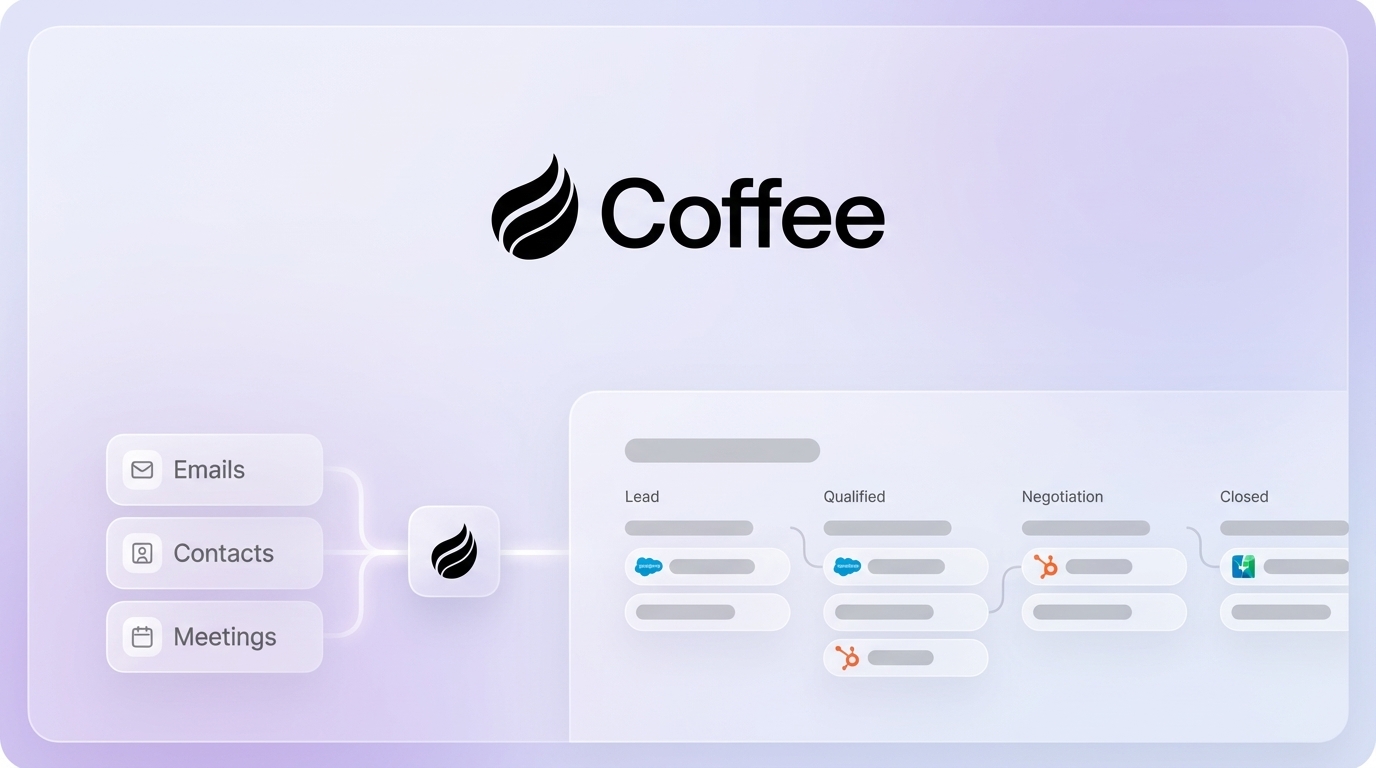
Eliminate manual data entry: Coffee connects to Google Workspace or Microsoft 365 to automatically create and enrich contacts, companies, and activities. Emails, meetings, and calendar events flow into the CRM without manual input, saving an estimated 8 to 12 hours per rep each week.
Automate pre- and post-meeting workflows: The platform prepares meeting briefings with attendee details, company context, and interaction history. After meetings, AI generates summaries, action items, and follow-up email drafts that reps can edit and send, reducing time spent on routine documentation.
Provide pipeline intelligence: A built-in data warehouse powers the Pipeline Compare feature, which shows week-over-week pipeline changes in one view. Teams can quickly see which deals have advanced, which are new, which have closed, and which may be stalled, without exporting data or building custom reports.
Consolidate the sales tech stack: Coffee combines CRM, data enrichment, call recording, and pipeline analytics in one platform. This consolidation can reduce spend on separate point tools and simplify the overall system architecture.
Improve rep experience and adoption: Coffee is designed as a sales co-pilot that supports daily workflows. By giving reps direct value in the form of automation and guidance, it encourages adoption and helps keep data complete and current without strict enforcement.
Request access to see how Coffee can support your sales pipeline efficiency.
How AI Improves Key Stages of the Sales Pipeline
Automated Data Capture and Enrichment
Coffee automates core CRM data management by capturing and enriching customer information from email and calendar activity. When Google Workspace or Microsoft 365 accounts are connected, Coffee scans interactions to create contacts and companies, log activities, and enrich records with job titles and company details from licensed data partners that can replace separate enrichment tools such as ZoomInfo.
This automation improves data quality by reducing skipped fields, inconsistent formatting, and missing updates. Reps can shift time away from low-value data entry toward outreach, discovery, and advancing open opportunities.
Real-Time Pipeline Visibility for Managers and Reps
Coffee’s unified data model and Pipeline Compare feature give teams real-time visibility into pipeline health. Managers can review week-over-week changes in deal value, stage, and ownership in a single view. It becomes easier to identify stalled opportunities, newly created deals, and shifts that affect the forecast.
With cleaner, centralized data, pipeline reviews can focus on strategy and deal execution rather than on finding and reconciling information from multiple reports.
Streamlined Meeting Workflows and Follow-Up
Coffee automates key steps before, during, and after meetings. Reps receive briefings that summarize attendees, company background, active deals, and previous interactions. An AI bot can join calls on platforms such as Google Meet or Zoom to record and transcribe the conversation.
After the meeting, Coffee generates a structured summary, highlights action items, and drafts follow-up emails for review in connected email platforms. Summaries can align with sales methodologies like MEDDIC or BANT so that qualification remains consistent across the team.
Improved Rep Adoption and CRM Satisfaction
Strong user adoption is essential for CRM value, and Coffee is designed to reduce friction in everyday work. By handling administrative steps and surfacing relevant insights, it provides tangible benefits for reps within their normal workflow.
The interface emphasizes clarity and speed so that updating the CRM feels like a byproduct of doing the work, not a separate chore. As a result, data becomes more complete and reliable, which further improves coaching, forecasting, and planning.
Comparison: Traditional CRMs vs. Coffee for Pipeline Efficiency
|
Feature Area |
Traditional CRM Approach |
Coffee’s AI-First Approach |
|
Data Entry |
Manual, time-consuming, and prone to errors |
Automatic capture from email and calendar, with enrichment |
|
Data Quality |
Often incomplete, outdated, and inconsistent |
Accurate, current, and AI-enriched |
|
Pipeline Visibility |
Fragmented data that may require manual reporting |
Real-time, unified data with a Pipeline Compare view |
|
Task Automation |
Limited, rule-based workflows |
AI-powered automation for meetings and follow-ups |
|
Tech Stack |
Multiple point solutions, higher complexity and cost |
Consolidated platform for CRM, enrichment, and intelligence |
|
User Experience |
Often seen as a reporting tool, with variable adoption |
Designed as a co-pilot that supports daily rep workflows |
This comparison outlines how Coffee differs from traditional CRMs. Legacy systems can often be adapted but may require extra configuration and add-ons, while Coffee focuses on built-in automation and a user experience designed around modern sales teams.
Request access to evaluate Coffee’s AI-first approach for your sales pipeline.
Frequently Asked Questions (FAQ)
How do AI tools eliminate manual data entry in sales pipelines?
AI tools such as Coffee connect to email and calendar systems to extract and structure information automatically. Each interaction generates data that flows into the CRM without manual input, which can save an estimated 8 to 12 hours per rep each week.
Can AI-powered sales pipeline tools integrate with my existing CRM?
Yes. Coffee offers a Companion App that integrates with Salesforce and HubSpot. After a simple authentication process, it syncs data in both directions so teams can use AI features while keeping their existing CRM as the primary system of record.
What kind of ROI can I expect from investing in AI for sales pipeline efficiency?
Teams using Coffee can expect time savings from reduced administrative work, typically 8 to 12 hours per week per rep. Additional gains can come from consolidating multiple tools into one platform and from better pipeline visibility that supports more accurate forecasting. Exact ROI depends on deal size, sales cycle length, and team structure.
Is my data secure with an AI-first CRM?
Data security is a core requirement for Coffee. The platform maintains SOC 2 Type 2 compliance and adheres to GDPR, with defined security policies and controls to protect sales and customer data.
How quickly can my team start seeing results from an AI-powered sales pipeline tool?
Teams can see benefits soon after setup, because automated data capture and meeting workflows start working immediately. Most organizations fully integrate Coffee into their daily sales processes within 30 to 60 days, depending on team size and change-management pace.
Conclusion: Unlock Your Sales Team’s Potential with AI-Powered Pipeline Efficiency
Traditional CRM systems often require heavy manual data entry and spread information across multiple tools, which slows down sales teams and weakens pipeline insights. AI-first platforms such as Coffee automate data capture, streamline meeting workflows, and provide clearer pipeline intelligence in a single environment.
Whether used as a standalone CRM or as a companion to Salesforce or HubSpot, Coffee helps teams improve data quality, forecasting, and day-to-day productivity. Organizations that adopt AI-driven pipeline management are better positioned to run focused, efficient sales processes.
Request access to explore how Coffee’s AI-first CRM can support your sales operations.