
In today’s fast-evolving sales landscape, artificial intelligence is reshaping how teams interact with customers and manage internal processes. The market for customer relationship management (CRM) tools is witnessing a significant shift, driven by the need for efficiency amid increasing complexity in sales cycles and heightened customer expectations. Traditional methods of tracking action items, often manual and fragmented, struggle to keep pace with the demands of modern sales environments. Data from industry reports highlights that nearly three-quarters of sales reps spend excessive time on administrative tasks, leaving less room for actual selling. This inefficiency, coupled with the growing adoption of AI technologies, signals a turning point for sales leaders and revenue operations (RevOps) professionals. AI-driven action item tracking within CRMs offers a path to streamline workflows, improve data quality, and boost overall sales productivity. This guide explores the transition to automated systems, providing actionable insights for organizations aiming to stay competitive in 2025 and beyond.
Why Manual Action Item Tracking Holds Teams Back
Manual tracking of action items in traditional CRMs creates bottlenecks that slow down sales growth. With sales cycles becoming shorter and customer demands more immediate, delays in follow-ups or missed commitments can directly impact revenue.
Sales reps often spend hours logging notes, updating records, and managing tasks by hand. Studies indicate that only about 35% of their time goes toward actual selling, with the rest consumed by administrative work as shown in this analysis of sales productivity. This imbalance pulls focus away from closing deals.
Data quality also suffers in manual systems. Missed follow-ups lead to lost opportunities, incomplete records distort forecasting, and inconsistent entries obscure pipeline insights. Many reps resort to external tools like spreadsheets, creating ‘shadow CRMs’ that fragment data and reduce visibility for leadership. Adopting AI to automate data capture and provide actionable insights can help sales teams work smarter and regain focus on customer relationships.
How AI-Driven Action Item Tracking Boosts Sales Efficiency
AI transforms action item tracking from a tedious chore into a strategic asset. By automating task identification and integrating with sales workflows, these systems enable teams to act proactively rather than reactively.
Key Features of AI Action Item Tools
AI-powered systems stand out due to their ability to simplify complex processes. Here are the core elements that drive their value:
- Automated Detection: Natural language processing scans emails, meeting transcripts, and call recordings to pinpoint action items without manual input.
- Task Prioritization: Smart algorithms rank tasks based on deal stage and historical context, focusing reps on high-impact follow-ups.
- Status Updates: Real-time monitoring tracks action item progress, eliminating the need for constant manual checks.
- Workflow Sync: Action items connect directly to the sales pipeline, ensuring alignment with broader CRM objectives.
Measurable Benefits for Sales Operations
Using AI for action item tracking allows teams to anticipate challenges and act decisively. Continuous data insights replace sporadic manual reviews, improving follow-up reliability and speeding up deal progression. Teams can engage customers with timely, informed responses, strengthening relationships and driving better outcomes.
Curious about implementing smarter sales tools? Connect with Coffee to explore AI-driven pipeline solutions at this link.
Coffee: A Leader in AI-First Action Item Tracking
As part of the broader trend toward AI adoption in sales, Coffee stands out with its innovative CRM platform. Designed to overcome the shortcomings of legacy systems, it integrates action item tracking as a central feature to enhance data accuracy and rep efficiency.
Capturing Action Items with Meeting Intelligence
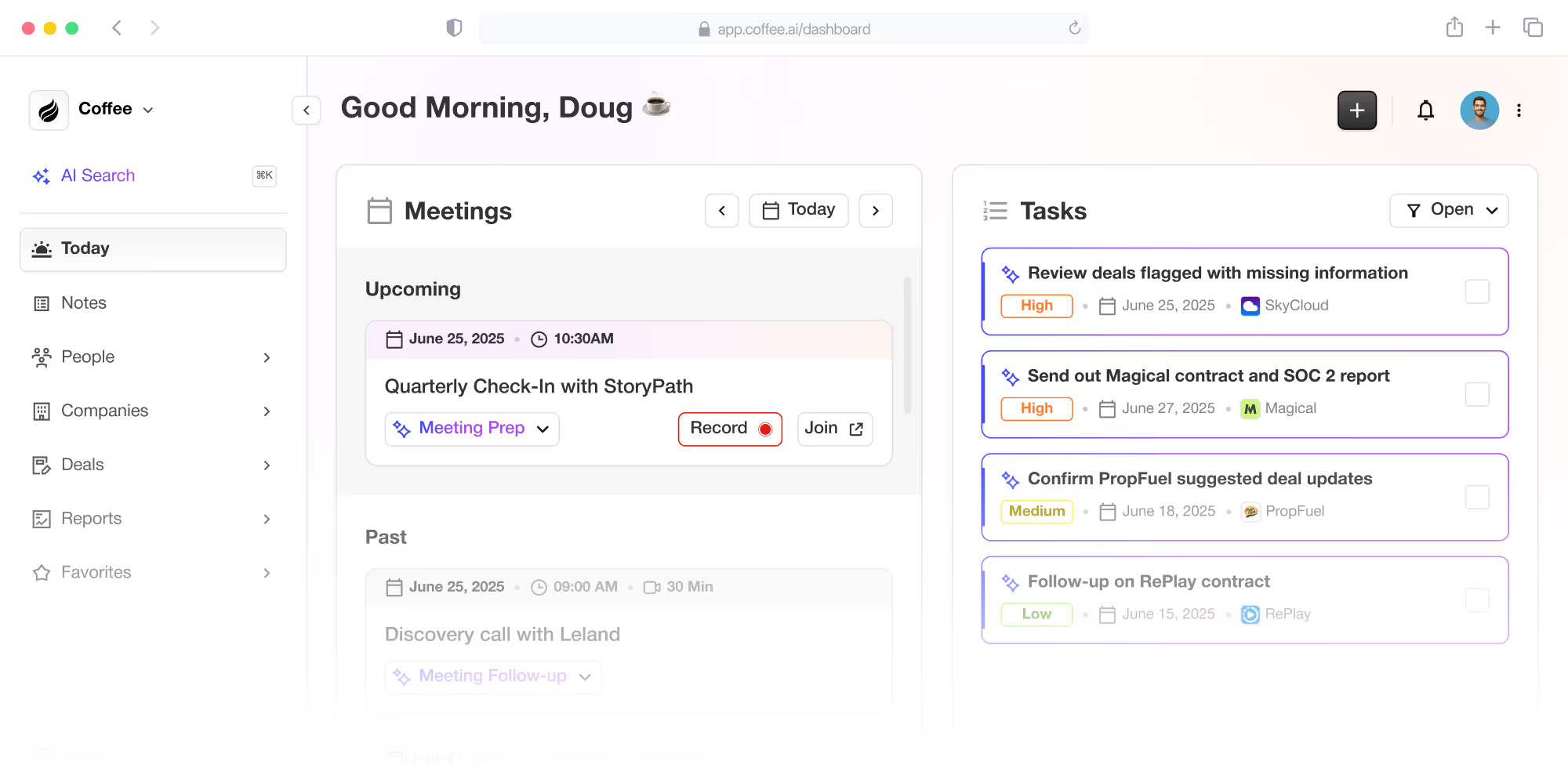
Coffee deploys an AI-powered bot for virtual meetings on platforms like Google Meet, Microsoft Teams, and Zoom. The bot records and transcribes discussions, extracting action items using natural language processing. This cuts down on manual note-taking, ensuring no critical task is overlooked.
Post-meeting, the system organizes summaries using established sales frameworks such as BANT or MEDDIC, aligning insights with deal qualification goals. It also prepares follow-up emails with action items embedded, which reps can edit and send directly through Gmail, saving time on routine communication.
Streamlined Activity Logging and Pipeline Updates
By syncing with email and calendar tools, Coffee automatically updates ‘last activity’ and ‘next activity’ fields, keeping deal stages accurate without manual effort. It also creates and enriches contact profiles with details like job roles and company data, reducing reliance on external enrichment tools.
Deep Pipeline Insights with Historical Data
Coffee includes a data warehouse for storing pipeline snapshots, powering a ‘Pipeline Compare’ tool. This feature lets users analyze changes over specific timeframes, highlighting deals that advance or stall. Such automation turns pipeline reviews into focused strategy sessions, unlike older CRMs requiring manual data pulls for similar analysis.
Ready to elevate your sales process? Explore Coffee’s AI capabilities by requesting access at this link.
Planning Your Move to AI-Driven Tracking: Key Steps
Adopting AI for action item tracking involves more than technology. Sales leaders and RevOps need to evaluate readiness, integration options, and cultural factors to ensure long-term success.
Assessing Your Team’s Readiness for Change
Start by reviewing your current CRM setup, data practices, and team openness to AI tools. Strong leadership support and identifying internal advocates who can champion adoption are crucial for smooth implementation.
Choosing Between Full CRM or Add-On Integration
Decide whether to adopt a standalone AI-first CRM or enhance existing tools like Salesforce or HubSpot. Coffee offers flexibility with a full CRM option for complete overhauls and a companion app for layering AI features onto current systems, syncing data seamlessly.
Tracking Success Through Measurable Outcomes
Define clear metrics to gauge impact, such as improved conversion rates or faster pipeline movement. Coffee’s data suggests reps can save 8 to 12 hours weekly through automation, freeing time for customer engagement.
Navigating Adoption with Effective Change Management
Resistance to new tools often stems from habit. Position AI as a supportive ally, not a burden. Gradual deployment, thorough training, and ongoing feedback help align the system with team needs and boost acceptance.
Common Challenges in AI CRM Adoption and How to Avoid Them
Transitioning to AI-driven systems can present obstacles. Recognizing these early allows teams to build strategies that minimize disruption and maximize value.
Data quality remains a foundation for AI success. Inconsistent or incomplete data from legacy systems can limit effectiveness. Platforms like Coffee prioritize capturing reliable data directly from communications to address this issue.
Overusing manual overrides can also erode automation benefits. Establish policies to keep most tracking automated, maintaining data integrity. Additionally, poor user experience can hinder adoption. Coffee emphasizes intuitive design to make the tool feel like a helpful partner, encouraging consistent use.
Finally, fragmented tech stacks create inefficiencies. Coffee consolidates action tracking, data enrichment, and pipeline analysis into a single platform, reducing silos compared to using multiple disconnected tools.
Comparing AI-First and Traditional CRM Approaches
Understanding the differences between AI-driven and legacy CRM systems helps clarify where value lies for action item tracking.
|
Feature |
Legacy CRMs |
AI-First CRMs |
Key Advantage |
|
Task Creation |
Manual input, basic lists |
Auto-generated from interactions |
Cuts down on errors |
|
Data Collection |
Manual, across sources |
Automated, centralized |
Improves accuracy |
|
Pipeline Analysis |
Manual exports needed |
Built-in historical tracking |
Enables faster decisions |
|
User Interaction |
Often feels burdensome |
Feels supportive |
Boosts team buy-in |
AI-first systems generally offer stronger efficiency and engagement through consistent follow-ups and data-driven interactions, outpacing older methods.
Interested in upgrading your sales tools? Request access to Coffee’s platform at this link.
Preparing Your Organization for AI CRM Success
Effective implementation starts with a clear assessment of capabilities and gaps. Sales leaders should focus on infrastructure, culture, and defined goals to drive results.
Evaluate your tech stack for compatibility and data migration needs. Coffee’s focus on high-quality data capture can help resolve issues inherited from older systems. Cultural alignment also matters; teams accustomed to data-driven work adapt faster with leadership backing.
Set milestones to track progress. Early wins might include higher adoption rates, while long-term goals could target improved win rates through AI insights.
Building a Sustainable Sales Tech Strategy
AI advancements and shifting market needs demand adaptable systems. Coffee’s architecture, with a built-in data warehouse and API support, allows for easy updates and feature additions, helping teams remain agile without constant overhauls.
Common Questions About AI Action Item Tracking
How Does Coffee Ensure Relevant Action Items for Sales Teams?
Coffee applies natural language processing to analyze communications and extract meaningful tasks. It aligns these with sales frameworks like MEDDIC or SPICED, ensuring relevance. Reps retain the ability to adjust suggestions, balancing automation with control.
Will AI Tracking Work with My Current Tools?
Coffee connects with Google Workspace and Microsoft 365, pulling activity data without redundant entry. Its meeting bot supports multiple platforms, and email integration allows follow-ups directly from Gmail, fitting into existing processes.
What Protections Are in Place for Sales Data?
Coffee complies with SOC 2 Type 2 and GDPR standards, using encryption and strict access controls. Customer data isn’t used for AI training, maintaining confidentiality.
How Does Coffee Enhance Existing Salesforce or HubSpot Systems?
Through its companion app, Coffee layers AI features onto Salesforce or HubSpot, syncing data and writing back insights as needed. This upgrades current systems without breaking established workflows.
What Returns Can I Expect from AI Tracking?
Coffee’s automation can save reps 8 to 12 hours weekly on routine tasks. Better data accuracy sharpens pipeline visibility, while reliable follow-ups improve customer outcomes and sales results.
Conclusion: Advancing Sales with AI-Driven Solutions
AI-powered action item tracking provides a clear opportunity to refine sales operations with precise, proactive tools. As an example of this trend, Coffee’s platform tackles issues like manual workloads, offering real-time insights and automated workflows for stronger efficiency.
Don’t let outdated methods slow your team. Improve pipeline oversight and customer connections with Coffee’s approach. Request access today at this link.