Written by: Doug Camplejohn, CEO & Co-Founder, Coffee | Last updated: July 21, 2026
What Operations Leaders Should Know Before Renewing Affinity
- Operations leaders at 10–25 person VC and PE firms typically choose between staying on Affinity, moving to UI-first CRMs like Attio, or adopting an AI agent like Coffee to remove manual data entry.
- This comparison focuses on five concrete factors: per-user annual cost, implementation effort, data capture automation, pipeline visibility, and long-term administrative workload using 2026 pricing data.
- Affinity relies on a sales-led onboarding motion with meaningful implementation and migration fees, while Coffee uses agent-led deployment that connects through simple authentication and avoids professional services for standard teams.
- Coffee’s autonomous agent manages data entry, enrichment, meeting workflows, and pipeline intelligence, delivering 8–12 hours of weekly time savings per user compared with manual CRM maintenance.
- Review Coffee’s current pricing to estimate how an AI agent can lower your team’s total cost of ownership while improving data quality and operational efficiency.
2026 Pricing Comparison for Affinity, Coffee, Attio, and Folk
| Plan / Tier | Per-User Annual Cost | Key Features | Source (Last Updated 2026-07-21) |
|---|---|---|---|
| Affinity Essential | $2,000 | Activity capture, relationship scoring, pipeline management, enrichment from 40+ sources | ClonePartner, Feb 2026 |
| Affinity Scale | $2,300 | Adds Chrome extension, email tools, deal-velocity analytics, MCP feature, mobile access | ClonePartner, Feb 2026 |
| Affinity Advanced | Contact sales | Adds AI meeting intelligence, bulk email, premium data enrichment | Affinity Pricing |
| Coffee Standalone | Contact us for current seat rates | Autonomous agent: auto contact/company creation, enrichment, meeting bot, pipeline compare, visitor ID | Coffee.ai, 2026 |
| Coffee Companion (Salesforce / HubSpot) | View pricing for your team size | Agent layer on existing CRM: data sync, enrichment, meeting summaries, pipeline intelligence written back to Salesforce or HubSpot | Coffee.ai, 2026 |
| Attio Plus | $348 ($29/user/month, billed annually) | AI Attributes, web research agent, auto-fill fields, company summaries | AI Stack Guides, Jun 2026 |
| Attio Pro | $828 ($69/user/month, billed annually) | Adds call intelligence, sequences, workspace-credit overlay for additional AI actions | WeTheFlywheel, Jun 2026 |
| Folk Standard | $288 ($24/user/month, billed annually) | Magic Fields AI auto-population, AI outreach drafting, contact enrichment, folkX Chrome extension | AI Stack Guides, Jun 2026 |
All Affinity figures are indicative list prices that change frequently and must be confirmed directly with Affinity. Coffee pricing is seat-based with agent labor included; visit coffee.ai/pricing for current rates.
Setup and Onboarding Effort for Affinity vs Coffee
Affinity relies on a sales-led process with no self-serve path. Onboarding and implementation for mid-sized deployments usually include fees and data migration costs. For a 10-person investment team, Year 1 non-licensing spend often reaches several thousand dollars before the first deal is logged. These implementation costs stack on top of Affinity’s annual license fees for sales-led deployments.
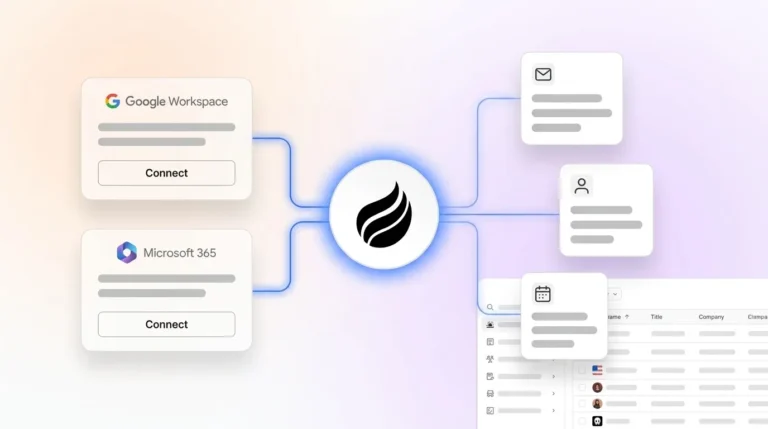
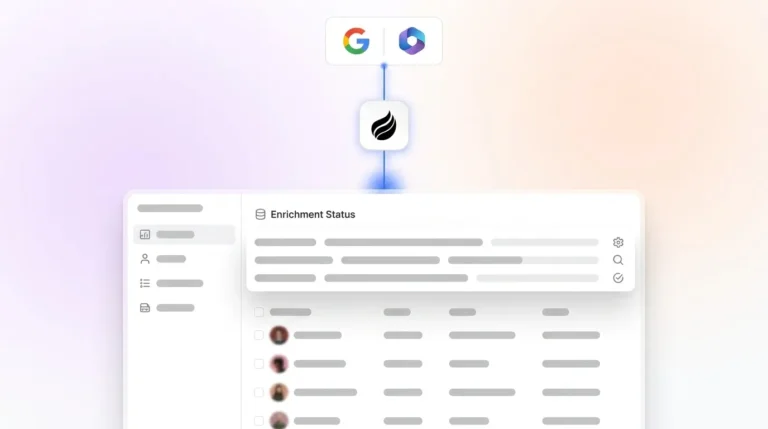
Coffee uses an agent-led deployment that connects to Google Workspace or Microsoft 365 through a simple authentication step. The agent starts auto-creating contacts, companies, and activity logs immediately, and a 10-person team does not need a professional services engagement. Custom AI systems for simple or predictive use cases typically deploy in 3 to 8 weeks, while traditional enterprise implementations of legacy platforms often take 3 to 8 months. For a Head of Operations working against a two-week internal deadline, that timing difference is significant.

See how Coffee’s deployment timeline compares to traditional CRM rollouts before you commit to a long implementation cycle.
Automatic Data Entry and Enrichment Across Platforms
Affinity builds its relationship intelligence on a graph of email and calendar signals, yet still depends on human curation for deal stages, notes, and enrichment fields beyond automated activity capture. Affinity data enrichment features are available without a specified Advanced-tier gate, with API access beginning at the Scale tier priced at $2,300 per user per year. Teams on Essential or Scale often source enrichment separately or absorb the upgrade cost.
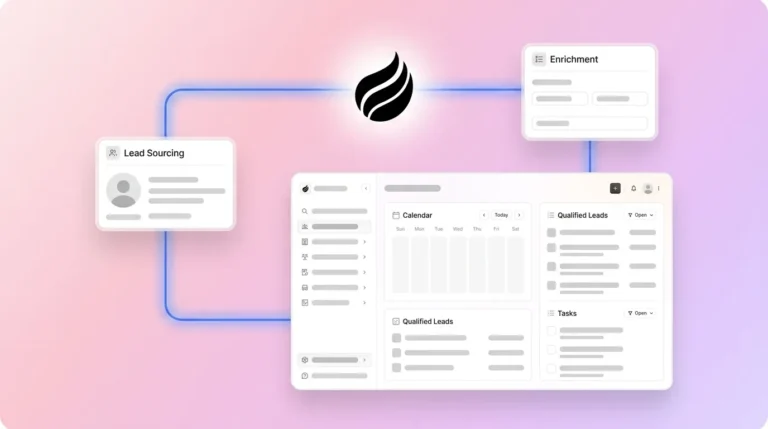
Coffee’s autonomous agent manages the full data-in loop. After calendar and email connection, it auto-creates contacts and companies, enriches records with job titles, funding data, and LinkedIn profiles through licensed partners, and logs last and next activity without human input. No Salesforce State of Sales 2026 benchmarks report data-entry time reductions for AI-native CRMs. For investment professionals, Coffee’s documented 8–12 hours of weekly time savings per user come directly from work that previously went into manual CRM maintenance.

Attio and Folk provide AI field auto-population, yet they stop short of a fully autonomous agent that captures unstructured data such as email text and call transcripts and then writes structured records back to the system without human review.
Meeting Management and Pipeline Intelligence for Deal Teams
Affinity’s AI meeting intelligence feature, including its AI Notetaker, is available on the Advanced and Enterprise tiers. Teams on lower tiers take notes manually and paste summaries into deal records. Relationship scoring exists across tiers, but pipeline review still depends on data assembled by humans.
Coffee’s agent acts as a pre- and post-meeting executive assistant on every plan. Before a call, it generates a briefing page that covers attendees, roles, and prior interaction history. During the call, the agent joins via Zoom, Teams, or Meet to record and transcribe. After the call, it produces summaries, identifies next steps, and drafts follow-up emails in Gmail for one-click review. The Pipeline Compare feature visualizes week-over-week deal movement, including progressed, stalled, and new opportunities, without spreadsheets or manual CSV exports. Teams that deploy AI agents for pre-call research and CRM field population report meaningful reductions in weekly research and admin time.

Total Cost of Ownership for a 10-Person VC or PE Team
This TCO example uses a 10-person team over one year. All Affinity figures come from Vendr’s 2026 contract data and ValueAdd VC’s mid-2026 fund cost analysis.
Affinity Scale (10 seats):
- Licensing: $23,000/year
- Implementation and onboarding: $5,000–$25,000 (one-time)
- Data enrichment add-on: $5,000–$15,000/year
- Ongoing admin and maintenance, estimated at 10–20% of implementation cost annually: $500–$5,000/year
- Year 1 total range: $33,500–$68,000
Coffee Standalone (10 seats):
- Licensing: seat-based, agent labor included, see Coffee pricing
- Implementation: agent-led, no professional services fee for standard deployments
- Data enrichment: included via licensed partners, no separate add-on required
- Ongoing admin: agent manages data hygiene autonomously
Licensing fees represent only 30–40% of total CRM expenditure for organizations using traditional platforms. Coffee’s agent-led model compresses implementation, enrichment, and admin labor costs to near zero for a 10-person team, creating a structurally lower TCO even before accounting for the productivity gains documented earlier.
Request a custom TCO analysis for your team size to see how these categories shift in your specific case.
Best-Fit Use Cases and How to Decide
Affinity works best when relationship-graph depth is the primary requirement. Typical examples include mapping warm introduction paths across a large partner network, tracking multi-touchpoint LP relationships, or operating in a firm where relationship scoring drives sourcing decisions at scale. Its data model fits investment workflows, and its network effects across the VC ecosystem create a real advantage for firms that depend on that graph.
Coffee is the stronger option for 10–25 person teams that prioritize operational efficiency, data quality, and cost control. The agent removes the manual entry burden that often slows Affinity adoption on smaller teams, delivers enrichment without a separate add-on contract, and produces pipeline intelligence without a dedicated CRM administrator. These operational advantages translate into faster time-to-value for teams that need immediate productivity gains rather than maximum relationship-graph depth.
Attio suits teams that want a modern UI and basic AI field population at a lower price point than Affinity, although its workspace-credit overlay for additional AI actions can introduce cost unpredictability at scale. Folk fits very small teams that focus on outreach more than structured deal pipeline management.
Key operational considerations for any migration include change management, data hygiene, and scalability. Coffee’s agent reduces adoption friction by removing the data-entry requirement. The same agent manages deduplication and enrichment continuously instead of as a periodic project. Affinity’s per-seat pricing scales linearly as teams expand beyond 2–5 members, while Coffee’s seat-based model with included agent labor keeps per-user economics more stable as the team grows.
Risks and Limitations for Affinity and Coffee
Affinity’s main risk for smaller teams is overbuying. A solo angel investor using Affinity reaches an approximate $20,000 annual floor, and a pre-seed micro fund with 2–3 seats pays an estimated $20,000–$24,000 annually. These costs are difficult to justify without relationship-graph scale that matches the spend. Manual entry requirements remain on Essential and Scale tiers, which creates the same data-quality risk that affects legacy CRMs. The average B2B sales rep spends roughly 29 hours per week on non-selling activities, with CRM updates accounting for about 6 hours.
For Coffee and other AI-native tools, the main integration question is depth of connection to existing workflows. Coffee currently integrates with third-party tools through Zapier, and deeper native integrations sit on the roadmap. Teams with complex, custom Salesforce or HubSpot configurations, including required fields, quota management, and territory hierarchies, should confirm that the Companion App model supports their field-mapping requirements before committing. Coffee is SOC 2 Type 2 and GDPR compliant, and customer data is not used to train public models, which addresses a common security review requirement in PE due diligence processes.
Schedule a technical review to validate Coffee’s integration with your Salesforce or HubSpot configuration before you finalize a migration plan.
Frequently Asked Questions
How long does Coffee implementation take for a 10-person VC or PE firm?
Coffee’s agent-led deployment connects to Google Workspace or Microsoft 365 through a single authentication step. For a 10-person team using the Standalone CRM, the agent begins auto-creating contacts, companies, and activity logs immediately after connection, usually within the same business day. Standard deployments do not require professional services, data migration projects, or formal user training because the agent handles the data-entry work that normally depends on user adoption. Teams using the Companion App on top of Salesforce or HubSpot follow the same authentication process, with the agent syncing, enriching, and writing insights back to the primary CRM from day one.
How difficult is a migration from Affinity to Coffee?
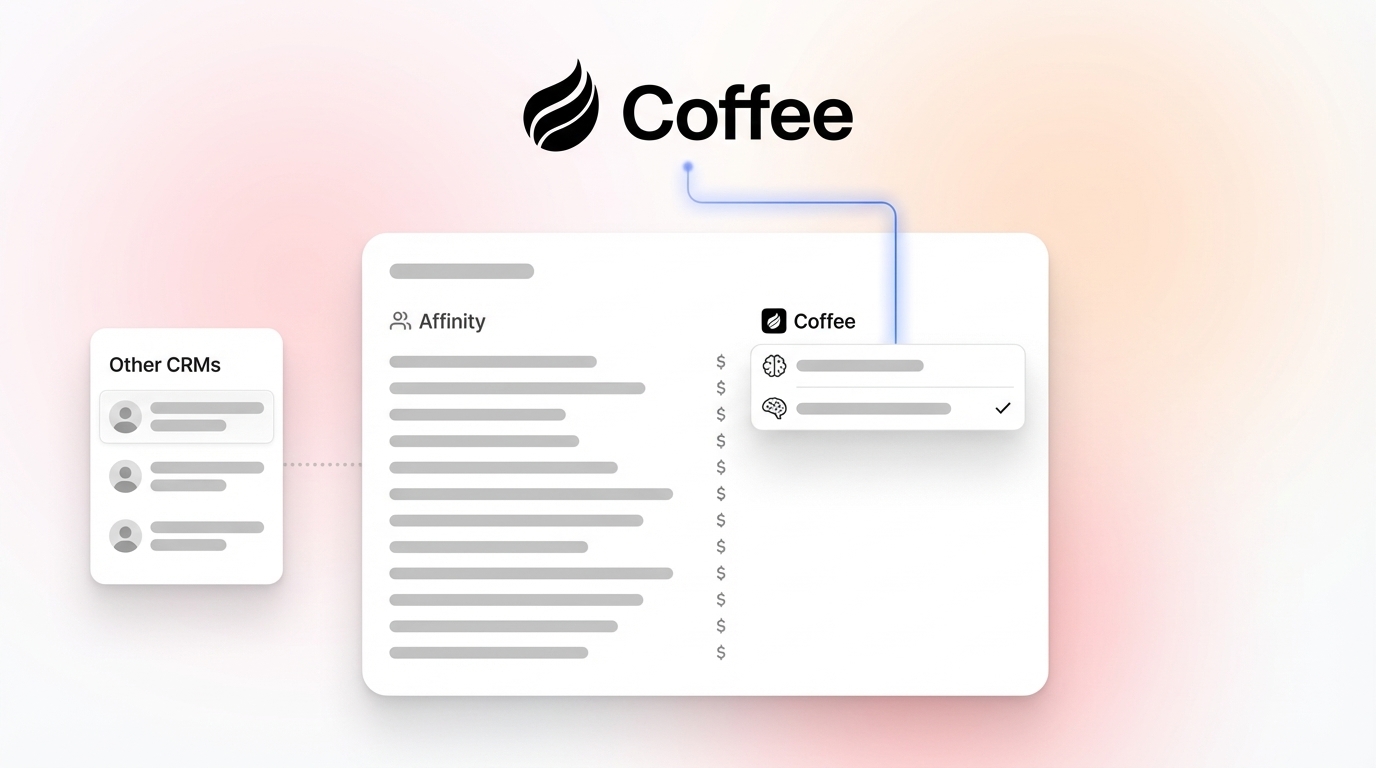
Migration effort depends on the volume and structure of existing Affinity data. For most 10–25 person investment teams, the main migration assets are contact records, company records, and deal history. Coffee’s agent starts capturing new interactions from email and calendar as soon as it connects, so the team can operate in Coffee from day one while historical data moves over. Because the agent enriches and deduplicates records continuously, the data hygiene work that often consumes 4–8 weeks during a legacy-to-AI migration shifts from the operations team to the agent. Teams should plan to run both systems in parallel for 30 days after go-live to validate data accuracy before fully decommissioning Affinity.
What security and compliance certifications does Coffee provide?
Coffee is SOC 2 Type 2 certified and GDPR compliant. Customer data is not used to train public AI models. For VC and PE firms that run internal security reviews before vendor approval, Coffee can share documentation that supports both certifications. Teams in heavily regulated sub-sectors, such as those managing public pension capital or operating under specific SEC data-handling requirements, should work directly with Coffee’s team to confirm whether additional compliance documentation is needed for their regulatory context.
How does Coffee perform for VC and PE compared with B2B sales teams?
Coffee targets the data-quality problem that affects any team relying on a CRM: bad data in produces bad insights out. In a VC or PE context, the agent’s core functions, including auto-creating contacts from email and calendar, enriching company records with funding and LinkedIn data, generating pre-meeting briefings, and producing post-meeting summaries with action items, map directly to deal sourcing, portfolio monitoring, and LP relationship management. The Pipeline Compare feature, which visualizes week-over-week deal movement without spreadsheets, supports deal pipeline reviews. Investment teams usually have longer relationship cycles and fewer but higher-value interactions, and Coffee’s meeting management and enrichment capabilities align well with that cadence. Teams that require deep relationship-graph mapping across a large warm-introduction network should confirm that Coffee’s contact and company graph meets that requirement before moving away from Affinity.
Does Coffee replace separate data enrichment tools like ZoomInfo or Apollo?
For most 10–25 person VC and PE teams, Coffee can replace separate enrichment tools. The agent augments contact and company records with job titles, funding data, and LinkedIn profiles through licensed enrichment partners, which removes the need for a separate ZoomInfo or Apollo subscription for standard enrichment use cases. Data quality is roughly comparable to dedicated enrichment tools for the majority of scenarios. Teams with highly specialized enrichment needs, such as real-time public market data feeds or deep alternative data integrations, should confirm coverage with Coffee’s team before canceling existing enrichment contracts. Consolidation delivers a clear benefit because eliminating a standalone enrichment tool removes both the per-seat cost and the integration maintenance work required to keep that tool synchronized with the CRM.