Written by: Doug Camplejohn, CEO & Co-Founder, Coffee | Last updated: June 26, 2026
Key Takeaways
- Legacy CRMs force manual data entry, leaving sales reps with only 35% of their time for actual selling.
- Standalone AI agents and visitor tools solve narrow problems but create tool fragmentation and shallow CRM integration.
- Coffee’s dual-mode agent unifies structured and unstructured data capture, enrichment, meeting orchestration, and pipeline visibility in one platform.
- Teams using Coffee report 8–12 hours of weekly time savings and deeper Salesforce/HubSpot write-back without added admin burden.
- Ready to eliminate manual CRM work and boost pipeline accuracy? View Coffee pricing and see how it fits your team.
Executive Summary: How Coffee Replaces Manual CRM Work in 2026
Legacy CRMs were designed as systems of record, not systems of action. This design creates a structural dependency on human data entry that Coffee’s market data quantifies: 71% of sales reps report spending too much time on data entry, leaving only 35% of their working hours for actual selling. Standalone AI agents address parts of this problem, such as outbound sequencing, call recording, and enrichment, but they introduce their own fragmentation. A dual-mode agent that operates as either a standalone CRM or a companion layer on Salesforce or HubSpot resolves both the data quality problem and the tool sprawl problem at the same time.
See how Coffee’s dual-mode architecture fits your current stack.
Seven Criteria for Evaluating AI Sales Agents for CRM
Seven criteria form the basis of this comparison. Each maps to a specific operational pain point common to mid-market SaaS sales teams.
- Automated data capture: Does the agent log contacts, activities, and interactions without human input?
- Unstructured data handling: Can the agent ingest and structure emails, call transcripts, and meeting notes?
- Lead generation and enrichment: Does the agent identify and enrich prospects without third-party tools?
- Meeting orchestration and call automation: Does the agent prepare briefings, join calls, and generate follow-ups?
- Pipeline visibility and forecast accuracy: Does the agent produce reliable, current pipeline intelligence?
- CRM integration depth: Does the agent write back to Salesforce or HubSpot without administrative overhead?
- Implementation and ongoing admin burden: What is the setup effort and long-term maintenance cost?
Comparison: Legacy CRMs vs Standalone Agents vs Visitor Tools vs Coffee
| Criterion | Legacy CRM (Salesforce / HubSpot) | Modern Standalone Agent (Clarify, Day.ai) | Visitor ID Tool (RB2B, Warmly) | Coffee Dual-Mode Agent |
|---|---|---|---|---|
| Automated data capture | Manual, human-dependent | Partial, limited to unstructured or structured only | Website traffic only | Full, contacts, activities, and interactions auto-logged |
| Unstructured data handling | Not supported natively | Partial (Day.ai: unstructured only, Clarify: limited) | Not applicable | Structured and unstructured unified in data warehouse |
| Lead generation and enrichment | Requires ZoomInfo, Apollo add-ons | Limited built-in enrichment | Company-level or undifferentiated people lists | Built-in enrichment plus Suggested Leads matched to buyer persona |
| Meeting orchestration | None native, requires Gong, Fathom | Varies, typically partial | None | Briefings, AI bot, summaries, follow-ups, BANT/MEDDIC/SPICED notes |
| Pipeline visibility | Manual CSV exports or expensive add-ons | Limited history, no data warehouse | None | Automated Pipeline Compare with week-over-week change tracking |
| Salesforce / HubSpot integration | Native (is the system) | Shallow, lacks quota, forecasting, required-field depth | None | Deep two-way sync, writes enriched data back to existing instance |
| Implementation burden | High, months of configuration | Low-to-medium, limited enterprise readiness | Low (pixel only) | Low, single authentication, immediate agent activation |
Data Capture and Enrichment for Lead Generation
Legacy CRMs treat data capture as a human responsibility. The Coffee Agent inverts this by connecting to Google Workspace or Microsoft 365 and scanning emails and calendars to auto-create contacts, companies, and activity logs. Enrichment such as job titles, funding rounds, and LinkedIn profiles is appended via licensed data partners, which removes the need for standalone tools like Apollo or ZoomInfo for most mid-market use cases.

The Visitor Identification feature extends lead generation to anonymous website traffic. A single tracking pixel identifies visitors by name, title, email, and company, then surfaces real-time Slack alerts. Where competitors like RB2B and Warmly surface company-level data or undifferentiated people lists, Coffee’s Suggested Leads feature recommends the two or three specific individuals inside a visiting company who match the defined buyer persona. Reps can then trigger immediate LinkedIn outreach or drip enrollment without leaving the agent.

Meeting Orchestration and AI Call Automation
Once leads are captured and enriched, the Coffee Agent extends its automation to the next stage of the sales cycle, meeting preparation and follow-up. The Coffee Agent functions as a pre- and post-meeting executive assistant. Before each call, it generates a briefing covering attendee roles, past interactions, and open action items. During the call, an AI meeting bot joins Zoom, Teams, or Google Meet to record and transcribe. After the call, the agent produces a structured summary, identifies next steps, and drafts a follow-up email in Gmail for the rep to review and send.

Notes are structured according to BANT, MEDDIC, or SPICED depending on team preference. This structure ensures consistent qualification data enters the CRM without manual formatting. The agent replaces the typical stack of Fathom or Gong for recording, manual note-taking, and separate follow-up drafting. Three separate tasks become one agent action.

Pipeline Visibility and Forecast Accuracy
Pipeline intelligence stays reliable only when the underlying data is complete and current. Because the Coffee Agent captures every interaction automatically and stores it in a built-in data warehouse, the Pipeline Compare feature can visualize week-over-week changes such as progressed deals, stalled opportunities, and new additions without manual CSV exports or add-on forecasting tools. Pipeline reviews shift from interrogation sessions where reps explain gaps to strategic discussions grounded in agent-verified data.
Stack Consolidation and Deep Salesforce or HubSpot Integration
A typical mid-market sales stack includes HubSpot or Salesforce for records, ZoomInfo for enrichment, SalesLoft for outreach, Fathom for recording, and Gong for intelligence. This fragmentation means each tool requires its own login, contract, and maintenance cycle, which multiplies administrative overhead and creates data silos between systems. The Coffee Agent consolidates these fragmented functions, performing enrichment, recording, meeting intelligence, and pipeline tracking within a single product that reduces tool sprawl and closes integration gaps.
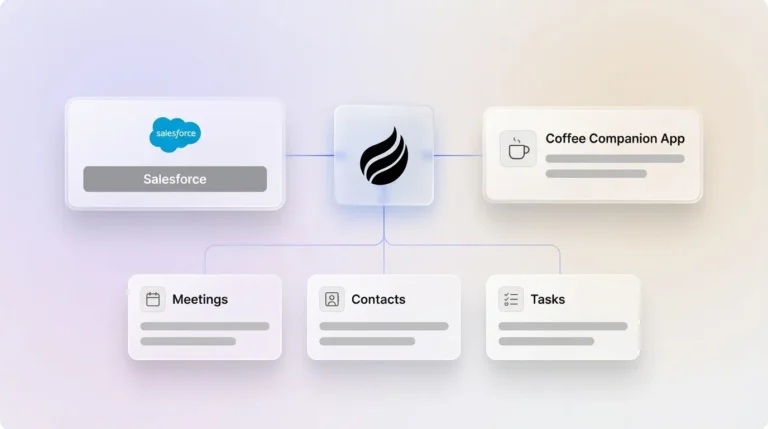
For teams committed to Salesforce or HubSpot, the Companion App deploys via a single authentication. The agent writes enriched contacts, activity logs, call summaries, and pipeline changes back to the existing CRM instance, including quota fields, required fields, and forecasting categories that newer alternatives like Clarify lack the integration depth to handle reliably.
Calculate your savings from consolidating to a single platform.
Implementation Effort and Ongoing Admin Work
Legacy CRM implementations routinely require months of configuration, custom field mapping, and ongoing RevOps maintenance. The Coffee Agent activates through a single OAuth connection to Google Workspace or Microsoft 365 and begins logging data immediately. Pricing is seat-based with no metering on agent actions or LLM usage, which removes the variable cost unpredictability common to usage-based AI tools.
Example Weekly Workflow: Eight Steps That Remove Manual Tasks
The following workflow shows how the Coffee Agent replaces manual tasks across a standard sales week, producing the time savings described earlier by automating eight previously manual tasks.
- Email and calendar sync: Agent connects to Google Workspace or Microsoft 365 and auto-creates contact and company records from inbound and outbound correspondence.
- Enrichment: Agent appends job title, funding data, and LinkedIn profile to each new record via licensed data partners.
- Visitor identification: Tracking pixel fires, the agent identifies named visitors, matches them to buyer persona, and sends a Slack alert with Suggested Leads.
- Pre-meeting briefing: Agent generates a “Today” page summarizing attendees, roles, prior interactions, and open action items before each scheduled call.
- Call recording and transcription: AI meeting bot joins the call, records, and transcribes in real time.
- Post-call summary and follow-up: Agent generates structured notes (BANT/MEDDIC/SPICED), identifies next steps, and drafts a follow-up email for rep review.
- CRM writeback: All enriched data, activity logs, and call summaries sync automatically to Salesforce or HubSpot with required fields populated.
- Pipeline Compare: Agent surfaces week-over-week pipeline changes ahead of the Monday review, replacing manual spreadsheet preparation.
Best-Fit Use Cases by Company Size and Stack
1–20 employees (Standalone CRM): Founders and early sales hires who have outgrown spreadsheets but find HubSpot or Pipedrive to be expensive manual chores benefit most. The Coffee Standalone CRM deploys the agent as the full system of record with no legacy migration required.
20–50 employees (Companion App): RevOps leaders at SaaS companies already invested in Salesforce or HubSpot who face low adoption and poor data quality gain an immediate lift. The Companion App adds the Coffee Agent as an intelligent layer without replacing the existing CRM, preserving historical data and existing workflows while eliminating manual entry going forward.
50+ employees: Coffee is not designed for large enterprises with complex custom workflows or heavily regulated industries that require multi-year security reviews.
Operational Details: Compliance, Integrations, and Scale
Coffee is SOC 2 Type 2 and GDPR compliant. Data captured by the agent is not used to train public models. Current third-party integrations beyond Salesforce and HubSpot are available via Zapier, with deeper native integrations on the product roadmap. Teams evaluating scalability can rely on the seat-based pricing model, which scales linearly with headcount without introducing per-action cost complexity.
Risks and Limitations of Autonomous AI Sales Agents
Autonomous agents introduce change-management considerations. Reps accustomed to manual workflows may initially distrust agent-generated summaries or enrichment data. A review step, where reps confirm agent-drafted follow-ups before sending, preserves human judgment while reducing effort. Enrichment data quality from built-in sources is comparable to most mid-market use cases but may not match the depth of enterprise-tier ZoomInfo contracts for highly specialized verticals. Integration coverage beyond Salesforce and HubSpot currently depends on Zapier, which introduces latency for teams that require real-time bidirectional sync with niche tools.
Decision Matrix: Matching Company Profile to Coffee Deployment
| Company Size | CRM Commitment | Primary Pain | Recommended Solution |
|---|---|---|---|
| 1–20 employees | None / spreadsheets | No scalable system of record | Coffee Standalone CRM |
| 20–50 employees | HubSpot or Salesforce (committed) | Low adoption, poor data quality | Coffee Companion App |
| 20–50 employees | HubSpot or Salesforce (evaluating) | Tool sprawl, manual entry | Coffee Standalone CRM or Companion App |
| 50+ employees | Salesforce (deeply customized) | Complex enterprise workflows | Legacy CRM with point solutions (Coffee not recommended) |
Frequently Asked Questions
How long does it take to implement an autonomous AI sales agent?
Coffee activates through a single OAuth authentication with Google Workspace or Microsoft 365. Once connected, the agent begins scanning emails and calendars and auto-creating records immediately, with no multi-week configuration phase. For the Companion App, connecting to an existing Salesforce or HubSpot instance follows the same single-authentication model, with the agent beginning to write enriched data back to the CRM the same day.
What is the migration effort when moving from Salesforce or HubSpot?
Teams adopting the Coffee Companion App do not migrate away from Salesforce or HubSpot, because the agent operates as an intelligent layer on top of the existing instance and preserves all historical data, custom fields, quotas, and forecasting configurations. Teams choosing the Coffee Standalone CRM as a full replacement can import existing contact and company records via standard CSV import. Historical activity data from legacy CRMs varies in portability depending on the source system’s export capabilities.
How does Coffee ensure SOC 2 Type 2 and GDPR compliance?
Coffee maintains SOC 2 Type 2 certification, which means its security controls have been independently audited over an observation period, not just assessed at a point in time. GDPR compliance covers data residency, processing agreements, and the right to deletion for contacts stored within the agent. Data captured by the Coffee Agent is not used to train public AI models, which addresses the primary data governance concern raised by RevOps leaders evaluating AI tools for sales workflows.
How can teams measure improvement in pipeline forecast accuracy?
The most direct measurement approach compares forecast-to-close variance before and after Coffee deployment. Before deployment, forecast variance is typically driven by missing or stale CRM data, such as deals logged late, activities not recorded, and stage changes made manually after the fact. After deployment, the Coffee Agent’s Pipeline Compare feature tracks week-over-week changes automatically and gives managers a verified, agent-sourced view of deal progression. Teams can establish a baseline by auditing CRM data completeness, such as the percentage of deals with logged activities, call summaries, and next steps, in the 90 days prior to deployment and comparing it to the 90 days following activation.
Conclusion: How to Select the Right AI Sales Agent for Your CRM
For RevOps and sales leaders at 10–50 person SaaS companies, the core decision in 2026 is not whether to adopt an AI agent for sales. The real decision is which architecture fits the existing stack and team size. Legacy CRMs will not solve the data quality problem they created. Single-purpose point solutions add cost and complexity without addressing the root cause. Modern standalone agents lack the integration depth required for teams committed to Salesforce or HubSpot.
Coffee’s dual-mode architecture, Standalone CRM for teams without a legacy CRM commitment and Companion App for teams invested in Salesforce or HubSpot, is the only path that unifies structured and unstructured data, eliminates manual entry, and delivers reliable pipeline intelligence without requiring a platform replacement or adding administrative burden. The agent handles the data entry, the meeting orchestration, the enrichment, and the pipeline tracking. The rep handles the selling.