
Key takeaways:
- Legacy CRMs often fragment customer data, slow down sales teams, and limit visibility into pipeline health.
- Sales representatives spend a significant share of their time on manual data entry instead of selling, which reduces productivity and revenue.
- AI agent CRMs like Coffee automate data capture, meeting workflows, and insight generation so teams can focus on conversations and closing deals.
- Coffee can replace or augment existing CRMs, unifying sales data in a single AI-first platform.
- Higher data quality and proactive insights from Coffee support more accurate forecasting and stronger customer relationships.
Traditional CRMs were built to centralize data and standardize reporting, yet many sales teams still work with fragmented information across email, calendars, call tools, and spreadsheets. Reps often spend more time updating records than talking to customers, while leaders struggle to get a reliable view of the pipeline.
An AI agent for sales CRM replacement addresses these issues by automating data capture, organizing every interaction in one place, and surfacing insights in real time. Instead of acting as a passive database, the CRM becomes an active assistant that supports daily sales work.
Coffee is an AI-first platform created for this new way of operating. It automates data entry, unifies customer context, and provides guidance throughout the sales cycle so teams can prioritize the right accounts and deals.
To see how an AI agent for sales CRM replacement can support your revenue strategy, request access to Coffee and review the platform in action.
The Problem: Legacy CRMs Are Holding Your Sales Team Back
Traditional CRM systems set out to centralize customer data, streamline sales processes, and improve productivity. In practice, many legacy platforms create friction for modern teams that work across email, chat, video, and multiple sales tools. Understanding these gaps explains why an AI agent for sales CRM replacement is increasingly important for staying competitive.
Fragmented Data & Lack of a Single Source of Truth
A major flaw in many traditional CRMs is fragmented data. Customer information lives in separate systems for email, call recording, marketing automation, and support. Sales representatives often jump between tools for contact management, enrichment, outreach, and call review, which slows down daily work.
This fragmentation creates blind spots. A support email thread might reveal renewal risk, yet that context may never reach the account manager if it stays in another system. The promised single source of truth turns into partial views, which leads to missed opportunities, duplicated work, and inconsistent customer experiences that can hurt revenue.
Modern sales teams need complete customer visibility, not manual research. When data is scattered across platforms, sales representatives spend valuable time searching for context instead of engaging prospects. Over time this inefficiency compounds and becomes a competitive disadvantage as customers expect more personalized and informed interactions.
The Manual Data Entry Drain
Manual data entry is one of the most common pain points in traditional CRMs. After every call, meeting, or email, sales representatives are expected to log notes, update stages, and copy information between systems.
This requirement creates a cycle of poor data quality and low adoption. Representatives rush through updates so they can return to selling, which leads to incomplete or inaccurate records. Managers then rely on imperfect data for reporting and forecasting, and the CRM becomes less useful for everyone.
Many teams report that representatives spend only about 35 percent of their time on active selling, with the rest consumed by administrative work that could be automated. In a competitive environment where each interaction matters, pushing top performers into hours of data entry becomes a direct cost to revenue.
Outdated Architecture & Inflexibility
Some traditional CRMs still rely on architectures designed before AI and modern cloud workflows were common. Vendors have added features over time, yet underlying design choices can make it harder to process complex data or support specific business needs without extra customization.
Unstructured data such as emails, call transcripts, and meeting notes is especially challenging. If the system cannot analyze these conversations, important buying signals and risk indicators remain buried in text. As a result, trend analysis and forecasting may miss key context that exists outside structured fields.
Inflexibility also shows up in configuration. Simple workflow changes can require heavy customization projects, outside consultants, or internal technical resources. This slows responses to new markets, products, or sales motions and makes it harder for teams to adjust their process as they learn.
Poor User Adoption & “Shadow CRMs”
The mix of fragmented data, manual updates, and rigid workflows often leads to low user adoption. Many sales representatives see their CRM as a reporting tool for management instead of a system that helps them sell. When people feel the system takes more than it gives, they naturally avoid it.
In response, some teams create shadow CRMs in tools like Notion, Evernote, or spreadsheets where they track the details that matter for day-to-day execution. These personal systems often contain the most current and actionable information, while the official CRM receives only minimal updates for reporting.
This gap between official systems and real workflows creates risk. Critical customer information can live outside centralized tools, which makes collaboration harder and weakens institutional knowledge when people change roles or leave. A modern AI agent for sales CRM replacement must reverse this dynamic by delivering clear value to end users while still giving leaders reliable data for planning.
The Solution: Introducing Coffee as Your AI Agent for Sales CRM Replacement
Coffee is built as an AI agent for sales CRM replacement from the ground up. Instead of layering AI features onto older architectures, it uses an AI-native design that directly addresses long-standing issues in traditional systems. The goal is not just smarter reporting, but a new way to manage revenue work.
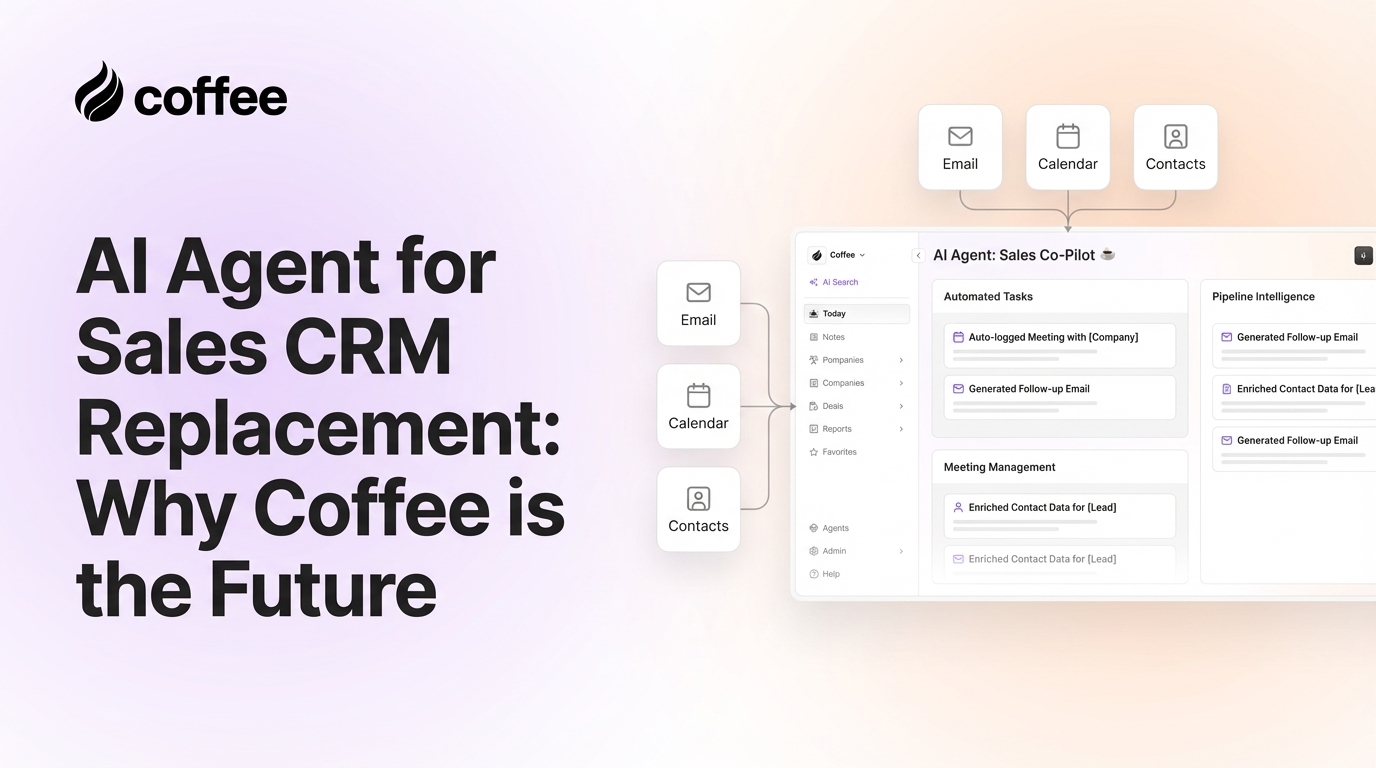
At its core, Coffee operates as a sales co-pilot. It automates routine tasks, consolidates customer data from email, calendars, and communication platforms, and keeps records current without constant manual input.
Coffee supports two deployment models so teams can adopt it at their own pace. The Standalone product offers a complete AI-first CRM for small and mid-sized companies that want to replace legacy systems. The Companion App connects to an existing CRM and adds intelligent automation and insights without requiring an immediate switch.
The platform also includes a unified data warehouse. It tracks historical snapshots of customer interactions and pipeline changes, which allows for deeper trend analysis and more reliable forecasting than many traditional systems provide.
Sales organizations that want their CRM to support the way they actually work can request access to Coffee and evaluate how an AI agent CRM fits their revenue strategy.
How Coffee’s AI Agent Functions as Your Sales Co-Pilot
Coffee’s AI agent capabilities touch every stage of the sales process, from prospecting to renewal. Instead of asking representatives to adapt to rigid system rules, Coffee adapts to existing workflows and amplifies what top performers already do well.
Eliminate Manual Entry and Unify Your Data Automatically
Coffee begins with automatic data capture and enrichment. When a team connects Google Workspace or Microsoft 365, the platform scans emails and calendar events to create and update contacts, companies, and deals.
The system then enriches these records. Coffee adds job titles, company details, funding information, LinkedIn profiles, and location data from licensed partners. This built-in enrichment keeps records consistent and reduces the need for extra tools or manual research.
Activity logging is also automated. Coffee pulls last activity and next activity information directly from email and calendar systems so pipeline data stays current without extra clicks. This level of automation can save an estimated 8 to 12 hours per week for each representative while raising overall data quality.
Accelerate Meetings through AI-Powered Management
Meetings are a major part of sales work, and Coffee streamlines preparation and follow-up. The Today page gives each representative a briefing for upcoming meetings that includes attendee details, company background, and a summary of past interactions.
Coffee’s AI meeting bot can join Google Meet, Microsoft Teams, and Zoom calls to record and transcribe conversations. Once set up, the bot runs in the background so representatives can focus on the discussion instead of taking notes.
After the meeting, Coffee generates a concise summary, highlights follow-up actions, and drafts email responses that open directly in Gmail for review. This reduces manual follow-up work and ensures that next steps are captured reliably.
The platform can structure summaries using common sales methodologies such as BANT, MEDDIC, MEDDPICC, or SPICED. Teams gain consistent qualification data that supports better forecasting and smoother handoffs between team members.
Gain True Pipeline Intelligence with Historical Snapshots
Coffee’s data warehouse makes it possible to analyze pipeline changes over time. The system automatically records historical snapshots of opportunities so teams can see how deals moved, stalled, or changed value.
The Pipeline Compare feature uses these snapshots to show week over week changes without exports or spreadsheets. During pipeline reviews, leaders and representatives can quickly see which deals advanced, which regressed, and which were added or removed.
By keeping complete historical context, Coffee supports more accurate performance analysis and forecasting. Teams can study real progression patterns instead of relying only on static point in time views.
Build Targeted Prospect Lists Instantly
Coffee includes a natural language list builder that combines AI with built-in enrichment. Representatives can type requests such as “Find all VPs of sales in North American companies between 50 and 500 employees that have over 10 million dollars in funding and use Salesforce,” and the system converts that query into a precise target list.
This capability helps focus outbound efforts on the most relevant prospects while feeding clean data directly into the broader customer record.
Teams that want AI powered prospecting and automated data management can request access to Coffee and explore how an AI agent CRM fits into their revenue operations.
Coffee vs. Traditional CRMs: A Paradigm Shift with an AI Agent Replacement
The differences between Coffee and traditional CRMs go beyond feature checklists. They reflect distinct views on how sales technology should support daily work. Understanding these contrasts helps explain why incremental add-ons to legacy systems often fall short of what AI agent CRM replacements can provide.
|
Feature / Aspect |
Traditional CRMs |
Coffee (AI Agent for Sales CRM Replacement) |
|
Data Entry |
Primarily manual, high burden for representatives |
Largely automated by AI agents, minimal manual input |
|
Data Quality |
Often inconsistent, prone to human error, fragmented |
High quality, unified, and enriched automatically by AI agents |
|
Insights |
Reactive reporting, requires manual analysis |
Proactive, AI-driven, actionable insights without manual reporting |
|
User Adoption |
Often low, seen as a management tool |
High, seen as a sales co-pilot that simplifies work |
|
Tech Stack Complexity |
May require multiple integrations for enrichment, call recording, and similar needs |
Consolidated, all-in-one platform with integrated AI capabilities |
|
Architecture |
May rely on older architectures, with varying adaptability to unstructured data |
AI-native, built to handle structured and unstructured data, data warehouse |
These architectural differences shape the entire user experience. Traditional CRMs often expect teams to adjust their workflows to fit the system, while Coffee uses AI agents to adapt to how successful sales teams already operate.
Data quality is a major dividing line. Legacy systems depend heavily on manual input, which can erode accuracy over time. Coffee automates collection and enrichment so data quality improves as the system processes more interactions.
Insight generation also shifts from reactive to proactive. Traditional tools often require users to know which reports to run and how to interpret them. Coffee continuously analyzes available data and surfaces relevant insights, allowing representatives and managers to spend more time on strategy and customer conversations.
User adoption follows from this design. When representatives view the CRM as a partner that reduces busywork and supports their goals, they are more likely to use it consistently. Higher adoption then feeds better data, which leads to better insights and outcomes.
Frequently Asked Questions About AI Agent CRMs
How does an AI agent CRM handle data security and privacy?
Data security and privacy are central requirements for any CRM. Coffee uses a comprehensive security framework, maintains SOC 2 Type 2 compliance, and aligns with GDPR so customer data receives strong protection during processing and storage.
Coffee also keeps company data out of model training. The platform does not use customer data to train shared AI models, and it maintains strict segregation so proprietary information stays private, including content from meeting transcripts and generated insights.
Can an AI agent CRM integrate with my existing tools?
Coffee is designed to work with existing technology stacks while lowering overall complexity. The platform offers Zapier integrations that enable data flow between Coffee and many business applications, so teams can add AI capabilities without rebuilding their stack.
For organizations that plan to keep their current CRM, the Companion App model syncs data between systems. Users can run their sales process in Coffee while writing selected enriched fields and insights back to the primary CRM, which preserves the system of record and reduces duplication.
Is an AI agent for sales CRM replacement only for large companies?
AI agent CRM technology is useful for organizations of many sizes, not only large enterprises. Small and mid-sized teams often benefit the most, because they may lack dedicated admins or operations staff to maintain complex traditional setups.
Automation of data entry and administrative work lets smaller teams operate with cleaner data and better visibility. Coffee’s automatic capture and enrichment provide value from the start without long implementations or extensive configuration.
How does an AI agent CRM improve forecasting accuracy?
Coffee improves forecasting accuracy by combining complete data capture with historical analysis. Its data warehouse stores full snapshots of pipeline states, which creates a record of how deals move over time.
The Pipeline Compare feature then highlights changes between periods, such as deals that advanced, stalled, or decreased in value. Managers can compare these patterns with past performance to build forecasts that reflect actual behavior instead of relying only on subjective estimates.
What happens to our data if we decide to switch away from Coffee?
Organizations retain control of their data if they decide to move away from Coffee. The platform offers export capabilities for customer records, interaction histories, and enriched fields in standard formats that other systems can accept.
This focus on portability helps prevent vendor lock-in and lets teams make future platform decisions based on their needs.
Conclusion: How An AI Agent CRM Replacement Supports Modern Sales Teams
Traditional CRM systems often struggle to meet the demands of modern sales organizations. Data fragmentation, heavy manual entry, and uneven adoption are structural issues that incremental feature updates rarely solve.
Coffee offers an AI agent for sales CRM replacement that addresses these challenges with automation, unified data, and proactive insights. By removing routine busywork and providing timely guidance, the platform helps sales teams treat the CRM as a daily partner rather than an obligation.
The shift toward AI-driven CRM platforms is already underway. Organizations that move early to AI-native tools can reduce friction in their sales process and respond faster to changing customer expectations.
Coffee’s combined approach to sales automation, data unification, and insight generation creates a foundation for sustainable revenue growth. When representatives spend more time on conversations and less on administration, performance improves in ways that leaders can measure.
Teams that are ready to move beyond incremental fixes to legacy systems can evaluate an AI agent CRM replacement today. Request access to Coffee and review how the platform aligns with your sales strategy.