
Key Takeaways
- AI agents reduce manual data entry so sales teams spend more time on direct customer conversations and closing deals.
- Automated lead qualification, meeting workflows, and forecasting give sales leaders clearer visibility into pipeline health.
- Personalized outreach at scale becomes realistic when AI agents structure and connect activity data across tools and channels.
- A single AI-first platform can replace several point solutions, which lowers costs, improves data quality, and supports CRM adoption.
- Teams that want these outcomes in 2026 can request access to Coffee’s AI sales agent to streamline their daily workflows and operations: Request access to Coffee.
The Problem: Why Traditional CRMs Are Stifling Sales Productivity
Many sales teams lose hours each week to admin work and scattered data. Coffee’s market data shows that 71% of sales reps spend too much time on data entry, and only 35% of their time on actual selling. Traditional CRMs depend on humans to keep records updated, so the system acts more like a demanding landlord than a helpful assistant.
This reliance on manual work leads to fragmented data, constant updates, and platforms that struggle with unstructured information. Poor user experience and low adoption often create a bad data in, bad data out loop. These issues drag down both productivity and revenue. AI agents shift CRMs from passive databases to active systems that capture, enrich, and organize data with minimal effort from reps.
Sales teams that want a practical path out of this pattern can add an AI agent that handles routine CRM tasks in the background. Request access to Coffee’s intelligent sales platform to see this in action.
1. Eliminate Manual Data Entry to Reclaim Selling Time
Manual data entry drains time and energy from sales professionals. AI agents capture and enrich contacts, companies, and activities automatically, so reps focus on calls, demos, and closing business.
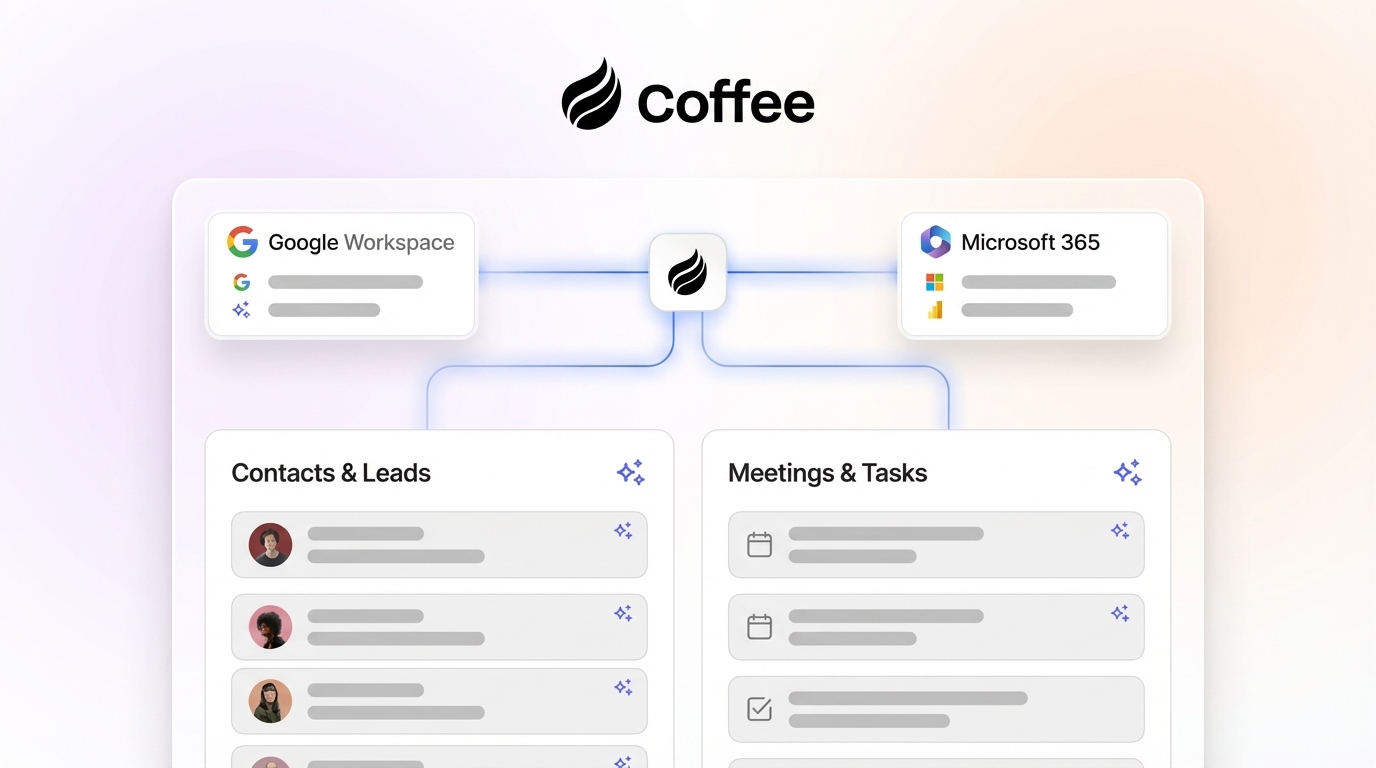
Coffee’s Agent creates and updates contacts and companies from connected Google Workspace or Microsoft 365. It logs emails, meetings, and calls, and keeps deal stages current in a single view. This reduces repetitive tasks and gives reps back meaningful hours each week for selling instead of typing.

2. Supercharge Lead Qualification and Prioritization
Unprioritized lead lists slow teams down. AI agents analyze firmographic and activity data to flag the prospects most likely to move, so reps can organize their day around high-value outreach.
Coffee’s List Builder feature turns a natural language prompt into a targeted list. A rep can say, “Find me VPs of Sales in North America at companies with $10M+ funding using Salesforce,” and the Agent uses built-in enrichment to assemble that list. This reduces reliance on separate data tools and keeps prospecting inside one workspace.

3. Elevate Meeting Management and Follow-Up Automation
Effective sales meetings require research before the call and clear follow-up afterward. Both tasks take time and are easy to postpone when calendars fill up.
Coffee’s AI-powered meeting management works like a virtual assistant inside the sales workflow. A Today view gives each rep a briefing for upcoming meetings. The Agent joins calls to record and transcribe, then produces concise summaries, highlights next steps, and drafts follow-up emails for review. This creates a consistent process from prep to follow-up without extra tools.

Teams that rely on a repeatable meeting process gain better notes, clearer next steps, and more predictable follow-through. Request access to see how Coffee supports this end to end.
4. Achieve True Pipeline Intelligence and Forecasting Accuracy
Leaders need accurate, current pipeline data to make sound decisions. When reps update deals manually in a rush, reports often lag behind reality.
Coffee’s Agent keeps data fresh by tracking activity and deal changes continuously. The Pipeline Intelligence and Compare view shows week-over-week shifts, such as progressed, stalled, or new deals. Managers can spend less time chasing updates and more time discussing strategy, risk, and next steps with the team.
5. Personalize Outreach and Customer Interactions at Scale
Prospects respond better to messages that reflect their context, goals, and past conversations. AI agents help by organizing information from meetings and emails in a structured way.
Coffee’s Agent structures notes using frameworks like BANT or MEDDIC. It associates discovery details with each contact and deal, so follow-ups and sequences can reference specific pain points, timelines, and decision criteria. Reps maintain a personal tone even when working larger books of business.
6. Consolidate Your Sales Tech Stack and Reduce Complexity
Many teams use separate tools for CRM, enrichment, call recording, note-taking, and forecasting. This increases cost, splits data across systems, and creates more onboarding and training work.
Coffee reduces this sprawl by combining CRM workflows, data enrichment, meeting recording, and pipeline intelligence in one AI-first platform. A single Agent handles tasks that previously required several point solutions. This consolidation lowers software spend, reduces integration overhead, and gives everyone a shared source of truth.

7. Turn CRM Adoption into a Strategic Advantage
Low CRM adoption limits visibility and weakens forecasting. When reps see the CRM as extra work, they avoid updating it or enter minimal information.
Coffee’s approach centers on an Agent that handles busywork by default. Reps delegate repetitive tasks, like logging activity or updating stages, to the system. Over time, the CRM shifts from a static database to a working tool that supports day-to-day selling, which encourages regular use and produces more reliable data.
Sales organizations that want to improve CRM adoption can test this agent-first model. Request access to Coffee and explore how an AI agent supports your existing process.
How Coffee Compares: AI-First Agent vs. Legacy CRMs
Coffee’s Agent vs. Traditional Methods
|
Feature / Aspect |
Coffee’s AI Agent Approach |
Legacy CRMs (Salesforce, HubSpot) |
Impact |
|
Data Entry |
Automated, Agent captures and enriches data from emails, calendars, and calls. |
Manual, Relies on human input, which often introduces inaccuracies. |
Time saved per rep each week and more complete records |
|
Data Quality |
High fidelity, Agent pulls from ground truth sources and standardizes fields. |
Variable, Human error leads to gaps and the familiar garbage in, garbage out problem. |
More dependable reporting and forecasting |
|
Meeting Management |
Intelligent, Agent briefs, records, transcribes, summarizes, and drafts follow-ups. |
Fragmented, Requires manual prep, external recording, and separate notes. |
Consistent follow-up and clearer next steps |
|
Pipeline Intelligence |
Real-time and accurate, Agent tracks changes and surfaces insights. |
Delayed and manual, Often depends on CSV exports and periodic cleanups. |
More focused and strategic pipeline reviews |
Conclusion: Use AI Agents To Unlock Modern Sales Productivity
In 2026, sales performance depends on more than activity volume. Teams need accurate data, clear processes, and tools that reduce friction instead of adding tasks. AI agents help by capturing customer interactions, enriching records, and updating pipelines in the background.
The seven approaches in this article show how AI agents can support reps without replacing them. From automated data entry and lead qualification to meeting workflows and pipeline intelligence, an agent-first CRM model gives sellers more time for conversations and gives leaders cleaner data for decisions.
Teams that want to modernize their sales operations can start by adding an AI agent alongside existing systems. Request access to Coffee to see how an autonomous AI agent can support your sales productivity in 2026.
Frequently Asked Questions (FAQ) About AI Agents for Sales Productivity
How does an AI agent improve data quality compared with manual entry?
Coffee’s Agent ingests data directly from emails, calendars, and call transcripts, then structures it into contacts, accounts, and activities. The system auto-creates and enriches records and logs every interaction, which reduces missed details and keeps information current. This good data in approach supports more reliable reporting and planning than inconsistent manual entry.
Can AI agents support personalized outreach instead of generic automation?
Coffee’s Agent builds personalization into the workflow by organizing meeting notes with frameworks like BANT or MEDDIC and linking those notes to each contact and deal. When reps follow up, the Agent can suggest language that reflects the prospect’s role, pains, and timing, so outreach feels specific rather than generic.
Can AI agents work with existing CRMs like Salesforce or HubSpot?
Many AI agents, including Coffee, can complement current CRM investments. Coffee’s Companion App runs as an intelligent layer on top of Salesforce or HubSpot, which remain systems of record. The Agent focuses on getting accurate data in, while your existing CRM continues to handle reporting, integrations, and historical data.
What ROI can teams expect from AI agents in sales?
Teams that adopt AI agents such as Coffee’s usually see value in three areas. Reps reclaim hours each week from manual updates, which they can redirect to selling. Tool consolidation lowers software and integration costs. Better data quality improves forecast accuracy and helps leaders allocate effort to the right deals.
How secure is data when using an AI agent for sales operations?
Coffee focuses on security and compliance for sales data. The platform is SOC 2 Type 2 and GDPR compliant, and customer data is not used to train public AI models. This protects sensitive pipeline information while still allowing the Agent to automate day-to-day work for the sales team.