
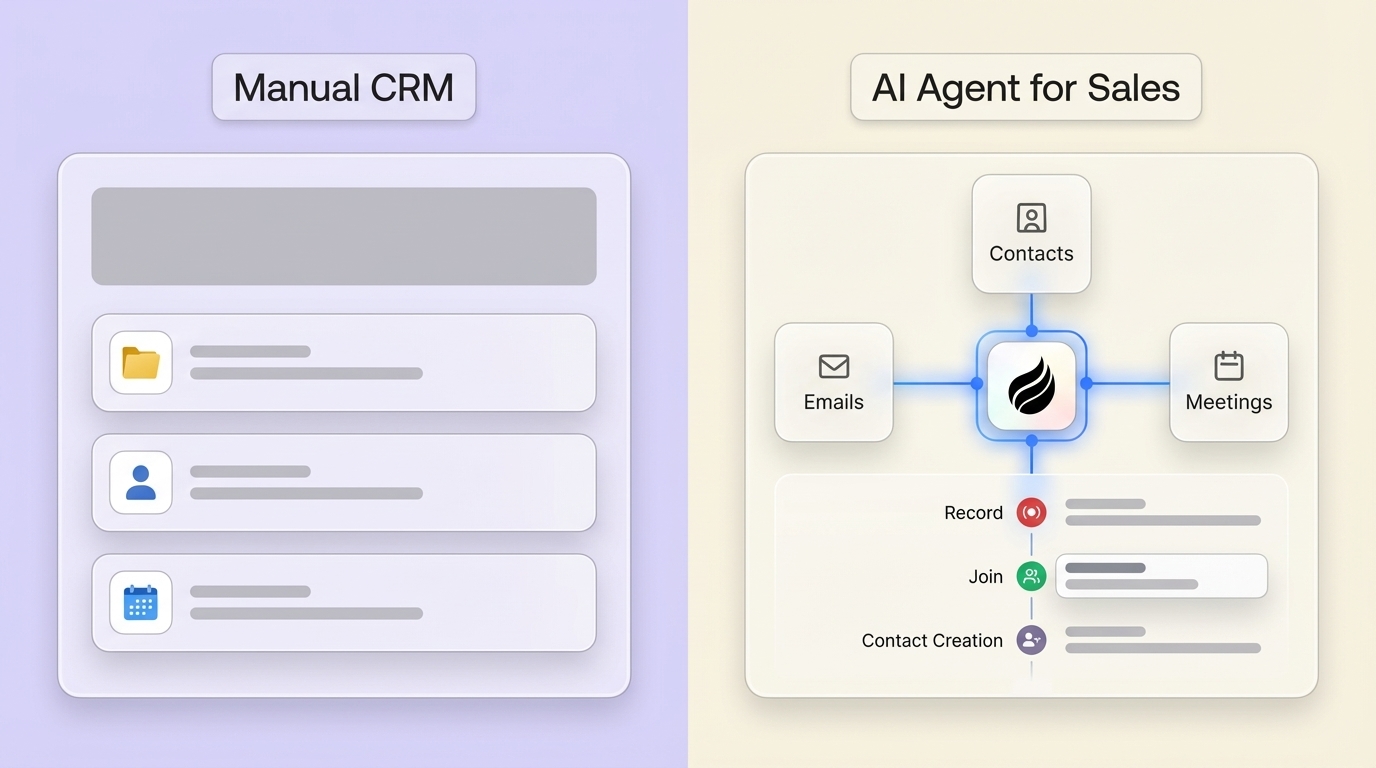
Key Takeaways
- Manual CRM data entry creates gaps, delays, and errors that limit visibility, forecasting accuracy, and revenue performance.
- An AI sales agent captures activities automatically, improves data quality, and reduces administrative work for every representative.
- Clear evaluation criteria include data accuracy, automation depth, adoption, integrations, reporting quality, and total value of ownership.
- AI agents lower long-term CRM costs by reducing implementation effort, training time, maintenance, and dependence on multiple point tools.
- Coffee provides an AI-first sales platform and companion app that removes manual CRM tasks so teams can focus on selling. Get started with Coffee to see it in action.
Protect Revenue By Fixing CRM Data And Workflows
Sales performance depends on accurate, current CRM data. Many teams still wrestle with incomplete records, outdated contacts, and inconsistent activity logging. These gaps force leaders to question every report and slow down decisions.
The main problem comes from expecting busy salespeople to perform meticulous manual data entry. Representatives spend hours updating fields instead of running meetings, writing outreach, or advancing deals. Poor data then drives flawed forecasts and misaligned targets.
You can break this cycle by introducing an AI sales agent that handles data capture and organization as work happens, instead of after the fact.
Get started with Coffee to reduce manual CRM work across your team.
Introducing Coffee: An AI Agent That Handles Your CRM Work
Coffee functions as an AI sales agent rather than a traditional system of record. It operates in two modes: a standalone AI-first CRM for small and mid-sized teams, and a companion app for Salesforce and HubSpot that improves data quality without replacing your current CRM.
Coffee focuses on four core jobs: capturing data, managing meetings, surfacing pipeline intelligence, and consolidating tools into a single, agent-led workflow.
Automated Data Entry And Enrichment
Coffee scans emails and calendars, then automatically creates and updates contacts, companies, and activities. Representatives gain complete timelines without typing notes into dozens of fields. The agent enriches records with context so every account has a usable profile.

AI-Powered Meeting Management
Coffee joins calls, records and transcribes conversations, summarizes key points, and drafts follow-up emails. Representatives leave a meeting with clear next steps already structured and ready to send, instead of relying on scattered notes and memory.

Pipeline Intelligence
Coffee tracks week-over-week changes in the pipeline automatically. Leaders can see which deals moved, stalled, expanded, or contracted without manual spreadsheet exports or custom reports. Pipeline reviews shift from data inspection to coaching and strategy.
Consolidated Sales Stack
Coffee replaces or augments multiple tools in the sales stack, including CRM, enrichment, call recording, and forecasting. One agent orchestrates activity across these areas, which reduces software cost and the effort required to keep tools aligned.
A CRM Experience Representatives Will Actually Use
Salespeople interact with Coffee through simple workflows and AI-generated views, not dense forms. The agent takes on repetitive tasks, so representatives spend more of the day prospecting, meeting, and closing.
Define Success With Clear Evaluation Criteria
Sales leaders can compare AI agents and manual CRM approaches more effectively when they anchor decisions to specific criteria.
Data Quality And Accuracy
Strong sales operations rely on complete, timely, and trustworthy data. An AI agent should capture activities as they happen and reduce opportunities for human error or omission.
Operational Efficiency And Automation
Effective solutions reduce low-value tasks such as logging activities, updating fields, and preparing reports. Time saved in these areas converts directly into more selling time.
Sales Productivity And Adoption
Tools only create value when sales teams use them. Evaluate how easily representatives can work inside the system and how much incremental selling capacity the solution unlocks.
Integration And Ecosystem Compatibility
Revenue teams benefit most when an AI agent fits into existing tools, calendars, and email clients, and when it can sit on top of an existing CRM without major disruption.
Reporting And Forecasting Accuracy
Leaders need real-time visibility into pipeline health, activity levels, and risk. Reliable reporting depends on consistent, automatic data capture.
Total Value Of Ownership
Effective evaluation includes subscription price, setup and integration work, training, ongoing administration, and the impact of bad or missing data over time.
AI Agent For Sales vs. Manual CRM: Head-To-Head
The table below compares an AI sales agent like Coffee with manual CRM usage across core areas.
|
Feature Area |
AI Agent for Sales (Coffee) |
Manual CRM Usage |
Impact Differential |
|
Data Entry And Management |
Agent auto-creates contacts and companies, logs activities, and enriches data from email and calendar. |
Representatives key data into fields by hand, often after the fact, which leaves gaps. |
Large reduction in administrative workload and fewer missing records. |
|
Data Quality And Accuracy |
Unified structured and unstructured data with real-time validation and consistent capture. |
Data quality depends on individual habits, so records drift out of date or stay incomplete. |
Stronger decisions based on a more complete picture of accounts and deals. |
|
Sales Productivity |
Reps typically regain many hours each week previously spent on updates and follow-up drafting. |
Reps devote a large share of time to updating CRM instead of running meetings or prospecting. |
Time shifts from admin work toward direct revenue-generating activities. |
|
Pipeline Intelligence |
Agent surfaces changes and risk in real time, without manual exports or spreadsheet work. |
Leaders rely on periodic, manual updates and static reports that can quickly go stale. |
Forecasts move closer to objective, data-backed views of pipeline health. |
Get started with Coffee to compare this approach with your current manual CRM process.
See The Full Value, Not Just The Feature List
Total value of ownership includes the cost of people’s time and process complexity, not only software licenses. Coffee reduces hidden costs that accumulate in manual CRM environments.
Reduced Implementation Effort
Coffee connects to Google Workspace or Microsoft 365 and begins capturing data with minimal configuration. Teams avoid long rollout projects and complex field mapping before any value appears.
Lower Training Requirements
Users interact with simple views and AI summaries instead of dense forms. Less time in training sessions means faster adoption and earlier impact on the pipeline.
Minimal Ongoing Maintenance
Coffee manages data hygiene in the background, which reduces the need for cleanup projects, bulk updates, and constant admin intervention.
Scalability As Teams Grow
The agent handles higher email volume, more meetings, and more users without a matching increase in operations headcount or manual workload.
Real-World Scenarios Where An AI Agent Stands Out
Different sales organizations see benefits from an AI agent in distinct ways.
Scenario 1: Small Team Moving Beyond Spreadsheets
Founding sales teams often start with spreadsheets and a basic CRM. Coffee gives them an AI-first system that maintains clean records, captures every touchpoint, and surfaces next actions without adding a heavy process.
Scenario 2: Mid-Market Team With Low CRM Adoption
Many mid-market organizations run Salesforce or HubSpot but still face missing data and low rep engagement. Coffee operates as a companion app that handles data capture and enrichment, while the existing CRM remains the system of record.
Scenario 3: Leadership Needing Reliable Forecasts
Executives need confidence in commitment numbers and risk assessments. Coffee tracks every pipeline change and related activity so forecasts reflect current behavior, not memory or guesswork.

Get started with Coffee to align these scenarios with your own sales motion.
Conclusion: Move From Manual CRM To An AI Agent
Manual CRM processes slow down revenue teams and create uncertainty in forecasts. An AI sales agent such as Coffee, automates data capture, simplifies meeting workflows, and improves pipeline visibility so leaders can manage based on facts, not assumptions.
Sales leaders who want better data quality, higher rep productivity, and more accurate forecasts can begin by layering Coffee on top of the current stack or adopting it as an AI-first CRM.
Get started with Coffee and shift your team’s time from updating CRM to closing deals.
Frequently Asked Questions About AI Agents For Sales
How does an AI agent solve the problem of fragmented sales data?
Coffee connects emails, calendars, and calls to the right contacts, accounts, and opportunities automatically. Every interaction lands in a single, coherent timeline, which removes data silos and reduces the need to switch between tools.
Can an AI agent integrate with my existing CRM, like Salesforce or HubSpot?
Yes. Coffee offers a companion app that sits on top of Salesforce or HubSpot, automates data capture, and respects your existing system of record and workflows. Teams gain AI-driven data quality without a disruptive migration.
Will an AI agent actually save my sales team time on data entry?
Coffee automates contact creation, activity logging, meeting summaries, and follow-up drafts. Representatives reclaim hours each week that previously went into manual updates, and can use that time for outreach and deal work.
How does an AI agent improve sales forecasting accuracy?
Coffee records every change in deal stage, amount, and activity. Leaders see which opportunities move forward, stall, or shrink, and can base forecasts on real behavior rather than infrequent manual updates.
What makes Coffee’s AI agent different from basic CRM automation?
Traditional automation relies on static rules and manual configuration. Coffee interprets context across emails, calendars, and calls, updates the right records, enriches data, and surfaces insights, so it behaves more like a co-pilot for the sales team than a rules engine.