Written by: Doug Camplejohn, CEO & Co-Founder, Coffee | Last updated: July 13, 2026
Key Takeaways
- AI-native CRMs use agent-led architectures to ingest, parse, and structure data from emails, calls, and calendars without manual input.
- Legacy CRMs require hours of manual data entry, while AI-native systems like Coffee recover 8–12 hours per rep each week through zero-touch extraction.
- Multi-agent reliability challenges and hallucination risks are reduced through ground-truth sourcing, approval loops, and strict non-training data policies.
- Coffee offers both standalone CRM deployment for growing teams and companion app integration with Salesforce or HubSpot, with enterprise-grade governance and SOC 2 Type 2 compliance.
- Teams ready to eliminate manual CRM work can get started with Coffee and experience autonomous data extraction built for revenue operations.
How AI-Native CRMs Turn Emails and Transcripts into CRM Records
AI-native systems are designed so that removing the AI would render the product non-functional, which creates a clear break from legacy platforms with bolted-on AI features. The extraction pipeline behind this architecture follows a defined sequence.
- Ingestion: The agent connects to Google Workspace or Microsoft 365 and pulls emails, calendar events, and meeting recordings in real time.
- Parsing and OCR: Content is parsed and extracted using layout-aware models that handle complex formats. The system applies OCR to scanned documents and audio transcription to call recordings.
- Chunking and Embedding: Content chunks are converted into vector embeddings and stored in a vector database. This step enables semantic similarity search across all customer interactions.
- NLP and Entity Resolution: Natural language processing extracts named entities, sentiment, topics, intent, and key objections from unstructured text. The system then resolves those entities against existing CRM records.
- Structured Output: Extracted data is written back to the CRM as structured fields, including contact records, deal stages, activity logs, and next steps, without manual input.
- Agent Orchestration: An orchestration layer coordinates models, tools, and APIs. It triggers follow-up drafts, meeting briefings, and pipeline updates as downstream actions.
Unstructured data such as emails, transcripts, and documents constitutes 90% of total enterprise data volume. AI-native CRMs are the only architectures that convert that volume into structured, actionable pipeline intelligence at scale. Coffee’s agent runs this entire pipeline as soon as it connects to a user’s inbox and calendar, then populates contacts, companies, and activity logs without a single manual entry.

Why AI-Native CRM Data Entry Outpaces Legacy Systems
Traditional CRMs act like glorified spreadsheets that force sales reps to log calls, categorize leads, and write follow-up emails by hand. The operational contrast with agent-led systems shows up clearly in day-to-day work.
| Task | Legacy CRM (Manual) | AI-Native CRM (Agent-Led) | Time Impact |
|---|---|---|---|
| Post-call data entry | Rep manually logs outcome, notes, next steps | Agent extracts and writes structured output automatically | Multiple hours per week recovered per rep |
| Contact and company creation | Rep manually creates records from email signatures | Agent auto-creates records from inbox and calendar scans | Reps typically recover 8–12 hours each week |
| Deal context assembly | Rep manually reviews CRM records, emails, and call notes before meetings | Agent delivers pre-meeting briefing automatically | Meaningful time saved on every active deal |
| Pipeline stage updates | Rep manually advances deals after each interaction | Agent identifies buying signals and updates stages automatically | AI forecasts are designed to come within 5% of actuals but typically miss by 15–20%. |
Autonomous call summarization alone removes many hours per year from post-call data entry. Teams see noticeable efficiency gains once they remove and automate repetitive admin tasks.

Reliable Autonomous CRM Extraction Without Hallucination
AI hallucination rates vary widely by model and task, reaching 39.6–91.4% in systematic reviews and nearly 50% on certain reasoning tests. In CRM environments, a hallucinated contact field or fabricated deal stage can quietly distort forecasts and pipeline reviews.
Multi-agent systems in production fail at rates between 41% and 86.7%, with 79% of failures stemming from coordination issues rather than model limits, a phenomenon called Semantic Intent Divergence, where agents develop inconsistent interpretations of shared objectives. This coordination problem compounds across agent chains, so a chain of five agents at 95% individual reliability drops to roughly 77% end-to-end reliability.
Coffee addresses these risks through three structural controls.
- Ground-truth data sourcing: The agent extracts only from verified first-party sources such as emails, calendars, and transcripts. This approach anchors outputs to factual artifacts instead of model guesswork.
- Approval-loop design: Post-call summaries and follow-up drafts surface to the rep for review before sending. Human judgment remains in place at high-stakes decision points.
- SOC 2 Type 2 compliance and non-training data policy: Customer data is never used to train public models, which prevents proprietary deal information from appearing in third-party model outputs.
AI achieves 95%+ to 99%+ accuracy in CRM data processing and extraction tasks, while manual entry averages 82–98% accuracy. High accuracy creates a foundation for trust, which governance then reinforces.
Permission Controls and Approval Loops for Agent-Led CRM
AI-native governance architectures define agent permissions at the read, create, and edit level, maintain audit trails that log every agent action from data input to final decision, and enforce human-in-the-loop validation for high-impact actions. Coffee’s governance model applies these principles across four layers.

- RBAC: Permissions are scoped by user role so agents access only the data relevant to each team member’s function.
- Runtime policy enforcement: Governance has shifted from static documents to runtime enforcement, where agent actions such as prompts, tool calls, data access, and outputs are intercepted at execution time to enforce identity, permissions, and data-handling rules before they run.
- Human-in-the-loop checkpoints: Complex negotiations and outbound communications require rep review before the agent acts. Routine logging and enrichment proceed autonomously.
- Audit trails: Audit logs capture prompts, tool calls, inputs and outputs, approval steps, data lineage, and reasoning summaries. These records support traceability and compliance.
Get started with Coffee, with autonomous data extraction and governance controls built in.
How Coffee Compares to Attio, Day.ai, Clarify, Salesforce, and HubSpot
| Platform | Data Provenance & Integration Depth | Deployment Models | Zero-Touch Extraction Reliability |
|---|---|---|---|
| Coffee | First-party extraction from email, calendar, and transcripts; SOC 2 Type 2; non-training data policy; deep Salesforce and HubSpot integration with quota, forecasting, and required-field awareness | Standalone CRM or Companion App on Salesforce/HubSpot | Approval-loop design with ground-truth sourcing; agent writes structured outputs back to system of record without manual input |
| Attio | Real-time data ingestion by syncing with a company’s entire tech stack to maintain a live view of customer health | Standalone CRM only | Passive database logic, relying on sync instead of agent-led extraction from unstructured sources |
| Day.ai | Ingests data from Gmail/Outlook, Slack, and video meetings to automatically transcribe calls and log activity, with a focus on unstructured productivity data | Standalone only, with limited depth for established Salesforce or HubSpot integrations | Strong unstructured data capture but limited structured CRM field mapping at enterprise depth |
| Clarify | Ambient Intelligence monitors calendars and emails and extracts goals, pain points, stakeholders, and objections from meeting transcripts | Standalone only, with integration capabilities that often fall short for established mid-market teams | Strong unstructured extraction but limited provenance guarantees and no companion deployment model |
| Salesforce | Agentforce Atlas Reasoning Engine supports multi-step actions across OpenAI, Anthropic, and Google Gemini models, built on 25 years of legacy architecture | Standalone enterprise CRM with no companion model | Best frontier ReAct agents achieve only 38% pass@1 accuracy on realistic enterprise data queries per the 2026 DAB benchmark, with high implementation complexity |
| HubSpot | CRM bolted onto a marketing platform, focused on structured data with no native unstructured extraction pipeline | Standalone only, with no companion model | Relies on human data entry for CRM accuracy, and AI features act as add-ons instead of core architecture |
2026 Readiness Checklist for Moving to an AI-Native CRM
This checklist helps you confirm organizational readiness before deploying an AI-native CRM with autonomous data extraction.
- Team size: 1–200 employees with an active sales motion, where Coffee’s standalone model fits teams of 1–20 employees and the companion model fits teams already on Salesforce or HubSpot. Your current headcount guides which deployment model makes sense.
- Current CRM state: After you confirm team size, identify whether the team uses a legacy system, a spreadsheet, or no CRM at all, since each option maps to a different Coffee deployment path and level of implementation effort.
- Data quality baseline: Surveys indicate that 76% of organizations report less than half of their CRM data is accurate and complete. Establish a baseline before migration so you can measure improvement after rollout.
- Email and calendar connectivity: Confirm Google Workspace or Microsoft 365 access, because Coffee’s agent needs this connection to begin autonomous extraction immediately.
- Sales methodology alignment: Determine whether the team uses BANT, MEDDIC, or SPICED, since Coffee’s agent structures meeting notes to match the chosen framework automatically.
- Change-management capacity: Systematic data cleanup before AI implementation typically requires months, often 60–80% of total project time, and remains essential to avoid project failure. Allocate that window for companion deployments.
- Governance requirements: Confirm SOC 2 Type 2 and GDPR compliance needs, and verify that the chosen platform enforces a non-training data policy.
- Integration scope: Map existing tools such as Zoom, Teams, Meet, and Zapier against Coffee’s supported connectors, while keeping in mind that deeper integrations continue to expand on the roadmap.
Frequently Asked Questions
How does Coffee integrate with existing Salesforce or HubSpot instances?
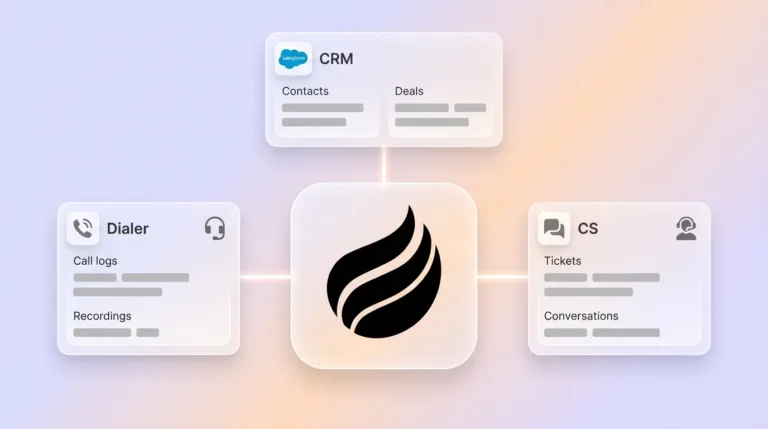
Coffee’s Companion App deploys through a simple authentication flow that connects the Coffee Agent to an existing Salesforce or HubSpot installation. After authentication, the agent syncs data, enriches records, and writes structured outputs such as call summaries, contact updates, activity logs, and pipeline stage changes directly back to the primary CRM. Coffee is built with a deep understanding of Salesforce and HubSpot architecture, including quotas, forecasting models, required fields, and custom objects, which separates it from newer alternatives that lack this integration depth. No data migration is required because the agent operates as an intelligent layer on top of the existing system of record.

What are Coffee’s security and data-handling policies?
Coffee is SOC 2 Type 2 and GDPR compliant. Customer data is never used to train public AI models, so proprietary deal information, contact data, and communication content remain within the customer’s environment. The agent applies role-based access control to scope data access by user function, and every agent action is logged for audit purposes. These measures address the most common obstacles to AI adoption in revenue operations, which are data security concerns and accuracy issues.
How long does implementation take for standalone vs. companion deployment?
The standalone CRM supports fast onboarding. Connecting Google Workspace or Microsoft 365 activates the agent immediately, and contact and company records begin populating from existing email and calendar data. For companion deployments on Salesforce or HubSpot, the authentication and field-mapping process remains straightforward, although teams with significant legacy data quality issues should allocate two to four weeks for a data cleanup pass before enabling automatic sync. This preparation period helps the agent produce accurate outputs from day one instead of inheriting legacy data errors.
What does Coffee cost, and what ROI evidence supports the investment?
Coffee uses seat-based pricing, where customers pay for human seats and the agent’s labor is included without metering on LLM usage or automated processes. ROI evidence from the broader AI-native CRM category is consistent, with autonomous CRM platforms saving each sales rep two to three hours daily by automating data entry, task creation, and routine follow-ups. Coffee’s benchmarks show the time savings described earlier, roughly 8–12 hours per rep weekly, come primarily from automatic contact creation, enrichment, and activity logging. McKinsey research indicates that AI-using sales teams report 50% more leads. For teams currently paying for separate enrichment tools, recording platforms, and forecasting add-ons, Coffee consolidates those costs into a single agent-led platform.
Conclusion: Why Agent-Led CRM Becomes the New Default
Legacy CRMs act as passive databases that produce bad data when they depend on humans to put good data in. The difference between autonomous and automated CRM is thinking versus doing, where automated CRM follows preset rules and autonomous CRM analyzes data to make intelligent decisions and adapt over time. Agent-led architectures remove the manual entry grind, deliver provenance-backed extraction from every email and transcript, and apply governance controls that make outputs trustworthy enough to use in real decisions.
Coffee is the only platform that delivers this across both deployment models, acting as the standalone system of record for growing teams and as the companion agent that finally makes Salesforce or HubSpot work the way they were supposed to. 83% of sales teams using AI grew revenue last year, compared to 66% of teams without AI. The gap between agent-led and legacy approaches continues to widen in 2026, and the cost of inaction shows up in hours lost per rep, per week, and per deal.