Written by: Doug Camplejohn, CEO & Co-Founder, Coffee | Last updated: July 10, 2026
Key Takeaways for Choosing a 2026 CRM
- Legacy CRMs act as passive databases that rely on manual data entry, while agent-based systems like Coffee actively capture and act on data automatically.
- Sales teams lose significant time to non-selling tasks, and agent CRMs reduce admin work by 8–12 hours per rep each week through automated logging and enrichment.
- Implementation and onboarding move dramatically faster with agent CRMs, often under 30 minutes, compared to the weeks or months required by legacy platforms.
- Agent architecture improves data quality, pipeline visibility, and forecast accuracy by eliminating human error and maintaining full interaction history.
- Ready to eliminate manual CRM work? See Coffee’s pricing and start your free trial to automate data entry from day one.
Why CRM Architecture Matters in 2026
The decision in 2026 centers on which CRM architecture you trust with your pipeline. Salesforce’s State of Sales data shows salespeople spend 60% of their time on non-selling tasks including manual data entry and handovers. That figure reflects a structural problem, not a discipline problem. This article compares legacy passive databases such as Salesforce and HubSpot with modern agent-based all-in-one CRM systems such as Coffee.
Seven Criteria to Judge All-in-One CRM Platforms
Seven criteria determine which architecture fits your team:
- Data quality and automation, meaning whether the system captures data automatically or relies on reps.
- Implementation effort, meaning how long before the system is operational and producing value.
- User adoption, meaning whether reps use it willingly or treat it as overhead.
- Integration requirements, meaning how many point solutions it replaces or requires.
- Pipeline visibility, meaning how accurate and current deal-stage data stays.
- Stack consolidation, meaning whether it reduces tool sprawl or adds to it.
- Ongoing administrative burden, meaning who maintains the system after go-live.
The comparison table below addresses these criteria through six key dimensions: architecture type, data entry method, AI capabilities, adoption rates, onboarding time, and deployment flexibility. These dimensions show how each platform performs against the evaluation framework in practice.
Legacy CRMs vs Agent CRM: Side-by-Side Comparison
| Criterion | Legacy CRMs | Agent CRM (Coffee) |
|---|---|---|
| Architecture | Passive system of record, stores data entered by humans | Active system of intelligence, agent captures, enriches, and acts autonomously |
| Data entry | Primarily manual, records often incomplete | Automated from email, calendar, and call transcripts, most required fields filled |
| 2026 AI capabilities | Bolt-on AI suggestions requiring human approval, AI sits outside the core data model | Agent embedded at architecture level, executes multi-step workflows end-to-end |
| Adoption rate | Only 26% of sales reps report “high” CRM adoption (full intended use), while overall organizational CRM adoption ranges from 68% to 91% depending on company size and study | The AI CRM market is growing at 34.6% CAGR versus 8.5% for traditional CRM |
| Onboarding time | Legacy CRMs such as SAP typically require 8–12 weeks of traditional training | Typical CRM adoption takes 3–6 months for initial or full usage rather than under 30 minutes |
| Deployment model | Single system of record only | Standalone CRM or Companion App layered on existing Salesforce or HubSpot |
Setup and Onboarding Speed with Coffee
Legacy CRM implementations are front-loaded with configuration work. Field mapping, workflow rules, and user training consume weeks before a single deal is logged accurately. No-code CRMs deliver up to a 70% reduction in implementation timelines compared to traditional platforms, yet even modern-UI legacy systems still require humans to populate the data model.
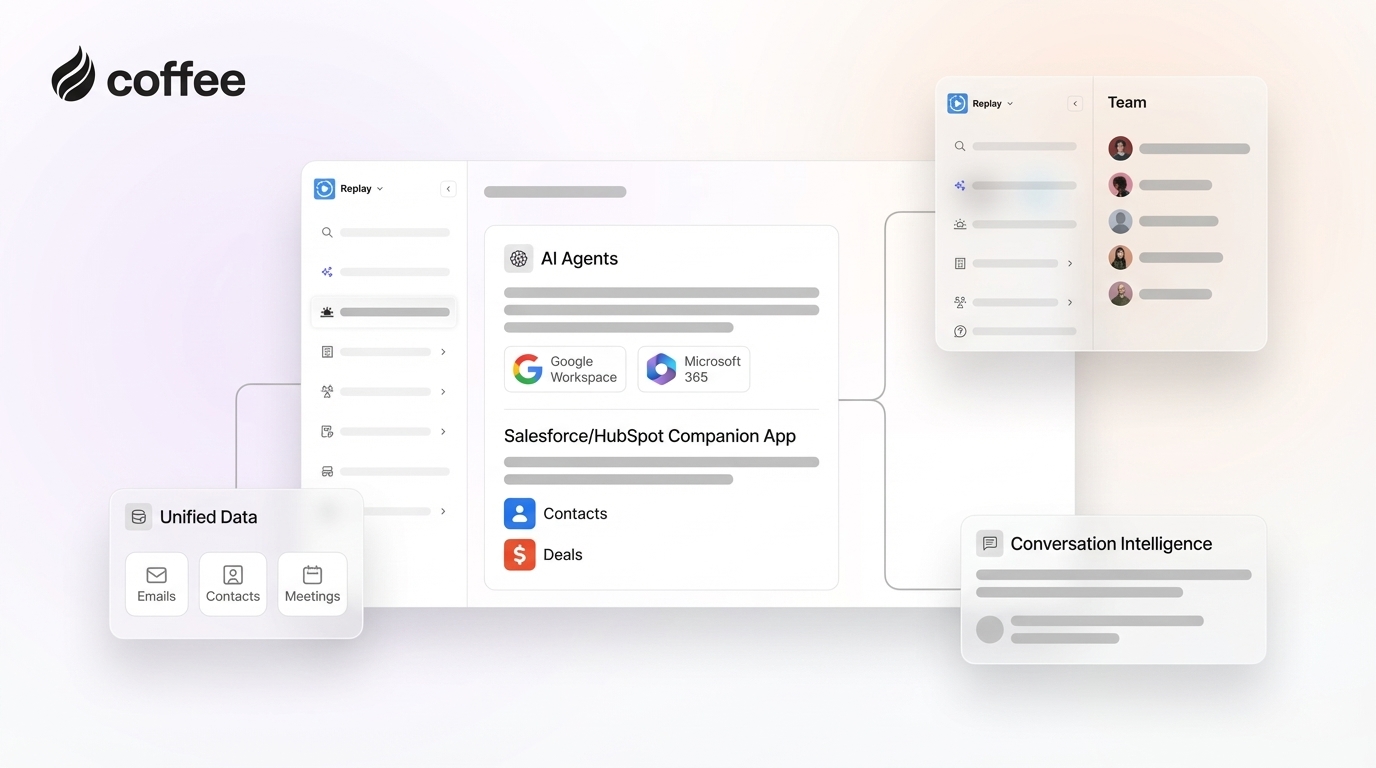
Coffee connects to Google Workspace or Microsoft 365 and begins auto-creating contacts, companies, and activity logs immediately. For teams already on Salesforce or HubSpot, the Companion App authenticates and starts writing enriched data back to the existing system of record without a migration project.
Data Capture and Ongoing Maintenance
The average sales rep spends an average of six hours a week on manual data entry, nearly 15% of their time. AI auto-logging of calls, emails, deal stages, and next steps typically saves 4–6 hours per rep per week on CRM admin alone, and Coffee’s agent delivers 8–12 hours per week in total administrative savings by also handling meeting briefings, follow-up drafts, and pipeline updates.
Manual data entry has an average error rate of 1–4% at the field level. That error rate compounds into dirty CRM data, which directly reduces close rates. Coffee’s agent ingests unstructured data such as email threads, call transcripts, and calendar events, then converts it into structured records, eliminating the source of that error rate.
Frontline Usability and Rep Experience
Many CRM users cite manual data entry as a key reason for low adoption. Legacy CRMs invert the value proposition, so reps serve the software rather than the software serving reps. The result is shadow CRMs such as spreadsheets and Notion docs that become the real workspace while the official CRM degrades.
Coffee’s agent removes the entry burden entirely. Reps receive a Today page with meeting briefings, attendee context, and prior deal history. After calls, the agent generates summaries, extracts next steps, and drafts follow-up emails in Gmail for one-click review. AI tools that sit inside existing workflows and produce outputs automatically earn long-term adoption, a standard that legacy CRMs consistently fail to meet.

Manager Visibility and Pipeline Intelligence
Validity’s 2025 State of CRM Data Management report found that 37% of CRM users lost revenue due to poor data quality. Pipeline reviews built on manually entered data become interrogation sessions, not strategic discussions.
Coffee’s Pipeline Compare feature visualizes week-over-week changes automatically, including progressed deals, stalled opportunities, and new additions, without CSV exports or manual prep. Because the agent captures every interaction into a built-in data warehouse, historical context is never lost when fields are updated, which is a structural flaw in relational-database CRMs. AI enhances overall sales forecast accuracy by 15–25% when the underlying data is clean. That data quality depends on how many systems must sync and reconcile information, which leads directly into integration complexity.
Integration Complexity and Stack Consolidation
A typical legacy CRM stack for a 10-person sales team includes the CRM itself, a data enrichment tool such as ZoomInfo or Apollo, a call recording tool such as Gong or Fathom, a sales engagement platform such as Outreach or SalesLoft, and a website visitor identification tool. As noted earlier, sales reps spend the majority of their time on non-selling work, and toggling between these fragmented tools makes that problem worse.
Coffee consolidates enrichment, meeting recording, pipeline intelligence, and visitor identification into one agent. The visitor identification pixel turns anonymous website traffic into named prospects with job titles, LinkedIn profiles, and company data, then surfaces Suggested Leads, which are the two or three specific individuals inside a visiting company who match your buyer persona and are ready for immediate outbound action. Current third-party integrations run via Zapier, with deeper native integrations on the roadmap.

Long-Term Flexibility and Administrative Burden
Legacy-dependent organizations allocate more than 70% of IT budgets to maintaining existing systems rather than improving them. That maintenance burden stems from architectural decisions made decades ago. Salesforce carries 25 years of accumulated technical debt, while HubSpot was built as a marketing tool with a CRM bolted on later. Neither platform was designed to ingest unstructured data as a first-class input, which now requires expensive workarounds.
The elevation of unstructured data such as emails, notes, and call transcripts to first-class status is the most fundamental architectural impact of AI on CRM in 2026. Coffee’s data warehouse architecture retains full interaction history, enabling the agent to surface context that relational-database CRMs discard on every field update. Coffee is SOC 2 Type 2 and GDPR compliant, and customer data is not used to train public models.
How AI Is Changing, Not Replacing, CRM
AI will transform rather than displace enterprise CRM platforms, with the AI-in-CRM segment growing at 28% CAGR. Gartner predicts that 40% of enterprise applications will include task-specific AI agents by 2026, up from less than 5% in 2025. The CRM category remains, while its architecture changes. Passive databases that require human maintenance are giving way to agent-based systems that maintain themselves and treat unstructured data as a primary input.
All-in-One CRM That Automates Data Entry
Reliable data entry automation requires more than a sync integration. It requires an agent that reads unstructured inputs such as email threads, calendar invites, and call transcripts, then converts them into structured CRM records without human review at each step. Manual CRM updates after a call take time, and AI auto-logging reduces that to a quick review and confirmation. Coffee’s agent removes even that review for routine activity logging and reserves human attention for strategic decisions.

Try Coffee’s agent on your pipeline and see automated data capture in action within minutes.
All-in-One CRM Without Manual Entry
Zero manual entry becomes realistic only when the CRM agent handles four data sources: email, calendar, call transcripts, and web enrichment. Coffee connects to Google Workspace or Microsoft 365 on authentication, scans existing email and calendar history to backfill contacts and companies, joins calls via its AI meeting bot, and enriches records with job titles, funding data, and LinkedIn profiles through licensed data partners. AI CRM agents can fill most required CRM fields. The remaining fields are populated through structured note-taking frameworks such as BANT, MEDDIC, or SPICED, which are applied automatically during call transcription.

All-in-One CRM for Small Business Teams
Manual data entry costs SMBs $36,000–$78,000 annually in labor and error correction. For a 1–20 person team, that cost is disproportionate. Legacy CRMs designed for enterprise scale, such as Salesforce and HubSpot, impose configuration complexity and ongoing admin overhead that small teams cannot absorb. Coffee’s Standalone CRM is built specifically for this profile, which includes founders and early sales hires who have outgrown spreadsheets but cannot afford to hire a RevOps administrator to maintain a legacy system. Seat-based pricing means the agent’s unlimited labor is included, with no metering on LLM usage or automation runs.
Best-Fit Use Cases for Coffee
Three scenarios map to distinct recommendations:
- Early-stage teams (1–20 employees): Coffee Standalone CRM. Connect Google Workspace or Microsoft 365, and the agent populates the CRM from existing email and calendar history within minutes. No configuration project and no RevOps hire are required.
- Growing sales orgs with no current CRM: Coffee Standalone CRM with Pipeline Compare for weekly reviews. The agent handles enrichment, meeting intelligence, and visitor identification in one platform, replacing four to five point solutions.
- Teams committed to Salesforce or HubSpot: Coffee Companion App. The agent authenticates, reads interaction data from email and calls, enriches records, and writes structured data back to the existing system of record. Low CRM adoption and poor data quality improve without a migration.
Operational and Long-Term Considerations
Change management for agent-based CRMs stays simpler than for legacy platforms because reps are asked to do less, not more. The primary adoption risk sits with manager behavior. If pipeline reviews continue to rely on manual rep updates rather than agent-generated data, the agent’s output goes unused. Process consistency requires that call recording stays enabled for every customer-facing meeting and that the agent’s follow-up drafts are reviewed rather than bypassed.
Scalability is a structural advantage of agent architecture. Traditional CRM scales poorly because admin workload increases with team and data growth, often leading to inconsistencies, while AI CRM reduces manual load and maintains data quality without added administrative burden. Coffee’s data warehouse retains full interaction history as the team grows, enabling the agent to surface increasingly precise pipeline intelligence over time.
Risks and Limitations of Agent CRMs
Agent-based CRMs carry their own risks that buyers should evaluate honestly:
- Hidden maintenance work: The agent requires clean email and calendar permissions. Reps who use personal email accounts for customer communication create blind spots the agent cannot fill.
- Incomplete automation: Agents built on dirty data route prospects incorrectly and damage the sales process. A backfill period is required for teams migrating from a legacy system with inconsistent historical data.
- Integration gaps: Coffee’s current third-party integrations run via Zapier. Teams with deep native integration requirements for tools outside Google Workspace, Microsoft 365, Zoom, Teams, or Meet should verify compatibility before committing.
- Process problems: Software architecture does not fix undefined sales processes. An agent that automates a broken qualification workflow automates the broken outcome. Sales methodology configuration, whether BANT, MEDDIC, or SPICED, must reflect how the team actually qualifies deals so automation reinforces the right behavior.
Decision Framework for Selecting Coffee
Match your constraints to the appropriate option:
- 1–20 employees, no existing CRM, want zero admin overhead: Coffee Standalone CRM.
- Growing sales org, frustrated with HubSpot or Pipedrive maintenance, not yet at enterprise scale: Coffee Standalone CRM or a migration from the legacy platform.
- Committed to Salesforce or HubSpot, low adoption, poor data quality: Coffee Companion App, with no migration required and the agent writing enriched data back to the existing system.
- Large enterprise with complex custom workflows, heavily regulated industry: Coffee is not the right fit, so evaluate Salesforce Agentforce or Oracle’s agent layer on existing infrastructure.
- Evaluating on price alone without a proof of concept: The only reliable evaluation method is a POC on actual CRM data to verify the agent adapts to your specific ICP and deal patterns.
Start your Coffee POC today, connect your workspace, and let the agent prove itself on real pipeline data.
Frequently Asked Questions
How long does it take to implement Coffee?
For the Standalone CRM, implementation begins the moment you authenticate Google Workspace or Microsoft 365. As described in the setup section, authentication triggers an immediate backfill of your existing communication history, with contacts and companies appearing within minutes. There is no multi-week configuration project. For the Companion App on Salesforce or HubSpot, a simple authentication allows the agent to begin reading interaction data and writing enriched records back to your existing system. Most teams are operational the same day they sign up.
Do I need to migrate my existing CRM data to use Coffee?
Teams that deploy the Companion App avoid migration. Coffee’s agent layers on top of your existing Salesforce or HubSpot instance, enriching and maintaining records without requiring a data migration. For teams moving to the Standalone CRM from a legacy platform, Coffee can import existing contact and company records. The agent then takes over ongoing data capture from email, calendar, and calls, so the historical import becomes a one-time event rather than an ongoing maintenance task.
How does Coffee handle data security and compliance?
Coffee is SOC 2 Type 2 and GDPR compliant. Customer data is not used to train public AI models. The agent processes email, calendar, and call data to populate CRM records, and all data handling operates under Coffee’s security framework. Teams in heavily regulated industries such as healthcare or finance with multi-year security review requirements should evaluate whether Coffee’s current compliance posture meets their specific obligations before committing.
What happens to data quality if reps stop using the system actively?
This behavior highlights the core architectural advantage of an agent-based CRM. Because Coffee captures data from email, calendar, and call recordings automatically, rep inactivity in the CRM interface does not degrade data quality. The agent logs interactions regardless of whether the rep manually updates a record. The primary dependency is that customer-facing communication runs through connected accounts such as Gmail, Outlook, Zoom, Teams, or Meet. Reps who conduct meetings or send emails through connected channels contribute to data quality passively, without any deliberate CRM action.
Can Coffee replace tools like ZoomInfo, Gong, and a separate forecasting tool?
For most SMB and mid-market teams, Coffee can replace several of these tools. Coffee’s agent handles contact and company enrichment through licensed data partners at a quality level comparable to standalone enrichment tools for the majority of use cases. The AI meeting bot records, transcribes, and summarizes calls, replacing standalone conversation intelligence tools. Pipeline Compare automates weekly pipeline reviews, replacing manual CSV exports and add-on forecasting tools. The visitor identification pixel with Suggested Leads replaces standalone website visitor identification tools. Teams with enterprise-scale enrichment requirements or specialized conversation intelligence workflows should evaluate coverage depth against their specific use case before consolidating.
Conclusion: Picking the Right All-in-One CRM
The all-in-one CRM category in 2026 splits along a single architectural line: passive databases that require human maintenance versus active agents that handle data capture, enrichment, and pipeline intelligence autonomously. Legacy CRMs were built for an era when reps typed notes after calls. Agent CRMs are built for an era when the software does that work instead.
For SMB founders, Heads of Sales, and RevOps leaders who have outgrown spreadsheets or feel exhausted by HubSpot and Salesforce maintenance, the decision stays straightforward. The decision is not whether to automate data entry, but which agent to trust with the job. Coffee is built specifically to answer that question, delivering good data in and good data out, with no humans acting as data entry clerks.
See how Coffee’s agent handles your pipeline, connect your workspace, and go live in under 30 minutes.