
The sales environment has shifted dramatically over the past decade, driven by technological advancements and changing customer expectations. Traditional methods of managing customer relationships, often reliant on manual processes and fragmented data, struggle to meet the demands of today’s fast-paced market. As businesses navigate this complex landscape, AI-powered tools have emerged as a critical component for staying competitive. Companies now prioritize data-driven insights over intuition, seeking ways to better understand communication patterns across customer touchpoints. This guide explores how AI-first Customer Relationship Management (CRM) systems address these challenges, offering sales leaders and executives a clear path to improve performance, enhance data accuracy, and build stronger customer connections. Amid this broader trend, platforms like Coffee stand out by automating data capture and delivering actionable intelligence, reflecting a significant shift in how sales strategies are crafted and executed.
Why Communication Patterns Matter for Sales Success
Sales strategies built on incomplete or outdated data no longer deliver results. Many traditional CRMs fail to keep pace with the speed and complexity of modern sales cycles, leaving teams with fragmented insights. Analyzing communication patterns through AI offers a way to bridge this gap, providing a deeper understanding of customer interactions.
AI-driven tools help sales teams uncover valuable insights from emails, calls, and meetings. By automating data collection, these platforms allow leaders to make informed decisions that boost effectiveness and responsiveness. This shift to a data-centric approach marks a fundamental change in sales operations.
Organizations that embrace AI for communication analysis can better anticipate customer needs. Quick access to insights means teams can adapt strategies in real time, creating a distinct edge over competitors still relying on manual processes.
Want to see how AI can enhance your sales outcomes? Request access to Coffee and explore its practical benefits for your team.
How AI CRMs Redefine Sales Effectiveness
The Evolution of CRM Technology
Older CRM systems often require significant manual input, which can slow down sales processes. AI-first CRMs tackle this issue by automatically pulling and organizing data from emails, calendars, and recorded meetings. This continuous, hands-free data capture ensures that customer information remains current and comprehensive.
Practical Advantages of AI CRM for Sales Teams
AI CRMs provide a complete picture of customer interactions by automating data collection and delivering insights. This reduces time spent on repetitive tasks, letting sales reps focus on building relationships. Key features include:
- Automatic creation of contacts from meeting attendees.
- Data enrichment to fill in gaps in customer profiles.
- Pipeline analysis to guide strategic decisions.
Platforms like Coffee integrate these capabilities, helping teams prioritize meaningful engagement over administrative work.
Inside Coffee’s AI-Driven CRM Platform
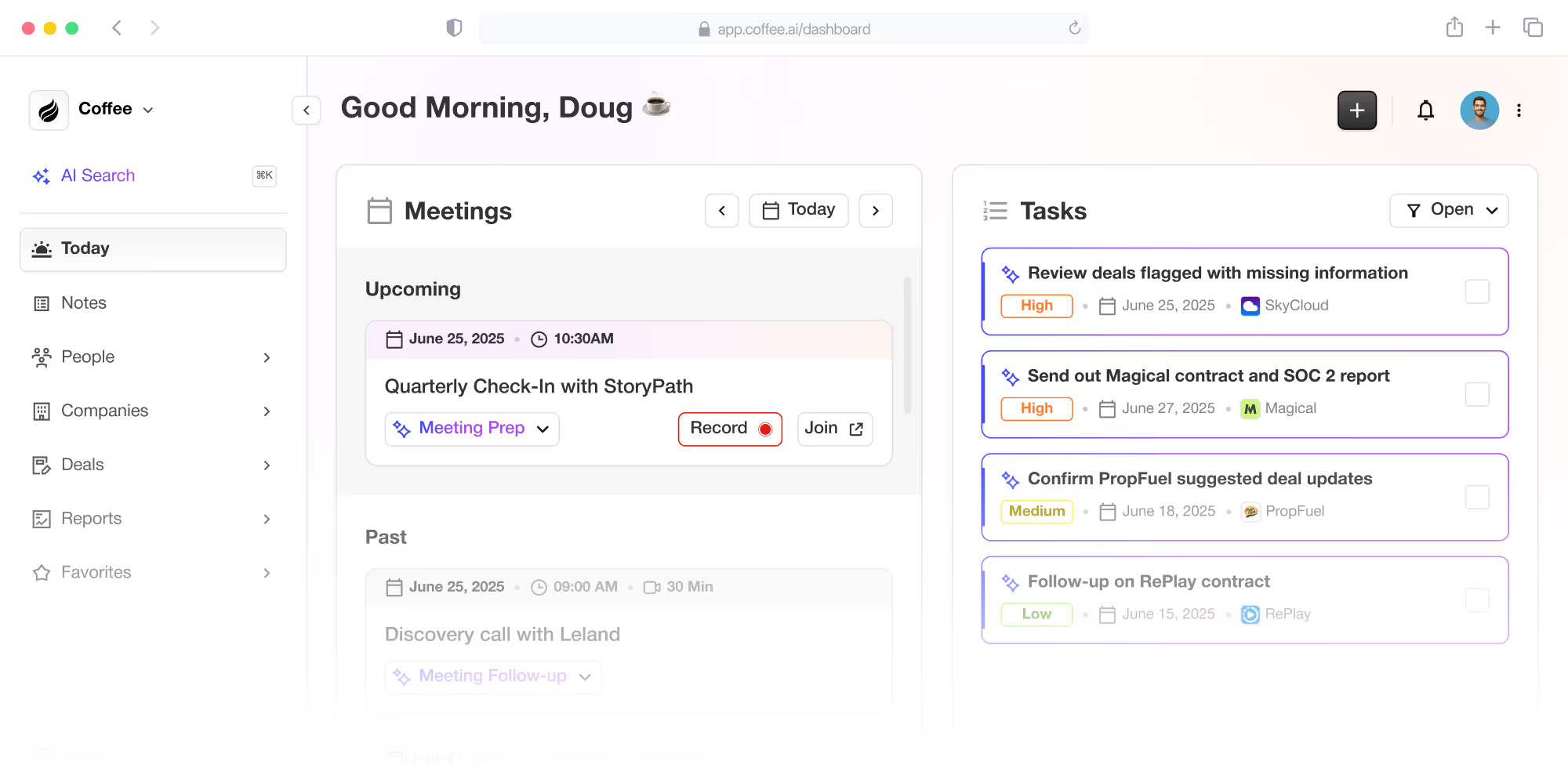
Coffee’s technology focuses on automating data capture with precision, ensuring sales teams work with reliable information. Its tools simplify meeting management by providing pre-call summaries and post-meeting recaps, along with automated follow-up emails. Integration with existing CRMs means deal records update automatically, tasks are created, and activities are logged without extra effort.
Additionally, Coffee offers automated note-taking, generating detailed summaries and actionable next steps from meetings. This streamlines daily workflows, allowing sales reps to focus on client needs rather than documentation.
Legacy CRMs vs. AI-First Solutions: A Side-by-Side Look
| Feature | Legacy CRM | Coffee (AI-First CRM) | Impact on Analysis |
|---|---|---|---|
| Data Capture | Relies heavily on manual entry | Automatic from emails, calls, and AI meeting tools | Comprehensive data versus incomplete records |
| Data Quality | Prone to errors from manual input | Consistent through automated processes | Accurate insights versus unreliable results |
This table highlights clear differences in functionality. Legacy systems often introduce inefficiencies through manual processes, while AI-first CRMs like Coffee capture detailed interaction data automatically, leading to more dependable insights for decision-making.
Key Benefits of Using Coffee for AI CRM
Boosting Sales Team Performance
AI tools save time by handling repetitive tasks, allowing sales reps to focus on high-impact activities. Coffee’s platform cuts down data entry time by an estimated 8 to 12 hours per week, freeing reps to build stronger client relationships.
Improving Customer Knowledge
With automated data collection, Coffee uncovers details about customers that manual methods often overlook. By combining information from various sources, sales teams can customize their approach to match specific client needs.
Reducing Costs Through Efficiency
Automation of data entry and workflows lowers operational expenses while maintaining data accuracy. Coffee combines multiple functions, such as CRM updates, call recording, and forecasting, into a single platform, simplifying tech stacks and cutting costs.
Enhancing Forecasting Accuracy
Coffee’s Pipeline Compare tool tracks changes in deal progress week by week. This clear view of pipeline health helps leaders allocate resources effectively and adjust strategies based on real-time data.
Ready to streamline your revenue operations? Request access to Coffee and see how its AI CRM tools can support your goals.
Steps to Implement AI CRM for Sales Success
Evaluating Your Organization’s Needs
Start by reviewing your current sales processes and data quality. Identify areas where manual tasks slow down operations or where insights are lacking. This assessment helps pinpoint how AI CRM can fill those gaps and improve outcomes.
Engaging the Right Teams
Implementation works best with support from sales leaders, operations teams, and IT staff. Sales leaders drive adoption, operations ensure system integration, and IT handles security and technical setup for a smooth rollout.
Addressing Team Hesitation
Some sales reps may view new tools skeptically, fearing oversight rather than support. Positioning AI CRM as a way to save time and improve results can help ease concerns and encourage use.
Tracking Progress and Impact
Measure success with specific metrics like time saved on data entry, improved data completeness, and sales growth. Regularly check adoption rates and user feedback to refine the implementation process.
Common Challenges in AI CRM Adoption
Overlooking Data Quality Issues
AI depends on clean, accurate data to deliver value. Implementing AI tools on top of flawed datasets leads to poor results. Prioritizing automated data capture and strict governance standards ensures better outcomes.
Misusing AI as an Add-On Feature
Treating AI as a minor enhancement to existing systems often creates inefficiencies. Platforms like Coffee are built with AI at their core, offering a more cohesive experience and stronger data integration.
Ignoring User Needs
Tools that don’t address sales reps’ daily challenges risk low adoption. Coffee focuses on practical features, like automated meeting prep and easy activity tracking, to ensure reps see immediate value.
Neglecting Data Security
Handling customer data requires strict compliance with regulations. Coffee meets SOC 2 Type 2 and GDPR standards, ensuring responsible data management and protecting sensitive information.
Answering Key Questions About Coffee’s AI CRM
How Does Coffee Ensure High-Quality Data Automation?
Coffee captures and organizes data from emails, calendars, and meetings automatically. This reduces errors from manual entry, maintaining consistency and accuracy across customer records.
What Are the Benefits of a Unified Sales Tech Stack with Coffee?
Combining tools into a single AI-driven platform like Coffee simplifies operations. It reduces costs, minimizes integration hassles, and provides clearer insights for better decision-making.
How Does Coffee Support Pipeline Analysis?
Coffee stores historical pipeline data, allowing users to track deal progress over time. Its Pipeline Compare feature highlights changes in momentum, helping leaders act quickly on opportunities or risks.
Curious about AI-driven CRM in action? Request access to Coffee and experience how it can enhance your sales processes.
Conclusion: Strengthen Your Sales Strategy with Coffee
AI is reshaping the future of sales by driving efficiency and deeper customer insights. Companies sticking to outdated CRM systems risk falling behind as others adopt advanced tools to optimize interactions and boost revenue.
As part of this growing trend, Coffee offers a robust AI-first CRM platform and a companion app for existing systems. Whether used as a standalone solution or to enhance current tools, Coffee automates comprehensive data capture and delivers insights that lead to measurable sales improvements.
Interested in upgrading your sales approach with AI? Request access to Coffee today and learn how its CRM capabilities can drive lasting growth for your team.