Written by: Doug Camplejohn, CEO & Co-Founder, Coffee
Key Takeaways for Your 2026 CRM Choice
- Attio CRM excels in customization through its relational database model but still relies on manual data maintenance, unlike fully autonomous options.
- Salesforce delivers enterprise scalability with heavy manual entry, while HubSpot offers marketing-led automation but lacks proactive agent capabilities.
- Coffee’s autonomous agent removes 71% of time usually wasted on data entry and enables instant productivity through AI-driven data capture and enrichment.
- Head-to-head comparisons show Coffee leading in setup speed (minutes vs. weeks), data automation (10/10 score), and total cost of ownership for SMBs.
- Explore Coffee’s agent-driven CRM for proactive automation that outperforms passive systems like Attio.
Attio CRM Key Features: 2026 Deep Dive
Attio CRM is built on a proprietary relational database model that enables high customization, allowing users to create custom objects such as “Projects,” “Contracts,” or “Candidates” and define relationships between them. This flexibility represents both Attio’s greatest strength and its core limitation, because users can model complex processes but must manually maintain data quality.
Attio’s Flexible Data Model and Custom Objects
Attio’s flexible data model uses Objects (standard: Companies, People, Deals, Workspaces, Users; custom: for example Invoices, Partners, Investor Updates), Records (instances of objects), and Attributes (data points), enabling modeling of business processes like B2B sales cycles, VC deal flow, recruiting, or PLG product usage syncs. This flexibility requires upfront planning and ongoing manual oversight to keep structures aligned with changing processes.
Automations and Workflows for Manual Burden Reduction
To reduce some of this manual burden, Attio provides workflow automation capabilities. Attio CRM supports trigger-based workflow automations, such as automatically creating “Customer Onboarding” records and tasks when a deal closes as “Closed Won,” notifying via Slack for new investors, or alerting on stalled deals after 14 days. These automations help with repetitive tasks but remain reactive instead of proactively managing data and next steps.
Enrichment and Sync Features for Cleaner Data
Attio’s Automated Relationship Intelligence automatically populates CRM records from connected email (Google or Microsoft) and calendar syncs, and enriches them with job titles, employee count, funding rounds, social profiles, and industry classifications from public sources. Attio’s auto-dedup and real-time sync features significantly reduce manual work, although teams still verify and structure relationships themselves.
Pricing Tiers and Record Limits in 2026
Attio CRM pricing as of early 2026 includes a Free tier for up to 3 users with core features, Plus tier around $36 per user per month with unlimited records and advanced automations, Pro tier around $86 per user per month with custom objects and advanced permissions, and a custom Enterprise tier with SAML SSO. This structure focuses on user count and capabilities instead of hard record caps.
The table below summarizes Attio’s core capabilities and highlights a consistent pattern: each feature reduces some manual work but still depends on ongoing human oversight and configuration.
| Feature | Description | Strengths | Limitations |
|---|---|---|---|
| Custom Objects | User-defined data structures | Unlimited flexibility | Requires manual planning |
| Auto-Enrichment | Contact/company data population | Reduces manual entry | Needs verification |
| No-Code Automations | Visual workflow builder | Easy to configure | Reactive, not proactive |
| Real-Time Syncs | Email/calendar integration | Live data updates | Manual relationship mapping |
| Pipeline Views | Kanban-style boards | Visual deal tracking | Static visualization |
| Calculated Attributes | Automated value computation | Dynamic insights | Limited AI reasoning |
| AI Attributes | Research agent insights | Structured data generation | Credit-based limitations |
| Call Intelligence | Meeting transcription | Conversation capture | Manual template setup |
Attio provides solid foundational features, yet its passive architecture still requires constant human intervention. Experience autonomous CRM that eliminates manual maintenance entirely with Coffee.

Attio vs. Salesforce, HubSpot & Coffee: Head-to-Head Matrix
The core difference between these platforms comes from their architectural philosophy. Attio’s automation maturity is growing, offering email sequences, integration blocks, and an automation credit system, but it still lags behind HubSpot’s extensive native automation with up to 300 fully customizable workflows. Coffee operates as an autonomous agent that removes manual data entry entirely and manages CRM operations end to end.
| Capability | Attio | Salesforce | HubSpot | Coffee |
|---|---|---|---|---|
| Auto Data Entry | Full sync and enrichment | Manual heavy | AI-powered across departments | Fully autonomous |
| Meeting Intelligence | Template-based | Third-party required | Basic transcription | AI briefings and summaries |
| Pipeline Insights | Static reports | Complex dashboards | Marketing metrics | Autonomous analysis |
| Integrations | API-first | Extensive but complex | 2000+ apps | Unified stack replacement |
| Setup Time | 1-4 weeks | 4-6 months | Quick AI setup | Minutes |
| Scalability | Custom objects | Enterprise grade | Multi-department | Agent-driven growth |
The capability comparison above shows functional differences across automation, intelligence, and setup effort. Quantifying these differences reveals Coffee’s most decisive advantages for teams focused on productivity and cost.
| Criteria | Attio | Salesforce | HubSpot | Coffee |
|---|---|---|---|---|
| Data Entry Automation (1-10) | 6 | 3 | 8 | 10 |
| Unstructured Data Handling | 4 | 2 | 8 | 9 |
| Stack Consolidation | 5 | 4 | 7 | 10 |
| TCO for SMBs | 7 | 2 | 5 | 9 |
| Adoption Rate | 8 | 4 | 6 | 10 |
Coffee.ai introduced an Intelligence layer that allows users to define and store deep context on business model, product specifics, ICP, and competitors for tailored AI suggestions and insights in February 2026. This capability reinforces the comparison data by showing how Coffee invests in autonomous intelligence instead of additional manual configuration.
Real-World Scenarios: Where Coffee Outperforms Attio
Small and midsize teams see the clearest contrast between Attio and Coffee. For teams with 1-20 reps, Coffee operates as a standalone CRM where the agent handles all data entry, enrichment, and analysis automatically. Teams achieve full productivity on Attio in a median of 12 days compared to HubSpot’s 6-8 weeks, while Coffee enables productivity within minutes of connection to Google Workspace or Microsoft 365.
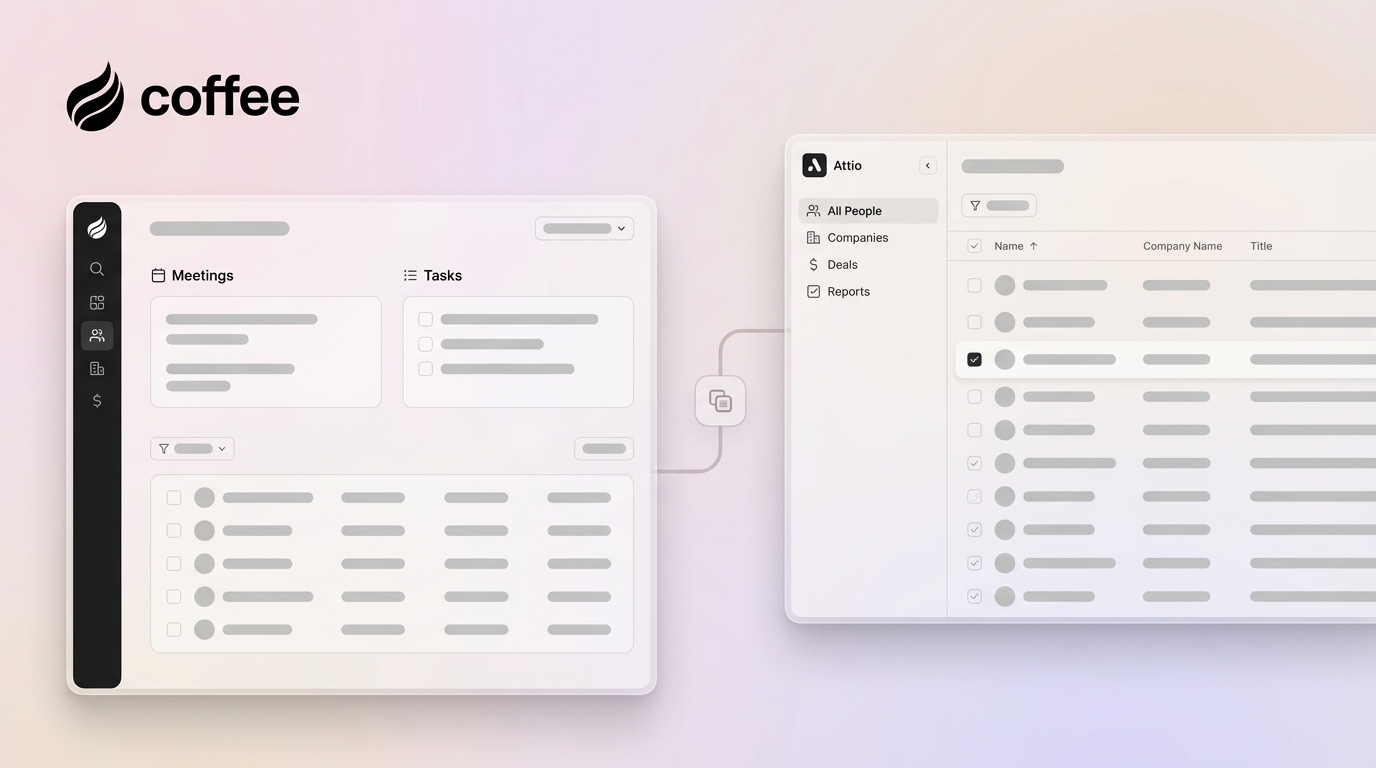
Mid-market teams can deploy Coffee as a companion to existing Salesforce or HubSpot instances, where the agent ensures “good data in” while the legacy system remains the system of record. This companion approach proves especially valuable for revenue operations. Coffee.ai’s Stripe integration, launched in January 2026, automatically imports customers and companies, enriches them, and adds paid invoices to deals as Closed Won, which removes manual revenue tracking that usually slows dual-system deployments.

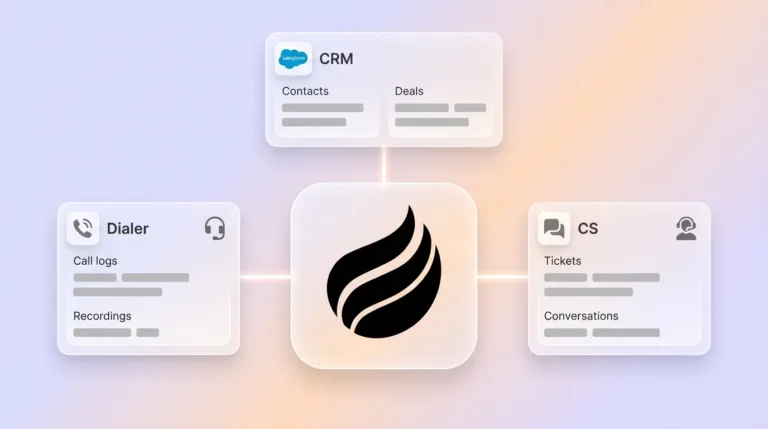
Coffee also changes how teams manage relationships and meetings. Unlike Attio’s manual relationship mapping, Coffee’s agent automatically unifies data from emails, calendars, and transcripts, creating a complete activity record without human effort. Building on this unified data foundation, Coffee.ai launched Custom Meeting Briefings and Summaries in February 2026, enabling users to define exact formats and focuses like high-level executive summaries or granular technical breakdowns. The combination of automatic data unification and intelligent summarization saves 8-12 hours per week per rep and boosts selling time to more than 65 percent.

Cost comparisons highlight the long-term impact of these differences. The 2026 total cost of ownership comparison reveals Attio’s hidden complexity costs. While Attio’s 3-year TCO is approximately $1,200 per user compared to Salesforce’s $8,150, Coffee removes the need for ongoing administration through agent automation. See how Coffee’s agent automation reduces your total cost of ownership.
Attio CRM FAQ (2026 Updates)
What is Attio’s record limit?
Attio offers unlimited records on its Plus plan starting at $36 per user per month. The Free tier supports up to 3 users with core features, while the Pro tier at $86 per user per month includes custom objects and advanced permissions. Unlike traditional CRMs with hard record caps, Attio’s pricing scales with team size instead of data volume.
How does Attio compare to Coffee for automation?
Attio provides trigger-based workflow automations and email sequences through a visual builder, but it requires manual configuration and ongoing maintenance. Coffee operates as an autonomous agent that handles data entry, enrichment, and analysis automatically without human intervention. Attio automates specific tasks, while Coffee automates the entire CRM workflow from data capture through insight generation.
Does Attio handle unstructured data effectively?
Attio processes unstructured data through its AI Attributes and Call Intelligence features, along with auto-processing of email and calendar data. These capabilities handle emails, transcripts, and conversational context with credit-based usage. Coffee’s agent architecture provides broader unstructured data unification across channels and uses that context for continuous decision support.
What is Attio’s pricing structure for 2026?
Attio’s 2026 pricing structure follows the tiered model detailed earlier, with plans ranging from a free option for small teams to enterprise-grade features. See the pricing breakdown in the features section above for specific per-user costs and capability differences across tiers.
How does Attio’s implementation time compare to other CRMs?
Attio’s implementation falls in the middle of the spectrum discussed earlier, faster than many enterprise platforms but requiring more setup than agent-based alternatives. Coffee enables productivity within minutes of connecting to existing email and calendar systems, because the agent immediately begins autonomous data capture and enrichment without manual configuration or training.
Conclusion: Framing Your 2026 CRM Decision
Your choice between Attio, Salesforce, HubSpot, and Coffee depends on how much manual work your team accepts versus how much autonomous operation you want. Attio offers strong flexibility for teams ready to invest in upfront configuration and ongoing maintenance. Salesforce provides enterprise-grade breadth with matching complexity. HubSpot focuses on marketing-sales-service integration through its unified Data Hub and Smart CRM with quick AI-powered setup.
Coffee represents a different path for CRM, centered on an autonomous agent that removes manual data entry while delivering stronger insights through a “good data in, good data out” architecture. For SMBs seeking modern automation without legacy bloat, Coffee’s agent-led approach delivers immediate productivity gains and supports long-term scalability.
As the CRM landscape shifts toward agent-based automation, teams face a clear choice between passive databases and proactive agents. Make the shift to proactive agent automation with Coffee and transform your team’s productivity.