Written by: Doug Camplejohn, CEO & Co-Founder, Coffee | Last updated: September 15, 2026
Key Takeaways For AI-First Teams
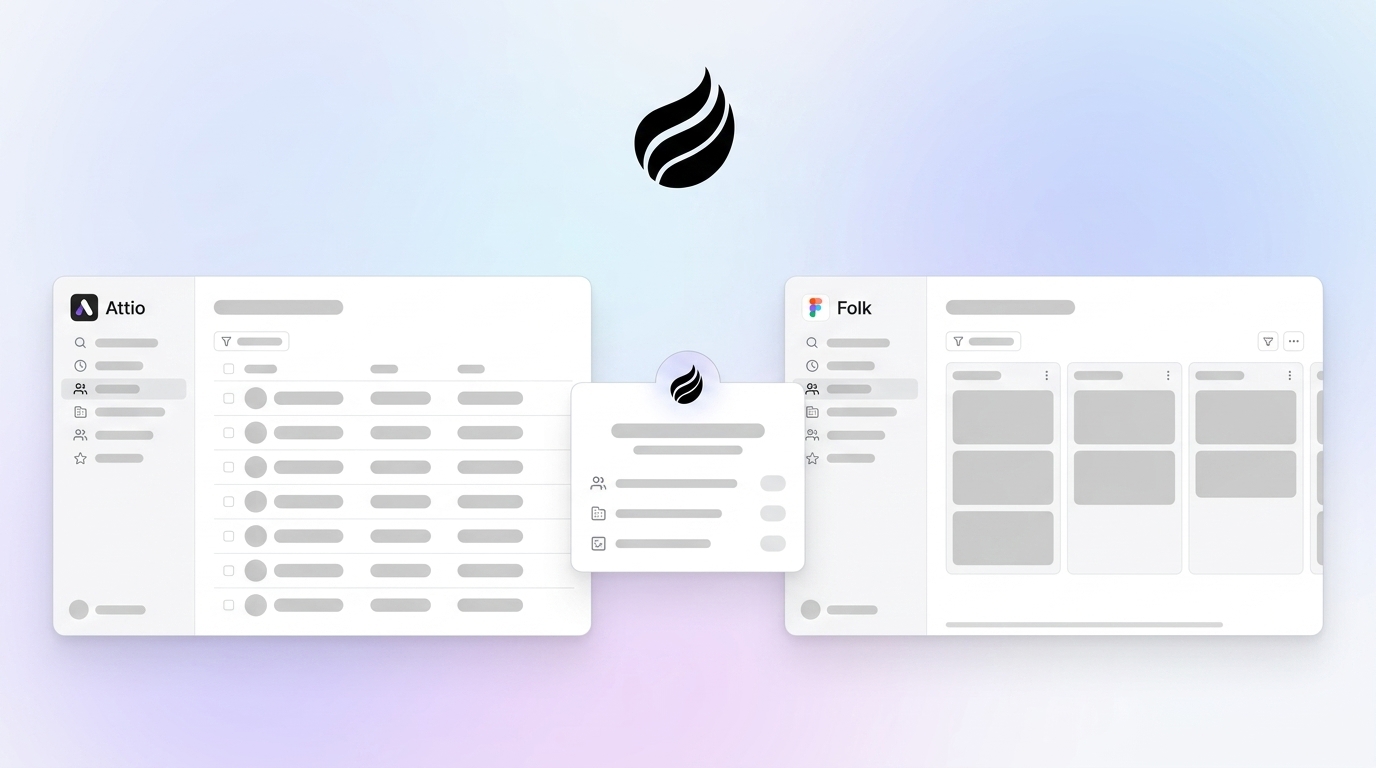
AI-first startups choose between Attio’s flexible data model, Folk’s lightweight relationship workspace, and Coffee’s fully agentic CRM.
- Attio suits data-heavy teams that need a relational database with custom objects, while Folk targets small teams seeking a lightweight relationship workspace that can launch quickly.
- Both Attio and Folk still rely on humans to maintain records, which keeps sales teams spending only about 35% of their time actually selling.
- Attio’s relational model rewards technical founders who will build on the API and model product usage data, but its Pro tier at $79/seat/month is required to unlock Call Intelligence and Sequences.
- Folk’s shallow data model and folkX Chrome extension make it ideal for founder-led networking and warm-intro motions, but it hits a ceiling earlier for teams with complex data relationships.
- AI-first startups that want to remove manual data entry from day one can see how Coffee’s agentic CRM works and compare it against assisted tools.
How AI-First Startups Change The CRM Decision
AI-first startups usually have product usage signals, PLG motions, technical founders who will actually use an API, and sales cycles that involve developer evaluation. This profile changes the Attio vs Folk decision because these teams care deeply about how the CRM handles unstructured data such as call transcripts, product events, and email threads. They also feel the pain when a tool depends on humans to keep records clean.
For a twenty-person company with no operations function, the CRM is populated on Friday without anyone having spent Friday populating it. That is the standard an AI-first startup should hold any CRM to, and neither Attio nor Folk meets it out of the box.
The failure mode runs in the other direction as well. The biggest CRM mistake founders make is making the system too complex too early. When updating the CRM feels like admin work, the team stops using it and the data becomes unreliable. For AI-first startups, that failure arrives faster because the team already context-switches between product, engineering, and sales.
Setup And Design: Attio Vs Folk For A Technical Founder
Attio is built on a proprietary relational database model where relationships between objects are first-class, including one-to-one, one-to-many, and many-to-many. Teams define custom objects, attributes, and relationship types from the ground up. Users describe this as closer to designing a schema in Postgres than configuring a traditional CRM. Attio’s typical onboarding time is 1–3 days for most teams, and a workspace admin can apply schema changes in real time with no deployment pipeline.
Folk uses a deliberately shallow data model of people, companies, groups, and pipelines, allowing a two-person agency to be live in an afternoon. Its Magic Fields are AI-generated columns defined by plain-English prompts that generate values across all records using enriched contact data and synced interaction history. Folk does not allow users to create custom object types or model relationships between entities the way Attio does.
The practical tradeoff is clear. A technical founder who will build on the API and model product usage data usually finds Attio’s flexibility worth the setup investment. The data model is the only decision in Attio that is expensive to change later. If the team gets it wrong, they spend the next year working around it. Folk’s setup is faster but hits a ceiling earlier for teams with complex data relationships.
Pricing And Team Size: Attio Vs Folk
The table below compares list pricing across both tools’ tiers. Watch how the features AI-first startups actually buy, such as Call Intelligence, sequences, and API access, sit one tier above the advertised entry price in both products.
| Plan | Attio (Annual Billing) | Folk (Annual Billing) | Key Limit |
|---|---|---|---|
| Entry / Free | $0 (up to 3 seats) | No free plan; 14-day trial only | Attio free: 50,000 records, 100 AI credits/seat/month |
| Standard / Plus | $35/seat/month (up to 10 seats) | $24/user/month | Folk Standard: email campaigns capped at 2,000 sends/user/month; no sequences |
| Pro / Premium | $79/seat/month (unlimited seats) | $48/user/month | Attio Pro unlocks Call Intelligence and Sequences; Folk Premium unlocks API and sequences |
Two pricing mechanics matter for AI-first startups. First, Attio gates Call Intelligence and Sequences, the features most sales teams buy an AI CRM for, behind the Pro tier at $79/seat/month on annual billing. Buyers comparing Attio’s sticker price against other vendors should model Pro, not Plus. Second, Folk’s entry price of $30/member/month rises in practice because Deals, sequences, dashboards, and API access sit on the $60 Premium plan. Teams should model seat count against Premium rather than Standard.
Headline pricing also hides long-term data costs. B2B contact data decays at roughly 22.5% annually. Poor data quality costs organizations an average of $12.9 million annually once wasted campaign spend, lost sales time, and bad decisions are counted. Manual admin time becomes a real cost that never appears on a software invoice.
AI And Automation: What Attio And Folk Actually Do
Attio’s AI capabilities live inside the data model through AI Attributes, which are record-level fields that run an AI model to research, classify, summarize, or generate content automatically, plus a Research Agent and Call Intelligence that records, transcribes, and summarizes meetings into the relevant deal. Attio also offers a hosted MCP server with more than thirty tools, letting Claude or ChatGPT search records and log notes directly.
Folk’s AI features, Magic Fields and AI Assistants, are metered through workspace-wide credit caps: the Standard plan includes 2,000 Magic Field credits and 500 enrichment credits per month. Folk’s folkX Chrome extension captures contacts from LinkedIn in a single click, and its relationship intelligence surfaces the strongest connection to a given contact across the team.
Both tools assist when a human asks for help. On autonomy, Attio assists on request, and the daily motion of updating records and driving follow-ups stays manual. Folk’s Magic Fields generate values when prompted, but people still own the underlying data hygiene.
Do Attio And Folk Automate Data Entry?
Attio and Folk reduce some manual work, but they do not automate data entry in a fully autonomous way. Neither Attio nor Folk ships enterprise-grade, real-time, bi-directional sync on its own. Teams that rely solely on these tools for frequent updates across multiple systems can expect data inconsistencies and rising manual intervention. Both tools reduce manual entry through email and calendar sync or enrichment, which helps but does not remove the workload.
Attio and Folk remain primarily human-operated interfaces even when they add AI assistance. A person still opens the app, reads the summary, and clicks the buttons. The agentic alternative looks different. Automatic contact and company creation starts from Google Workspace the moment a new email thread begins. AI meeting briefings appear before every call. Post-call summaries and follow-up drafts generate without rep input. Pipeline Compare visualizes week-over-week changes without a manual CSV export.

Coffee delivers this agentic pattern. The Coffee Agent connects to Google Workspace or Microsoft 365 and immediately scans emails and calendars to populate the CRM with people, organizations, and activity history. No one on the team acts as a data entry clerk. Put the Coffee Agent to work and shift that time back to selling.

What Breaks At Each Headcount Stage
That gap between assisted and agentic CRMs shows up differently at each headcount stage. Here is where Attio and Folk start to strain.
Under 10 people: Founder-led sales works in either tool. Folk’s shallow data model is fast to set up and sufficient for managing warm relationships and investor pipelines. Attio’s free tier covers up to three seats with 50,000 records. The manual data entry burden stays manageable because the founder handles it and the pipeline remains small enough to hold in memory.
10–25 people: The first sales hire arrives and immediately asks for automation that Attio and Folk do not provide without human input. Data hygiene becomes a RevOps problem. When updating the CRM feels like admin work, the team stops using it and the data becomes unreliable. Attio’s Plus plan caps at 10 seats, which pushes growing teams to Pro at $79/seat/month to unlock Call Intelligence and Sequences. Folk’s enrichment credits, 500 per workspace per month on Standard, are shared across the entire workspace, so a team of five salespeople enriching contacts daily can exhaust the quota quickly.
25–50 people: Reporting, forecasting, and integration requirements expose the limits of both tools. Attio’s reporting, while improved, still lags Salesforce and HubSpot in filtering depth, drill-down, and scheduled report delivery. Folk’s reporting is limited to basic dashboards on Premium and lacks cohort analysis, deal-velocity modeling, and forecast tooling. At this stage, switching CRMs carries real cost. For a mid-size team of 10–50 users with moderate complexity, all-in migration costs typically total $40,000–$150,000, including productivity losses.
Founder-Led Sales Vs PLG Motion
Folk fits founder-led networking, LinkedIn outreach, and warm intros especially well. Its folkX Chrome extension, WhatsApp sync, and relationship intelligence features support motions where deals start with a LinkedIn connection or a mutual introduction. Folk is best suited for small relationship-driven teams, such as boutique agencies, recruiters, founders running fundraising or partnership pipelines, and consultants, where contacts arrive from LinkedIn or email rather than product signups.
Attio fits usage-signal-driven pipelines and teams that want to model product data. Attio has become the CRM of choice for AI-native companies including Lovable, Granola, Modal, and Replicate. Its custom objects, API-first architecture, and ability to ingest Segment or Stripe events make it a natural fit for a PLG motion where product usage signals drive outreach.
The AI-first startup profile that matches Folk is a two-to-five person team doing founder-led enterprise sales, where every deal starts with a warm intro and the pipeline is measured in dozens of relationships. The profile that matches Attio is a technical team with a PLG motion, a first sales hire who will build on the API, and a need to model product data alongside contact records.
The Agentic CRM Alternative: Coffee
Coffee is the agentic CRM built for AI-first startups. It operates in two models: a Standalone AI-First CRM for 1–20 person teams that have outgrown spreadsheets but find manual CRMs to be expensive chores, and a Companion App for teams already on Salesforce or HubSpot that want the Coffee Agent to handle data capture without switching their system of record.

The Coffee Agent’s concrete capabilities address the exact gap Attio and Folk leave open:
- Automatic Contact And Company Creation: Upon connection to Google Workspace or Microsoft 365, the agent scans emails and calendars to populate the CRM with people and organizations, with no manual entry required.
- AI Meeting Briefings And Summaries: The agent prepares a “Today” page before every call, joins the meeting to record and transcribe, then generates summaries, next steps, and follow-up email drafts post-call, structured to BANT, MEDDIC, or SPICED if needed.
- Pipeline Compare: The agent visualizes week-over-week pipeline changes, highlighting progressed deals, stalled opportunities, and new additions. This replaces manual CSV exports and turns pipeline reviews into strategic discussions.
- Lead Finder: Natural-language search builds targeted prospect lists from Coffee’s own database, acting as a built-in alternative to ZoomInfo or Apollo.io.
- Visitor Identification: A single tracking pixel turns anonymous website traffic into named, qualified prospects with enriched profiles, surfacing the specific individuals inside a visiting company who match the buyer persona.
- Campaigns: Multi-step email sequences run natively from the rep’s own connected mailbox, with stop-on-reply enabled by default so no automated email fires after a real conversation starts.
Agentic CRM addresses manual data entry directly. Reps spend significant time logging calls, updating records, and moving data between systems, and agentic architectures automate routine actions like logging calls, updating records after meetings, and routing tickets. Coffee follows this architecture from day one and treats automation as the core, not an add-on to a passive database.

Start with Coffee free and let the agent handle data entry, meeting summaries, and pipeline intelligence so your team can sell instead of type.
What To Do Next: Recommendation By Stage
The right CRM depends on stage, GTM motion, and tolerance for manual data entry.
- Pre-seed, Under 10 People, Founder-Led Sales: Folk may be sufficient. Its shallow data model, LinkedIn extension, and relationship intelligence cover the warm-intro motion without requiring schema design. Expect to hit its ceiling when the first sales hire arrives.
- 10–25 Person AI-First Startup With PLG And A First Sales Hire: Attio’s relational data model fits better if the team will build on the API and model product usage data. Budget for Pro at $79/seat/month to access Call Intelligence and Sequences, and invest in schema design upfront because that decision is expensive to change later.
- Any Stage Where Manual Data Entry Is The Constraint: Coffee is the recommended path. The Coffee Agent automates contact creation, meeting summaries, and pipeline intelligence from day one, saving reps 8–12 hours per week and keeping the CRM aligned with reality without human effort.
For teams evaluating the agentic option, explore Coffee’s pricing and plans to find the right fit for your stage.
Frequently Asked Questions
What Is The Best CRM For An AI Agency?
The best CRM for an AI agency depends on team size and sales motion. Key considerations:
- Under 10 People, Relationship-Driven: Folk covers LinkedIn outreach, warm intros, and investor or client pipelines with minimal setup.
- 10–25 People, Technical Team With API Needs: Attio’s relational data model and API-first architecture fit agencies building custom workflows or modeling client data.
- Any Size, Data Entry As The Bottleneck: Coffee’s agentic CRM automates contact creation, meeting summaries, and pipeline tracking from Google Workspace or Microsoft 365, which removes the manual entry burden that consumes most of a sales rep’s non-selling time.
- Already On Salesforce Or HubSpot: Coffee’s Companion App deploys the Coffee Agent as an intelligent layer on top of the existing system and handles data capture without a platform switch.
Is AI Going To Replace CRM?
AI is changing how teams use CRMs rather than removing CRMs entirely. Traditional CRMs act as passive databases that rely on humans to enter and maintain data. Agentic CRMs deploy AI agents to handle data capture, enrichment, meeting summaries, and pipeline updates autonomously. The system of record remains, and the human data entry role shifts to an agent. Salesforce, HubSpot, and newer vendors including Coffee are all moving toward this architecture, with the key difference being whether AI is bolted onto a legacy data model or built into the core from the start.
Which CRM Is Beginner Friendly?
Folk is the most beginner-friendly option among modern startup CRMs. Its spreadsheet-style interface, pre-built pipeline templates, and folkX Chrome extension allow a small team to be operational in an afternoon with no schema design required. Attio has a steeper learning curve. Its relational data model rewards teams that invest in upfront architecture but can feel complex for non-technical first-time CRM users. Coffee is beginner-friendly in a different way because the agent handles setup tasks like contact creation and activity logging automatically, so the team starts with a populated CRM rather than an empty one.
What Are The Downsides Of Using A CRM?
The primary downsides of using a CRM are:
- Manual Data Entry Burden: Most CRMs require humans to log calls, update records, and maintain data hygiene, which competes directly with selling time.
- Low Adoption: When updating the CRM feels like admin work, reps stop doing it, data quality degrades, and the system becomes unreliable for forecasting.
- Complexity At Scale: CRMs that are easy to set up often hit ceilings at 10–25 users, while CRMs with the depth to scale often require significant upfront configuration investment.
- Switching Costs: Migrating between CRM platforms carries real cost in time, money, and productivity loss, which makes the initial choice consequential.
- Data Decay: The 22.5% annual decay rate mentioned earlier means a CRM that starts clean loses nearly one in four records within 12 months without continuous enrichment.
Can Attio Or Folk Sync With My Product Analytics Stack?
Attio connects more naturally to product analytics stacks than Folk. Its API-first design and support for custom objects make it easier to ingest events from tools like Segment or Stripe and tie them to accounts and opportunities. Folk focuses on relationship data and LinkedIn-driven workflows, so teams that rely heavily on product usage signals often outgrow its shallow model sooner.