Written by: Doug Camplejohn, CEO & Co-Founder, Coffee | Last updated: August 16, 2026
Key Takeaways for Attio, HubSpot, and Coffee
- Both Attio and HubSpot Sales Hub require manual data entry, which consumes rep time and creates ongoing data quality challenges.
- Attio offers flexible schema and a modern UI but demands technical configuration and struggles with adoption among non-technical users.
- HubSpot provides mature reporting dashboards and broad integrations, yet still depends on reps for accurate data input and faces API scaling limits.
- Coffee’s agent-led model autonomously captures emails, calls, and calendar data, removing manual entry while working as a standalone CRM or companion app.
- Teams that want to remove the data-entry burden should see how Coffee’s agent guarantees accurate pipeline intelligence without manual updates.
How This Comparison Evaluates Attio, HubSpot, and Coffee
Each criterion below uses a consistent definition so you can compare all three platforms fairly.
- Data quality and maintenance: How accurately and completely the platform captures customer interactions without human intervention.
- Implementation effort: Time, cost, and complexity required to reach operational go-live for a 25–100 user team.
- User adoption: The degree to which reps integrate the platform into daily workflows without friction or resistance.
- Integration complexity: Breadth of native connectors and the cost of maintaining third-party integrations over time.
- Reporting visibility: Depth and reliability of pipeline, forecast, and activity reporting available to managers.
- Automation depth: Ability to automate multi-step workflows across objects without manual triggers or workarounds.
- Scalability: Performance and governance stability as data volume, user count, and process complexity grow.
- Ongoing administrative burden: Dedicated admin capacity required to keep the platform healthy and current.
Side-by-Side Comparison: Attio vs HubSpot Sales Hub vs Coffee in 2026
| Criteria | Attio | HubSpot Sales Hub | Coffee |
|---|---|---|---|
| Data quality and maintenance | Manual entry required, automatic enrichment from web sources but no autonomous logging of calls or emails | Manual entry required, email-only deduplication by default allows duplicate records across sequences | Agent auto-creates contacts, logs activities, and enriches records from emails, calendars, and call transcripts without human input |
| Implementation effort | Flexible schema requires technical configuration, with a steeper setup for non-technical operators | 8–16 weeks for mid-market B2B, with longer timelines common without a clean database or pre-aligned lifecycle stages | Connects via Google Workspace or Microsoft 365 authentication, and the agent begins populating records immediately |
| User adoption | Notion-like UI appeals to technical users, and a steep learning curve for non-technical team members even after technical setup | Interface feels clunky for teams under 20–30 users, and numerous properties and fields create friction in daily deal updates | Agent handles busywork so reps interact with a pre-populated system rather than a blank form |
| Integration complexity | Native integrations with tools like Segment, Slack (via Pylon), Linear, Productboard, PandaDoc, Clay, Google Meet, Zoom, and Microsoft Teams, plus Zapier and custom API or SDK integrations | Broad native ecosystem, but a burst API limit of 100–190+ requests per 10 seconds is the first ceiling hit by integrations at scale | Currently integrates via Zapier and acts as a Companion App on top of existing HubSpot or Salesforce instances, preserving existing integration investments |
| Reporting visibility | Reporting capabilities are more limited than enterprise competitors, and flexible but require manual configuration | Ready-to-use dashboards for pipeline, forecast, sales activity, and lead sources, with a report builder that cross-references all objects | Pipeline Compare feature visualizes week-over-week deal changes automatically, and accurate output is guaranteed by agent-captured input |
| Automation depth | Automations rely on manual workflow builders and are not AI-first despite marketing claims | Native automation struggles with complex branching and multi-condition routing, and contacts can re-enter workflows and create race conditions | Agent automates meeting briefings, post-call summaries, follow-up drafts, activity logging, and multi-step email sequences natively |
| Scalability | Flexible data model scales well for SaaS product data, but no server-side programming language or app marketplace equivalent to enterprise CRMs | API limits cause critical automations to stop at high data volumes, while the structured object model reduces long-term admin burden as sales ops scale | Designed for small to mid-market teams and not suited for large enterprises with complex custom workflows |
| Ongoing administrative burden | Custom schema requires ongoing admin discipline, and over-customization creates a scalability trap when accumulated fields exceed admin capacity | Dedicated CRM admin requirements range from 0.5 to 2+ FTEs depending on complexity, and a full customization setup typically requires an additional $20,000–$40,000 consultant fee | Agent handles data maintenance autonomously, so no dedicated CRM admin is required for data hygiene |
Eliminate the administrative overhead that both Attio and HubSpot require with Coffee’s agent-led approach.
Setup and Onboarding for Attio and HubSpot in 2026
A realistic HubSpot CRM implementation for a mid-market B2B company runs 8–16 weeks, broken into discovery and revenue model mapping, core configuration, Marketing Hub sync, integrations, and validation. Alignment delays on lifecycle stages and MQL criteria commonly cause timeline slippage.
Attio’s flexible schema shortens initial configuration for technical operators but introduces a different cost. Every custom object, attribute, and relationship type must be designed before the system can be used reliably. Non-technical team members frequently find Attio overwhelming even after a technical user has completed the setup.
Data migration in mid-market CRM implementations often takes longer than planned because dead data, field mapping, and edge cases are not scoped in advance. When additional integrations must be configured during this process, the timeline extends further. These delays compound into a temporary productivity slowdown for sales reps post-launch, regardless of which platform is chosen.
Data Capture and Quality in Attio and HubSpot G2 Reviews
Seventy-three percent of sales ops time goes to non-sales functions such as data cleanup and report generation, and more than 70% of field reps spend five or more hours per week on CRM entry alone. Both Attio and HubSpot Sales Hub rely on reps to supply this input.
Attio provides automatic enrichment from web sources and a flexible data model that can ingest product usage data without custom code. However, Attio was built in 2019 and is not an AI-first CRM, so configuration and automations still rely on manual workflow builders. Call transcripts, email threads, and unstructured interaction data require manual processing or third-party tools.
HubSpot Sales Hub’s structured object model creates a complete chronological interaction timeline, but HubSpot defaults to email-only deduplication, allowing a single prospect to exist as multiple records via personal versus work email and become enrolled in contradictory sequences simultaneously. Ninety-nine percent of RevOps respondents in one survey struggle with technical data issues, and 71% say poor data hurts their go-to-market performance.
AI-powered CRM automation can substantially reduce manual CRM updates and rep administrative tasks. Neither Attio nor HubSpot delivers this outcome natively in 2026.

Usability and Manager Visibility in Daily CRM Use
Even when teams enforce data discipline manually, usability determines whether reps maintain that discipline over time. Attio’s Notion-like interface appeals to technical founders and operators who prefer to design their own data structures. It works best for technical founders or operators comfortable structuring data and building workflows themselves, but it creates adoption friction for sales reps who are not data architects.
HubSpot provides ready-to-use dashboards for pipeline, forecast, sales activity, and lead sources, with a report builder that cross-references data from all objects for detailed analyses such as conversion rates by stage and marketing attribution. This reporting depth gives managers strong visibility when reps enter accurate data. Low CRM adoption still creates significant forecast variance.
A 2001 Gartner estimate projected that 55% of CRM projects through 2005 would fail to deliver expected benefits, and research frequently identifies insufficient user adoption as a primary cause of CRM implementation failures. Manager visibility remains only as reliable as the data reps choose to enter.
Customization, Integrations, and Long-Term Flexibility
Attio offers native integrations with apps including Segment, Slack (via Pylon), Linear, Productboard, PandaDoc, Clay, Google Meet, Zoom, and Microsoft Teams, plus Zapier for connections to thousands of other tools and custom integrations via API and SDK. For teams with complex stacks, this breadth still requires careful management of the integration layer.
HubSpot’s broader native ecosystem reduces early integration friction, but this breadth creates a hidden liability. Teams develop stronger dependencies on third-party tools and their ongoing reliability, pricing, and maintenance burden. Because these integrations can represent a significant portion of total CRM implementation cost, teams face substantial rebuild expenses when migrating to a new platform.
Over-customization in CRMs creates a scalability trap when accumulated custom fields, automation rules, and permission structures exceed the organization’s admin capacity and governance discipline. Both Attio and HubSpot are susceptible to this liability as teams grow.
Best-Fit Scenarios for Attio, HubSpot, and Coffee
The right platform depends on team size, technical capacity, and tolerance for administrative overhead.
Choose Attio if:
- Your team is technical and comfortable designing custom data models from scratch.
- You are an early-stage SaaS company that needs to map product usage data directly into your CRM without custom code.
- Your integration requirements are limited to Gmail, Outlook, Slack, Segment, or Stripe natively.
- You prefer a lightweight, flexible interface over a structured all-in-one ecosystem.
Choose HubSpot Sales Hub if:
- Your team needs mature, out-of-the-box reporting dashboards without custom configuration.
- You are already invested in HubSpot’s marketing or service hubs and need a unified object model.
- You have budget for a dedicated admin or implementation partner and a clean database under 10,000 records.
- Your sales process is straightforward enough to fit HubSpot’s standard lifecycle stage model.
Choose Coffee if:
- Your team cannot afford to have reps spend time on data entry and CRM maintenance.
- You want an agent that captures emails, calendar events, and call transcripts automatically without human input.
- You are already on HubSpot or Salesforce and want an agent layer that improves data quality without a migration.
- You are a 1–100 person team that wants a standalone AI-first CRM where the agent manages the system of record.
Risks and Limitations of Passive CRMs
Industry research puts the failure rate for CRM migrations between 30% and 55%, with poor data quality at 34%, weak user adoption at 43%, and insufficient training at 22% as the top three causes. These failures stem from the passive database model, where systems cannot produce reliable output when reps do not enter data.
A mid-sized company’s Salesforce-to-HubSpot migration took 10 weeks including architecture redesign and training. Raw data migration formed only one component of total migration costs, with discovery, cleanup, workflow rebuild, integration work, and training making up the rest.
For mid-market CRM deployments, switching platforms typically costs $50,000–$150,000 in migration scope and requires 8–14 weeks. Teams that overbuy on features they never adopt compound this cost by locking themselves into contracts before discovering the adoption problem.
Gartner has estimated that poor data quality costs organizations an average of $12.9 million per year, and this cost accumulates silently inside passive CRMs where no agent enforces data hygiene.
Decision Framework for Choosing Attio, HubSpot, or Coffee
The table below summarizes the primary constraint that should drive each platform choice.
| Primary Constraint | Recommended Platform | Key Reason |
|---|---|---|
| Technical team, flexible data model needed | Attio | Schema-first design without rigid objects, ideal for SaaS product data mapping |
| Mature reporting and marketing integration required | HubSpot Sales Hub | Structured object model with ready-to-use dashboards and broad native ecosystem |
| Data quality and admin burden are the primary pain points | Coffee | Agent captures data autonomously and works as standalone CRM or companion on existing HubSpot or Salesforce |
| Already on HubSpot or Salesforce, migration not viable | Coffee Companion App | Agent layer improves data quality without replacing the existing system of record |
| 1–20 person team that has outgrown spreadsheets | Coffee Standalone CRM | Agent manages the system of record from day one, with no dedicated admin required |
Teams with fewer than 20 users and no dedicated RevOps function should avoid platforms that require 0.5+ FTE admin capacity to operate reliably. Teams already embedded in HubSpot’s ecosystem should evaluate the Coffee Companion App before committing to a migration that carries a total migration cost averaging 2–4 times the first-year license savings.
Frequently Asked Questions
How long does Attio or HubSpot implementation take for 25–100 users?
HubSpot Sales Hub implementation for a mid-market B2B team typically runs 8–16 weeks, as described in the setup section. In practice, alignment delays on lifecycle stages and MQL criteria are a common cause of slippage. Attio’s implementation timeline is shorter for technical operators who can design the data model themselves, but non-technical team members frequently require additional onboarding time even after the schema is configured. For both platforms, data migration often takes longer than planned when dead records, duplicate contacts, and inconsistent field naming are not addressed before kickoff. A 25-user team with a moderately complex database should budget roughly 10–14 weeks for either platform and plan for a temporary productivity dip post-launch.
What are the real costs of migrating from HubSpot in 2026?
The data-movement fee for a standard mid-market HubSpot migration typically runs $5,000–$15,000. The invisible costs are larger. Integration rebuild can represent a significant portion of total implementation cost. Training and productivity loss for a team add to overall expense through periods of reduced output. A sales team can incur significant costs in delayed pipeline from reduced productivity post-migration. Contract overlap, where both old and new CRM licenses run simultaneously, can add duplicate subscription costs. Total switching costs for a mid-market deployment can range between $50,000 and $150,000 before accounting for the opportunity cost of RevOps time diverted to the migration project.
Which platform delivers better data quality according to 2026 G2 reviews?
Neither Attio nor HubSpot Sales Hub delivers strong data quality by default, because both rely on human data entry as the primary input mechanism. Attio’s automatic enrichment from web sources improves contact completeness, but call transcripts, email threads, and meeting notes require manual processing or third-party tools. HubSpot’s structured object model creates a reliable interaction timeline when reps use it consistently, but the deduplication issue discussed earlier means data quality still depends on manual cleanup of duplicate records. G2 reviewers in 2026 rate Attio higher overall (4.3 versus HubSpot’s 4.4), and the rating gap reflects UI flexibility and ease of setup more than data quality outcomes. Data quality in both platforms remains a function of rep discipline, not platform architecture. Coffee’s agent model is the only option in this comparison that captures data autonomously from emails, calendars, and call transcripts without relying on rep input.
How does Coffee’s agent reduce manual data entry compared with Attio and HubSpot?
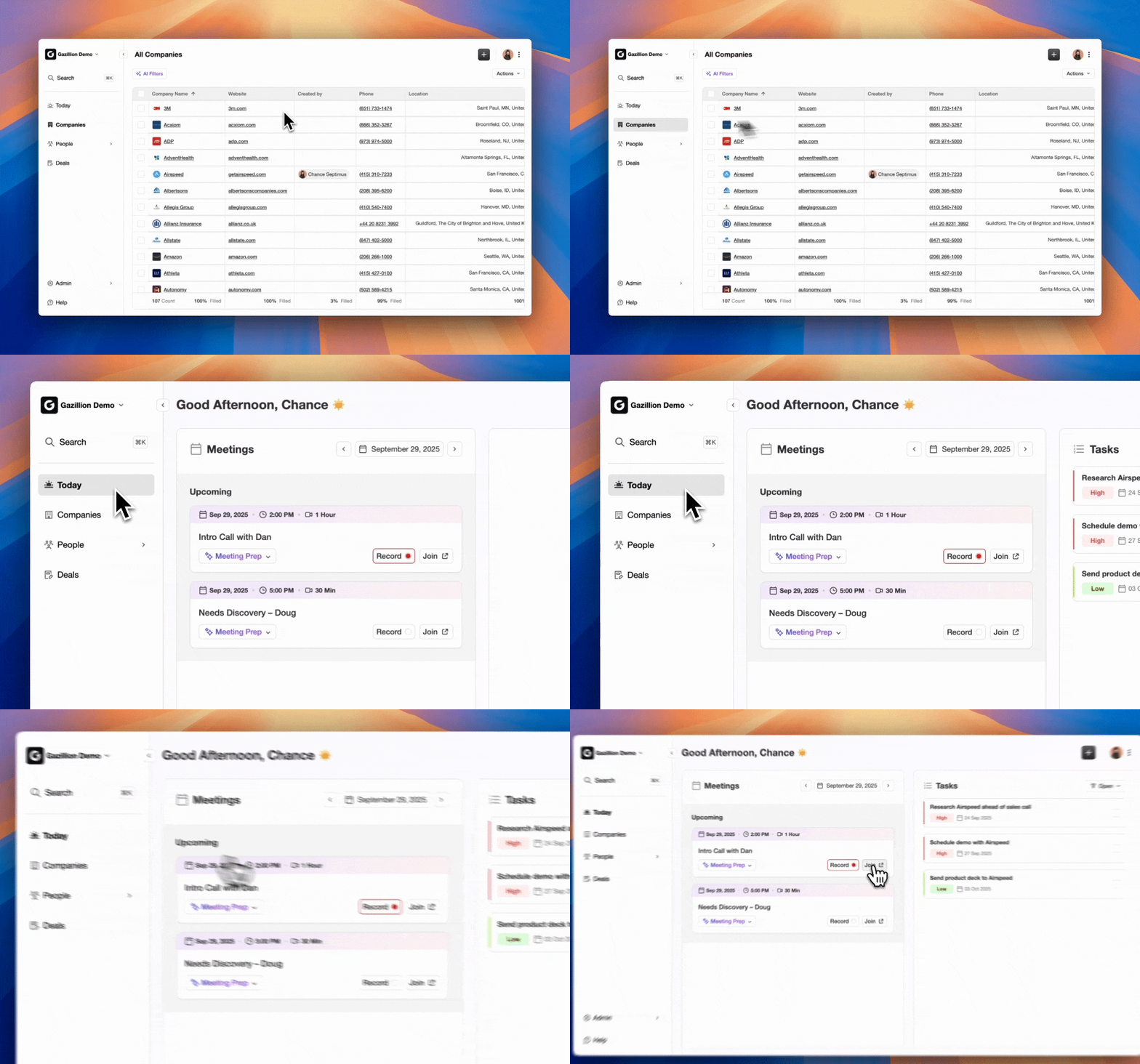
Coffee’s agent connects to Google Workspace or Microsoft 365 and immediately begins scanning emails and calendar events to auto-create contacts, companies, and activity logs. It enriches records with job titles, funding data, and LinkedIn profiles via licensed data partners, which removes the need for separate enrichment tools. During and after sales calls, the agent joins via Zoom, Teams, or Meet to record, transcribe, and generate summaries, next steps, and follow-up email drafts structured according to BANT, MEDDIC, or SPICED. The Pipeline Compare feature then visualizes week-over-week deal changes automatically, replacing manual CSV exports. For teams already on HubSpot or Salesforce, Coffee operates as a Companion App, where the agent handles the data-in process and writes enriched, structured data back to the existing system of record. Reps interact with a pre-populated CRM rather than a blank form, which creates a structural difference between an active agent and a passive database.
Which option scales best for mid-market RevOps teams?
HubSpot Sales Hub scales most predictably for RevOps teams that need structured reporting across marketing, sales, and service objects, provided the team has dedicated admin capacity and stays within API rate limits. Attio scales well for SaaS teams that need to map product usage data directly into their CRM, but its limited native integration ecosystem and absence of a server-side programming language create a ceiling for complex enterprise workflows. Coffee scales for teams of 1–100 users as a standalone CRM and for larger teams as a Companion App on top of HubSpot or Salesforce. The agent model means that data quality does not degrade as headcount grows, because the agent, not the rep, is responsible for data entry. For RevOps leaders whose primary concern is forecast accuracy and pipeline visibility, Coffee’s agent-guaranteed data quality offers the most durable foundation at any team size within the mid-market range.
Conclusion: Why Coffee Complements or Replaces Attio and HubSpot
Both Attio and HubSpot Sales Hub function as passive databases. Their G2 ratings reflect UI quality and ecosystem breadth, not the removal of manual data entry, which drives the CRM adoption failures examined earlier and keeps sales reps spending large portions of their working day on non-selling tasks. Attio wins on flexibility and modern UI. HubSpot wins on reporting depth and ecosystem maturity. Neither wins on data quality, because neither has an agent doing the work.

Coffee’s agent model removes the data-entry burden entirely. It operates as a standalone AI-first CRM for teams of 1–100 or as a Companion App that improves data quality inside an existing HubSpot or Salesforce instance, without requiring a migration that carries a $50,000–$150,000 switching cost for mid-market teams. The agent captures emails, calendar events, and call transcripts, enriches records automatically, and delivers accurate pipeline intelligence out because it guarantees good data in.
Hire the agent your CRM has always needed and let Coffee handle the data work.