Written by: Doug Camplejohn, CEO & Co-Founder, Coffee | Last updated: July 9, 2026
Key Takeaways for Sales and RevOps Leaders
- Traditional CRMs like Attio and Monaco still rely on manual data entry, creating the “CRM tax” that wastes 8–13 hours per rep each week.
- Agent-native systems such as Coffee capture, enrich, and structure data automatically from email and calendar activity with no human input.
- Coffee delivers full pre- and post-meeting automation, Pipeline Compare intelligence, and visitor identification without configuration or add-on tools.
- Teams reach operational value the same day by connecting Google Workspace or Microsoft 365, with no field mapping or data migration required.
- Eliminate the CRM tax and unlock autonomous sales workflows by exploring Coffee’s pricing options for your team size.
The Problem: Manual CRM Workloads in 2026
SPOTIO’s 2026 State of Field Sales survey reports that the average field rep spends 21% of the work week on administrative tasks and data entry, roughly 8 hours per rep. Nearly two-thirds of B2B organizations say reps spend 5 or more hours per week on manual CRM data entry. SuperOffice’s research places the average even higher, at 13 hours per week, which equals 28% of a full working week.
B2B field sales reps spend just 33% of their time on active selling. This aligns with Lyzr’s finding that 67% of selling time goes to research, data entry, and chasing context. Sellers lose a substantial portion of their week to work that software can handle.
The root cause sits in the architecture. Traditional CRM expects reps to create contacts, fill fields, log calls, and update deals by hand, which produces incomplete data. Attio improves the interface but keeps the same passive-database logic. Monaco adds an AI assistant layer without removing the human-entry dependency. Neither eliminates what Gartner calls the “CRM tax.”
Head-to-Head Comparison: Attio, Monaco, and Agent-Native Coffee
The comparison below shows how each platform handles the core factors that decide whether a CRM removes or preserves manual data entry. Focus on “Data Capture Architecture” and “Weekly Time Savings” to see which systems still depend on human-initiated records and which operate autonomously.
| Criteria | Attio | Monaco | Coffee |
|---|---|---|---|
| Data Capture Architecture | Flexible relational database with AI built into core from the ground up, still requires human-initiated record creation for most workflows | AI-assistant layer on passive database, human supervision required for data entry | Autonomous agent scans email and calendar to auto-create contacts, companies, and activities without human input |
| Automation Depth | Agent-operable via MCP protocol, requires developer configuration to reach autonomous operation | AI suggestions and workflow triggers, execution still human-confirmed | Full pre- and post-meeting automation, pipeline compare, visitor identification, and outbound list building, no configuration required |
| Weekly Time Savings | Partial, interface efficiency gains but passive-database platforms still require manual CRM data entry | Partial, AI assistant reduces some lookup time | AI agents save senior practitioners 10-12 hours per week and customer service reps 8-9 hours per week (median 6.4) by largely eliminating manual data entry |
| Integration Reality | Native integrations, Attio belongs to the AI-native, agent-friendly CRM category to varying degrees | Limited native integrations, relies on third-party connectors | Standalone CRM or Companion App on top of Salesforce/HubSpot, Zapier for broader stack, deep understanding of Salesforce quotas, forecasting, and required fields |
| Pipeline Intelligence | Reporting dashboards, natural language Ask Attio interface | AI-generated summaries, manual pipeline review | Automated week-over-week Pipeline Compare, no CSV exports required |
| Setup Effort | Moderate, flexible data model requires configuration | Moderate, AI layer requires training and workflow mapping | AI-native CRMs achieve same-day to 7-day onboarding, contrasting with traditional CRM’s 30–90 days for SMB or 6–12 months for Enterprise, agent activates on Google Workspace or Microsoft 365 connection |
| Visitor Identification | Not included natively | Not included natively | Pixel-based identification of named individuals with persona-matched Suggested Leads, closes loop from pixel hit to LinkedIn outreach |
Data Capture and Enrichment for Attio, Monaco, and Coffee
CRM evaluations in 2026 hinge on whether the system captures data automatically or waits for a human to create every record. AI-native CRM captures emails, links calendar meetings to deals, and creates and enriches contacts without human intervention, while traditional CRM relies on manual, time-consuming entry.
Attio’s architecture is modern, yet autonomous data capture still needs developer configuration via MCP before it becomes fully agent-operable. Monaco applies an AI assistant layer that surfaces suggestions but keeps the human entry step in place.
Coffee’s agent connects to Google Workspace or Microsoft 365 and immediately scans emails and calendars to populate contacts, companies, and activity logs. It enriches records with job titles, funding data, and LinkedIn profiles through licensed data partners, which removes the need for separate enrichment tools like Apollo or ZoomInfo. As shown in the comparison above, these automation gains translate into 10–12 hours saved per week for senior practitioners, the 70% reduction in data entry time that automated capture enables.
Meeting Orchestration and Pipeline Visibility with Coffee
In agent-operable systems, data entry becomes exhaust from normal work rather than a separate task, and forecasting shifts from manual estimation to continuous inference. Coffee turns this principle into a concrete meeting orchestration workflow.
Before a meeting, Coffee’s agent prepares a briefing on attendees, roles, and past interaction context. During the call, the agent joins via Zoom, Teams, or Meet to record and transcribe. After the call, it generates summaries, identifies next steps, and drafts follow-up emails in Gmail for the rep to review and send.

The agent can structure notes according to BANT, MEDDIC, or SPICED, so qualification data stays consistent. Because Coffee’s agent stores history in a built-in data warehouse, the Pipeline Compare feature visualizes week-over-week changes such as progressed deals, stalled opportunities, and new additions without manual CSV exports. High AI and agent usage by sellers can correlate with stronger sales performance.
Get started with Coffee and review standalone and companion app plans.
Visitor Identification and Outbound Automation with Coffee
Most CRM platforms, including Attio and Monaco, do not ship with website visitor identification. Coffee embeds this capability directly into the agent. A single tracking pixel placed in the site’s <head> tag begins identifying anonymous visitors as named individuals with name, title, email, and LinkedIn profile, along with company, pages visited, time on site, and visit frequency.
Standalone visitor identification tools often show company-level data or long, undifferentiated people lists. Coffee’s Suggested Leads feature instead uses the team’s buyer persona to recommend the two or three individuals inside a visiting company most worth contacting, with LinkedIn profiles surfaced for immediate outreach or auto-enrollment into a drip campaign.

For outbound list building, Coffee’s agent accepts natural language commands such as “Find me VPs of Sales in North America at companies with $10M+ funding using Salesforce” and runs the workflow using integrated enrichment data. Traditional SDRs spend significant time manually researching accounts and booking meetings, while AI SDR agents can handle much higher volumes automatically. Logic Luminate, a B2B digital marketing agency, raised reply rates from under 5% to 34% and close rates from 12% to 67% after deploying a fully autonomous AI-driven prospecting system.

Setup Effort, Change Management, and Total Cost
AI-native CRMs achieve same-day to 7-day onboarding, contrasting with traditional CRM’s 30–90 days for SMB or 6–12 months for Enterprise. Coffee activates once email and calendar connect, and the agent begins populating records immediately. Teams avoid field mapping exercises, data migration projects, and workflow configuration just to reach baseline value.
Total cost of ownership for 5–30 person teams evaluating Attio or Monaco must include the tools Coffee replaces, such as a separate enrichment provider, a meeting recording and transcription tool, a visitor identification platform, and a forecasting add-on. Because Coffee consolidates these capabilities into a single agent, its seat-based pricing includes unlimited labor with no metering on LLM usage or automated processes, which makes the true cost comparison more favorable than per-seat pricing alone suggests.
Risks and limitations deserve clear attention. Coffee’s broader stack integrations currently run through Zapier, with deeper native integrations on the roadmap. Teams with highly customized Salesforce or HubSpot instances should validate specific field-mapping requirements before committing. AI-powered CRM automation does not fix bad data, it scales it, and organizations with successful AI initiatives invest more heavily in data and analytics foundations than those without. Coffee addresses this at the architectural level by treating the agent as the data quality mechanism from day one.
Stage-Based Best-Fit Use Cases
Team size, existing stack, and growth stage shape the right choice. Use the scenarios below to match your situation to the most suitable option.
Pre-seed and seed-stage founders (1–10 people, no existing CRM)
- Primary need: eliminate spreadsheet chaos without adding a manual CRM chore.
- Best fit: Coffee Standalone CRM meets this need directly, since the agent activates in under 30 minutes with no admin overhead and captures data automatically from day one.
- Alternative consideration: Attio becomes viable if the team wants a highly customizable relational model and has developer resources to configure agent operations via MCP, accepting extra setup complexity.
- Why Monaco does not fit: at this stage, Monaco’s AI assistant delivers limited value because it needs sufficient historical data volume to generate useful suggestions.
Scaling teams (10–30 people, committed to Salesforce or HubSpot)
- Primary need: improve CRM data quality and adoption while keeping the current system of record.
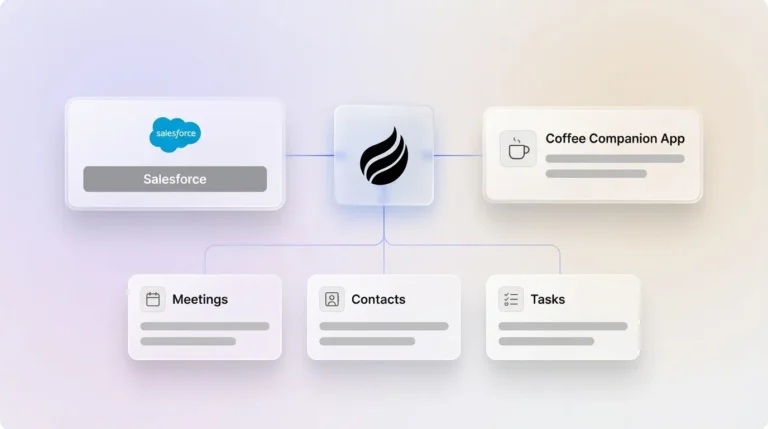
- Best fit: Coffee Companion App deploys an agent that writes enriched data back to the existing CRM, which removes the “garbage in” problem without a migration project.
- Role for Attio: better evaluated as a standalone replacement rather than a companion layer, since it centers on its own relational model.
- Role for Monaco: evaluate based on depth of native Salesforce or HubSpot integration and whether AI suggestions translate into measurable adoption improvements.
RevOps-led teams prioritizing pipeline accuracy
- Primary need: replace manual pipeline reviews with automated, data-warehouse-backed intelligence.
- Best fit: Coffee’s Pipeline Compare feature and built-in data warehouse deliver week-over-week visibility without add-ons or manual exports.
- In 2026, leading RevOps teams track data quality alongside pipeline metrics as a KPI, a standard Coffee’s agent is designed to meet automatically.
Frequently Asked Questions
How long does implementation take for an autonomous agent CRM in 2026?
Coffee implementation involves connecting a Google Workspace or Microsoft 365 account. The agent then scans emails and calendars and populates contacts, companies, and activity logs without manual configuration, so most teams reach operational baseline within the same day. The Companion App deployment for Salesforce or HubSpot adds a simple authentication step that lets the agent sync, enrich, and write data back to the existing system of record. Teams avoid data migration, field mapping exercises, and multi-week onboarding projects that traditional CRM implementations often require.
Does agent-native architecture improve data quality over Attio or Monaco?
Agent-native architecture improves data quality at a structural level. Attio and Monaco both depend on humans to initiate record creation and field updates, which means records go stale when people get busy. Coffee’s agent captures data as a byproduct of normal email, calendar, and meeting activity, logging last activity, next activity, contact details, and enrichment data continuously without waiting for a rep to update the CRM.
The agent also operates on a built-in data warehouse rather than a flat relational database, so historical context remains available when fields change. This architectural difference makes “good data in, good data out” achievable at scale instead of aspirational.
Can these tools automate outbound workflows without manual CSV work?
Coffee removes CSV-based outbound work entirely. The List Builder feature accepts natural language commands to build targeted prospect lists using integrated enrichment data. The Visitor Identification feature routes website visitors directly into outbound campaigns with enrichment already filled in.
The agent can auto-enroll identified prospects into drip campaigns or surface them as Slack notifications for immediate LinkedIn or email outreach. Attio supports outbound automation through prospecting and lead scoring agents, yet full automation still requires developer configuration via MCP. Monaco’s outbound automation depends on the depth of its workflow trigger system and usually includes manual review steps before execution.
Which option works best as a companion layer for existing Salesforce or HubSpot stacks?
Coffee serves as the only option in this comparison built specifically as a companion layer. The Coffee Companion App deploys the agent on top of an existing Salesforce or HubSpot instance and handles data capture and enrichment so the system of record stays accurate without human effort.
Coffee also has deep knowledge of Salesforce-specific constructs such as quotas, forecasting, required fields, and validation rules that newer AI-native tools often lack. Attio functions as a standalone CRM replacement rather than a companion layer. Monaco’s companion capabilities vary by integration depth and should be tested against specific Salesforce or HubSpot configurations before purchase.
Conclusion: Choosing the Right CRM for Your Stage and Stack
Attio offers a modern CRM with a flexible relational architecture and real AI investment, while Monaco provides AI assistance on top of a passive database. Neither eliminates the CRM tax described earlier because neither deploys an autonomous agent that captures data without human input. AI agents are expected to play a central role in strategic goals, and by the end of 2026, 40% of enterprise applications will include task-specific AI agents, an eightfold increase from less than 5% in 2025. The architecture decision you make now determines whether your team aligns with that shift or stays locked into another cycle of manual maintenance.
For 5–30 person B2B SaaS teams that already feel the pain of manual data entry in Attio or Monaco, Coffee offers a direct path to reliable data and autonomous workflows. Teams can adopt Coffee as a standalone CRM when starting fresh or as a companion agent when committed to Salesforce or HubSpot.
Get started with Coffee and eliminate the CRM tax for your team today.