Written by: Doug Camplejohn, CEO & Co-Founder, Coffee | Last updated: June 22, 2026
Key Takeaways for Automating CRM Data Entry
- Automating CRM data entry replaces manual logging with systems that capture and structure information from emails, calendars, and call transcripts.
- Manual entry costs teams thousands in lost selling time and produces decaying, incomplete, or fabricated CRM records.
- Legacy CRMs and basic automation tools cannot process unstructured data or preserve historical context without human intervention.
- AI agents like Coffee ingest signals from multiple sources and write clean, enriched records back to Salesforce or HubSpot automatically.
- Eliminate manual entry from day one with Coffee. Review pricing and deployment options.
1. The Real Cost of Manual CRM Data Entry
Salesforce’s 2026 State of Sales report finds that sales reps spend 60% of their time on non-selling tasks, including manually entering customer notes. Field sales surveys show that many reps spend several hours per week on manual CRM data entry.
The financial math is direct. A rep earning $100,000 who spends 25% of their week on admin represents roughly $25,000 in misallocated compensation annually, or $250,000 across a ten-person team. In a ten-person team where each rep logs 45 minutes per day, the team loses 37.5 hours of selling time per week, which equals a full-time rep’s capacity lost to data entry every quarter.
Data quality degrades in parallel. Many sales staff admit to fabricating CRM data because manual entry is time-consuming, and CRM data can decay at a significant rate each year. Forecasts then rely on decaying, partially fabricated records. Bad data in produces bad data out.
See how Coffee reclaims those 37.5 hours per week — view pricing
2. Why Legacy CRMs and Basic Automation Still Fail
Salesforce, HubSpot, Pipedrive, and Attio share a common architectural assumption: humans will reliably enter data. They act as passive containers. When a field is overwritten, the historical context disappears. When a rep forgets to log a call, the deal timeline develops a gap. Native automation features such as Einstein Activity Capture and HubSpot’s activity sync address structured inputs like calendar events but cannot process unstructured data at the level required for complete records.
This limitation is fundamental. Unstructured data such as email text, call recordings, and meeting notes lacks predefined fields, which makes it difficult to organize and process with traditional relational databases that rely on consistent schemas. Audio recordings require transcription and NLP before they produce usable CRM data, a step that exceeds the capabilities of basic workflow automation tools. Unstructured data represents roughly 80–90% of all enterprise information assets, yet most native CRM tools cannot analyze it effectively.
Rule-based tools like Zapier operate on fixed triggers and predefined field mappings. Traditional automation tools follow predefined rules and fixed workflows, while AI agents use large language models to reason dynamically, adapt to new situations, and decide which tools to use at runtime. A Zapier workflow that copies a form submission into a contact record cannot read a call transcript, infer deal stage, and update several related fields at once.
3. How AI Agents Transform CRM Data Capture
The CRM industry is moving toward agentic AI, which uses autonomous agents that execute tasks without manual clicks, enabling systems to shift from reactive insights to proactive and autonomous action. Gartner predicts that 40% of enterprise applications will include task-specific AI agents by the end of 2026, up from less than 5% in 2025.
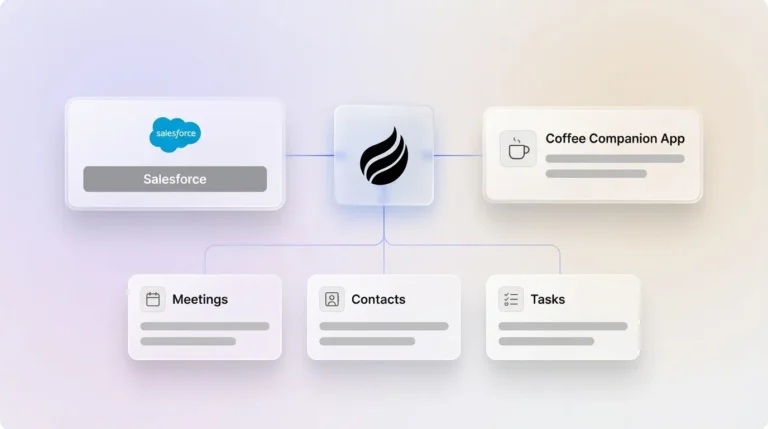
An AI agent for CRM connects to email, calendar, and call infrastructure, ingests both structured and unstructured signals, and writes clean, enriched records back to the system of record without a human in the loop. Coffee follows this architecture. It operates in two modes. The Standalone CRM mode serves teams of 1–20 that have outgrown spreadsheets. The Companion App mode layers on top of existing Salesforce or HubSpot instances. In both modes, the Coffee Agent handles data intake so that accurate intelligence comes out.

Deploy the Coffee Agent in your CRM — view pricing and setup
4. Salesforce Playbook: 5 Steps to Zero Manual Entry
- Authenticate Coffee as a Companion. Connect Coffee to your Salesforce org via OAuth. Coffee maps to your existing objects such as Contacts, Accounts, Opportunities, and Activities, and respects required fields, validation rules, and forecasting categories.
- Connect Google Workspace or Microsoft 365. Coffee immediately scans emails and calendar events to auto-create and enrich Contacts and Accounts. It populates job titles, LinkedIn profiles, and funding data from licensed enrichment partners.
- Deploy the AI Meeting Bot. Coffee joins Zoom, Teams, or Meet calls, records, transcribes, and generates structured summaries aligned to BANT, MEDDIC, or SPICED. After each call, it writes activity records and next steps directly to the associated Salesforce Opportunity.
- Enable Pipeline Compare. Coffee’s data warehouse tracks every field change. Week-over-week pipeline movement such as progressed deals, stalled opportunities, and new additions surfaces automatically, which replaces manual CSV exports and Salesforce report builds.
- Activate the Intelligence Layer. Coffee’s Intelligence layer, launched in February 2026, stores deep context on your ICP, product, and competitors to deliver tailored AI suggestions inside every deal view. Reps no longer need to research manually before calls.
5. HubSpot Playbook: 5 Steps to the Same Outcome
- Authenticate Coffee as a Companion. Connect Coffee to HubSpot through a simple OAuth flow. Coffee syncs to Contacts, Companies, Deals, and Engagements, writing back to HubSpot’s native objects so your existing workflows and reporting stay intact.
- Connect Email and Calendar. Coffee auto-creates HubSpot Contacts from email threads and calendar invites, enriches them with firmographic data, and logs every interaction as a HubSpot Engagement without rep action.
- Deploy Meeting Recording and Summaries. Coffee’s Custom Meeting Briefings and Summaries, released in February 2026, let teams define exact summary formats, from executive overviews to granular technical breakdowns, and write them back to HubSpot Deal records automatically.
- Integrate Billing Signals. Coffee’s Stripe integration, launched in January 2026, automatically imports customers and companies, enriches them, and marks paid invoices as Closed Won deals. This flow removes the manual step of updating deal stage after payment.
- Run Pipeline Reviews from Coffee’s Compare View. Coffee surfaces week-over-week HubSpot pipeline changes in a single view. Pipeline reviews shift from interrogation sessions to strategic discussions without spreadsheets.
6. How the Coffee Agent Works End-to-End
Coffee delivers an end-to-end workflow that captures every key signal and keeps CRM records current. After connecting to Google Workspace or Microsoft 365, Coffee begins ingesting email threads and calendar events to auto-create Contacts and Companies. It enriches each record with job titles, LinkedIn profiles, and funding data.

The AI Meeting Bot joins calls, transcribes them, and generates structured summaries that write back to the CRM. Activity logging such as last activity and next activity updates autonomously so deal state stays current. Pipeline Compare then visualizes changes across any time window, drawing from Coffee’s built-in data warehouse that preserves full history rather than overwriting fields. The table below shows how Coffee’s agent architecture solves the core limitations that prevent legacy CRMs and basic automation from eliminating manual entry.

| Capability | Legacy CRM (Salesforce / HubSpot native) | Basic Automation (Zapier / RPA) | Coffee Agent |
|---|---|---|---|
| Unstructured data ingestion (emails, transcripts) | Not supported natively; requires specialized NLP | Fixed-field triggers only, no reasoning | Full ingestion and structuring via LLM |
| Historical context preservation | Field overwrites destroy history | No history layer, mirrors source system | Built-in data warehouse retains full history |
| Auto-enrichment | Requires separate tools such as ZoomInfo or Apollo | Requires manual field mapping for each integration | Built-in enrichment via licensed data partners |
| Rep time saved per week | 0 hrs, reps still enter data manually | Partial, structured inputs only | 8–12 hours per rep per week |
Reality Check: No automation layer removes 100% of human judgment. Edge cases such as unusual deal structures or non-standard meeting formats may require occasional rep review. Coffee surfaces these exceptions rather than silently dropping them, so data quality remains auditable.
See Coffee’s end-to-end automation in your CRM — review pricing
7. Evaluation Framework for Selecting a CRM Agent
Integrations. Any agent should write back to your CRM’s native objects, not just a sidebar view. Coffee syncs to Salesforce and HubSpot objects directly and connects to additional tools via Zapier, with deeper integrations on the roadmap. Native QuickBooks and Stripe integrations extend automated data capture beyond sales into revenue operations. The Stripe sync mentioned earlier removes manual deal-stage updates after payment, while QuickBooks brings billing data into the same workflow.
Security and Compliance. Coffee is SOC 2 Type 2 certified and GDPR compliant and maintains a strict policy that customer data is never used to train public models. These baseline certifications matter most for teams in regulated-adjacent industries. When you evaluate multiple vendors, verify that each can produce their SOC 2 report on request rather than accepting compliance claims at face value.
Implementation Effort. Evaluations of AI CRM platforms should prioritize hands-on testing via demos and free trials to measure how AI features perform in real workflows rather than relying on vendor claims. Coffee’s authentication flow supports same-day deployment without professional services.
Team Size Fit. For teams of 1–20 without an existing CRM, Coffee’s Standalone mode removes the overhead of configuring Salesforce or HubSpot. For committed Salesforce or HubSpot shops in the 20–150 person range, the Companion mode preserves existing workflows while the agent handles all data capture. Newer agent-category competitors such as Day.ai and Clarify lack the depth of Salesforce and HubSpot integration, including quota management, forecasting categories, and required field validation, that mid-market RevOps teams depend on.
Pricing Model. Coffee uses seat-based pricing. The agent’s labor, including unlimited data capture, enrichment, meeting recording, and pipeline tracking, is included in the seat cost with no metering on LLM usage or automated processes.
Frequently Asked Questions
Does automating CRM data entry require replacing Salesforce or HubSpot?
Automation of CRM data entry does not require replacing Salesforce or HubSpot. Coffee operates as a Companion App that layers on top of existing Salesforce or HubSpot instances. It authenticates via OAuth, maps to your existing objects and field configurations, and writes enriched data back to your system of record. Your existing workflows, reports, and integrations continue to function. The only change is that reps stop entering data manually because the Coffee Agent handles that work.
What happens to data quality when an AI agent writes to the CRM instead of a human?
AI-agent capture improves consistency compared with human entry because it draws from ground-truth sources such as email threads, calendar metadata, and call transcripts rather than rep memory after the fact. Coffee’s built-in data warehouse preserves historical context that legacy CRM field overwrites would destroy. Edge cases surface for rep review rather than being dropped silently, which keeps the data auditable. The practical result is fewer blank fields, fewer fabricated entries, and a pipeline that reflects actual deal activity.
How does Coffee handle call transcripts and meeting notes specifically?
The Coffee AI Meeting Bot joins Zoom, Microsoft Teams, or Google Meet calls to record and transcribe in real time. After each call, the agent generates structured summaries that can follow BANT, MEDDIC, or SPICED qualification frameworks, then writes those summaries as activity records to the associated CRM deal or contact. Teams can define custom summary templates, from high-level executive overviews to granular technical breakdowns, and write them back to Coffee, HubSpot, or Salesforce automatically. The agent also drafts follow-up emails in Gmail for the rep to review and send.

Is Coffee suitable for a team that has never used a formal CRM?
Coffee works well for teams that have never used a formal CRM. Coffee’s Standalone CRM mode serves companies of 1–20 people that have outgrown spreadsheets or Notion but view Salesforce and HubSpot as expensive and maintenance-heavy. The agent manages the system of record from day one by auto-creating contacts from email, enriching records, logging activities, and tracking pipeline. This approach removes the manual setup phase where data quality often degrades before the team builds habits.
What does Coffee cost, and how is it priced?
Coffee uses seat-based pricing. Each human seat covers unlimited agent labor, including data capture, enrichment, meeting recording, transcription, pipeline tracking, and all AI-generated outputs. The platform does not meter LLM calls or automated processes. Full pricing details are available at coffee.ai/pricing.
Conclusion: Turning CRM Data Entry into an Automated Workflow
The shift from training reps to log data to hiring an agent that logs it automatically is a 2026 deployment decision, not a distant future state. Legacy CRMs will not change their architectural reliance on human entry, and rule-based automation tools cannot process the unstructured signals where most deal context lives. AI agents that ingest email, calendar, and call data and write clean records back to the system of record provide a practical path to zero manual entry and reliable pipeline intelligence. The implementation playbooks above apply whether your starting point is a blank slate or an existing Salesforce or HubSpot instance. The remaining choice is which agent you trust to handle the work.