Written by: Doug Camplejohn, CEO & Co-Founder, Coffee | Last updated: June 29, 2026
Key Takeaways
Automated sales meeting notes capture every spoken word, structure it against a sales methodology, and log the output directly into a CRM without manual rep effort.
Without automation, sales teams lose 8–12 hours per rep each week to data entry, which creates stale records, inaccurate forecasts, and fragmented shadow systems.
The five-step implementation process covers connecting data sources, mapping call types to CRM fields, configuring the AI agent, generating structured summaries, and validating automatic CRM writeback.
Success depends on tracking hours saved, CRM field completion rates, pipeline forecast accuracy, and follow-up email send times from day one.
Teams ready to reclaim selling time can start your Coffee trial and have the full system live within one week.
Why Automated Meeting Notes Matter for Revenue Teams
Manual note-taking and CRM updates drain selling time from every rep. Every hour spent transcribing notes, formatting summaries, and pasting data into CRM fields is an hour not spent advancing pipeline. At 8–12 hours lost per week per rep, a 10-person sales team bleeds 80–120 hours of selling capacity every single week. That drag shows up directly in missed quota and slower revenue growth.
Downstream consequences compound quickly. When reps skip manual entry, deal records go stale and key fields stay blank. Stale records produce inaccurate forecasts, and inaccurate forecasts erode trust between sales leadership and the board. At the same time, reps build shadow systems such as spreadsheets, Notion pages, and personal notes that live outside the CRM. These shadow systems fragment the single source of truth that RevOps depends on for pipeline reviews, territory planning, and quota modeling.
Before rolling out automation, confirm that your foundation is in place. These five prerequisites create the technical and operational base for Coffee. Google Workspace or Microsoft 365 provides calendar integration so the agent can detect meetings and trigger automatic recording. CRM access credentials for Salesforce, HubSpot, or Coffee Standalone allow the agent to write structured data directly into the system of record and remove copy-paste work. A defined note standard or sales methodology such as BANT, MEDDIC, or SPICED gives the AI clear structure so it can extract the right fields from unstructured conversation. A recording consent policy reviewed and approved by legal or compliance protects the company from regulatory risk. Finally, a one-week onboarding window for reps ensures they can adopt the new workflow without disrupting active deals.
Teams that meet these criteria are ready to implement the five-step system below. With this foundation in place, the rollout becomes a straightforward sequence instead of a risky experiment.
Five-Step System to Implement Automated Meeting Notes
The implementation follows a clear five-step sequence. Each step has a defined owner, specific inputs, and measurable outputs. Follow them in order to move from zero automation to a fully logged, AI-structured meeting note system that your team can trust.
Step 1: Connect Data Sources and Finalize Consent Standards
Purpose: Establish the data pipeline and legal foundation before any recording begins.
Inputs: Google Workspace or Microsoft 365 credentials, CRM admin access, legal-approved consent language.
Owner: RevOps lead with sign-off from legal counsel.
Start by connecting the Coffee Agent to your email and calendar environment through OAuth authentication. This single connection allows the agent to auto-create contacts, log activities, and associate every future meeting with the correct CRM record. Reps no longer need to link meetings to opportunities by hand. For Salesforce or HubSpot users, a companion authentication connects Coffee’s writeback to the existing system of record so data flows into the fields your team already uses.
Consent handling comes next and cannot be skipped. Recording laws vary by jurisdiction. Many U.S. states follow single-party consent, while others require all parties to agree. For any call involving a prospect or customer, the safest standard is all-party notification so every participant understands that an AI assistant is recording and transcribing the conversation.
Consent Language Callout: Use a calendar invite disclaimer such as: “This meeting may be recorded and transcribed by an AI assistant for internal note-taking purposes. By joining, you consent to this recording.” Pair this with a brief verbal confirmation at the start of the call. The Coffee Agent can announce its presence when joining Zoom, Teams, or Google Meet, which satisfies notification requirements automatically. Recording without consent creates legal exposure that no productivity gain can justify, so treat this step as mandatory.
Output: Active data connection, consent policy documented, CRM field permissions confirmed.
Step 2: Map Call Types to Specific CRM Fields
Purpose: Define which data points must be captured from each call type so the Coffee Agent knows what to extract and where to write it.
Each call type surfaces different qualification signals, so the AI needs clear instructions. A discovery call focuses on budget, authority, and core pain. A demo call validates fit against specific use cases and impact. A negotiation call tracks commercial terms, decision criteria, and timelines. Without a field map, the agent captures everything but structures nothing, which leaves you with long transcripts instead of actionable CRM data.
Configure this map inside the Coffee Agent’s methodology settings. The agent then structures every post-call summary against the correct framework and populates only the fields relevant to that call stage. This approach keeps CRM records clean, consistent, and easy to review during pipeline meetings.
Step 3: Configure the Coffee Agent Across People, Data, and Systems
Purpose: Deploy the AI meeting bot so it joins calls automatically, transcribes in real time, and prepares data for structured summarization.
Configuring the Coffee Agent requires coordination across three layers. Start with people. Inform reps that the Coffee Agent will appear as a named participant in their calendar invites so they are not surprised when it joins. Run a 30-minute enablement session that shows what the bot captures, how summaries are generated, and where data lands in the CRM. This context builds trust and encourages adoption.
The second layer is data. The Coffee Agent ingests unstructured conversation such as spoken language, filler words, and tangents, then converts it into structured CRM fields. Legacy CRMs built on relational databases often lose historical context when fields are overwritten. Coffee’s built-in data warehouse keeps the full transcript alongside the structured summary, and both layers stay queryable for future analysis.
The third layer is systems. The agent joins Zoom, Microsoft Teams, and Google Meet through calendar invite detection, so reps do not need to add a manual bot-invite link. After each call, the agent writes the structured summary back to the CRM record automatically. Reps do not have to touch the record for standard updates.
Join a meeting from the Coffee AI platform
Fragmentation Pitfall: Many teams run a separate recording tool such as Fathom or Gong, a separate enrichment tool such as ZoomInfo, and a separate CRM, then stitch outputs together by hand. This setup creates three failure points and no unified history. The Coffee Agent consolidates recording, transcription, enrichment, and CRM writeback into one workflow, which removes the stitching tax entirely.
Step 4: Turn Transcripts into Summaries and Follow-ups
Purpose: Convert the raw transcript into a formatted summary, populated CRM fields, and a draft follow-up email without adding work for the rep.
Immediately after a call ends, the Coffee Agent generates a structured summary using the methodology template configured in Step 2. A standard discovery call summary follows this template:
Attendees: [Names, titles, company]
Meeting objective: [One sentence]
Key findings: [BANT fields populated]
Next steps: [Numbered action items with owners and due dates]
Follow-up draft: [Ready-to-send email in Gmail for rep review]
The rep reviews and sends the follow-up email. That single action becomes the only manual step in the post-call workflow, which frees the rest of the time for selling activities.
Create instant meeting follow-up emails with the Coffee AI CRM agent
Inconsistent Field Mapping Pitfall: If call type templates are not configured in Step 2, the agent defaults to a generic summary that may omit critical qualification fields. A discovery call summary that skips “Budget confirmed” or “Decision-maker name” creates false confidence in incomplete data. Always complete Step 2 before enabling Step 4 outputs so every summary supports accurate qualification.
Step 5: Validate Automatic CRM Logging and Close the Loop
Purpose: Confirm that structured data has written back correctly to the CRM and that the deal record reflects the current state of the opportunity.
Handoffs: The Coffee Agent pushes the structured summary to the CRM record, updates “last activity” and “next activity” fields, and flags any required fields that could not be populated from the transcript, such as budget not discussed.
Outputs: Updated opportunity record, populated methodology fields, logged activity timestamp, and a flagged exceptions list for rep follow-up.
Tool Fragmentation Pitfall: Teams using a standalone recording tool that does not write back to the CRM still rely on humans to copy-paste summaries into deal records. That manual step recreates the very problem automation should solve. Coffee’s direct CRM writeback, described in Step 1, closes this loop so every call lands in the right record without human intervention.
Validation and Success Criteria for Automated Notes
Measurement keeps the automation honest and proves value to leadership. Track four metrics from day one and establish baselines before go-live so week-over-week improvement stays visible and concrete.
Metric
Baseline Method
Target Outcome
Measurement Cadence
Hours saved per rep per week
Pre-automation time audit (manual survey)
Reclaim the full 8–12 hours currently lost to manual entry
Weekly
CRM field completion rate
% of required fields populated per deal stage
90%+ completion without manual entry
Weekly
Pipeline forecast accuracy
Forecast vs. actual close rate (trailing 90 days)
Variance reduction of 15%+ within 60 days
Monthly
Follow-up email send time
Average minutes from call end to follow-up sent
Under 30 minutes (from 2–24 hours manually)
Weekly
Review these metrics in a shared RevOps dashboard so sales, marketing, and leadership see the same picture. Coffee’s Pipeline Compare feature surfaces week-over-week deal changes automatically, which replaces manual CSV exports and turns pipeline reviews into strategic conversations instead of data-reconciliation sessions.
Scaling Coffee for Different Team Sizes and Motions
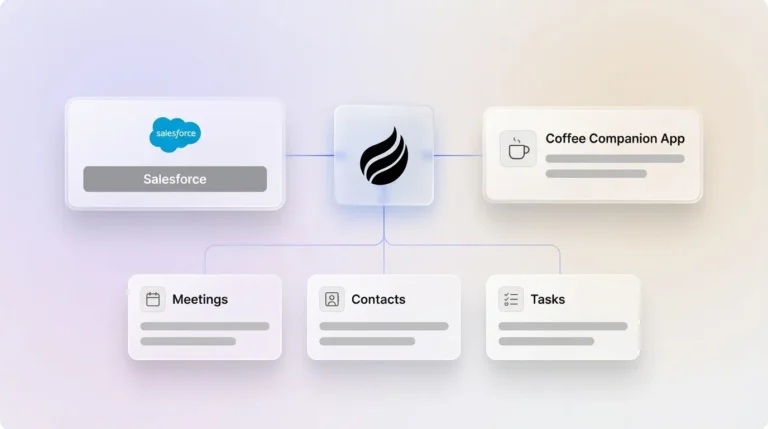
Deployment patterns vary by team size and tech stack. For teams of five reps or fewer, the Coffee Standalone CRM offers the fastest path. Setup time stays under one hour, and the agent handles the full system of record without Salesforce or HubSpot licenses. For teams of 10–25 reps already committed to Salesforce or HubSpot, deploy Coffee as a companion app so the agent writes back to the existing system of record and preserves current workflows, quotas, and forecasting configurations.
Sales motion also shapes configuration. Enterprise teams with long cycles and multiple stakeholders benefit from MEDDIC templates at the negotiation stage and from enabling Pipeline Compare to track multi-threaded deal progression week over week. High-velocity inside sales teams running 10 or more calls per day see more value from concise BANT templates at the discovery stage, which keep summaries short and CRM updates fast.
As the team scales, Coffee’s Visitor Identification feature extends automation to the top of the funnel. A single tracking pixel identifies anonymous website visitors, matches them to named individuals, and surfaces Suggested Leads that match the buyer persona. Warm prospects then flow directly into outbound sequences without manual research or list building.
Frequently Asked Questions
How long does it take to set up automated meeting notes with Coffee?
Most teams are fully operational within one week. The core setup, which includes connecting Google Workspace or Microsoft 365, authenticating the CRM, and configuring call-type templates, can be completed efficiently by a RevOps admin. Rep enablement typically requires multiple sessions totaling around 120 hours over 3–6 months to reach full productivity. For Salesforce or HubSpot companion deployments, the authentication process remains straightforward and does not require a custom integration build or professional services engagement.
Is Coffee compliant with SOC 2 Type 2 and GDPR requirements?
Yes. Coffee is SOC 2 Type 2 certified and GDPR compliant. Call recordings and transcripts are stored securely and are not used to train public AI models. Data handling policies are available for review during the evaluation process. For teams in regulated industries, Coffee recommends a legal review of recording consent practices specific to the jurisdictions where prospects and customers are located before enabling the AI meeting bot.
How deeply does Coffee integrate with Salesforce and HubSpot compared to standalone recording tools?
Coffee’s integration goes significantly deeper than standalone recording tools like Fathom or Gong. Those tools capture and transcribe calls but require a human to move structured data into CRM fields. Coffee writes structured summaries, populated methodology fields, and activity logs directly to the correct CRM record automatically. It also understands Salesforce-specific constructs such as required fields, opportunity stages, quota configurations, and forecast categories that generic AI tools do not account for, which prevents writeback errors that corrupt pipeline data.
What happens to the automation as the sales team grows?
Coffee’s seat-based pricing model scales linearly with headcount. Adding a new rep means adding a seat, while the agent’s labor remains unlimited and does not meter by call volume, transcript length, or AI processing. As the team grows, Coffee’s methodology templates, field maps, and CRM writeback rules apply uniformly to every new rep from day one. This consistency removes the onboarding lag that usually comes with manual note-taking habits. Advanced features like Visitor Identification and Suggested Leads become more valuable at scale because they feed a continuous pipeline of warm, persona-matched prospects into the outbound workflow.
Conclusion: Put Automated Sales Meeting Notes to Work
Manual note-taking and CRM data entry sit firmly in the category of administrative overhead, not selling. The five-step system described here, which covers connecting data sources, mapping fields, configuring the Coffee Agent, generating structured summaries, and validating CRM writeback, removes that overhead from your reps’ calendars. Reps reclaim those lost hours each week that previously went into manual updates. CRM data quality improves from day one, and forecasts become reliable enough to support confident planning. The entire workflow can be live within a week.