Written by: Doug Camplejohn, CEO & Co-Founder, Coffee | Last updated: June 20, 2026
Key Takeaways
- Manual CRM data entry drains mid-market sales teams through hidden labor costs, preventable errors, and lost pipeline.
- Reps spend many hours each week on data tasks, and automation gives that time back while sharply cutting error rates.
- Most teams see CRM automation ROI within 3–6 months through labor savings and reduced spend on separate tools.
- Coffee brings CRM, enrichment, and intelligence into one platform so teams can replace multiple legacy subscriptions.
- Teams ready to remove manual entry and accelerate ROI can review Coffee pricing and plans today.
Annual Cost Impact of Manual CRM Data Entry
McKinsey Global Institute data shows employees spend an average of 1.8 hours per day on data collection and entry tasks, which equals 23% of a typical workday. For a 10-person team, that time reaches 4,680 hours annually before you even factor in error correction or lost pipeline. This data-entry burden sits inside a broader productivity problem: Salesforce State of Sales reports indicate that sales reps spend about 70% of their time on non-selling tasks, and manual CRM work represents a major share of that administrative load.
The cost extends far beyond raw labor hours. The 1x10x100 rule holds that an error caught at entry costs 1x to fix, 10x once it is in the system, and 100x once it reaches a customer or decision. This exponential cost structure explains why low-quality CRM data hits revenue so hard. Validity research found that 44% of companies lose more than 10% of annual revenue due to low-quality CRM data, so a $30 million company risks at least $3 million each year. Across organizations of all sizes, Gartner estimates poor data quality drives an average of $12.9 million in annual losses per company.
Time Burden of CRM Data Entry for Sales Reps
HubSpot’s 2025 State of Sales Report does not report that sales representatives spend 17% of total work hours on CRM data entry. The Forrester Activity Study tracking more than 3,000 sales reps found the average rep spends about two days per week on administrative tasks. Those hours represent time pulled away from pipeline-building activities and compound the financial losses described earlier.
Labor-savings formula (swap your own numbers):
Annual labor savings = Reps × Hours saved per week × 50 weeks × Fully loaded hourly rate
Teams that apply realistic benchmarks for hours saved per employee per week at a fully loaded cost of $35 per hour often uncover large savings for a 10-rep team. At Coffee’s typical savings range, the model turns net-positive even before you account for any uplift in pipeline or win rates.
Use Coffee’s pricing to plug real numbers into your savings formula.
ROI Drivers of CRM Data-Entry Automation
Automated validation can reduce CRM error rates significantly. Manual entry often produces 1–4% error rates per field, and the same operator who achieves 0.5% accuracy at 9 a.m. may degrade to 3% or more by late afternoon. Coffee’s agent maintains consistent machine-level accuracy around the clock and removes that human variability.
Error reduction protects revenue that would otherwise leak out of the funnel. A valid phone number or email address increases the chance that a deal progresses. B2B contact data degrades at roughly 2.1% per month, or over 22% annually, so a static manual CRM loses accuracy every week unless an agent refreshes records continuously.

Reclaimed selling time adds another layer of return on top of error reduction. Improvements in selling time allocation can produce a notable revenue lift because more time on the right accounts drives higher conversion rates, faster deal velocity, and stronger pipeline coverage. Many reps who work with AI agents report higher odds of hitting sales targets. Salesforce research shows that SMBs can achieve strong returns on automation investments with relatively short payback periods, and a 2014 Nucleus Research analysis found that CRM deployments returned an average of $8.71 for every dollar spent.
Legacy CRM Stack Costs Compared to a Coffee Agent
Legacy CRM seat pricing hides the true cost of a full sales tech stack. A typical mid-market Salesforce Sales Cloud deployment at $165 per seat per month for 10 reps costs $19,800 per year in licenses alone. That figure excludes the tools required to compensate for Salesforce’s passive architecture, such as a data enrichment tool like ZoomInfo at roughly $15,000–$25,000 per year, a conversation intelligence platform like Gong at about $12,000–$18,000 per year, and a sales engagement layer like Salesloft at around $9,000–$15,000 per year. Combined, total annual stack spend reaches $55,800–$77,800 before you count any labor.
HubSpot Sales Hub Professional at $90 per seat per month for 10 reps runs $10,800 per year in licenses. The same enrichment and intelligence gaps usually require similar point-solution spend, which produces a comparable total stack cost despite the lower core license price.
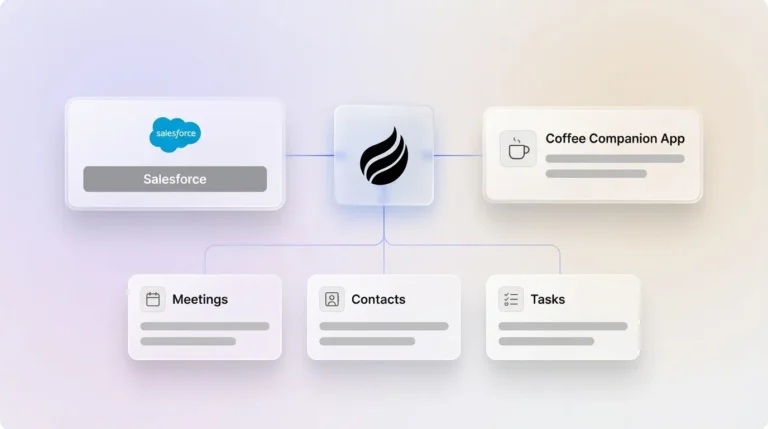
Coffee consolidates CRM, enrichment, meeting intelligence, and pipeline tracking into a single seat-based price. The agent’s unlimited labor comes included, with no metering on processes or LLM usage. For teams already on Salesforce or HubSpot, Coffee’s Companion App deploys through simple authentication and writes clean data back to the existing system of record without replacing it. In both cases, the hidden tool-stack spend gets removed rather than lightly trimmed.

10-Rep Scenario: Cash-Flow and Payback Timeline
The example below shows how savings accumulate for a 10-rep team. Coffee reaches positive ROI in the first month and delivers $84,000 in net savings by the end of year one.
| Month | Cumulative Manual Cost | Cumulative Coffee Cost | Cumulative Net Savings |
|---|---|---|---|
| 1 | $8,000 | $1,000 | $7,000 |
| 3 | $24,000 | $3,000 | $21,000 |
| 6 | $48,000 | $6,000 | $42,000 |
| 12 | $96,000 | $12,000 | $84,000 |
Manual cost figures come from published benchmarks for a 10-person team at $8,000 per month. Coffee platform cost is illustrative at $1,000 per month for 10 seats, and you can confirm current pricing on the Coffee pricing page. Legacy CRM add-on approaches that rely on bolt-on AI features and separate enrichment tools often extend payback to 6–12 months because of higher combined stack costs and extra implementation work. As the table shows, Coffee’s autonomous agent model aligns with the 3–6 month payback benchmark referenced earlier, even before you factor in revenue uplift.
Choosing Between Coffee Standalone and Companion
Teams can use a simple checklist to match Coffee’s deployment options to their current stack and growth plans before any CFO review.
Choose Coffee Standalone if: Your team has 1–20 reps, you currently work from spreadsheets, Notion, or a lightweight CRM like Pipedrive, you want the agent to serve as the full system of record, and you have no existing Salesforce or HubSpot contract to preserve.
If you already have an enterprise CRM investment to protect, choose Coffee Companion (Salesforce or HubSpot) instead: Your team has 10–100 reps, you maintain an active Salesforce or HubSpot instance with existing data, quotas, and forecasting configurations, your RevOps team needs data quality improvements without a platform migration, and your primary pain is low CRM adoption with missing activity data from calls and emails.
If your team matches criteria from both lists, both models are appropriate: Your team spends more than 5 hours per rep per week on manual entry, your CRM data accuracy sits below 90%, you run three or more point solutions such as enrichment, recording, and engagement that could be consolidated, or your last pipeline review required a manual CSV export.
Compare Coffee Standalone and Companion options for your team.
Frequently Asked Questions
How quickly does CRM automation pay for itself?
For most mid-market teams of 10 or more reps, Coffee’s autonomous agent reaches payback within 3–6 months. The calculation combines direct labor savings from eliminated data entry hours, error-correction cost avoidance, and reduced point-solution spend. Teams replacing a full legacy stack that includes a CRM license plus enrichment, recording, and engagement tools often see even faster payback because Coffee consolidates all four functions into a single seat price. Typical benchmarks for hours saved per week at a fully loaded hourly rate produce substantial annual labor savings for a 10-rep team, and those savings exceed typical annual platform costs by a wide margin.
What security certifications does an autonomous CRM agent require?
Coffee is SOC 2 Type 2 certified and GDPR compliant. Data ingested by the agent, including emails, calendar events, and call transcripts, is not used to train public models. For most mid-market teams in non-regulated industries, SOC 2 Type 2 satisfies the security review requirements of CFOs and IT stakeholders. Teams in healthcare or financial services with multi-year compliance review cycles fall outside Coffee’s current ideal customer profile.
How does Coffee maintain data-quality parity with dedicated enrichment tools?
Coffee’s agent augments contact and company records with job titles, funding data, and LinkedIn profiles through licensed data partners, which removes the need for standalone tools like Apollo or ZoomInfo for most use cases. The agent also ingests unstructured data such as email threads, call transcripts, and calendar context that enrichment-only tools cannot process. For the majority of mid-market GTM workflows, Coffee’s built-in enrichment performs on par with dedicated enrichment subscriptions while avoiding the integration overhead and duplicate record risk that come from syncing a separate data provider into a legacy CRM.
How long does implementation take for Standalone versus Companion deployments?
Coffee Standalone activates as soon as you connect Google Workspace or Microsoft 365. The agent begins scanning emails and calendars to auto-create contacts, companies, and activity logs within minutes of authentication. Coffee Companion for Salesforce or HubSpot deploys through a simple OAuth authentication flow that authorizes the agent to read from and write back to the existing instance. Neither deployment requires professional services, custom development, or extended IT review. Most teams capture clean, automated data within the same business day they sign up.

Build a Custom ROI Model for Your Team
The formulas in this article work as templates that you can adapt to your own environment. Swap in your team’s rep count, fully loaded hourly rate, current error rate, and existing tool-stack spend inside the labor-savings formula and cash-flow table to create a CFO-ready business case tailored to your organization. The conservative inputs used here come from published benchmarks and represent the lower bound of the savings range.
Coffee’s agent delivers consistent time savings per rep per week across both Standalone and Companion deployments, without manual configuration to keep data quality high over time. The agent solves the data-in problem permanently so your team benefits from accurate forecasting, faster deal cycles, and higher quota attainment every quarter.
Build your custom savings model and see your payback timeline.