
In today’s fast-moving sales world, staying ahead means embracing technology that works for you, not against you. The market landscape for customer relationship management (CRM) has shifted dramatically over the past decade. Traditional systems, once the backbone of sales operations, now struggle to keep pace with the demands of data-driven, real-time decision-making. Sales teams face mounting pressure to close deals faster while juggling an ever-growing stack of tools and manual tasks. This is where artificial intelligence (AI) steps in, reshaping how businesses approach sales automation. AI-First CRM platforms have emerged as a response to these challenges, offering solutions built from the ground up to streamline processes and empower teams.
The global CRM market, valued at over $50 billion in 2023, reflects a growing appetite for tools that simplify sales operations. Yet, many organizations still rely on legacy systems that drain time and resources. Studies indicate that sales reps spend nearly two-thirds of their time on non-selling tasks like data entry or administrative work. Meanwhile, AI adoption in sales is accelerating, with companies reporting up to a 30% increase in productivity after implementing AI-driven tools when leveraging automation for routine tasks. This guide dives deep into why traditional CRMs often fall short, how AI-First platforms address these gaps, and what this means for your sales strategy. We’re here to unpack the trends, weigh the pros and cons, and spotlight tools like Coffee that exemplify this shift toward intelligent automation.
Why Traditional CRMs Struggle in Today’s Sales Environment
Legacy CRMs fail to meet modern needs due to outdated structures and fragmented workflows. Sales reps lose hours each week to manual data entry, often toggling between disjointed tools. Research shows that 71% of reps feel overwhelmed by data tasks, leaving just 35% of their time for actual selling based on consistent feedback from sales professionals. This inefficiency stems from systems designed decades ago, before AI or integrated tech stacks became critical.
Consider the typical sales toolkit: HubSpot for CRM, ZoomInfo for data, SalesLoft for outreach, and Fathom for call logs. Managing these platforms not only costs money but also creates gaps where data gets lost. Outdated customer info leads to missed opportunities, while the mental strain of juggling systems impacts performance. Many reps even build personal trackers in spreadsheets or apps like Notion, further scattering valuable insights.
Architecturally, older platforms like Salesforce, launched over 25 years ago, face challenges in fully adapting to AI’s needs. While updates have added AI features and tools for data tracking, their core design can hinder seamless integration compared to newer systems. HubSpot, though more recent, started as a marketing tool and later expanded to CRM, which sometimes limits its depth in sales-specific AI applications. This mismatch between modern demands and legacy setups paves the way for AI-First CRMs to offer a more cohesive solution.
What Makes AI-First CRM Different?
AI-First CRM platforms stand out by embedding artificial intelligence into their core design. Unlike traditional CRMs that tack on AI as an extra feature, these systems prioritize automation and data unity from the start. They pull information from emails, calendars, and calls to create a single, clear view of customer interactions without manual input.
In contrast, older CRMs with added AI often deal with fragmented data and delayed insights. Their structure, typically tied to static databases, overwrites historical info, limiting trend analysis. AI-First systems use modern data warehouses to store past snapshots, enabling detailed tracking of deal progress over time. They also focus on user-friendly experiences, working quietly in the background to log activities and suggest next steps.
Key Ways AI-First CRMs Boost Efficiency
- Automatic Data Entry: These platforms monitor emails and calendars to build and update contact profiles, cutting down on manual work by 8-12 hours weekly.
- Workflow Streamlining: From pre-meeting briefs with attendee details to post-call summaries and follow-up drafts, repetitive tasks get handled instantly.
- Predictive Pipeline Tools: Features like trend tracking help spot stalled deals early, guiding strategic decisions without extra tools.
- Unified Tech Stack: Combining CRM, data enrichment, and call logging into one system reduces costs and simplifies daily use.
Want to see how this works for your team? Request access to Coffee and explore AI-driven sales automation firsthand.
How Coffee Leads the Way in AI-First Sales Tools
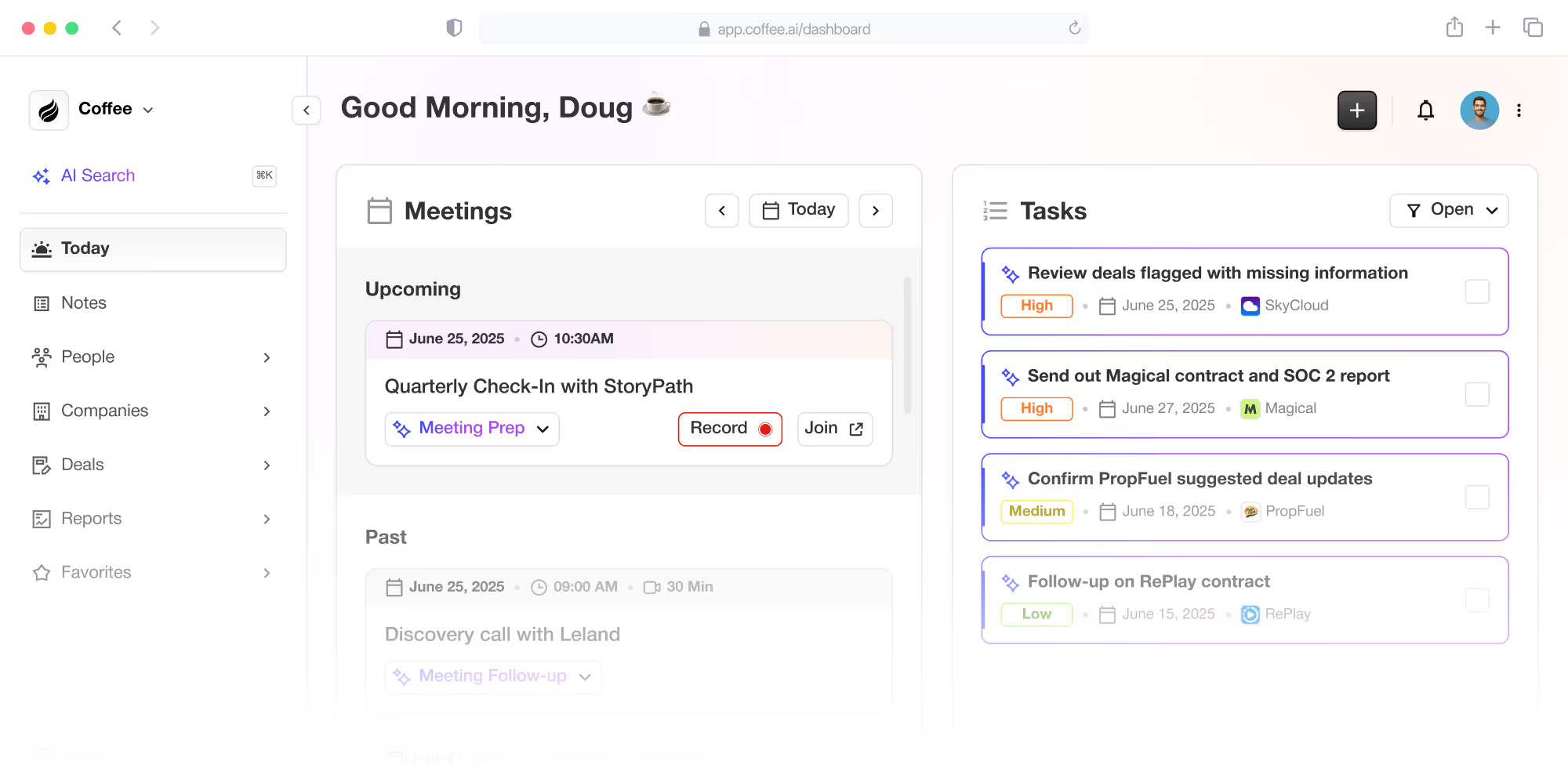
As a prime example of the AI-First trend, Coffee offers a platform that tackles the pain points of modern sales teams. By integrating with Google Workspace or Microsoft 365, it starts automating data tasks right away. Emails and calendar events turn into populated CRM records, capturing every interaction without user effort. Beyond logging, Coffee enriches data with details like job titles and funding history, reducing reliance on separate tools.
Meeting management is another strength. Before calls, it provides summaries of attendees and past chats. During sessions, an AI bot records and transcribes on platforms like Zoom or Teams. After, it drafts follow-ups and flags action items, customizable to sales methods like BANT or MEDDIC. Coffee’s pipeline feature also stands out, showing week-to-week changes to highlight deal momentum or risks, making reviews more actionable.
What sets Coffee apart is its dual role. It works as a standalone CRM for smaller businesses moving beyond spreadsheets, offering a full, easy-to-use system. For larger firms tied to Salesforce or HubSpot, it acts as a companion app, adding AI automation without disrupting existing setups. This flexibility makes it a practical choice for diverse needs.
Benefits and Challenges of Adopting AI-First CRM
Switching to an AI-First CRM brings clear upsides, starting with time savings. Automation frees up hours for selling, with reps often gaining 8-12 hours weekly to focus on clients. Better data quality, drawn directly from emails and calls, supports sharper insights compared to error-prone manual entry. Workflow efficiency also improves, as tasks like meeting prep and follow-ups are handled automatically.
On the flip side, challenges exist. Organizations with messy or scattered data may need cleanup efforts before seeing full benefits. Stakeholder alignment is crucial, as resistance from sales or IT teams can slow adoption. Integration with niche tools or custom setups might not always be straightforward, requiring extra planning. Weighing these trade-offs helps determine if the move aligns with your current setup and goals considering readiness and infrastructure needs.
Steps to Prepare Your Team for AI-First Tools
Before jumping in, assess your readiness across a few key areas. Start by mapping out your sales workflows to pinpoint manual bottlenecks. Check your data quality; incomplete or outdated records can limit AI effectiveness. Engage leaders from sales, operations, and IT to ensure everyone’s needs shape the transition.
Next, look at ROI metrics. Calculate time saved by multiplying freed-up hours by rep compensation rates. Factor in cost reductions from consolidating tools. Over time, improved deal management and pipeline clarity add to the value. A pilot test with a small group can validate these gains, refining your approach before a full rollout.
Tips for Maximizing AI-First CRM Impact
Data is the foundation of AI success. Connect your CRM to primary sources like email and calendars for accurate inputs. Set up regular audits to keep records fresh and consistent. User adoption also matters. Highlight how automation cuts busywork, and offer training focused on personal benefits, not just features.
Keep optimizing as the system learns from usage. Gather feedback to tweak settings or workflows. Over 3-6 months, as data builds, insights and automation grow stronger. Staying proactive ensures you get the most from your investment.
Ready to simplify your sales process? Request access to Coffee and see how AI-First design boosts your team’s output.
Comparing AI-First and Traditional CRMs
|
Feature |
Traditional CRM |
Coffee (AI-First) |
|
Core Design |
Built decades ago, AI added later |
AI at the core from day one |
|
Data Input |
Heavy manual entry |
Automated, saves 8-12 hours/week |
|
Insights |
Basic, often delayed |
Real-time pipeline trends |
|
User Experience |
Often feels like a task |
Built for rep ease, high usage |
This table shows why platforms like Coffee gain traction. Their focus on automation and user needs creates ongoing value, while older systems lag in adapting to today’s pace. Over time, AI-First data accuracy fuels better decisions, a cycle traditional CRMs struggle to match.
Planning Your AI-First CRM Rollout
First, analyze your current setup. List workflows, tech tools, and pain points to set a baseline. Involve key players early to align on goals. Then, pick a platform that fits—standalone for fresh starts or companion for existing systems like Coffee offers. A small pilot helps test impact and iron out issues.
For full deployment, prioritize training on benefits over mechanics. Monitor usage and address hurdles fast. Review performance regularly; AI tools improve with data over time. This phased approach keeps momentum and builds confidence in the shift.
Staying Ahead with AI-First Sales Tech
AI capabilities keep evolving, and AI-First platforms are built to adapt without major overhauls. Unlike legacy systems, they can incorporate new features as tech advances. Choosing a vendor with a clear innovation plan ensures your tool stays relevant.
Shape your sales processes to use AI strengths. Update methods to leverage automation and maintain strong data practices for compliance and quality. Train teams to see AI as a partner, blending tech precision with human connection skills for the best outcomes.
Take the first step now. Request access to Coffee and build a sales future powered by intelligent automation.
Common Questions About AI-First Sales Automation
Can AI CRM Fully Replace Manual Data Entry?
Platforms like Coffee significantly cut down manual entry by pulling data from emails and calendars to build records. Most routine updates happen automatically. However, unique deal details or custom fields may still need human input. The result is still a major time gain, often 8-12 hours weekly, for focusing on clients.
Does AI-First CRM Enhance Pipeline Accuracy?
Yes, by capturing detailed interaction data and maintaining historical records, AI-First tools like Coffee offer clearer pipeline views. Real-time updates reflect changes instantly, unlike manual systems where delays skew forecasts. This depth helps track deal speed and spot issues early.
Will AI-First CRM Work with My Current Tools?
Integration is a key strength for many AI-First CRMs. Coffee, for instance, connects with Salesforce and HubSpot as a companion, enhancing without replacing. Options like Zapier or APIs often support links to other marketing or custom systems. Early evaluation of your tech stack ensures a smooth fit.
What’s the ROI for AI-First CRM?
Time savings alone often justify the cost within a year, with reps gaining 8-12 hours weekly using tools like Coffee. Combining multiple tools into one platform cuts expenses on separate data or recording apps. Improved deal focus adds longer-term revenue gains.
How Soon Do Results Show After Implementation?
Many see gains in weeks as automation reduces workload. AI-First CRMs have a shorter learning curve, with basic use mastered quickly. Full benefits unfold over 3-6 months as data accumulates for deeper insights. Strong initial data connections speed up this timeline.
Final Thoughts on AI-Driven Sales Transformation
Gone are the days of wrestling with outdated CRMs that bog down your team. AI-First platforms like Coffee mark a turning point, using smart automation to lift manual burdens and sharpen focus on relationships and deals. This guide has walked through the limits of older systems, the edge of AI-First design, and practical steps to make the switch.
The impact goes beyond just saving time. Better pipeline clarity and streamlined operations position your business to act faster and smarter. Whether as a full CRM or an add-on to Salesforce or HubSpot, tools like Coffee adapt to where you are while pointing to where sales tech is headed.
Now’s the time to rethink your sales approach. Embrace technology that works as a true ally. Request access to Coffee and start experiencing how AI-First automation can redefine your team’s potential.