
Key Takeaways
- AI-first CRMs reduce reliance on manual data entry by using autonomous agents that capture and enrich customer data in the background.
- Traditional CRMs with AI add-ons can improve existing workflows, but core manual processes and data quality challenges often remain.
- Sales teams gain more value when CRM tools consolidate outreach, data enrichment, and forecasting into a single, integrated platform.
- Small teams that have outgrown spreadsheets and mid-market companies tied to legacy CRMs can both benefit from AI, but often in different ways.
- Teams that want autonomous CRM automation and time savings can get started quickly with Coffee at Coffee pricing.
The Automation Imperative: Why Traditional CRMs Fall Short in Modern Sales
Modern sales teams need automation that removes manual work instead of adding new administrative tasks. Traditional CRMs often assume that sales reps will consistently enter complete and accurate data into the system.
The Manual Data Entry Crisis
Many sales reps feel stuck in administrative work. Coffee market data shows that 71% of sales representatives spend too much time on data entry, and only 35% of their time on actual selling activities. Traditional CRMs often become data hubs that require constant updating instead of tools that support relationship building and deal progression.
Fragmented Workflows and Tool Proliferation
Sales teams frequently move between several tools for records, enrichment, outreach, and call recording. Every switch adds friction and increases the risk of lost context, duplicated records, and inconsistent activity tracking.
Architectural Limitations and Data Loss
Legacy CRM architectures were not built for continuous, AI-driven automation. Many platforms still rely on forms, fields, and manual workflows. As a result, critical data often goes uncaptured or becomes outdated quickly.
Sales teams that want to escape the manual data entry cycle can explore autonomous CRM automation at Coffee pricing.
Defining the Landscape: AI-First CRM vs. Traditional CRM with AI Companion Apps
AI-First CRM: The Agent-Led Model
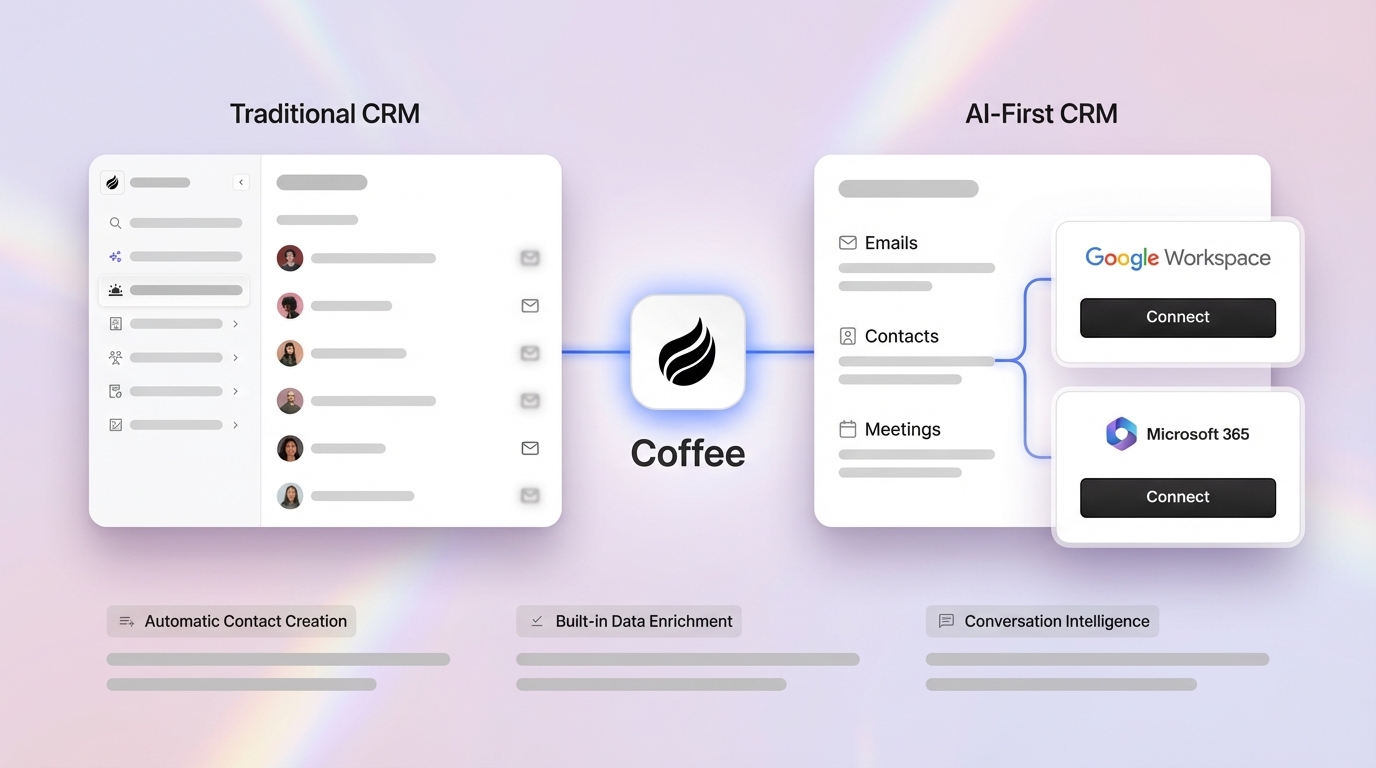
AI-first CRMs use an autonomous agent as the core of the system. Coffee follows this approach. The agent captures emails, meetings, and calls, creates and enriches records, and keeps customer data up to date with minimal human input.
This model improves data quality through automation, so teams see “good data in, good data out” without extra effort. Small and mid-sized businesses that have outgrown spreadsheets often adopt AI-first CRMs to gain automation without a heavy implementation project.
Traditional CRM with AI Companion Apps
Traditional CRMs that add AI companion apps keep the original platform in place while layering intelligence on top. This path suits companies that remain committed to a legacy CRM but struggle with adoption, data quality, or a scattered tool stack.
AI companions can automate parts of data capture and enrichment. However, the core system still depends on manual input, which limits the depth of automation an organization can achieve.
Key Evaluation Criteria for Unlocking Sales Automation and Efficiency
Data Quality and Automated Data Capture
Effective CRMs prioritize accurate, complete data with minimal manual entry. Strong solutions automate capture from email, calendar, call recordings, and other systems, then enrich that data to build reliable customer profiles.
User Experience and Adoption Rates
Sales reps adopt tools that save time and help close deals. CRM solutions should reduce administrative tasks, surface next steps, and provide clear context so reps can focus on conversations instead of updates.
Ecosystem Integration and Stack Consolidation
Tech stacks with many overlapping tools often slow teams down. The most effective CRM approaches centralize key workflows, connect to core systems, and reduce the number of logins and manual handoffs.
Actionable Pipeline Intelligence and Forecasting
Revenue leaders need fast answers to questions about pipeline health, deal risk, and forecast accuracy. CRMs should convert raw activity data into clear, current insights instead of requiring exports and manual spreadsheet work.
Total Value of Ownership and Operational Efficiency
Implementation time, training needs, maintenance, and integration work all affect CRM value. The best options lower the total cost of ownership while improving productivity per rep and keeping administrative overhead low.
In-Depth Comparison: Coffee’s Agent-Led Approach vs. AI-Augmented Traditional CRMs
Data Quality and Automated Capture
Coffee uses an autonomous agent to capture and maintain customer data. The agent creates contacts, enriches records with details like role and public profiles, and logs interactions from email, calendar, and calls. This process creates a unified and current view of each account.
Traditional CRMs with AI companions still center on manual entry. AI can assist with enrichment or suggestions, but core data often depends on whether reps complete forms and update fields consistently.

User Experience and Adoption
Coffee positions the agent as a co-pilot for reps. The agent prepares for meetings, drafts follow-up emails, updates pipeline stages, and flags risks, so reps can concentrate on conversations and strategy.
Traditional CRMs, even with companion apps, often keep complex interfaces and manual workflows. Reps still need to enter notes, adjust stages, and maintain records, which can reduce adoption and data completeness.
Ecosystem Integration and Stack Consolidation
Coffee consolidates key functions that many teams handle with separate tools. CRM, enrichment, meeting intelligence, and forecasting live in one platform, which reduces context switching and licensing overhead.
Traditional CRMs often rely on multiple AI apps for specific tasks. Each new app can introduce integration work, separate contracts, and additional training, which may offset some automation benefits.
Actionable Pipeline Intelligence and Forecasting
Coffee builds on accurate, automatically captured data to support pipeline analysis. Features like Pipeline Compare highlight movement in deals, new risks, and stalled opportunities without extra reporting work.
Traditional CRMs with AI can generate insights, but the quality of those insights depends on how complete and current the underlying data is. Manual gaps reduce the value of forecasting and risk analysis.
Total Value of Ownership and Operational Efficiency
Coffee aims to save each rep 8 to 12 hours per week by reducing manual data entry, consolidating tools, and lowering training needs. The agent handles much of the ongoing maintenance that administrators and operations teams often manage in legacy systems.
Traditional CRMs with AI companions may require more configuration, integration management, and ongoing data cleanup. These hidden costs can limit the overall efficiency gains from AI enhancements.
|
Capability |
Coffee: AI-First CRM |
Traditional + AI Apps |
Key Difference |
|
Data Entry Model |
Autonomous, agent-driven |
Manual with AI assistance |
Foundational vs. supplemental automation |
|
User Experience |
Co-pilot that removes busywork |
Enhanced but still complex |
Redesign vs. incremental change |
|
Stack Complexity |
Unified platform |
Multiple-layered tools |
Consolidation vs. accumulation |
|
Time Savings |
8–12 hours weekly per rep |
Variable, integration-dependent |
Predictable vs. inconsistent |
Tailoring Your Solution: Real-World Scenarios and Recommendations
Scenario 1: Small to Mid-Sized Businesses Outgrowing Manual Systems
Teams with 1 to 20 employees often move from spreadsheets to a first CRM and want automation without a dedicated admin. These teams benefit from AI-first CRMs that capture activities automatically, organize contacts, and provide simple pipeline views.
Coffee’s standalone AI-first CRM offers automated data capture, meeting support, and pipeline insights with minimal setup. The agent manages many tasks that traditional CRMs require admins to handle.

Scenario 2: Mid-Market Companies Committed to Existing CRMs
Mid-market organizations that already standardized on a traditional CRM may prefer to keep that system, yet still want better data and automation. AI companion apps can provide an overlay that captures activities and enriches data without a full migration.
Coffee’s companion app connects to existing CRMs to automate data capture, improve record completeness, and support reps during meetings and follow-up, while leaving the core system in place.
Teams that want to improve sales efficiency without a full platform change can review options at Coffee pricing.

Conclusion: Choosing an Agent-Led Path to Sales Automation
The decision between an AI-first CRM and a traditional CRM with AI apps determines how much automation your team can achieve in daily work. AI-first platforms such as Coffee treat the agent as the primary operator of the CRM, which supports cleaner data, higher adoption, and more consistent insights.
Organizations that want a modern, automated foundation may favor AI-first CRM. Teams that remain invested in an existing CRM can still gain important benefits from AI companions, yet often with more limited transformation. Sales leaders who want to move toward an agent-led future can review both AI-first and companion options at Coffee pricing.
Frequently Asked Questions
What is the main automation difference between an AI-first CRM and a traditional CRM with AI add-ons?
AI-first CRMs such as Coffee embed an autonomous agent into the core platform. The agent handles data capture, enrichment, and analysis by default. Traditional CRMs with AI add-ons still depend on manual input as the primary source of data, while AI operates as a secondary enhancement.
Can an AI companion app fully solve poor data quality in an existing CRM?
AI companion apps can improve data quality by logging activities automatically and enriching records. Coffee’s companion app reduces the chances of missing information by capturing emails, meetings, and calls. However, when the underlying CRM still relies on manual processes, some gaps and inconsistencies may remain.
How does an AI-first CRM affect sales team efficiency compared to traditional setups?
AI-first CRMs reduce time spent on data entry, meeting prep, and manual reporting. Coffee reports that many reps save 8 to 12 hours per week, which they can redirect toward prospecting and deal management. Traditional setups, even with AI, often keep fragmented workflows that limit these time savings.