
In today’s fast-paced business environment, the customer relationship management (CRM) landscape is undergoing a significant shift. Companies are under pressure to adapt to evolving customer expectations, tighter budgets, and intensified competition. Traditional CRM systems, once seen as the backbone of sales operations, often struggle to keep pace with these demands, leaving sales teams bogged down by inefficiencies and disconnected data. As organizations seek smarter ways to drive revenue and improve productivity, artificial intelligence (AI) is emerging as a critical tool. AI-first CRM platforms are reshaping how sales teams operate by automating repetitive tasks, unifying data, and delivering actionable insights. Among these innovations, Coffee stands out as a compelling example of how intelligent automation can address long-standing challenges and position businesses for growth.
This guide dives into the capabilities of AI-driven CRM automation, with a focus on how solutions like Coffee help executives overcome the limitations of legacy systems. You’ll find practical insights on assessing automation potential, understanding its impact on sales performance, and building a strategy for long-term success.
Why Legacy CRM Systems Fall Short in Today’s Market
Data Fragmentation Slows Down Sales Teams
Sales efficiency suffers when teams rely on outdated CRM systems. Representatives spend just 35% of their time selling, with the majority of their day consumed by tasks like data entry and administrative work. This imbalance slows down deal cycles and affects team morale.
The cost of inefficiency adds up. When 71% of a salesperson’s time goes to non-selling activities, organizations miss out on opportunities and incur higher operational expenses. Legacy platforms often force teams to juggle multiple tools for managing data, researching prospects, and analyzing calls, resulting in scattered information and inconsistent records.
Old Technology Limits AI Integration
Many traditional CRM systems lack the architecture to support modern AI tools. Their design struggles to handle diverse data types, such as emails or call transcripts, which are essential for generating meaningful insights. Without built-in capabilities for real-time analysis or historical data storage, these platforms require complex workarounds or additional tools to enable automation.
Modern AI systems thrive on unified data. Sales conversations and meeting notes hold valuable information that can drive smarter workflows. Platforms with updated architectures are better equipped to process this data and turn it into actionable steps for sales teams.
Low Adoption Undermines CRM Value
Sales professionals often see legacy CRMs as a chore rather than a tool. When adoption rates drop, data becomes incomplete, pipeline visibility fades, and forecasting loses accuracy. This creates a cycle of frustration and poor results.
Many salespeople turn to alternatives like spreadsheets or apps such as Notion for managing customer information. While these workarounds help individuals, they lack the structure needed for scalable insights, leaving organizations without reliable data for strategic decisions.
How AI-First CRM Redefines Sales Automation
AI Moves Beyond Simple Workflow Rules
AI-first CRM platforms shift from rigid automation to adaptive, intelligent systems. Coffee, for instance, prioritizes high-quality data by automatically pulling information from emails, calendars, and call records. This approach cuts down on manual work and ensures data accuracy for better decision-making.
Such systems help sales teams spot trends, prioritize tasks, and focus on high-value activities. By embedding AI into core functions, platforms like Coffee enable a more dynamic response to business needs.
Automating Data Entry and Updates
Manual data entry eats up valuable time, but AI-first tools tackle this issue head-on. Coffee connects to Google Workspace or Microsoft 365 to scan emails and calendar events, automatically building contact and company profiles. Sales representatives save an estimated 8 to 12 hours per week, allowing them to focus on closing deals.
The platform also enriches data with details like job titles, company size, funding history, and LinkedIn profiles. This built-in feature keeps records consistent without the need for separate tools. Activity tracking further ensures pipeline updates happen automatically by logging interactions from email and calendar data.
Streamlining Meeting Preparation and Follow-Ups
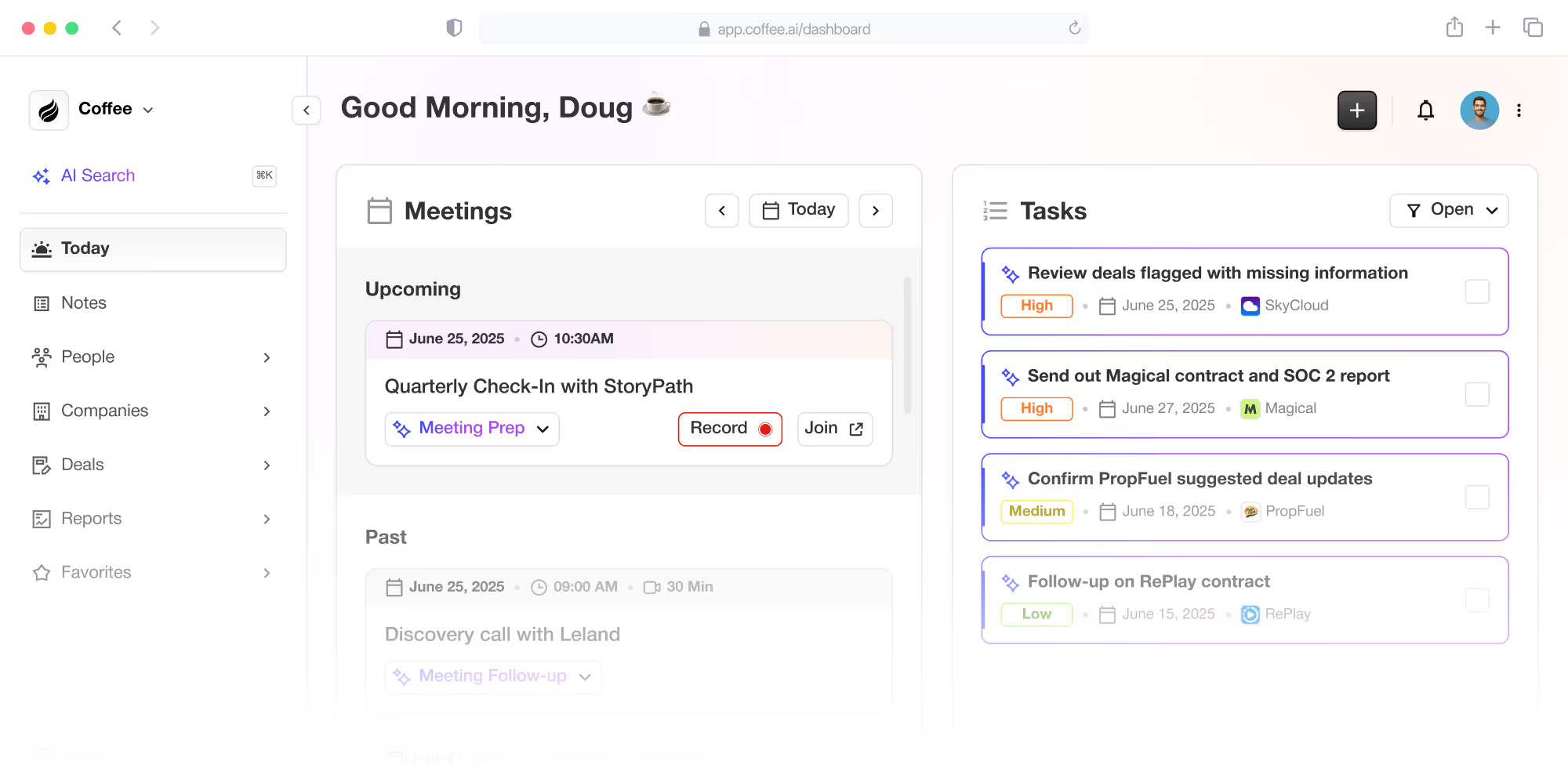
Meetings play a crucial role in sales, and AI can enhance every step. Coffee’s “Today” page offers briefings with attendee details, company background, and past interaction summaries, equipping representatives with context before each call.
An AI bot joins virtual meetings on platforms like Google Meet, Microsoft Teams, or Zoom to record and transcribe discussions. After meetings, Coffee generates summaries, identifies action items, and drafts follow-up emails tailored to methodologies like BANT or MEDDIC. This reduces administrative load and ensures consistent follow-through.
Key Benefits of Coffee’s AI Automation for Sales Leaders
Improving Pipeline Insights with Historical Data
Understanding pipeline trends is vital for forecasting and planning. Coffee’s Pipeline Compare tool uses a built-in data warehouse to store historical snapshots, letting users analyze deal progression week-over-week or over custom periods. This simplifies identifying new opportunities, stalled deals, or risks with minimal effort.
In contrast, some legacy systems require extra steps or tools to deliver similar visibility, slowing down analysis. Coffee turns pipeline reviews into focused, strategy-driven discussions.
Simplifying the Sales Tech Stack
Managing multiple sales tools creates complexity and cost. Coffee combines CRM, data enrichment, call recording, and forecasting into one platform, reducing the need for separate solutions. This cuts down on software expenses, training time, and integration challenges while improving data consistency and team efficiency.
See how a unified system can streamline your operations. Request access to Coffee’s AI-first CRM platform.
Encouraging Sales Team Buy-In
A CRM is only effective if the team uses it. Coffee’s design focuses on supporting sales tasks with features like automated data capture and meeting preparation. This makes the platform feel like a helpful partner rather than a burden, addressing common frustrations with older systems.
When sales teams engage with the tool, data quality improves, leading to better insights and decisions across the organization.
Targeting Prospects with Precision
Building prospect lists can be time-consuming, but Coffee simplifies it with natural language queries. Users can request specific profiles, such as “VPs of sales in North American companies with 50 to 500 employees, over $10 million in funding, and using Salesforce.” The platform delivers tailored results, helping teams focus on building relationships rather than hunting for leads.
Measurable Impact of AI CRM Automation
Boosting Revenue and Cutting Costs
Automation directly saves time, which translates to cost savings. By reducing 8 to 12 hours of administrative work per sales representative weekly, Coffee frees up resources for selling. Organizations can redirect this effort toward generating revenue and closing more deals.
Supporting Team Retention
Sales roles are demanding, and administrative burdens can lead to burnout. With automation handling routine tasks, representatives focus on meaningful interactions, improving job satisfaction. This helps retain talent and preserve valuable expertise within the team.
Delivering Fast Results
The timeline for seeing benefits varies based on an organization’s readiness and adoption speed. Coffee’s intuitive setup and automatic data integration minimize delays, helping teams realize value sooner compared to more complex systems.
Comparing Coffee to Traditional CRM Platforms
Coffee’s AI-first approach offers distinct advantages over legacy systems like Salesforce and HubSpot. While traditional CRMs provide automation features, Coffee emphasizes seamless data handling and user-friendly design as part of the broader trend toward intelligent sales tools.
Here’s how Coffee stacks up:
- Data Entry & Enrichment: Coffee automates data capture from emails and calendars, saving 8 to 12 hours per representative weekly. Legacy systems often rely on manual input or paid add-ons.
- Meeting Support: Coffee provides AI-driven briefings, summaries, and email drafts. Traditional platforms may require separate tools or manual effort for similar outcomes.
- Pipeline Analysis: Coffee offers one-click historical comparisons for quick insights. Older systems might need additional setup for comparable visibility.
- Tech Integration: Coffee unifies multiple functions into one platform, reducing complexity. Legacy CRMs vary in integration ease, often requiring extra solutions.
Coffee also uses a transparent seat-based pricing model, making costs predictable as teams grow.
Steps to Adopt AI Automation Successfully
Evaluating Your Organization’s Readiness
Implementing AI CRM automation starts with assessing your current setup. Review your technology infrastructure, team skills, and capacity for change. Data quality is critical since AI depends on reliable inputs. Setting clear goals and timelines ensures a smoother transition.
Leadership support plays a key role in driving adoption. Coffee offers onboarding assistance to help teams adapt quickly and start seeing benefits.
Steering Clear of Implementation Challenges
Many organizations focus too heavily on technical setup and overlook user training. Automation success depends on team buy-in and cultural alignment. Another common issue is automating outdated processes instead of rethinking workflows. Coffee encourages optimizing operations to fully leverage its features.
Avoid these hurdles with a strategic approach. Request access to Coffee’s platform for tailored support.
Planning Your AI Automation Rollout
Before launching, evaluate your technical systems and align automation goals with business priorities. Coffee provides onboarding, training, and optimization guidance to ensure quick results. Cross-functional teamwork and an easy-to-use interface help minimize disruptions and boost adoption.
The Future of Sales with AI-Driven Tools
Companies that adopt comprehensive automation gain a competitive edge. As part of this trend, Coffee turns CRM into a strategic asset by blending smart automation with an accessible design. This enables organizations to seize market opportunities and respond to challenges with agility, ensuring sustained growth.
Common Questions About AI CRM Automation with Coffee
How Soon Can Benefits Be Seen with Coffee?
Results depend on organizational readiness and team adoption, but many see improvements within weeks. Coffee’s straightforward design and minimal training needs help speed up the process.
What Metrics Should Track Automation Success?
Focus on time savings of 8 to 12 hours per representative weekly, clearer pipeline visibility, and higher team satisfaction. Tie these to specific business goals for measurable impact.
Does Coffee Fully Remove Administrative Work?
Coffee significantly cuts down on tasks like data entry and meeting follow-ups, saving representatives 8 to 12 hours weekly. This lets them prioritize selling and client relationships.
How Does Coffee Maintain Data Accuracy?
By pulling data directly from emails and calendars, Coffee avoids reliance on manual updates. Its data warehouse structure also stores historical records for ongoing accuracy.
What Changes Are Needed for Coffee’s Implementation?
Clear goals, user training, and leadership support are essential. Coffee’s design and resources help streamline the shift, reducing disruption and maximizing outcomes.
Elevate Your Sales Strategy with Coffee’s AI Automation
AI-first CRM automation addresses critical gaps in traditional systems. Coffee delivers a range of capabilities, from automated data handling to detailed pipeline insights, offering measurable value for sales teams. Its unified platform reduces tech complexity compared to disjointed legacy tools, providing a solid foundation for growth-focused businesses.
Sales success hinges on embracing intelligent tools. Start exploring the benefits of AI-driven CRM today. Request access to Coffee and see how it can reshape your sales operations.