Written by: Doug Camplejohn, CEO & Co-Founder, Coffee | Last updated: July 14, 2026
Key Takeaways for RevOps and Sales Leaders
- Legacy CRMs drain productivity as sales reps spend 65–72% of their time on non-selling tasks and data decays rapidly without automation.
- Autonomous AI agents replace manual busywork with a continuous observe-analyze-plan-execute-learn cycle that keeps CRM records accurate and pipelines visible.
- Agentic workflows deliver measurable gains: 80% faster lead response, up to 90% quicker case resolution, and 8–12 hours saved per rep each week.
- Effective governance, including least-privilege access, tiered approvals, audit logs, and human-in-the-loop checkpoints, ensures safe, compliant autonomous execution.
- See Coffee’s pricing to deploy an agent-first CRM that unifies data, automates workflows, and scales without metering costs.
Why CRM Is Shifting From Database to Execution Engine
Legacy CRMs were designed as passive containers: humans enter data, humans run reports, humans update stages. That architecture is collapsing under its own weight. Sales professionals spend around 70% of their working hours on non-selling tasks such as data entry and follow-up scheduling, and B2B contact data decays at roughly 30% per year, making manual maintenance a losing battle.
The market has responded to this productivity crisis by shifting from passive CRM databases to autonomous execution engines. 79% of enterprises have adopted AI agents in some form, but only 11% of deployments run in production, with many reporting measurable productivity gains. AI-powered sales teams close deals 35% faster on average, and Coffee saves sales reps 8–12 hours per week. The category has shifted from passive database to proactive execution engine.
Try Coffee free — the agent-first CRM built for this shift.
How Coffee’s Five-Stage Agent Cycle Actually Works
Autonomous agents operate through a continuous five-stage cycle that turns raw signals into concrete actions. Each stage feeds the next, creating a self-improving loop that replaces one-time rule configuration with ongoing goal-directed execution. The table below shows how each stage transforms CRM inputs into actions, and how the Learn stage feeds back into Observe to create continuous improvement.
| Stage | What the Agent Does | CRM Data Sources | Coffee Feature |
|---|---|---|---|
| Observe | Reads new leads, pipeline changes, emails, and calendar events | Google Workspace / Microsoft 365, CRM records | Auto-create Contacts & Activity Logging |
| Analyze | Synthesizes structured CRM data with unstructured sources via RAG-based retrieval | Deal history, call transcripts, enrichment data | Data Enrichment, MEDDIC/BANT Notes |
| Plan | Evaluates priorities and sequences 5–10 actions per cycle using LLM reasoning | Pipeline stage, ICP criteria, deal risk scores | Pipeline Compare, Suggested Leads |
| Execute | Updates records, sends follow-ups, schedules meetings, escalates tickets | CRM write-back, email, calendar | Automated Summaries, Follow-up Drafts |
| Learn | Stores outcome memory—reply rates, deal progress—to improve future decisions | Engagement signals, conversion outcomes | Built-in Data Warehouse |
This observe-analyze-plan-execute-learn cycle transforms how five core CRM workflows operate in practice. Each workflow below follows the same pattern: the agent replaces a manual trigger with continuous observation, swaps static rules for contextual reasoning, and turns one-time execution into ongoing learning. The Measured Outcome column highlights the productivity gain in each case.

| Workflow: Lead Routing | Traditional Approach | Agentic Approach | Measured Outcome |
|---|---|---|---|
| Trigger | Form submission fires static rule | Agent infers intent from email or web signal | 80% or more reduction in average response time from agentic lead routing |
| Scoring | Manual rep review | Agent scores against ICP in real time | Significant reduction in per-lead research time |
| Assignment | Round-robin or manager decision | Agent routes to best-fit rep autonomously | The 80% response-time improvement cited earlier, achieved through autonomous routing |
| Coffee Feature | Visitor Identification + Suggested Leads pixel | Named prospect with enrichment pre-filled, ready for outbound |
| Workflow: Meeting Orchestration | Traditional Approach | Agentic Approach | Measured Outcome |
|---|---|---|---|
| Pre-meeting | Rep manually reviews notes | Agent generates briefing with attendee context | Rep enters call informed without prep time |
| During call | Rep takes manual notes | Agent joins, records, transcribes | Admin time per meeting drops from 15+ minutes to 49 seconds with agentic AI scheduling |
| Post-meeting | Rep writes summary and follow-up | Agent drafts MEDDIC/BANT summary and follow-up email | Consistent qualification data enters CRM automatically |
| Coffee Feature | AI Meeting Bot + Automated Summaries | Follow-up drafted in Gmail for one-click send |
| Workflow: Case Resolution | Traditional Approach | Agentic Approach | Measured Outcome |
|---|---|---|---|
| Triage | Static queue assignment | Agent detects intent and routes to best-fit handler | Improved FCR with AI routing |
| Resolution | Human handles tier-1 tickets | Agent resolves autonomously within defined scope | Up to 90% faster resolution for tier-1 tickets |
| Escalation | Manual manager decision | Agent escalates when confidence is below threshold | Reduced escalation rates with AI routing |
| Coffee Feature | Activity Logging + bidirectional CRM write-back | Every resolution logged to the correct record automatically |
| Workflow: Pipeline Intelligence | Traditional Approach | Agentic Approach | Measured Outcome |
|---|---|---|---|
| Data collection | Manual CSV exports | Agent tracks all stage changes automatically | Reps reclaim 3+ hours/week spent on manual pipeline updates |
| Review prep | Manager interrogates reps | Agent surfaces progressed, stalled, and new deals | Pipeline reviews become strategic, not administrative |
| Forecasting | Gut-feel or static formulas | Agent generates real-time deal risk scores | 83% of sales teams using AI saw revenue growth vs. 66% without |
| Coffee Feature | Pipeline Compare (week-over-week visualization) | Built on data warehouse; full history retained |
| Workflow: Visitor Identification | Traditional Approach | Agentic Approach | Measured Outcome |
|---|---|---|---|
| Traffic capture | Anonymous sessions, no data | Pixel identifies name, title, company, pages visited | Anonymous traffic becomes named pipeline |
| Lead selection | Manual review of company lists | Agent recommends 2–3 specific contacts matching buyer persona | Suggested Leads narrows outreach to highest-fit individuals |
| Outbound action | Rep manually researches and reaches out | Real-time Slack alert; one-click add to CRM with enrichment | A B2B SaaS team substantially reduced lead response time |
| Coffee Feature | Visitor ID + Suggested Leads (vs. RB2B/Warmly company-only data) | LinkedIn profile surfaced for instant outbound without leaving the agent |
Traditional Automation vs. Agentic Loops
The productivity gains in those five workflows, including 80% faster lead response and up to 90% quicker case resolution, come from a different architecture. Traditional systems rely on fixed rules, while agentic loops reason over changing inputs. To understand why agents outperform rules-based systems, consider what happens when a workflow encounters an input it was not explicitly programmed to handle.

Rule-based automation moves known data through deterministic, fixed workflows. When a condition is not pre-defined, the workflow stalls. Traditional automation handles only structured data inputs, while agentic AI processes structured plus unstructured data with mixed, multi-source, changing context.
The practical difference is significant for revenue teams. Traditional CRM automation such as HubSpot sequences and Salesforce flows follows fixed rules, requires human-defined triggers, and cannot adapt when a prospect’s behaviour changes mid-sequence. An agentic loop reads the situation, such as an email reply, a missed call, or a funding announcement, and decides the next action without a human trigger. AI agents can analyze unstructured data such as call transcripts and emails, reason across context, and execute workflows previously requiring human judgment.
Coffee’s architecture is built for this distinction. Its agent ingests unstructured data from Google Workspace or Microsoft 365, including emails, transcripts, and calendar events, and structures it into the CRM record automatically, whether that record lives in Coffee’s Standalone CRM or in an existing Salesforce or HubSpot instance.
Guardrails and Human-in-the-Loop Controls
Autonomous execution introduces a clear risk: an agent with write access to your CRM and email can propagate errors at machine speed. Explicit governance controls keep agents inside defined boundaries and reserve high-stakes actions for humans. Coffee is SOC 2 Type 2 and GDPR compliant, and customer data is never used to train public models. Beyond platform-level security, effective agentic CRM governance relies on several connected operational controls.
Effective governance starts with least-privilege access. Data contracts must specify agent read/write permissions and confidence thresholds for every workflow. Within those boundaries, tiered action risk defines which operations run autonomously. Low-risk actions such as enriching firmographic fields execute automatically, while high-risk irreversible actions such as sending external communications always require explicit human approval.
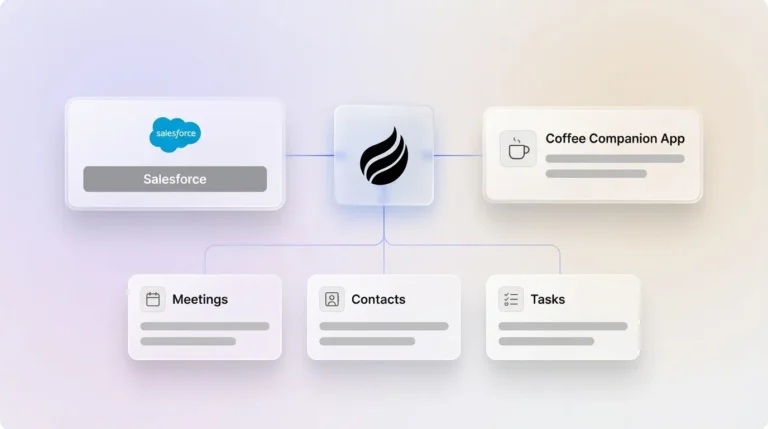
To keep the system of record accurate, bidirectional write-back in Coffee’s Companion App syncs enriched data back to Salesforce or HubSpot without human effort. Every autonomous decision remains traceable through audit logs. Event sourcing records every agent action, such as lead_submitted and qualification_scored, and enables reconstruction of why any autonomous decision occurred.
Finally, human override traceability preserves governance even when people step in. Every human override must preserve who changed the value, why, and the previous value to maintain governance integrity.
Human-in-the-loop checkpoints are configured as approval gates before high-stakes actions, allowing agents to prepare decisions while humans retain final authority. Coffee’s post-call follow-up workflow reflects this model: the agent drafts the email in Gmail, and the rep reviews and sends.

Strategic Trade-offs for Agentic CRM Adoption
Adopting agentic CRM introduces real trade-offs that RevOps leaders should weigh before committing. These considerations span effort, integration, cost, adoption, and reliability.
- Implementation effort: A minimum viable CRM agent covering 3–5 core workflows can typically be deployed in 2–4 weeks using existing platform tooling, assuming the CRM data layer is reasonably clean.
- Integration complexity: Mid-market teams can face multi-month CRM implementation timelines when deploying AI agent features on legacy platforms. Coffee’s Companion App reduces this by layering on top of an existing Salesforce or HubSpot instance through simple authentication.
- Cost: Mid-market agent CRM platforms vary in pricing for core agentic features. Coffee uses seat-based pricing with no metering on agent actions or LLM usage.
- Adoption: Technology readiness covers only part of successful AI agent deployment. People and processes must adapt, and reps must trust the agent before they stop maintaining shadow CRMs.
- Predictability: Agentic AI shows high adaptability but medium-to-lower predictability unless tightly governed. Governance frameworks, not model capability, determine production reliability.
Readiness and Evaluation Framework
RevOps leaders at 10–50 person tech companies should run a quick readiness check before deploying autonomous agents. Many AI projects never reach production, primarily because organizational foundations are missing rather than technology.
- Data quality: Assess whether a new employee could make sound decisions using your current CRM data. AI-ready data must be diverse, timely, accurate, secure, discoverable, and consumable.
- Process documentation: Mark a process as ready for agents when it is well documented and has low exception rates.
- Team size and current CRM: Teams already on Salesforce or HubSpot deploy Coffee as a Companion App, while teams under 20 people with no CRM deploy the Standalone product.
- Change capacity: Introducing agentic AI before fixing data and workflow gaps increases staff effort rather than reducing it.
- Ownership: Assign a knowledge owner, configuration owner, performance owner, and executive sponsor before launch.
- Measurement baseline: Define KPIs such as response time, pipeline coverage, and hours saved before the pilot begins so ROI is traceable.
Launch your first agentic workflow with Coffee in days, not months.
Common Pitfalls in Agentic CRM Projects
The most frequent failure modes in agentic CRM deployments are predictable and avoidable when teams plan for them upfront.
- Shadow CRMs: When reps distrust the system, they revert to spreadsheets or Notion. 60% of AI projects fail due to poor data governance or lack of AI-ready data, and shadow CRMs are both a symptom and a cause of poor data quality.
- Over-reliance on rules: Traditional automation breaks or stops when rules do not cover a case. Teams that build rule-heavy workflows before validating edge cases create brittle systems that require constant manual patching.
- Poor unstructured data handling: Legacy CRMs store only structured fields, so historical context disappears when a deal stage is updated. Making unstructured data usable for agents requires a six-stage pipeline of ingestion, parsing, chunking, metadata extraction, embedding, and indexing. Coffee’s built-in data warehouse handles this automatically from email and transcript sources.
- Scope creep before stability: Common failure patterns include scope creep before stability and absence of observability infrastructure. Limit the initial pilot to 3–5 workflows.
- Missing rollback mechanisms: The most frequently failed readiness checklist items are having a documented rollback plan and defined success metrics.
Implementation Guidance for a Four-Phase Rollout
A structured four-phase rollout minimizes risk and accelerates time-to-value for 10–50 person revenue teams. Each phase builds on the previous one, so skipping steps usually adds rework later.
- Discovery (Week 1): List every manual GTM task performed in a typical week, score each by frequency multiplied by average rep time cost, and prioritize the top 3–5 workflows.
- Pilot (Weeks 2–4): Connect Coffee to Google Workspace or Microsoft 365. The agent immediately begins auto-creating contacts, logging activity, and enriching records. For Salesforce or HubSpot users, authenticate the Companion App and validate bidirectional write-back.
- Validation (Days 30–60): Treat the first 30 days as a structured measurement window and track response time, task completion rate, and pipeline impact before any tuning.
- Measurement: One Coffee customer, a custom AI solutions firm generating tens of millions in revenue, eliminated manual pipeline reviews entirely using Pipeline Compare, replacing weekly spreadsheet exports with automated week-over-week deal visualization. The agent’s automatic contact creation from Google Workspace kept the CRM clean without any human data entry.
Sales organizations that reinvest AI time savings into high-impact activities are 2.2× more likely to exceed customer growth goals. The time savings described earlier, 8–12 hours per rep per week, are only valuable when they flow back into selling.
Frequently Asked Questions
What is the difference between agentic CRM and traditional CRM automation?
Traditional CRM automation executes predefined if-then rules when exact conditions are met. If a condition is not covered by a rule, the workflow stops and a human must intervene. Agentic CRM uses goal-directed reasoning to observe signals, infer context from incomplete or unstructured inputs, and select the best next action to reach a defined outcome, even when conditions are ambiguous. The practical result is that agentic systems handle email replies, call transcripts, and funding news as inputs, not just structured form fields. Coffee’s agent processes both structured CRM data and unstructured data from Google Workspace or Microsoft 365, ensuring every interaction is logged and every record stays current without human effort.
How does Coffee work if we already use Salesforce or HubSpot?
Coffee deploys as a Companion App that layers on top of your existing Salesforce or HubSpot instance. A simple authentication allows the Coffee Agent to read your CRM data, enrich it with information from emails, calendars, and call transcripts, and write accurate insights back to your system of record. Your existing workflows, quotas, required fields, and forecasting configurations remain intact. Coffee handles the data-in process so your CRM stays accurate without manual entry, and your pipeline reviews, forecasts, and reports reflect ground-truth data rather than whatever reps remembered to log.
What governance controls prevent the agent from taking unauthorized actions?
Coffee is SOC 2 Type 2 and GDPR compliant, and customer data is never used to train public models. At the workflow level, the agent operates on a tiered action model: low-risk actions such as contact enrichment and activity logging execute automatically, while higher-stakes actions such as outbound email drafts are surfaced for human review before sending. Every agent action is logged with a full audit trail. Human overrides preserve the previous value, the new value, and the reason for the change, maintaining full traceability. For teams on Salesforce or HubSpot, bidirectional write-back is scoped to the fields and objects defined during onboarding, so the agent cannot modify records outside its authorized scope.
How long does it take to see measurable results?
Coffee customers often see measurable time savings shortly after connecting their Google Workspace or Microsoft 365 account, because the agent begins auto-creating contacts and logging activity immediately. Pipeline Compare becomes useful within the first pipeline review cycle, typically week two or three, because the agent has already captured a baseline of deal states to compare against. Most customers see the 8–12 hour weekly time savings primarily from eliminating manual data entry, meeting prep, and post-call note-taking. Full ROI validation, including pipeline accuracy and conversion rate improvements, typically emerges within the first 30–60 days of structured measurement.
Conclusion: How to Evaluate Coffee for Your Team
Autonomous AI agents represent a structural shift in how CRM workflows operate, moving from passive data storage to continuous goal-directed execution. For RevOps leaders and Heads of Sales at 10–50 person tech companies, a few clear questions guide evaluation.
- Does the platform handle both structured and unstructured data, or only CRM fields?
- Does it deploy where your team already works, such as Salesforce, HubSpot, or a net-new CRM?
- Does it provide full audit trails, least-privilege permissions, and human review gates?
- Does it eliminate the need for point solutions like ZoomInfo, Gong, and separate visitor identification tools?
- Is pricing simple enough to evaluate ROI without consumption-based metering?
Coffee is the only agent-first platform that answers yes to all five. It unifies structured and unstructured data from Google Workspace or Microsoft 365, deploys as a Standalone CRM or Companion App on Salesforce or HubSpot, and includes enrichment, meeting intelligence, pipeline visualization, and visitor identification in a single seat-based price.