Written by: Doug Camplejohn, CEO & Co-Founder, Coffee | Last updated: July 15, 2026
Key Takeaways
- Sales teams in 2026 choose between passive relationship-mapping CRMs that rely on manual data entry and active AI agent CRMs that capture and structure data autonomously.
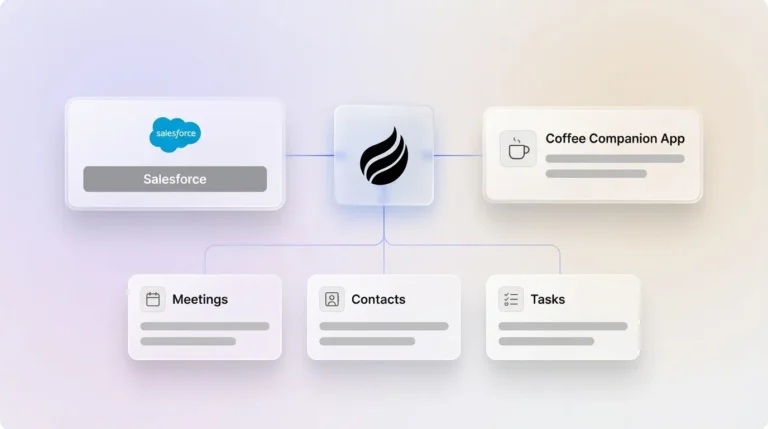
- Coffee is the only platform in this comparison that works as both a standalone CRM and a companion layer on existing Salesforce or HubSpot instances.
- Active agent automation in Coffee removes 8–12 hours of manual data entry per rep each week while processing unstructured data like call transcripts and emails.
- Pipeline intelligence in Coffee comes from verified, agent-captured data stored in a built-in data warehouse rather than rep-entered probability fields.
- Teams ready to eliminate manual CRM work can get started with Coffee as a standalone system or companion app.
Evaluation Criteria for Affinity CRM Alternatives
For 10–50 person tech companies, the wrong CRM choice compounds quickly. Salesforce’s 2026 State of Sales report, based on a survey of 4,050 sales professionals, found that reps spend 60% of their time on non-selling tasks, with manual data entry as the single largest category. Selecting a platform that perpetuates that burden creates a structural revenue problem. The seven criteria below frame every comparison in this article.
- Data quality and automation depth – The platform should capture structured and unstructured data automatically rather than depend on human input.
- Implementation effort – The system should deliver value quickly for a lean team without a dedicated CRM admin.
- Workflow fit for sales reps – The tool should serve the rep instead of forcing the rep to serve the tool.
- Integration requirements – The platform should operate natively alongside or on top of Salesforce and HubSpot.
- Reporting visibility – Pipeline intelligence should come from verified automated data instead of rep-entered probability fields.
- User adoption – Reps should actually use the system so shadow CRMs like spreadsheets and Notion do not persist.
- Long-term administrative burden – Ownership of data hygiene at month 12 and month 24 should be clear and manageable.
Side-by-Side Comparison of Leading Options
Now that the seven evaluation criteria are clear, the table below shows how Coffee, Attio, DealCloud, and HubSpot perform on each dimension. Use this high-level view to spot fit and gaps quickly. The detailed category analysis that follows then explains the nuance behind each comparison point.
| Criteria | Coffee | Attio | DealCloud | HubSpot |
|---|---|---|---|---|
| Data capture model | Active agent, auto-logs emails, calls, meetings, no manual entry required | Passive, syncs email/calendar metadata, structured fields require manual input | Passive, relationship data requires manual entry, built for financial services deal flow | Partially active, Breeze AI automates some logging, many fields still require rep input |
| Manual entry hours saved per rep/week | 8–12 hours/week (80% reduction from ~9 hrs baseline) | Partial reduction, no published automation benchmark | Minimal automation, designed for relationship mapping, not entry elimination | Up to 80% reduction reported in HubSpot AI implementations |
| Unstructured data (calls, emails, transcripts) | Yes, ingests and structures call transcripts, email threads, meeting notes | No, email/calendar metadata only, transcript content not natively processed | No, structured relational database, no transcript processing | Partial, Breeze AI summarizes some content, full transcript unification requires Gong/Chorus add-on |
| Deployment model | Standalone CRM or Companion App on Salesforce/HubSpot | Standalone only | Standalone only (financial services focus) | Standalone CRM, limited companion capability |
| Implementation speed (10–50 person team) | Days, connects via Google Workspace or Microsoft 365 authentication | Days for basic setup, relationship mapping takes weeks to populate | Weeks to months, enterprise-grade configuration required | 2–4 weeks for embedded AI value, full setup longer |
| Pipeline intelligence source | Automated, derived from verified agent-captured data in a built-in data warehouse | Relationship signals, recency and frequency scores, deal stage requires manual updates | Manual, rep-entered deal stages and relationship notes | Mixed, Breeze AI adds predictive scoring, underlying data quality depends on rep entry |
| AI CRM adoption context (2026) | Built as agent-first from inception | Post-ChatGPT UI, passive architecture unchanged | Pre-AI architecture, AI features limited | Approximately 65% of businesses use generative AI inside their CRM as of 2026, HubSpot Breeze is a primary driver |
Category-by-Category Analysis of Coffee vs Affinity Alternatives
Setup and Onboarding Speed
Coffee connects to Google Workspace or Microsoft 365 through a single authentication step and immediately begins auto-creating contacts, logging activities, and enriching records. DealCloud targets financial services firms and carries enterprise-grade configuration requirements measured in weeks. Attio deploys quickly for basic contact management but needs time for its relationship-mapping layer to populate meaningfully. Embedded AI capabilities within CRM platforms typically deliver value within 2–4 weeks for initial use cases, while standalone AI platforms that require integration often take 6–12 weeks for full implementation.
Data Capture and Maintenance Effort
Mid-market B2B sales reps spend 17% of their week, approximately 6.8 hours, on CRM data entry and pipeline updates alone. Coffee’s agent removes that category of work by auto-logging every email, call, and meeting. Attio and DealCloud both rely on passive architectures. They capture metadata signals but still require human input for deal-stage updates, notes, and qualification fields. HubSpot’s Breeze AI automates some logging but still depends on rep-entered data for core pipeline fields.

Usability for Frontline Sales Teams
Fifty-five percent of CRM implementations fail to meet their planned objectives. Coffee inverts the adoption problem by removing the data-entry obligation entirely. Reps receive meeting briefings, automated summaries, and drafted follow-ups instead of being asked to produce them. Attio offers a modern UI but does not remove the entry burden. HubSpot’s adoption challenges at the rep level are well documented, and its AI features improve the experience but do not eliminate manual work.

Manager Visibility and Reporting Quality
Coffee’s Pipeline Compare feature visualizes week-over-week deal changes automatically, using agent-captured data stored in a built-in data warehouse. AI and ML in sales forecasting produce a forecast variance of 8–15%, representing a 15–25% improvement over manual forecasting methods. Attio and DealCloud surface relationship-strength signals but do not provide automated pipeline-change tracking. HubSpot’s forecasting accuracy depends on the quality of rep-entered probability fields, which becomes a weakness when adoption is low.
Integration Complexity and Stack Fit
Coffee operates in two modes. It can run as a standalone system of record or as a companion layer that authenticates with existing Salesforce or HubSpot instances and writes enriched data back to them. Salesforce Agentforce often requires weeks to months for initial agent deployment because teams must configure Einstein, Data Cloud, and Agent Builder, while HubSpot Breeze agents deploy in minutes to hours. DealCloud integrations are purpose-built for financial services workflows and carry significant configuration overhead for general B2B sales teams.
Long-Term Flexibility and Future AI Workflows
The Creative Genius 2026 State of SMB AI Automation report found that mid-market companies with $25M–$100M in revenue have 74% adoption of at least one production AI workflow, with 82% planning to deploy more in the next 12 months. Coffee’s dual deployment model prevents lock-in to a rip-and-replace decision. Teams can start as a companion layer and migrate to standalone later or remain as a companion indefinitely.
Best-Fit Scenarios by Company Stage and Existing Stack
The right deployment depends on team size, existing stack, and process maturity.
Early-stage teams (1–20 people, no existing CRM): Coffee Standalone fits best. These teams have outgrown spreadsheets but view HubSpot and Pipedrive as expensive manual chores. The agent handles all data entry from day one, and there is no legacy data to migrate.
Growing sales orgs (20–50 people, evaluating first real CRM): Coffee Standalone or Companion App can work, depending on whether a prior CRM investment exists. The agent’s ability to auto-create contacts from Google Workspace or Microsoft 365 means the CRM is populated before the first rep logs in.
Teams with established Salesforce or HubSpot instances: Coffee Companion App is the right deployment. A single authentication step allows the Coffee agent to sync data, enrich records, and write insights back to the primary CRM. This preserves existing Salesforce configurations such as quotas, forecasting, and required fields while removing the manual entry burden that degrades data quality over time. Newer AI-first CRMs like Day.ai and Clarify lack the depth of Salesforce and HubSpot integration required to handle these configurations reliably.
Operational and Long-Term Considerations for RevOps Leaders
With nearly two-thirds of businesses now using generative AI in their CRM, the strategic question for RevOps leaders has shifted from whether to adopt AI CRM features to which workflows to automate first. Cross-functional ownership becomes critical in this context. When the agent handles data entry, RevOps can redirect hygiene effort toward pipeline analysis and forecasting calibration instead of chasing reps for CRM updates.
Change management requirements are lower for Coffee than for traditional CRM migrations because reps are not asked to change behavior. The agent observes existing communication patterns and structures them automatically. This passive observation model means training can focus on consuming agent outputs such as briefings, summaries, and pipeline comparisons rather than on data entry protocols.
B2B contact data decays at approximately 2.1% per month, meaning 22–30% of CRM contact records become inaccurate within a year without active hygiene. Coffee’s continuous agent-driven enrichment addresses this decay automatically. Affinity-style passive tools instead rely on periodic manual cleanup cycles, which leave organizations with gaps in field completeness between cleanup windows.
Risks, Limitations, and Common Misconceptions
No platform removes all manual judgment. Even with AI automation, full CRM hygiene remains challenging as tools can log calls and update records from interactions but still require human judgment on ambiguous data to maintain accuracy. Coffee’s agent handles the high-volume, repeatable entry tasks and then surfaces edge cases for rep review instead of guessing.
A common misconception is that passive relationship-mapping tools like Affinity provide equivalent pipeline intelligence to active agent CRMs. They do not. Affinity scores relationship strength based on email and calendar metadata frequency and recency. It does not process the content of those interactions, does not update deal stages, and does not generate forecasts from verified activity data.
Gartner predicts that through 2026, organizations will abandon 60% of AI projects that are not supported by AI-ready data. This risk becomes acute when teams deploy AI features on top of a passive CRM with poor underlying data quality. Coffee’s architecture addresses this at the foundation by ensuring good data enters the system before any intelligence layer attempts to analyze it.
Overbuying also creates problems. DealCloud is purpose-built for private capital and financial services deal flow. Deploying it for a general B2B SaaS sales team introduces unnecessary complexity and cost. Teams should match platform depth to actual workflow requirements.
Decision Framework and Summary Matrix
| Constraint | Coffee Standalone | Coffee Companion | Attio | DealCloud | HubSpot |
|---|---|---|---|---|---|
| No existing CRM, 1–20 people | ✓ Primary fit | — | Possible | Not recommended | Possible |
| No existing CRM, 20–50 people | ✓ Strong fit | — | Limited pipeline depth | Not recommended | Possible with AI tier |
| Existing Salesforce instance | — | ✓ Primary fit | Does not integrate as companion | Separate system | Separate system |
| Existing HubSpot instance | — | ✓ Primary fit | Does not integrate as companion | Separate system | Native AI features available |
| Financial services / private capital deal flow | Possible | Possible | Possible | ✓ Purpose-built | Possible |
| Eliminate manual data entry as primary goal | ✓ Primary fit | ✓ Primary fit | Partial | Minimal | Partial |
| Relationship network mapping as primary goal | Included via agent | Included via agent | ✓ Core feature | ✓ Core feature | Limited |
Frequently Asked Questions
How long does Coffee implementation typically take for a 10–50 person team?
Coffee connects to Google Workspace or Microsoft 365 through a single authentication step, and the agent begins auto-creating contacts, logging activities, and enriching records immediately after connection. For most teams in the 10–50 person range, the system becomes operational within days rather than weeks. There is no complex configuration, no required CRM admin, and no data migration required for a net-new deployment. Teams deploying Coffee as a Companion App on an existing Salesforce or HubSpot instance follow the same authentication process, and the agent begins writing enriched data back to the primary CRM shortly after setup.

What migration effort is required when moving from Affinity or similar tools?
Migration effort from Affinity depends on what data exists in the source system. Affinity primarily stores relationship-strength scores, contact records, and interaction metadata. Coffee’s agent can ingest contact records and begin enriching them immediately. Because Coffee auto-creates contacts from email and calendar history after connection to Google Workspace or Microsoft 365, many records populate automatically without a manual import. The more significant transition is behavioral. Teams moving from a passive relationship-mapping tool to an active agent CRM no longer need to maintain data entry habits, because the agent handles that work going forward.
How does Coffee integrate with existing Salesforce or HubSpot instances?
Coffee’s Companion App model deploys the Coffee agent as an intelligent layer on top of an existing Salesforce or HubSpot installation. A simple authentication step allows the agent to sync data bidirectionally, enrich contact and company records, log activities, and write pipeline insights back to the primary CRM. Coffee has deep knowledge of Salesforce and HubSpot configurations including quotas, forecasting fields, required fields, and custom objects, which are areas where newer AI-first CRMs frequently encounter integration failures. RevOps teams do not need to rebuild their existing CRM architecture. They add the Coffee agent as the data-entry and enrichment layer that keeps the system of record accurate without human effort.

What 2026 benchmarks exist for data quality and reporting accuracy after AI automation?
Several 2026-dated studies quantify the impact of AI automation on CRM data quality. Organizations with continuous AI data hygiene programs maintain more than 90% field completeness on required CRM fields, compared to 65–75% for organizations that rely on quarterly manual cleanup. A 12-rep SaaS sales team that implemented an AI automation layer on HubSpot improved pipeline data accuracy from 58% to 91% and reduced quarterly forecast miss rate from 28% to within 8% of actual results. AI-powered lead scoring achieves up to 90% accuracy compared to 30% for traditional manual methods. These forecasting and scoring gains depend on continuous automated data capture rather than periodic manual updates, which aligns directly with Coffee’s agent architecture.
How does Coffee scale security and performance as organizations grow?
Coffee is SOC 2 Type 2 and GDPR compliant. Data processed by the Coffee agent is not used to train public AI models. Coffee’s pricing model is seat-based, so teams pay for human seats, and the agent’s labor is included without usage-based metering on LLM calls or automated processes. The cost structure therefore scales predictably as headcount grows, without surprise overages tied to agent activity volume. For organizations with complex security review requirements, such as heavily regulated industries like healthcare or finance, Coffee’s current profile is best suited to tech-forward companies where standard SOC 2 Type 2 and GDPR compliance satisfies procurement requirements.
Conclusion: Choosing the Right AI-Driven Sales CRM
The core tradeoff in this comparison is architectural. Affinity, Attio, and DealCloud are passive systems that map relationships and store data but depend on humans to keep that data current and complete. HubSpot has added meaningful AI capabilities through Breeze, yet its underlying data quality still depends on rep adoption. Sales professionals often rate their company’s CRM data quality as poor or average due to reliance on manual data entry. AI intelligence layered on top of bad data cannot produce reliable forecasts.
Coffee solves the problem at the source. The agent captures structured and unstructured data automatically from emails, calendars, call transcripts, and meeting notes, then writes clean, enriched records to the system of record without human intervention. Whether deployed as a standalone CRM for teams building their first real sales infrastructure or as a companion layer on an existing Salesforce or HubSpot instance, Coffee is the only solution in this comparison that removes manual data entry while unifying all data sources into accurate pipeline intelligence.