Written by: Doug Camplejohn, CEO & Co-Founder, Coffee | Last updated: August 17, 2026
Key Takeaways for Choosing an AI CRM in 2026
- Autonomous data capture is the decisive factor for reliable pipeline automation. Platforms that still require manual entry cannot deliver accurate AI forecasting.
- Coffee is the only platform that unifies structured and unstructured data at the source, eliminating the 5.9 hours per rep per week spent on manual CRM logging.
- Legacy relational databases overwrite historical context on every update, which destroys the lineage required for trustworthy week-over-week pipeline analysis.
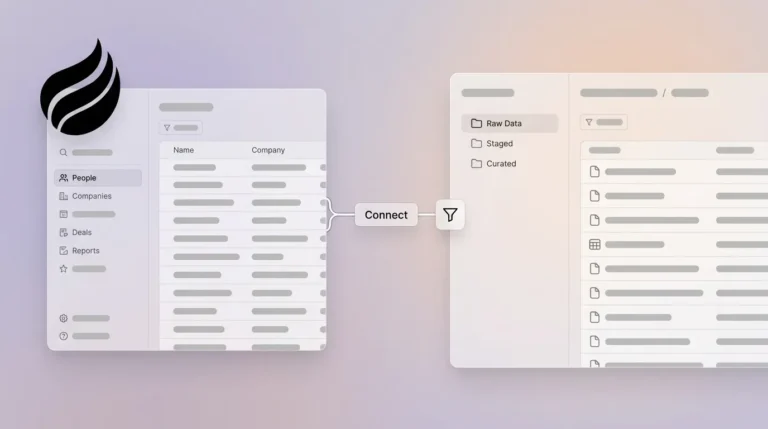
- Coffee operates as either a standalone CRM or a companion layer on existing Salesforce or HubSpot instances, removing the need for costly migrations or duplicate data entry.
- Ready to deploy autonomous pipeline automation without comparison fatigue? Start with Coffee today and remove manual CRM maintenance from your workflow.
How This Guide Evaluates Autonomous Pipeline Automation
This guide defines a clear evaluation framework before naming vendors. These criteria separate platforms that assist humans from platforms that execute autonomously.
- Depth of autonomous data capture: The platform must ingest structured data such as contacts, companies, and deal fields, along with unstructured data such as email threads, call transcripts, and calendar events, without human input.
- Elimination of manual entry: The platform should remove a high percentage of CRM administration tasks entirely instead of simply accelerating them.
- Pipeline intelligence accuracy: The platform needs to preserve historical context in a data warehouse instead of overwriting records and losing lineage.
- Integration flexibility: The platform should operate as a standalone system of record and as a companion layer on top of existing Salesforce or HubSpot instances.
- Implementation effort: Teams should see the agent capturing live data quickly, with minimal remediation required for existing records.
- User adoption: The platform must serve the rep, not demand that the rep serve the platform.
- Total cost of ownership: Evaluation must include seat fees, required point solutions, and remediation work.
Poor CRM data quality, including duplicates, missing fields, and inconsistent formatting, remains a significant hidden cost for AI pipeline automation. Many teams must remediate data before deploying agents on legacy systems, so evaluation needs to factor in that cost before comparing headline features.
Side-by-Side Platform Comparison
| Platform | Autonomous Data Capture | Pipeline Intelligence Accuracy | Integration Model |
|---|---|---|---|
| Coffee | Agent ingests email, calendar, and call transcripts automatically, unifying structured and unstructured data with no manual entry required | Preserves complete state history for trend analysis, enabling week-over-week pipeline views without spreadsheets | Standalone CRM or Companion App on top of existing Salesforce or HubSpot, with simple OAuth authentication |
| Salesforce Agentforce | Autonomous multi-step workflows for pipeline health monitoring and re-engagement triggers, structured data primary, unstructured data requires additional configuration | Atlas Reasoning Engine orchestrates pipeline workflows, with forecast accuracy dependent on data quality of the underlying Salesforce instance | Native Salesforce platform only, Agentforce 1 Sales tier priced at $550/user/month |
| HubSpot Breeze | Breeze Agents automate qualification, outreach, and pipeline updates, with GPT-5 backbone as of January 2026, while manual entry remains required for many unstructured data sources | Outcome-based pricing at $0.50 per resolved conversation and $1 per qualified lead, with forecast reliability tied to HubSpot record completeness | Native HubSpot platform serving 279K+ customers, with limited companion capability for non-HubSpot stacks |
| Pipedrive | AI sales assistant recommends deal prioritization and workflow automation handles reminders and routing, while data entry remains largely manual | AI-powered deal suggestions based on historical win patterns, with no native data warehouse for historical context preservation | Standalone CRM, workflow automation requires the Growth plan (successor to the former Advanced plan) at $39/user/month billed annually, integrations via third-party connectors |
The comparison above highlights one critical differentiator: autonomous data capture that feeds a reliable architecture. The next section explains why this factor outweighs many individual feature checkboxes.
Data Capture and Maintenance: Ending the Data Entry Grind
Salespeople spend on average 5.9 hours per week manually logging data into CRM, and at a fully loaded base salary of $75,000, that equals $10,000 per rep per year in direct salary costs alone. For a 20-rep team, that becomes $200,000 in annual payroll spent on record-keeping instead of selling.
The decay problem compounds the entry problem. CRM data decays at roughly 30% per year as contacts change roles, companies merge, and deal details shift. When reps enter data hours or days after meetings, critical nuances disappear permanently, and in relational database architectures, an updated field erases the prior value.
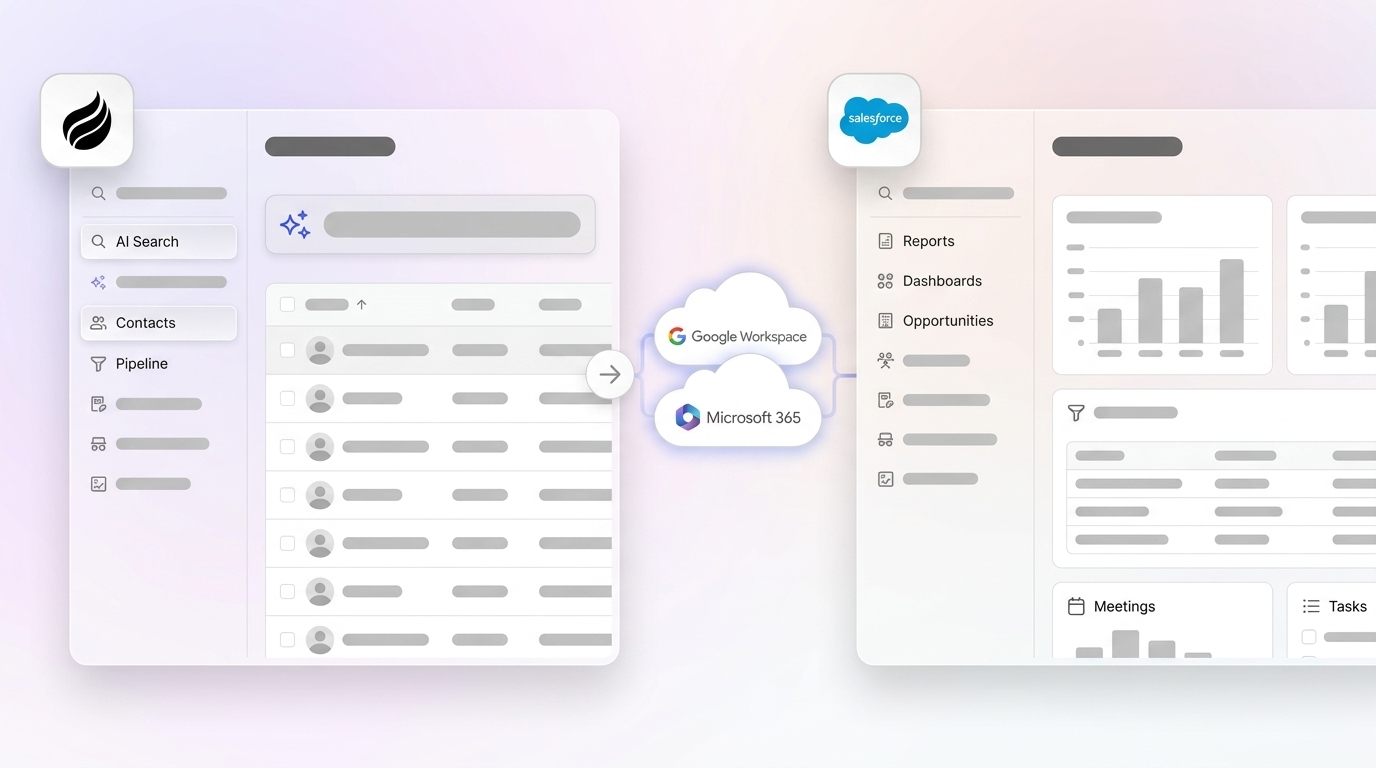
Coffee’s agent connects to Google Workspace or Microsoft 365 and immediately begins auto-creating contacts, logging activities, and enriching records with job titles, funding data, and LinkedIn profiles from licensed data partners. The system associates every note and interaction with the correct record automatically. Salesforce Agentforce and HubSpot Breeze have moved toward agentic execution for defined workflow steps, but in 2024–2025 both operated as copilot models requiring human review or execution at every step, and their 2026 agentic upgrades still depend on the quality of the underlying instance. Pipedrive automation handles reminders and routing while leaving data entry substantially in the hands of reps.
Pipeline Visibility and Forecasting Reliability
Twenty-eight percent of sales leaders identify driving predictable pipeline as their top priority for 2026. The main gap between that ambition and execution sits in data architecture. Legacy CRM systems use relational databases that overwrite records on update, which destroys the historical context required for reliable trend analysis.
Coffee’s built-in data warehouse preserves every state change and powers the Pipeline Compare feature, which visualizes week-over-week deal movement such as progressed opportunities, stalled deals, and new additions without CSV exports or manual review preparation. AI-augmented forecasting can reach higher accuracy than traditional methods, but that improvement only appears when the underlying data is complete and current. An agent that captures data autonomously acts as the prerequisite for that accuracy.
Companies using dedicated pipeline management tools can achieve improved revenue growth, and organizations that prioritize pipeline quality are 2x more likely to exceed customer acquisition expectations. Those outcomes depend on accurate data before it reaches the forecasting layer.
Meeting Orchestration, Lead Identification, and Outreach Automation
Coffee’s agent supports the full meeting lifecycle. Before calls, it prepares reps with a briefing that covers attendees, roles, and prior interaction context. During calls, it joins via Zoom, Teams, or Meet to record and transcribe. After calls, it generates summaries, identifies next steps, and drafts follow-up emails, structured according to BANT, MEDDIC, or SPICED depending on team preference.

For lead identification, Coffee’s Lead Finder accepts natural-language commands such as “Find me VPs of Sales at SaaS companies with 50–200 employees” and builds targeted prospect lists from its own database, which removes the need for a separate ZoomInfo or Apollo.io subscription. Lists feed directly into Campaigns, Coffee’s native multi-step email sequencing tool, which sends from the rep’s own connected mailbox with stop-on-reply enabled by default.

Salesforce Agentforce and HubSpot Breeze offer meeting summaries and outreach drafting, yet both depend on the rep to initiate workflows and review outputs at each stage. Traditional AI assistance speeds up human work by generating opportunity scores, drafting emails, and summarizing calls, while the human still triggers and approves every workflow step. Pipedrive does not offer native sequencing at comparable depth and requires point-solution integrations for outreach automation.

Best-Fit Use Cases by Team Size and Tech Stack
The right platform depends on current infrastructure and tolerance for implementation complexity.
- Early-stage teams (1–20 employees): Coffee’s Standalone CRM suits founders and early sales hires who have outgrown spreadsheets and Notion but view HubSpot and Pipedrive as expensive maintenance burdens. The agent handles setup automatically after connecting Google Workspace or Microsoft 365.
- Growing mid-market with existing Salesforce or HubSpot (10–50 reps): Coffee’s Companion App deploys as an intelligent layer on top of the existing instance. A simple OAuth authentication allows the agent to sync, enrich, and write insights back to the primary CRM without a migration. This path fits RevOps teams that must keep their system of record but need the data quality problem solved.
- Teams that have outgrown spreadsheets but reject legacy maintenance: Coffee Standalone replaces the CRM, enrichment tool, prospecting database, recording tool, and sequencing platform in a single seat-based subscription. Sales teams using AI saw revenue growth at a rate of 83% vs. 66% without AI, while sales reps spend 70% of their time on non-selling tasks.
Risks and Limitations of Each Approach
Each platform in this comparison carries specific risks that vendor marketing rarely surfaces.
- Salesforce Agentforce: Agentforce reached approximately $800M ARR by the end of fiscal 2026 and represents genuine agentic progress, yet the platform carries 25 years of legacy architecture. Autonomous features operate on top of a relational database that still loses historical context on field updates. Implementation complexity and per-seat cost at $550/user/month make it prohibitive for most mid-market teams without dedicated Salesforce administrators.
- HubSpot Breeze: HubSpot began as a marketing tool with a CRM added later. Breeze Agents improve workflow execution but do not resolve the architectural limitation of a system not designed for unified intelligence. Outcome-based pricing introduces variable cost that becomes difficult to forecast at scale.
- Pipedrive: Workflow automation covers reminders and routing but does not approach autonomous data capture. Teams still perform the data entry grind, and the platform offers no native data warehouse for historical pipeline analysis.
- Coffee: Coffee currently integrates with third-party tools via Zapier, with deeper native integrations on the roadmap. It does not suit large enterprises with complex custom workflows or heavily regulated industries that require multi-year security reviews. Gartner warned in 2025 that over 40% of agentic AI projects may be canceled by the end of 2027 due to escalating costs, unclear business value, or inadequate risk controls, which represents a risk for any agentic deployment without defined governance boundaries.
The most common misconception across all platforms is that adding AI features to a passive CRM solves data quality. Over 60% of AI pilots never make it past controlled environments, with the problem residing in noisy features, stale pipelines, and inaccurate labels rather than weak algorithms. AI amplifies bad data and does not correct it.
Decision Framework and Summary Matrix
The evaluation criteria, platform comparison, and risk analysis above converge on a simple decision tree. Your current infrastructure, team size, and tolerance for complexity determine which platform can deliver autonomous pipeline automation without new administrative burdens.
- No existing CRM, 1–20 reps, want zero admin overhead: Coffee Standalone
- Existing Salesforce or HubSpot, 10–50 reps, need data quality fixed without migration: Coffee Companion App
- Committed to Salesforce ecosystem, have dedicated admin resources, budget above $500/user/month: Salesforce Agentforce
- Marketing-led organization, HubSpot already central to operations, can absorb outcome-based pricing: HubSpot Breeze
- Small team, budget-constrained, can tolerate manual data entry in exchange for low cost: Pipedrive Advanced
The decision variable that overrides all others is data architecture. Gartner estimates the average annual cost of poor data quality at $12.9 million per organization, with AI systems amplifying the impact through scaled wrong decisions when acting on bad data. Only a platform with an agent that captures data autonomously at the source, before it enters the system, solves that problem structurally.
Frequently Asked Questions
How long does it take to implement Coffee and see the agent working?
For the Standalone CRM, implementation begins immediately after connecting Google Workspace or Microsoft 365 via OAuth. The agent starts scanning emails and calendars to auto-create contacts and log activities within the first session. Teams avoid lengthy onboarding, migration projects, and administrator configuration for core functionality. The Companion App for Salesforce or HubSpot follows the same authentication pattern, with the agent beginning to sync, enrich, and write insights back to the existing CRM shortly after connection. Most teams see the agent actively managing data capture on day one.
What happens to existing CRM data during migration to Coffee?
For teams adopting Coffee as a Standalone CRM, existing records can be imported, and the agent then takes over ongoing data capture and enrichment from that baseline so new interactions are logged automatically. For teams using Coffee as a Companion App, no migration occurs, because the existing Salesforce or HubSpot instance remains the system of record while Coffee’s agent writes enriched data back into it. This structure makes the Companion model particularly low-risk for mid-market teams with established CRM histories.
How does Coffee handle data security and compliance?
Coffee is SOC 2 Type 2 certified and GDPR compliant. Data processed by the Coffee agent does not train public AI models. For teams in regulated industries or those with specific data residency requirements, Coffee’s security posture covers the majority of mid-market use cases. Organizations in healthcare or financial services with multi-year security review requirements currently fall outside Coffee’s ideal customer profile.
How does Coffee’s data quality compare to dedicated enrichment tools like ZoomInfo?
Coffee’s agent enriches records with job titles, funding information, and LinkedIn profiles via licensed data partners, which provides coverage roughly on par with standalone enrichment databases for most mid-market use cases. The key distinction is that enrichment sits inside the agent’s workflow, so teams avoid separate subscriptions, CSV exports, and manual matching. For teams that currently pay for ZoomInfo or Apollo.io in addition to their CRM, Coffee consolidates that cost into a single seat-based price.
What is the difference between AI assistance and true autonomous execution in a CRM context?
AI assistance improves productivity inside a human-led process. The system suggests an email draft, scores a lead, or flags a stalled deal, and a human decides whether to act. True autonomous execution removes the human from the processing loop for defined tasks. The agent captures the interaction, enriches the record, logs the activity, updates the deal stage, and prepares the follow-up without waiting for a human trigger. Coffee’s agent operates in autonomous execution mode for data capture, enrichment, meeting management, and pipeline tracking. Salesforce Agentforce and HubSpot Breeze have moved toward autonomous execution for specific workflow steps in 2026, yet both still depend on the data quality of the underlying instance, which their architectures do not solve at the source.
Conclusion: Why Coffee Leads Autonomous Pipeline Automation
The 2026 CRM market delivers genuine agentic progress across Salesforce, HubSpot, and emerging platforms. Agentic features built on passive databases with manual data entry dependencies, however, cannot deliver reliable pipeline automation. The forecast accuracy gap between traditional and AI-augmented methods only closes when the data entering the system is complete, current, and captured autonomously.
Coffee is the only platform in this comparison that solves the data quality problem at the source through an agent architecture that unifies structured and unstructured data, preserves historical context in a built-in data warehouse, and operates either as a standalone system of record or as a companion layer on existing Salesforce and HubSpot instances. That flexibility, combined with seat-based pricing that includes unlimited agent labor, creates a direct path to reliable pipeline automation for mid-market sales teams.
Experience the only platform that solves data quality at the source and start your Coffee trial now.