Written by: Doug Camplejohn, CEO & Co-Founder, Coffee
Key Takeaways
- Sales reps spend only 30% of time selling, and AI-first CRMs can automate 8–12 hours of weekly admin work.
- Coffee ranks #1 for autonomous data entry, AI meeting bots, and warehouse-backed pipeline intelligence.
- Legacy CRMs like Salesforce require manual input, while AI agents proactively unify data and generate insights.
- Key evaluation criteria include autonomous ingestion, workflow consolidation, security, and clear seat-based pricing.
- Transform your sales team with Coffee’s agent-led automation, so reps stop acting like data clerks.

How to Evaluate AI-First CRM Platforms for Sales Teams
Select an AI-first CRM based on capabilities that traditional platforms cannot deliver. Start with autonomous data entry and enrichment from email and calendar systems, because this foundation keeps your CRM accurate without manual updates. That automated data then powers AI meeting management, which generates briefings and summaries that normally require prep time from reps.
These capabilities combine to create pipeline intelligence with historical tracking and comparison features, which improves forecasting accuracy. Beyond core functionality, review whether the platform consolidates workflows to replace multiple point solutions and offers an intuitive experience that supports rapid adoption. Also confirm flexible integration options as a standalone or companion system, enterprise security with SOC 2 compliance, and transparent total cost of ownership through seat-based pricing.
Data quality drives AI effectiveness, and AI is only as good as the data it touches, and messy data scales the mess. AI-first platforms address this through autonomous ingestion, while AI agents reduce administrative workloads by 20% to 45% across departments including sales.
Top 7 AI-First CRM Platforms for Sales Teams in 2026 (Ranked)
1. Coffee
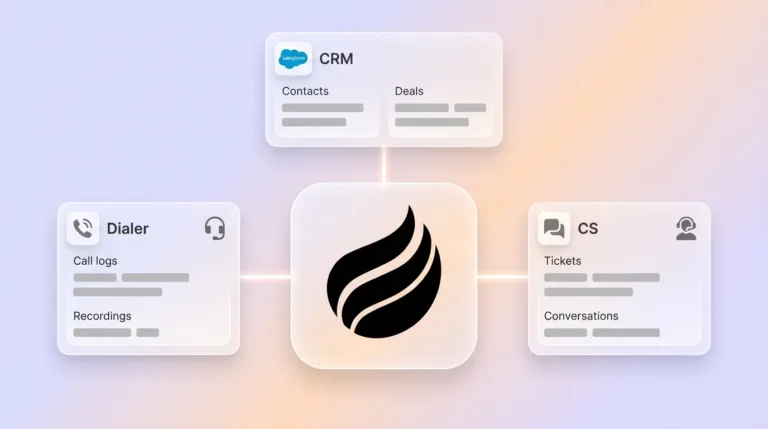
Coffee operates as a CRM agent that can function as a standalone AI-first CRM for small businesses or a companion app that enhances existing Salesforce and HubSpot installations. The platform addresses the fundamental flaw of legacy systems by deploying an intelligent agent to handle data unification, task automation, and interaction logging.
Strengths:
- Autonomous data entry from Google Workspace and Microsoft 365 with automatic contact and company creation
- AI meeting bot with briefings, summaries, and automated follow-up drafting
- Pipeline Compare feature with warehouse-backed historical tracking
- Natural language list builder for targeted prospecting
- Unified structured and unstructured data processing

Limitations: Coffee currently relies on Zapier for many third-party integrations, and deeper native integrations sit on the product roadmap.
Best For: Small to mid-sized sales teams, roughly 1–50 reps, that want to eliminate manual data entry while keeping existing CRM investments or rolling out a modern standalone solution.
Pricing: Transparent seat-based pricing that includes unlimited agent labor.
Implementation: Simple authentication setup with no development work, which enables deployment within days.
Demo Coffee to experience autonomous CRM management firsthand.

2. Clarify CRM
Clarify presents an AI-native platform for modern sales teams, with particular strength in processing unstructured data from conversations and interactions.
Strengths:
- Native AI architecture built for unstructured data processing
- Conversational intelligence with automatic transcription
- Modern user interface designed for rapid adoption
Limitations: Clarify offers a smaller integration ecosystem than established platforms, which can require manual data bridges for complex tech stacks.
Best For: Teams that prioritize conversation analysis and unstructured data insights over comprehensive workflow automation.
Pricing: Tiered subscription model with advanced AI features in higher plans.
3. Day.ai
Day.ai focuses on productivity gains through AI-powered workflow automation for sales teams that want to streamline daily operations.
Strengths:
- Productivity-focused AI automation
- Task management integration
- Streamlined daily workflow support
Limitations: The platform has a narrow scope compared to full CRM solutions and lacks deep pipeline management and forecasting capabilities.
Best For: Small teams that care more about task automation than comprehensive customer relationship management.
4. Rox
Rox operates as an AI sales platform with emphasis on automation and lead management, although user feedback points to limits in enterprise depth.
Strengths:
- AI-powered lead scoring and routing
- Sales process automation
- Integration with common sales tools
Limitations: Rox offers limited depth for complex sales processes, and case studies show gaps for growing teams that need more flexibility.
Best For: Very small teams with simple sales processes and minimal customization requirements.
5. Attio
Attio delivers a modern, flexible CRM interface with AI enhancements, while it still relies on a traditional passive database architecture.
Strengths:
- Modern, intuitive user interface
- Flexible data modeling
- Strong visual pipeline management
Limitations: The system remains passive and requires manual data entry, and it lacks autonomous agent capabilities for data ingestion and processing.
Best For: Teams that value a modern interface over autonomous automation and accept ongoing manual data entry.
6. Close
Close provides sales-focused CRM functionality with AI assistant features for small to medium sales teams.
Strengths:
- Built-in calling and communication tools
- AI assistant for basic automation
- Sales-specific workflow support
Limitations: Close does not use a data warehouse architecture for historical tracking, which limits advanced pipeline intelligence and forecasting accuracy.
Best For: Teams that require integrated calling functionality with basic AI assistance.
7. Pipedrive (AI Features)
Pipedrive adds AI capabilities to its established pipeline-focused CRM, although these features sit on top of the legacy architecture instead of being fully integrated.
Strengths:
- Strong visual pipeline management
- AI assistant for deal insights
- Established integration ecosystem
Limitations: The AI features act as reactive additions to a legacy system, still require manual data entry, and do not provide proactive automation.
Best For: Small teams that want familiar pipeline visualization with basic AI enhancements.
Among the seven platforms evaluated, Coffee stands alone in combining proactive agent architecture with historical intelligence and dual deployment flexibility. The other solutions either lack these capabilities entirely or implement them as reactive add-ons to legacy systems.
Side-by-Side Comparison Table and Key Tradeoffs
The following table highlights how each platform’s core agent capabilities and pricing model align with different team sizes and use cases. Use it to quickly see where Coffee’s autonomous agent model differs from reactive AI assistants and manual-entry CRMs.
| Platform | Key Agent Features | Best For | Pricing Model |
|---|---|---|---|
| Coffee | ✓ Autonomous entry, meetings, insights, warehouse intelligence, Zapier integrations | SMB standalone or enterprise companion | Seat-based, agent included |
| Clarify | ✓ Unstructured data focus, limited integrations | Conversation-heavy teams | Tiered subscription |
| Day.ai | ✓ Productivity automation, limited CRM depth | Task-focused small teams | Usage-based |
| Attio | ✓ Modern UI, passive manual entry | UI-focused teams | Per-seat pricing |
Coffee excels in autonomous operation and data warehouse intelligence, which removes the manual clerk work that slows traditional CRMs. The main tradeoff involves current reliance on Zapier for some integrations, although this approach still provides flexibility while native integrations develop.
Choosing an AI-First CRM and Rolling It Out with Your Team
Small businesses should prioritize Coffee’s standalone CRM for complete automation, while mid-market teams can use Coffee as a companion to existing Salesforce or HubSpot investments. This 20–45% reduction in administrative work enables meaningful stack consolidation and lower software and staffing costs.
Implementation success depends on real-world testing instead of a feature checklist. Trial two or three platforms with actual customer data, and then evaluate autonomous capabilities under realistic conditions. Measure time savings in daily workflows, and focus on platforms that show clear reductions in manual tasks rather than long feature lists.
Book a Coffee demo to see autonomous CRM management in action with your team’s actual data.
AI-First CRM FAQ for Sales Leaders
What is the best AI CRM agent for small sales teams?
Coffee stands out as the best AI CRM agent for small sales teams because it operates as a true autonomous agent rather than a passive database. Coffee automatically handles data entry from email and calendar systems, orchestrates meeting preparation and follow-ups, and provides warehouse-backed pipeline intelligence. Unlike traditional CRMs that require manual input, Coffee ensures good data flows in automatically, so teams can focus on selling instead of administrative work.
How do AI CRMs fix data entry problems?
AI CRMs fix data entry problems through autonomous ingestion of structured and unstructured data from email, calendar, and communication systems. Instead of relying on sales reps to manually update records, AI agents automatically create contacts, log activities, enrich company information, and track deal progression. This autonomous approach reduces administrative workloads by 20–45% while improving data accuracy and completeness beyond what manual entry can achieve.
How does Coffee compare to Salesforce for sales teams?
Coffee operates as an active agent, while Salesforce functions as a passive database. Salesforce requires manual data entry and depends on sales reps to maintain data quality, which often leads to low adoption and weak forecasting accuracy. Coffee’s agent automatically handles data ingestion, meeting orchestration, and pipeline tracking, which removes the manual work that makes Salesforce feel like a chore. Coffee can also work as a companion to existing Salesforce installations and provide the automation layer that Salesforce lacks.
What are the key AI CRM trends for 2026?
The key AI CRM trend for 2026 is the shift from passive databases to autonomous agents. Gartner predicts that 40% of enterprise applications will feature task-specific AI agents by the end of 2026, up from less than 5% in 2025. These agents perform structured work such as generating responses, updating records, and processing customer interactions without manual supervision. The trend centers on agentic AI that acts proactively instead of waiting for human prompts.
Are AI-first CRMs secure for US sales teams?
Leading AI-first CRMs like Coffee maintain enterprise-grade security with SOC 2 Type 2 compliance and GDPR adherence. These platforms ensure that customer data is not used to train public AI models and apply strict data governance for sensitive sales information. The security standards match or exceed traditional CRM platforms while still delivering advanced automation capabilities.
Conclusion
Coffee emerges as the clear leader among AI-first CRM platforms for sales teams in 2026. It offers a truly autonomous agent that removes manual data entry and provides warehouse-backed intelligence. The platform’s dual-model approach supports both standalone implementations and companion deployments, so teams can benefit regardless of current CRM investments.
The shift from passive databases to active agents represents the most significant evolution in CRM technology since cloud deployment. Teams that adopt autonomous platforms like Coffee will reclaim 8–12 hours each week for revenue-generating activities and achieve forecast accuracy that manual systems cannot match.
See Coffee’s pricing and start your trial, and give your sales team an AI agent that ends the data entry grind and keeps reps focused on closing deals and growing revenue.