Written by: Doug Camplejohn, CEO & Co-Founder, Coffee | Last updated: July 11, 2026
Key Takeaways for Gong-Focused Revenue Teams
- Sales leaders choose between Gong’s native AI for coaching and third-party agents for automated CRM data entry from transcripts.
- Eight evaluation criteria, including transcript depth, CRM automation, and total cost of ownership, guide the right Gong AI choice.
- Coffee leads for mid-market Salesforce and HubSpot teams by batch-processing Gong transcripts and writing structured data into CRM fields.
- Gong’s native AI excels at coaching and deal intelligence but needs extra configuration for complete CRM field mapping and automation.
- Turn every Gong transcript into clean CRM records with Coffee and cut post-call admin time.
Evaluation Criteria for Gong AI Tools in 2026
Every tool in this list is scored against the same eight criteria.
- Data quality and enrichment accuracy, which measures how reliably the tool extracts and structures conversation data.
- Depth of Gong transcript integration, which captures whether the tool reads full transcripts with speaker labels or only summaries.
- Automation of CRM data entry, which reflects how many fields are populated without human input.
- Coaching insight generation, which evaluates the quality of rep-level and team-level feedback derived from calls.
- Implementation effort, which measures time from sign-up to the first automated output.
- Slack and CRM workflow fit, which looks at native notification and routing capabilities.
- Team-size scalability, which checks suitability from early-stage to 200-rep organizations.
- Total cost of ownership (TCO), which includes seat pricing, add-on costs, and hidden maintenance burden.
Each tool below is evaluated against these eight criteria, with a focus on how well it serves mid-market teams already using Gong for call recording.
Top 9 AI Tools to Analyze Gong Sales Calls in 2026
1. Coffee: CRM Agent for Salesforce and HubSpot Teams
Coffee is the leading CRM agent for mid-market teams on Salesforce or HubSpot. The agent processes Gong transcripts in batch, maps BANT, MEDDIC, or SPICED fields to the correct CRM objects, fires Slack notifications, and drafts follow-up emails, all without a human acting as a data entry clerk. Implementation uses a single authentication step, which keeps setup fast. Pricing is seat-based with no LLM metering, so costs stay predictable as call volume grows.

2. Gong Native AI (Spotlight, Ask Anything, Mission Andromeda)
Gong’s own AI suite is the default starting point for most teams because it is already included in the platform license. It excels at coaching and deal intelligence inside the Gong interface, which makes it ideal for manager-led development. Teams that want automated CRM field population need to configure Orchestrate or add a third-party agent, a distinction explored in more detail in the Gong Native AI section below.
3. GTM Engine Sales Engine for RevOps Pipelines
GTM Engine ingests Gong transcripts alongside nine other recorder sources and performs bidirectional field-level sync with Salesforce or HubSpot across 17 no-code workflow task types. It fits RevOps teams that need granular pipeline hygiene rules and orphan detection alongside transcript processing, especially when multiple call recorders feed the same CRM.
4. Doe.so for MEDDPICC-Focused Teams
Doe.so integrates with Gong to extract MEDDPICC fields, objections, and committed next steps from full transcripts with speaker labels, then populates specific Salesforce or HubSpot fields and places follow-up email drafts in Gmail. It flags conflicting data points for human review rather than guessing, which reduces error rates on complex deals with many stakeholders.
5. Chorus (ZoomInfo) for Deal-Risk and Competitive Signals
Chorus focuses on deal-risk detection and competitive mention tracking within the ZoomInfo ecosystem. Its Gong integration depth is limited compared with native agents, so it works best when ZoomInfo already anchors the data stack. Teams on ZoomInfo gain the most value from its unified data layer and shared intelligence.
6. Avoma for Teams Without Gong
Avoma covers the full meeting lifecycle, including scheduling, transcription, summarization, and CRM sync. It suits teams that do not yet use Gong as their primary recorder and want an all-in-one meeting platform. For teams already on Gong, Avoma’s transcription and summarization features overlap heavily, which makes the combined stack redundant and more expensive.
7. Nooks for Outbound-Heavy Sales Motions
Nooks is a sales enablement platform oriented toward outbound execution rather than transcript-to-CRM automation. It suits SMB teams running high-volume dialing workflows more than mid-market RevOps teams focused on post-call logging. Gong and Nooks support different stages of the sales process and rarely replace each other.
8. Lindy for Custom Agent Builds
Lindy is a general-purpose AI agent builder that teams can configure to process Gong transcripts via Zapier. It requires more setup than purpose-built tools and depends heavily on internal prompt design. Technically resourced SMB teams that want bespoke workflows gain the most from Lindy.
9. Attention for Customer Success and Renewals
Attention provides aggregated analysis across multiple calls, feature-request summaries over time, automated Salesforce updates, and meeting-prep summaries auto-sent to reps. It is a strong option for customer success teams that track renewal signals across large call volumes and care about long-term account health.

Side-by-Side Comparison of Gong AI Tools
| Tool | Automated CRM Fields | Coaching Features | Setup Time | Pricing Model |
|---|---|---|---|---|
| Coffee | Full field-level write-back, including deal stage, budget, next steps, and BANT or MEDDIC or SPICED data | Structured summaries, Slack notifications, follow-up drafts | Less than one day | Per-seat, no usage metering |
| Gong Native AI | Selected fields via Orchestrate, full mapping requires configuration | AI Call Reviewer, AI Trainer, Spotlight, Initiative Tracking | Several days for Orchestrate setup | Platform license plus enablement tier |
| GTM Engine | Bidirectional field-level sync across many objects | Pipeline hygiene insights | Several days | Platform plus enrichment credits |
| Doe.so | MEDDPICC fields, objections, next steps, Gmail drafts | Deal-stage and next-step focus | One to three days | Per-call or per-seat |
| Chorus | Limited outside ZoomInfo, stronger when bundled | Deal-risk and competitive analysis | Several days | Bundled with ZoomInfo |
| Avoma | Standard CRM sync from meetings | Lifecycle and meeting management | One to three days | Per-seat |
| Nooks | Basic post-call logging | Low for transcript analysis | One to three days | SMB-focused pricing |
| Lindy | Custom fields via Zapier workflows | Depends on custom prompts | Several weeks for complex builds | Low base, higher setup effort |
| Attention | Automated Salesforce updates and prep notes | High for renewal and CS signals | Several days | Per-seat |
Coffee + Gong Workflow for Automated CRM Logging
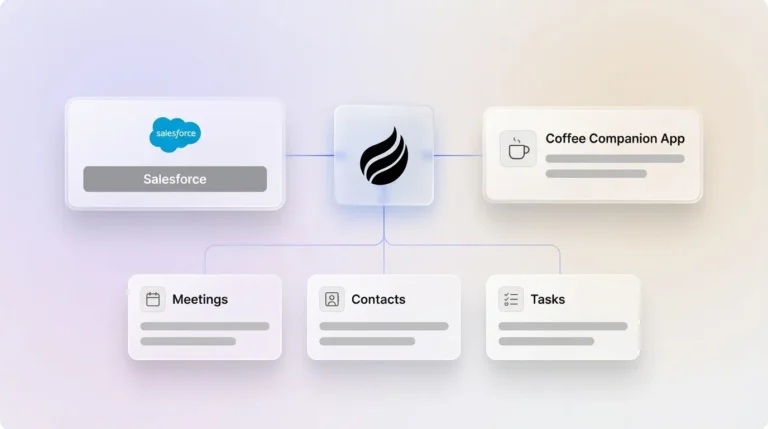
The Coffee and Gong workflow turns every recorded call into structured CRM data in four clear steps.
- Ingest: After a call closes in Gong, the transcript routes to Coffee through Zapier.
- Extract: Coffee’s agent parses the full transcript with speaker labels, then extracts the specific data points described earlier and structures them according to your chosen sales methodology.
- Write back: Structured summaries flow into the mapped fields in Salesforce or HubSpot.
- Notify: A Slack message surfaces the deal update, flagged risks, and a drafted follow-up email for one-click review before the rep’s next call.
Run your first Gong transcript through Coffee’s agent and see a live CRM update.
Coaching vs Logging: Clarify Your Primary Goal
Teams need a clear primary objective before they commit to any tool in this category, because that choice shapes whether they lean on Gong’s native features or add a third-party agent. Gong’s native AI, particularly the AI Call Reviewer and AI Trainer released under Mission Andromeda, is purpose-built for coaching. Gong Enable’s Initiative Tracking links enablement programs directly to revenue outcomes, measuring whether new behaviors appear in live deals and affect win rates, deal size, and ramp time. When rep development and manager leverage sit at the top of the priority list, Gong’s native suite usually covers the need.
Automated CRM logging represents a separate problem. Native CRM automation tools such as HubSpot flows or Salesforce flows handle internal workflows but cannot extract structured conversation data like deal stage, next steps, or budget details from call transcripts. Third-party agents such as Coffee, GTM Engine, and Doe.so exist specifically to close this gap. Teams that care about both coaching depth and automated logging should layer a third-party agent on top of Gong’s native features rather than replacing Gong AI.
Gong Native AI Capabilities for Coaching-First Teams
Gong launched Mission Andromeda in February 2026 as its first structured platform release, introducing Gong Enable as an AI-powered revenue enablement solution. The native feature set in 2026 includes several coaching and analysis tools.
- Spotlight Summaries: Automated post-call summaries surfaced inside the Gong interface.
- Ask Anything (Gong Assistant): A conversational AI experience that allows revenue teams to ask questions about customer calls and receive context-aware answers grounded in real conversations.
- AI Call Reviewer: Analyzes live customer interactions to identify individual and team-level skill gaps based on real behavior rather than intuition.
- AI Trainer: Allows reps to rehearse high-stakes scenarios using AI-generated simulations informed by successful conversations across the organization, delivering instant feedback without additional manager overhead.
- Initiative Tracking: Links enablement programs to revenue metrics so leaders can measure behavioral change in live deals.
- Gong Orchestrate: Launched in October 2025, Orchestrate added workflow automation that triggers actions based on conversation events and pushes select data points toward CRM systems.
Only 1–5% of sales calls are reviewed by managers without AI, and Gong makes review possible at scale for mid-market revenue teams. Gong’s native CRM push still covers a subset of fields and requires Orchestrate configuration, so it does not replace a dedicated CRM agent for full field-level automation.
Chorus, Avoma, Nooks, and Lindy in a Gong Stack
Chorus, now part of ZoomInfo, provides deal-risk detection and competitive intelligence. Its Gong integration is shallow for teams not already in the ZoomInfo ecosystem, and it functions best as a unified intelligence layer when ZoomInfo is the primary data provider.
Avoma manages the full meeting lifecycle and includes CRM sync. For teams already using Gong as their recorder, Avoma’s transcription and summarization features overlap significantly, which makes the combined stack redundant and expensive.
Nooks focuses on outbound sales execution. Gong is described as a revenue intelligence platform focused on call recording and post-call review rather than outbound execution tools such as sequencing or dialing, so the two tools serve different workflow stages and do not compete directly.
Lindy operates as a general-purpose agent builder. It can process Gong transcripts via Zapier but requires prompt engineering and workflow configuration that purpose-built tools handle out of the box. Technically strong SMB teams with specific custom requirements benefit most from Lindy.
2026 Update: New Agent Features and Time-Saving Impact
2026 Update (July 2026): Several releases and market signals shape tool selection this year.
- Mission Andromeda, detailed above, expanded Gong’s platform with MCP support for connecting to external AI systems.
- Coffee expanded Gong transcript ingestion via Zapier and strengthened CRM write-back capabilities.
- Gong reached more than $500M ARR in 2026 with 55% year-over-year growth.
- Coffee saves reps 8–12 hours per week on post-call admin through automated CRM logging and follow-up drafting.
- Sales reps spend approximately 24 hours per week on non-revenue-generating administrative tasks, according to a February 2026 analysis.
Decision Matrix by Team Size and CRM Stack
Team Profile Primary CRM Recommended Tool Rationale 1–20 reps, early-stage No CRM or spreadsheets Coffee Standalone CRM Agent handles the full system of record, so no legacy migration is required. 20–50 reps, growing mid-market HubSpot Coffee Companion App Deploys as an agent layer, preserves the existing HubSpot investment, and automates Gong transcript logging. 20–200 reps, mid-market Salesforce Coffee Companion App Deep Salesforce integration respects required fields, quotas, and forecasting, and seat-based pricing scales linearly. 50+ reps, coaching-first priority Salesforce or HubSpot Gong Native AI + Coffee Gong AI Trainer and Call Reviewer handle coaching, while Coffee manages CRM write-back that Gong Orchestrate does not fully automate. SMB, technical team, custom workflows Any Lindy or GTM Engine Flexibility justifies setup cost, while purpose-built agents remain faster for standard use cases. Risks and Limitations of Gong AI Agents
No tool in this category eliminates all manual work, so teams should understand several practical limitations before purchasing.
- Hidden maintenance: Zapier-based integrations require monitoring, and when connections break, CRM updates stop silently. Vendors should be asked specifically about real-time data sync capabilities and failure protocols when connections break.
- Incomplete automation: Most tools log that a call occurred but do not populate specific CRM fields such as deal stage, next steps, or budget based on transcript content. Teams should verify field-level write-back before committing.
- Integration gaps: Industry benchmarks indicate average B2B forecast accuracy of 70–80% when relying on manual CRM updates, and AI-powered methods can raise accuracy to 90% or higher, but only when the integration covers all required fields.
- Change management: Successful AI transformation requires integrated tech stacks with agents embedded in workflows, following the sequence of augmented, then assisted, then autonomous. Skipping change management reduces adoption and erodes time savings.
- Data compliance: Any agent processing call transcripts must be SOC 2 Type 2 and GDPR compliant. Coffee meets both standards, and data is not used to train public models.
How to Choose the Right Gong AI Agent for Your Team
Three questions narrow the field quickly and keep evaluation focused.
- What is the primary bottleneck? If CRM data quality and post-call logging time cause the most pain, a dedicated CRM agent such as Coffee, GTM Engine, or Doe.so solves the problem faster than configuring Gong Orchestrate. If rep coaching consistency matters more, Gong’s native AI suite is the right starting point.
- What CRM is the system of record? Teams on Salesforce need an agent with deep knowledge of required fields, quotas, and forecasting objects. Coffee and GTM Engine both support this, while newer alternatives often do not.
- What is the implementation budget? Purpose-built agents with single-authentication setup, such as Coffee and Doe.so, deploy in days. Custom agent builders such as Lindy and platform configurations such as Gong Orchestrate require weeks of RevOps time.
See Coffee’s seat-based pricing and connect your Gong account in minutes.
Frequently Asked Questions
How long does Coffee take to implement with Gong?
Implementation uses a single authentication step to connect Coffee to your Salesforce or HubSpot instance, followed by a Zapier connection that routes Gong transcripts into Coffee. Most teams complete setup in under a day and do not need engineering support. Customizable summary templates allow RevOps to map transcript fields to CRM objects, and the first automated CRM update typically runs within hours.
What migration effort is required when switching from native Gong logging?
Switching from Gong’s native CRM logging to Coffee does not require migrating historical data. Coffee operates as a companion agent on top of your existing Salesforce or HubSpot instance, so existing records, fields, and workflows remain intact. The transition involves disabling Gong’s native CRM push for the fields Coffee will own, then mapping those fields in Coffee’s template editor. Teams typically run both in parallel for one to two weeks to validate output quality before fully switching.
How do these tools handle SOC 2 and GDPR compliance?
Coffee is SOC 2 Type 2 certified and GDPR compliant. Call transcript data processed by the Coffee agent is not used to train public AI models. For other tools in this list, compliance status varies, and Gong holds SOC 2 Type 2 and ISO 27001 certifications. GTM Engine, Doe.so, Chorus, and Avoma each publish compliance documentation on their security pages. Teams in regulated industries should request a Data Processing Agreement from any vendor before processing call recordings that contain customer personal data.
Which option scales best for a 50-rep team?
Coffee’s seat-based pricing scales linearly with headcount, and the agent’s processing capacity is not metered by call volume or LLM usage. A 50-rep team on Salesforce fits the core use case for the Coffee Companion App, because the agent handles field-level write-back, respects required fields and forecasting objects, and delivers Slack notifications per rep without extra configuration. Gong’s native AI scales equally well for coaching at this size, so a combined Coffee and Gong stack works best when both CRM accuracy and rep development are priorities.
Conclusion: Match the Right Agent to Your Constraints
Gong transcripts contain some of the richest deal signals available to a mid-market sales team. The real gap sits in the agent that turns those signals into accurate CRM records and consistent coaching actions. Gartner projects that 60% of B2B seller work will be executed through generative AI by 2028. Teams that delay automation of post-call logging compound a data quality deficit that becomes harder to reverse as headcount grows.
For mid-market teams on Salesforce or HubSpot, Coffee delivers a strong combination of Gong transcript depth, automated CRM field-level write-back, and low implementation overhead in 2026. Gong’s native AI remains the leading choice for coaching. The two work best together rather than in competition.
Turn every Gong call into a clean CRM record with Coffee and free your reps from manual logging.