
Key Takeaways
- Sales reps lose 71% of their time to manual data entry, while top tools reach 95-99% deliverability and 3-10% reply rates with AI personalization.
- Coffee ranks #1 with agent-led automation that auto-creates contacts, logs activities, and generates AI follow-ups, so reps avoid manual CRM work.
- Key evaluation criteria include deliverability, CRM auto-sync, AI personalization, and multichannel support, and Coffee performs strongly across all of them.
- Other strong options include Apollo.io for prospecting, Instantly.ai for deliverability, and Reply.io for multichannel outreach, but they lack Coffee’s full agent automation.
- Transform your sales workflow with Coffee’s agent-driven CRM, and get started today for seamless automation.
How to Evaluate Automated Email Sequence Tools for Sales Teams
Effective automated email sequence tools must perform well across seven core areas that directly affect sales productivity and revenue. Deliverability rates between 95-99% represent the gold standard, while anything below 94% signals sender reputation problems that block campaigns before prospects see them.
| Evaluation Criteria | Benchmark Standards | Impact on Sales |
|---|---|---|
| Deliverability & Warm-up | 95-99% inbox placement | Campaign reach and effectiveness |
| AI Personalization | 3-10% reply rates | Prospect engagement quality |
| CRM Integration | Auto-sync activities/contacts | Data accuracy and time savings |
| Multichannel Support | Email + LinkedIn + Phone | Touchpoint diversity and reach |
Poor CRM synchronization creates the “bad data in, bad data out” problem that slows legacy systems. Sales teams need agent-driven tools that automatically capture interactions, enrich contact records, and maintain data quality without human effort.
Free Email Sequence Options for Small Sales Teams
Budget-conscious small teams often choose free tiers, yet these usually include strict limits on contact volumes and sequence complexity. Most free plans cap users at about 500 contacts and only offer basic automation features.
Reddit-Backed Email Sequence Picks
Sales professionals on Reddit frequently point to deliverability failures as the main frustration with email automation tools. “Deliverability fails kill cadences before they even start” reflects a common view among teams dealing with inbox placement issues and manual CRM workflows.
The 8 Best Automated Email Sequence Tools for Sales Teams in 2026
1. Coffee – Agent-Led CRM Automation for Modern Teams
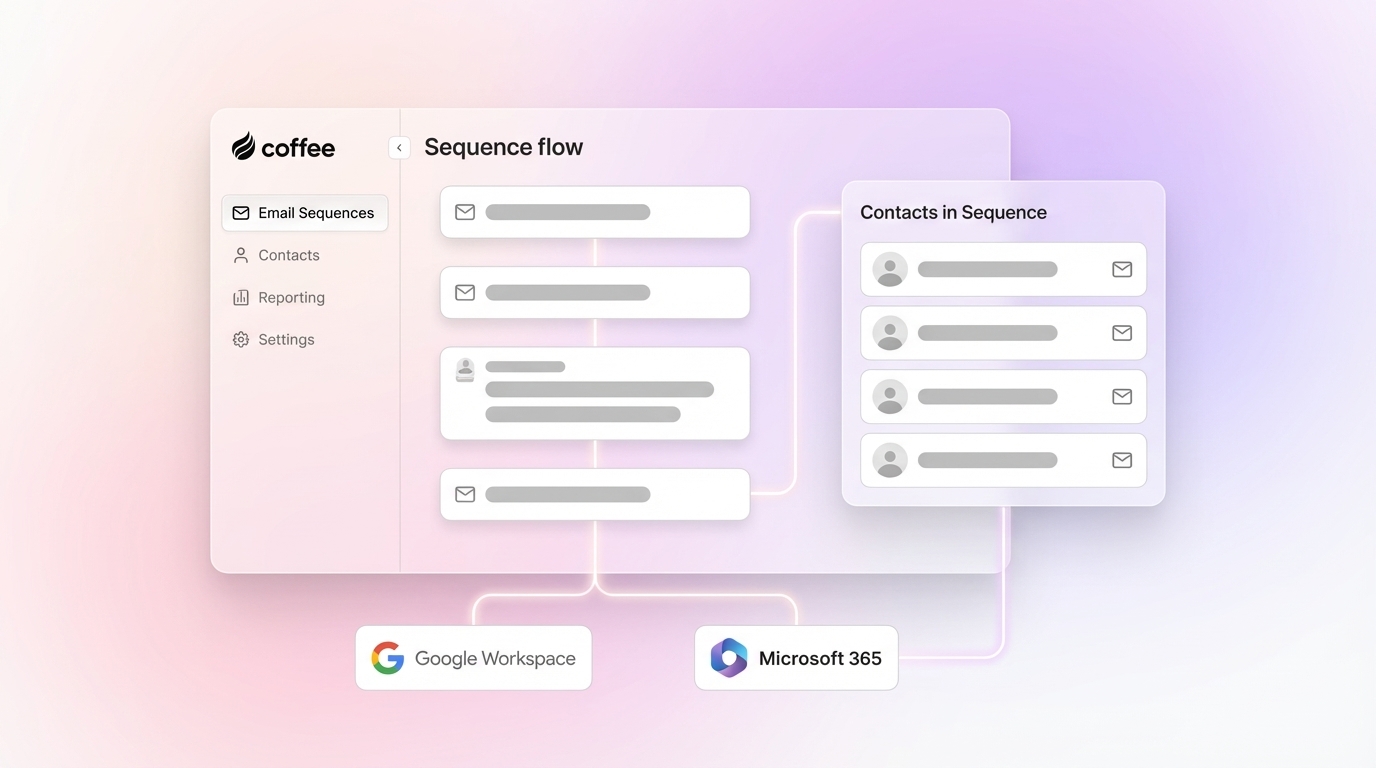
Coffee reshapes sales workflows through an autonomous agent that manages data entry, meeting follow-up, and pipeline intelligence from prospecting through closing. Unlike passive tools that depend on manual data entry, Coffee’s agent automatically creates contacts, logs activities, and drafts AI-powered summaries and follow-ups based on call transcripts and email interactions. The platform works as a standalone CRM for small teams or as a companion app that enhances existing Salesforce and HubSpot setups.

Key Strengths: Agent-driven automation that removes 71% of manual data entry, AI follow-ups after meetings, List Builder for natural language prospecting, and seamless Google Workspace integration.

Ideal For: SMB and mid-market sales teams with 1-100 employees that want comprehensive automation and unified CRM intelligence. It suits teams tired of manual data entry and scattered tool stacks.
Pricing: Simple seat-based pricing without confusing limits on AI usage or email volume.
2. Apollo.io – Database-Driven Prospecting at Scale
Apollo.io combines a large contact database with sequence automation, making it a strong choice for teams that prioritize lead generation volume. The platform excels at finding prospects and launching automated outreach campaigns, and it includes automated CRM integrations that reduce manual syncing.
Key Strengths: More than 265 million verified contacts, integrated prospecting and sequences, strong deliverability infrastructure, and a detailed analytics dashboard.
Limitations: Reported sync inconsistencies, limited AI personalization, and complex pricing tiers.
Ideal For: Sales teams focused on high-volume prospecting that already have defined CRM workflows.
3. Instantly.ai – Deliverability-First Cold Emailing
Instantly.ai focuses on inbox placement with unlimited email warm-up and advanced deliverability controls. The platform helps top performers reach 10%+ reply rates through strong sender reputation management and robust email infrastructure.
Key Strengths: Unlimited warm-up accounts, advanced deliverability tools, A/B testing, multichannel sequences, and AI agents such as Copilot.
Limitations: Steep learning curve for advanced CRM features.
Ideal For: Teams facing deliverability issues or running high-volume cold email campaigns.
4. Lemlist – Visual Personalization for Standout Outreach
Lemlist stands out with dynamic image and video personalization that creates unique visual assets for each prospect. The platform blends text-based personalization with custom images, GIFs, and personalized landing pages.
Key Strengths: Dynamic image personalization, video sequences, multichannel automation, a strong template library, and deep CRM integrations.
Limitations: Complex setup for advanced features and a higher cost per seat.
Ideal For: Creative sales teams in visual industries that need highly distinctive personalization.
5. Reply.io – Coordinated Multichannel Outreach
Reply.io specializes in coordinating outreach across email, LinkedIn, phone, and SMS within unified sequences. The platform delivers multichannel automation with conditional logic that reacts to prospect engagement.
Key Strengths: True multichannel sequences, LinkedIn automation, phone dialer integration, engagement tracking, AI personalization through Jason AI SDR, and automatic CRM syncing.
Limitations: Complex pricing structure.
Ideal For: Sales teams that need tightly coordinated outreach across several communication channels.
6. Saleshandy – Budget-Friendly Sequences for Small Teams
Saleshandy offers affordable email automation with core features for small sales teams. Plans start at $24 per month for basic sequences and deliverability, which gives teams cost-effective automation without enterprise complexity.
Key Strengths: Low pricing, a simple interface, basic CRM integration, email tracking, and AI-powered email variants.
Limitations: Basic personalization and limited multichannel support.
Ideal For: Small teams with tight budgets that need straightforward email sequence automation.
7. Outreach – Enterprise-Grade Sales Engagement
Outreach delivers broad sales engagement capabilities tailored to large enterprise teams. The platform includes advanced analytics, complex workflow automation, and many integrations, along with significant complexity and cost.
Key Strengths: Enterprise-level features, advanced analytics, extensive integrations, and conversation intelligence.
Limitations: High cost, complex setup, overkill for small teams, and a steep learning curve.
Ideal For: Large enterprise sales organizations with detailed and layered workflow needs.
8. HubSpot Native Sequences – Simple Automation for HubSpot Users
HubSpot’s built-in sequence feature offers basic email automation for teams already using HubSpot. It remains limited compared with specialized tools, yet it integrates smoothly with HubSpot’s CRM and marketing suite.
Key Strengths: Native CRM integration, inclusion with HubSpot plans, simple setup, and unified reporting.
Limitations: Limited sequence complexity, basic personalization, and restricted multichannel support.
Ideal For: Teams deeply invested in HubSpot that only need basic sequence automation.
Side-by-Side Comparison Matrix and Tradeoffs
| Tool | Deliverability | CRM Integration | Agent Automation | Small Team Fit |
|---|---|---|---|---|
| Coffee | Excellent | Full Auto-Sync | Yes | Perfect |
| Apollo.io | Good | Automated Sync | No | Good |
| Instantly.ai | Excellent | Robust | Yes | Fair |
| Lemlist | Good | Deep | No | Good |
Coffee’s agent automation stands out as the main differentiator because it removes the manual data entry that consumes 71% of sales rep time. Traditional tools still depend on human effort for CRM synchronization, while Coffee’s agent handles that work automatically.
Why Coffee Leads Automated Email Sequence Tools in 2026
Coffee’s agent-driven architecture solves the core problem that slows sales teams, which is the manual work required to keep CRM data accurate. The Coffee agent automatically logs emails, calendar events, and call activities while generating AI-powered summaries and follow-ups based on meeting transcripts and conversation context. This approach breaks the “bad data in, bad data out” cycle that weakens traditional CRMs.

The platform’s List Builder supports natural language prospecting commands such as “Find VPs of Sales in North America at $10M+ funding companies using Salesforce,” and the agent then runs the full workflow from research through outreach. For teams on HubSpot or Salesforce, Coffee works as a companion app that upgrades existing systems without a full migration. Get started with Coffee to see agent-led sales automation in action.

How to Choose the Right Tool and Avoid Common Pitfalls
Small sales teams with 1-20 employees gain the most from Coffee’s standalone CRM model, which delivers complete automation without legacy system complexity. Mid-market teams that already use Salesforce or HubSpot can adopt Coffee’s companion app to enhance current workflows with agent intelligence.
Common pitfalls include picking tools without strong CRM synchronization, selecting enterprise platforms that overwhelm small teams, and ignoring the impact of deliverability infrastructure. Teams should prioritize agent-driven automation instead of tools that keep data entry manual. Get started with Coffee to avoid these mistakes and implement true sales automation.
Frequently Asked Questions
What is the best free automated email sequence tool for small sales teams?
Saleshandy offers one of the most complete low-cost options for small teams, with basic sequence automation and email tracking at $24 per month. Coffee’s trial, however, gives teams access to full agent automation, including automatic contact creation, AI follow-ups, and CRM synchronization that removes manual data entry. For teams that plan to scale, Coffee’s agent-driven model delivers stronger long-term ROI than free tools with limited features.
Which email automation tool works best with HubSpot and Salesforce?
Coffee provides deep CRM integration as a companion app that acts as an intelligent agent on top of existing HubSpot or Salesforce instances. Unlike traditional tools that rely on manual data synchronization, Coffee’s agent automatically creates contacts, logs activities, and enriches records with AI-generated insights. This approach removes the 71% time loss from manual data entry and keeps your existing CRM as the single source of truth.
How does Coffee compare to Apollo.io for CRM automation?
Apollo.io excels at prospecting with its large contact database, yet it still requires significant manual effort to maintain CRM data quality. Coffee’s agent manages the full workflow from contact creation through activity logging, which removes the manual synchronization that drains sales rep time. Coffee also offers stronger AI personalization because the agent analyzes call transcripts and email context to draft relevant follow-ups, while Apollo relies more on basic template personalization.
What do Reddit users say about the best email sequence tools?
Reddit discussions often highlight deliverability failures and manual CRM synchronization as the biggest issues with email automation tools. Sales professionals frequently state that “deliverability fails kill cadences before they even start” and share frustration with tools that demand constant data entry. Coffee addresses both issues through its agent, which protects sender reputation and automatically manages CRM data, so it aligns closely with Reddit user priorities.
What reply rates can sales teams expect from automated email sequences in 2026?
Industry benchmarks show average reply rates of about 3.43% across tools, while top performers reach 10% or more with advanced personalization and strong deliverability. Coffee’s agent-driven model improves outcomes by pairing AI personalization, based on call transcripts and email context, with reliable data quality. The main advantage comes from Coffee’s ability to create contextually relevant follow-ups automatically instead of relying on static templates.
Conclusion: Move from Manual Tasks to Agent-Led Automation
Agent-driven tools like Coffee represent the next stage of sales automation because they remove the manual data entry that consumes 71% of sales rep time and deliver stronger personalization and CRM intelligence. Traditional email sequence tools keep the “bad data in, bad data out” cycle alive, while Coffee’s agent protects data quality through automated capture and enrichment. Get started with Coffee today and shift your sales workflow from manual effort to intelligent automation.