Written by: Doug Camplejohn, CEO & Co-Founder, Coffee | Last updated: July 12, 2026
Key Takeaways for 2026 AI CRM Buyers
- Autonomous AI CRMs in 2026 must capture both structured and unstructured data without human triggers or manual logging.
- Evaluation should focus on autonomy level, Salesforce and HubSpot integration depth, hours saved per rep, and total cost of ownership.
- Coffee leads this comparison with high autonomy, deep CRM write-back capabilities, and 8–12 hours saved per rep each week.
- Alternatives like Clarify, Attio, and legacy platforms either require manual triggers or lack companion-layer integration depth for mid-market teams.
- Explore Coffee’s flexible pricing to deploy an autonomous AI CRM that works as both a standalone system and a companion layer on your existing stack.
How to Evaluate Autonomous AI CRMs in 2026
Select an autonomous AI CRM by scoring each platform across four dimensions that determine whether manual data entry disappears or only shrinks slightly.
- Autonomy Level: The platform should capture structured and unstructured data without human triggers. It should update deal stages, enrich contacts, and log activities without rep effort.
- Integration Depth with Salesforce/HubSpot: The platform needs to write enriched data, call summaries, and pipeline changes back to an existing CRM with field-level fidelity, not just offer a shallow read connection.
- Time Saved per Rep: Sales reps spend roughly 5.5–11.5 hours per week on CRM data entry in traditional workflows, which equals about $3 million in annual salary costs for a 50-person team. The key question is how many of those hours the platform gives back.
- Total Cost of Ownership: Consider seat pricing, add-on licensing, and the hidden cost of point solutions the platform can consolidate or remove.
Clarify vs. Attio vs. Breakcold vs. Day.ai vs. Legacy CRMs
The table below scores each platform on the four evaluation criteria. Autonomy Level uses a three-tier scale: High (structured and unstructured data captured without human input), Medium (partial automation that still needs human triggers for some data types), and Low (primarily a passive database that relies on manual entry). Time Saved per Rep figures reflect published benchmarks where available. When a vendor has not published a figure, the cell notes the absence.
| Platform | Autonomy Level | Integration Depth with Salesforce/HubSpot | Time Saved per Rep |
|---|---|---|---|
| Coffee | High, agent ingests email, calendar, and call transcripts, AI search answers natural-language pipeline questions like “Which deals are stuck in negotiation?” without manual reporting | Deep, summary templates write back to HubSpot or Salesforce with field-level fidelity, companion mode operates as an agent layer on existing instances, handles quotas, forecasting, and required fields | 8–12 hours per week per rep (Coffee internal benchmark) |
| Clarify | Medium-High, Ambient Intelligence architecture autonomously captures, enriches, and updates pipeline data, with reported 80% reduction in admin work among users including Paramark and Sift | Shallow, lacks the integration sophistication to handle Salesforce and HubSpot quotas, forecasting hierarchies, and required fields at mid-market scale | Not independently published, vendor-cited 80% admin reduction without rep-hour equivalent |
| Attio | Low-Medium, AI-native architecture with strong contact enrichment, but operates on passive database logic that still requires human-initiated updates for most pipeline changes | Limited, functions as a standalone system of record, no published companion-layer capability for Salesforce or HubSpot | Not published |
| Breakcold | Low, social-selling and outbound sequencing focus, activity logging tied to manual outreach actions rather than ambient data capture | Basic, designed as a standalone outbound tool, not a Salesforce or HubSpot companion | Not published |
| Day.ai | Medium, focuses on unstructured data such as productivity and meeting notes but does not cover structured pipeline management autonomously | Shallow, lacks the integration capabilities to serve established teams running Salesforce or HubSpot at scale | Not published |
| Salesforce (legacy) | Low baseline, Agentforce add-on raises autonomy for enterprises, enterprises deploying Agentforce report 30–40% reduction in human response times, but configuration requires weeks to months and dedicated admin expertise | Native, deepest possible self-integration, but Agentforce MCP support remains in pilot as of 2026 and usage-based pricing adds about $2 per conversation | Lumen reports 4 hours saved per seller per week from Microsoft 365 Copilot, Agentforce figures vary by deployment |
| HubSpot (legacy) | Low-Medium baseline, Breeze AI raises autonomy, Breeze Agents handle end-to-end prospecting and outreach autonomously, but pipeline management automation remains shallow versus purpose-built agent CRMs | Native, HubSpot was the first major CRM to ship a production-grade MCP server, which enables open AI interoperability, Breeze agents deploy in minutes | Not published as a per-rep hour figure |
See how Coffee works as both a standalone CRM and a companion layer on your existing stack.
Data Entry Automation and Ambient Capture
Outbound sales reps spend only 28% of their time on direct selling activity, with the rest lost to CRM updates, manual research, tool-switching, and follow-up coordination. True elimination of manual work requires a platform that acts on ambient signals, not one that automates only tasks a rep explicitly initiates.
Coffee’s agent connects to Google Workspace or Microsoft 365 and immediately begins auto-creating contacts, logging activities, and enriching records with job titles, funding data, and LinkedIn profiles via licensed data partners. The January 2026 Stripe integration automatically imports customers and companies, enriches them, and marks paid invoices as Closed Won deals, with no rep action required. The February 2026 QuickBooks integration syncs invoices and payment statuses in real time within the CRM.
Clarify’s Ambient Intelligence architecture performs similar ambient capture for contacts and activities, and users report an 80% reduction in administrative work. Clarify, however, does not publish a companion-mode capability that writes enriched data back to an existing Salesforce or HubSpot instance with field-level accuracy. Attio and Breakcold require more manual triggers for pipeline updates. Legacy platforms like Salesforce and HubSpot rely on human entry at the baseline, with autonomous behavior available only through add-on products at additional cost.
Fifty-two percent of businesses cite data quality and availability as the biggest barrier to AI adoption, and that problem compounds when the CRM depends on humans to supply that data.
Meeting Capture and Pipeline Intelligence
Beyond email and calendar data, autonomous CRMs must also capture the unstructured intelligence buried in sales calls. Coffee’s agent joins Zoom, Teams, and Google Meet calls to record and transcribe, then generates summaries, next steps, and follow-up email drafts after each call. Custom Meeting Briefings and Summaries launched in February 2026 let teams define exact output formats, from high-level executive summaries to granular technical breakdowns, without manual reformatting. The agent structures notes according to BANT, MEDDIC, or SPICED automatically.
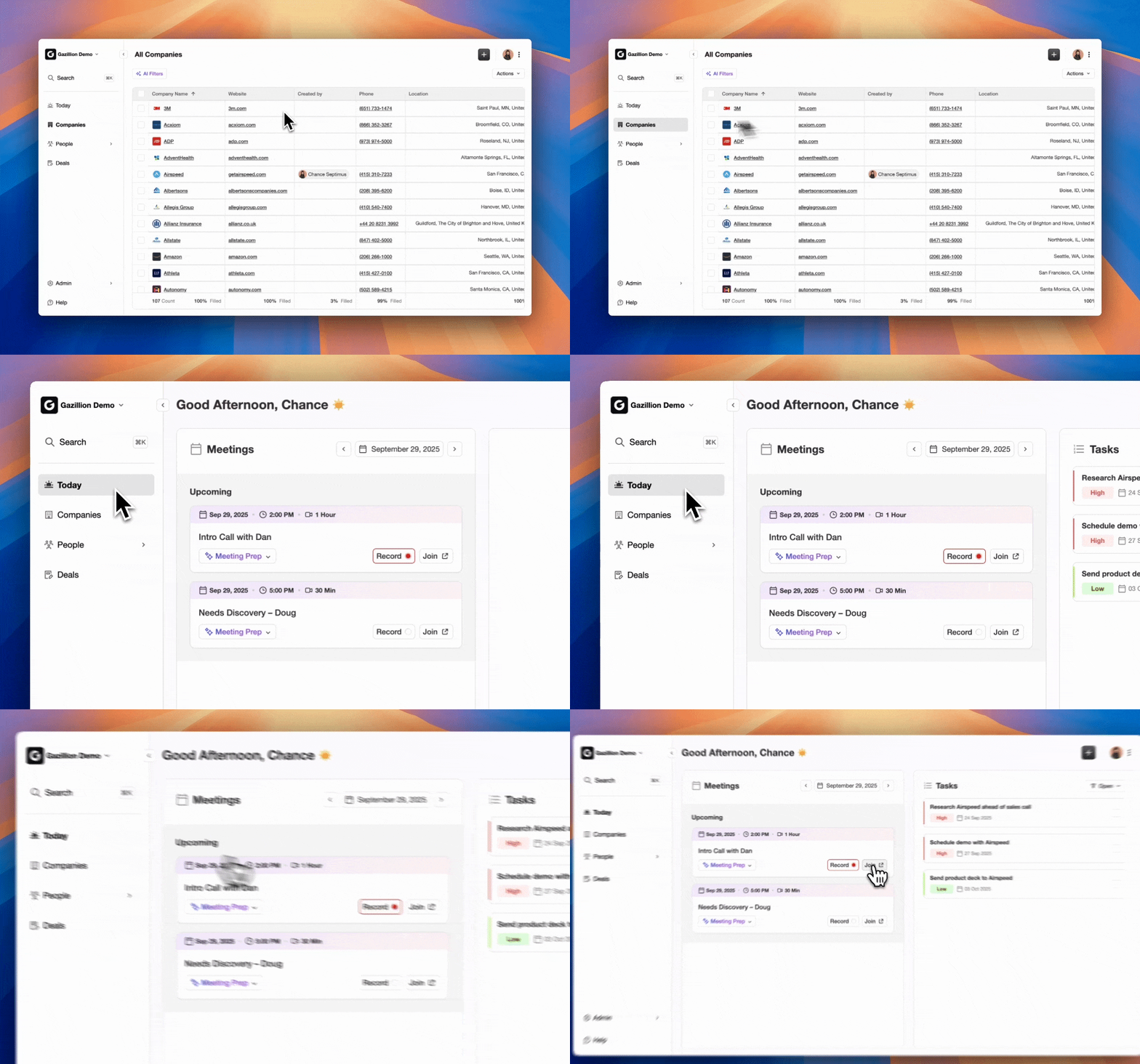
Pipeline intelligence in Coffee runs on a built-in data warehouse that preserves historical context. The Pipeline Compare feature visualizes week-over-week deal movement, including progressed, stalled, and newly added opportunities, without CSV exports. Traditional CRM forecasting that relies on gut feelings and spreadsheets produces errors of 20–30%, which creates budgeting chaos and erodes leadership confidence. Coffee’s agent-sourced data reduces that error at the input layer.

Day.ai focuses primarily on unstructured meeting data and productivity but does not extend that intelligence into structured pipeline management. Clarify offers meeting capture but has not published pipeline-compare or week-over-week movement features at the same depth.
Visitor Identification and Companion-App Intelligence
Coffee includes website visitor identification natively. A single tracking pixel identifies anonymous visitors by name, title, email, and LinkedIn profile, then surfaces real-time Slack notifications for high-fit accounts. The differentiator is Suggested Leads. Standalone tools like RB2B and Warmly surface either the company or undifferentiated people lists. Coffee instead uses the buyer persona to recommend the two or three specific individuals inside a visiting company most worth contacting, with LinkedIn profiles pre-loaded for immediate outreach.

No other platform in this comparison combines visitor identification, suggested lead scoring, and CRM companion-layer functionality in one product. Coffee’s February 2026 Intelligence layer allows teams to define their ICP, business model, and competitive context so that AI suggestions are grounded in company-specific knowledge rather than generic signals.
How Attio and Clarify Differ
Attio and Clarify both position themselves as modern alternatives to legacy CRMs, yet they serve different use cases and rely on different architectural assumptions.
Attio is an AI-native CRM built from the ground up on modern architecture, offering fast deployment, strong contact enrichment, and a flexible data model. Its autonomy, however, remains closer to a passive database. Pipeline updates and activity logging still require human-initiated actions in most workflows. Attio does not publish a companion-mode capability for teams already running Salesforce or HubSpot.
Clarify operates an Ambient Intelligence architecture that autonomously captures and enriches pipeline data, which makes it more autonomous than Attio at the data-capture layer. The trade-off is integration depth. Clarify lacks the sophistication to handle Salesforce and HubSpot quotas, forecasting hierarchies, required fields, and custom objects at mid-market scale. Teams that have outgrown a simple contact database but are not yet committed to a full CRM migration often find Clarify useful. Teams already invested in Salesforce or HubSpot usually find its integration shallow.
Clarify Alternatives for Outbound Sales Teams
Outbound-focused teams evaluating Clarify alternatives typically need ambient activity capture, sequencing support, and CRM writeback, not just a better contact database.
Breakcold is a social-selling CRM designed for outbound sequences and LinkedIn-centric prospecting. It does not offer ambient data capture from email or calendar, and its Salesforce and HubSpot integration is limited to basic contact sync. It works for very small teams running manual outbound but does not qualify as autonomous under 2026 benchmarks.
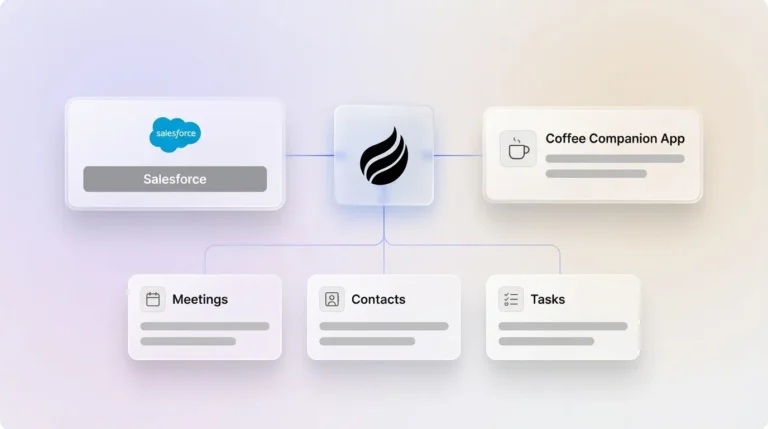
Adoption of autonomous AI agents among mid-market B2B teams has grown significantly, which shows that outbound teams are moving past experimentation. For teams that need outbound intelligence layered on an existing CRM, Coffee’s companion mode writes enriched prospect data, visitor identification results, and meeting summaries directly back to Salesforce or HubSpot. That approach removes the need for a separate outbound point solution.
Best-Fit Platforms by Company Stage and CRM Stack
The right platform depends on company size, current CRM investment, and whether the priority is replacing a system of record or augmenting one.
- 1–20 employees, no CRM or spreadsheets: Coffee Standalone. The agent manages the system of record from day one and auto-creates contacts from Google Workspace or Microsoft 365 without setup complexity.
- 20–200 employees, committed to HubSpot: Coffee Companion on HubSpot. The agent handles data-in so HubSpot stays accurate without rep effort, and summary templates write back with field-level fidelity.
- 20–499 employees, committed to Salesforce: Coffee Companion on Salesforce. Coffee’s understanding of Salesforce quotas, forecasting, and required fields makes it a strong companion-mode agent for mid-market Salesforce complexity.
- Teams evaluating Clarify as a standalone: Coffee Standalone offers comparable or greater autonomy with the option to migrate to companion mode if the team later adopts Salesforce or HubSpot, which preserves the investment.
- Outbound-first teams needing visitor identification: Coffee’s native visitor ID and Suggested Leads feature consolidates what would otherwise require RB2B or Warmly plus a separate CRM.
Find the Coffee deployment model that matches your team size and current CRM.
Operational Factors: Adoption, Security, and Cost
Approximately 79% of enterprises have adopted AI agents in some form, but far fewer run them in production at scale because the pilot-to-production gap demands organizational change management and updated performance metrics. The most common failure mode is not technical, it is adoption.
Automating too much too quickly can overwhelm teams and create distrust in AI recommendations. This adoption challenge often drives the pilot-to-production gap. A safer approach starts with one high-impact, low-risk use case such as automated activity logging, then expands to pipeline intelligence and forecasting.
On security, Coffee is SOC 2 Type 2 and GDPR compliant, and customer data is not used to train public models. Eighty-eight percent of organizations have experienced AI-related security incidents, yet only about 22% treat AI agents as identity-bearing entities with formal access controls, which makes compliance certification a non-negotiable evaluation criterion rather than a differentiator.
Coffee’s seat-based pricing model, where the agent’s labor is included at no additional metered cost, removes the usage-based billing risk that Salesforce Agentforce introduces at approximately $2 per conversation plus Data Cloud licensing.
Risks and Limitations Across Platforms
Every platform in this comparison carries documented limitations that teams should review before committing.
- Clarify: Shallow Salesforce and HubSpot integration limits viability for teams with existing CRM investments. No published companion-mode capability.
- Attio: Passive database logic means autonomy gains still require human-initiated actions. No companion mode for legacy CRMs.
- Breakcold: Outbound-only scope and not a system of record. No ambient data capture from email or calendar.
- Day.ai: Unstructured data focus without structured pipeline management autonomy. Integration depth with Salesforce and HubSpot is shallow.
- Salesforce Agentforce: Requires weeks to months for time to first agent because of Einstein, Data Cloud, and Agent Builder configuration. Usage-based pricing scales unpredictably.
- HubSpot Breeze AI: Lacks orchestration of complex multi-step workflows across external systems. It remains structurally coupled to HubSpot, which limits portability.
- Coffee: Deeper third-party integrations beyond Google Workspace, Microsoft 365, Salesforce, HubSpot, Stripe, and QuickBooks currently route through Zapier, with more native integrations on the roadmap. Coffee is not designed for large enterprises with highly complex custom workflows or heavily regulated industries that require multi-year security reviews.
Gartner estimates that more than 40% of agentic AI projects could be abandoned by 2027, often because organizations apply autonomy to the wrong workflows or cannot prove clear ROI. Matching the platform to the actual workflow, rather than selecting on feature count, remains the primary risk mitigation.
Decision Framework: Matching Stage, Stack, and Priority
The matrix below maps the three most common decision variables to a recommended platform. Treat it as a starting point and then validate each option against the specific Salesforce or HubSpot configuration in place.
| Company Stage | Current CRM | Primary Priority | Recommended Platform |
|---|---|---|---|
| 1–20 employees | Spreadsheets / None | Eliminate data entry from day one | Coffee Standalone |
| 20–200 employees | HubSpot | Improve data quality without migration | Coffee Companion (HubSpot) |
| 20–499 employees | Salesforce | Accurate pipeline intelligence and forecasting | Coffee Companion (Salesforce) |
| 1–100 employees | Clarify / evaluating | Autonomous capture and future CRM optionality | Coffee Standalone (with companion upgrade path) |
| Any | Any | Outbound and visitor identification in one tool | Coffee (Visitor ID and Suggested Leads) |
| 20–200 employees | Attio / evaluating | Modern UI and deeper autonomy | Coffee Standalone |
Compare Coffee pricing and deployment options for teams migrating from Clarify or Attio.
Frequently Asked Questions
How long does implementation typically take for autonomous AI CRMs in 2026?
Implementation timelines vary significantly by platform architecture. Coffee connects to Google Workspace or Microsoft 365 through a simple authentication step and begins auto-creating contacts, logging activities, and enriching records immediately, so most teams are operational within a single business day. The Coffee Companion mode for Salesforce or HubSpot follows the same authentication-first approach, and the agent begins writing enriched data back to the existing CRM within hours of connection. Platforms built on legacy architectures, such as Salesforce Agentforce, require weeks to months of configuration involving Einstein, Data Cloud, and Agent Builder before the first autonomous workflow runs. In 2026, agent-native platforms typically deploy in hours to days, while AI features bolted onto legacy systems require dedicated admin resources and longer timelines.
What migration effort is required when switching from Clarify?
Switching from Clarify to Coffee involves three steps. First, export contact and company records from Clarify. Second, import those records into Coffee or the connected Salesforce or HubSpot instance. Third, authenticate Coffee’s agent with Google Workspace or Microsoft 365. Because Coffee’s agent immediately begins enriching and updating records from live email and calendar signals, historical gaps in the imported data fill in autonomously over the first weeks of operation instead of needing manual cleanup. Teams running Coffee as a companion layer on Salesforce or HubSpot do not need to migrate their system of record at all. Coffee operates as an agent on top of the existing CRM, so the transition from Clarify affects only the data-capture layer, not the pipeline or reporting structure the team already relies on.
What data-quality benchmarks should teams expect from agent-powered CRMs?
Agent-powered CRMs that ingest structured and unstructured data from email, calendar, and call transcripts consistently outperform manual-entry CRMs on completeness and recency. Coffee’s agent saves reps 8–12 hours per week by removing manual logging, and because every interaction is captured at the source rather than recalled from memory, the data reflects ground truth instead of a rep’s summary. On enrichment quality, Coffee’s licensed data partners provide job titles, funding data, and LinkedIn profiles at a level comparable to dedicated enrichment tools like Apollo for most use cases. The broader industry benchmark shows that companies using enriched data see 25% more sales-qualified leads. The main quality risk in any autonomous CRM is the garbage-in problem. If the agent is not connected to the actual communication channels where deals happen, it cannot capture what it cannot see, which makes the email and calendar connection the most critical setup step.
Which platforms meet SOC 2 Type 2 and GDPR requirements?
Coffee maintains the same compliance standards mentioned earlier, with detailed audit reports available upon request. Salesforce publishes SOC 2 reports covering security, availability, and confidentiality controls for multiple services. HubSpot’s infrastructure providers are SOC 2 Type 2 certified and HubSpot is GDPR compliant via EU Cloud Code of Conduct certification, with standard CRM permission controls governing data access. Clarify, Attio, and Breakcold each publish security documentation on their respective sites, and teams in regulated industries or those handling sensitive customer data should request current compliance reports directly from each vendor before committing. The broader compliance landscape in 2026 is shaped by the EU AI Act and emerging U.S. state-level AI regulations, so teams should confirm that any autonomous agent platform maintains audit trails sufficient to show how automated decisions were made.
Conclusion and Next Steps for Clarify Alternatives
Many revenue leaders expect AI systems to handle more of their sales workflows by the end of 2027, which will collapse today’s stack of six to eight point tools. The platforms that qualify as truly autonomous in 2026, those that ingest structured and unstructured data without human input, form a short list. Coffee is the only platform on that list that operates as both a standalone agent CRM and a companion layer on Salesforce or HubSpot, which means it can meet teams where they are regardless of their current stack.
Teams that have outgrown Clarify’s integration depth, that run Salesforce or HubSpot with poor data quality, or that need outbound visitor identification without adding another point solution can address all three problems with a single platform. The agent handles the data entry. The pipeline intelligence follows. The stack consolidates.
Explore Coffee pricing and start removing manual data entry from your sales workflow today.