Written by: Doug Camplejohn, CEO & Co-Founder, Coffee | Last updated: July 13, 2026
Key Takeaways for Choosing a Clarify Alternative
- An autonomous sales CRM uses an AI agent to capture, enrich, and structure customer data from emails, calendars, and call transcripts without manual input. Assistive systems still depend on human review and logging.
- Coffee is the only solution offering both a standalone AI-first CRM and a companion agent layer that integrates with existing Salesforce or HubSpot stacks while eliminating data entry in both setups.
- Coffee’s agent handles data capture, pipeline intelligence, meeting orchestration, visitor identification, and long-term data warehousing, so teams get accurate pipeline insights without losing historical context.
- Teams save 8–12 hours per week per rep by automating pre- and post-call admin, pipeline reviews, and data updates, with accuracy rates that exceed typical manual entry.
- Start with Coffee today to deploy the right agent for your stack and remove manual CRM data entry permanently.
What Autonomous CRM Means in Practice
The distinction between agentic and assistive systems determines whether a CRM truly fixes data quality or only softens the pain. An assistive system, often marketed as AI-powered, surfaces suggestions, drafts emails, or scores leads, but a human still reviews, approves, and logs the outcome. An agentic system executes the full loop. It reads signals from emails, calendars, and call transcripts, decides what to create or update, writes the record, and feeds the outcome back to improve future decisions, all without human intervention.
Legacy CRM architectures create a structural flaw that assistive AI cannot fix. Salesforce and HubSpot rely on basic relational databases where each field update overwrites and erases historical context. CRM data reflects current state rather than the analytical history AI models require, so any intelligence layer built on top inherits the same blind spots. Coffee addresses this at the architecture level with a data warehouse that preserves every historical snapshot. This design enables the Pipeline Compare feature to visualize week-over-week deal changes without CSV exports or manual review.
Clarify’s Ambient Intelligence architecture delivers active leads, action items, pre-call briefings, and follow-ups automatically and records meetings via Zoom, Meet, and Teams. Clarify, however, lacks the integration capabilities that established teams require and does not support complex Salesforce and HubSpot configurations such as quotas, forecasting, and required fields. Day.ai focuses primarily on unstructured productivity data and does not function as a full system of record. These gaps in competing solutions highlight why a comprehensive autonomous system must address five core capability dimensions, which is where Coffee’s agent delivers a complete execution loop.
Coffee’s agent handles five capability dimensions that define true autonomy:
- Data capture and enrichment: The agent auto-creates contacts and companies from Google Workspace or Microsoft 365, augments records with job titles, funding, and LinkedIn profiles via licensed data partners, and automatically imports customers from Stripe, enriches them, and logs paid invoices as Closed Won deals.
- Pipeline intelligence: AI search on deals answers natural-language questions such as “Which deals are stuck in negotiation?” or “What is closing this month?” so leaders get answers without manual reporting.
- Meeting orchestration: The agent joins calls, transcribes them, generates summaries structured to BANT, MEDDIC, or SPICED, and drafts follow-up emails. Custom Meeting Briefings and Summaries, launched in February 2026, let users define exact formats from high-level executive summaries to granular technical breakdowns.
- Visitor identification: A single tracking pixel turns anonymous website traffic into named prospects with name, title, email, LinkedIn profile, pages visited, and time on site. The agent then surfaces Suggested Leads that match the buyer persona, which extends beyond what RB2B or Warmly provide.
- Long-term data warehouse: Coffee stores structured and unstructured data historically, so forecasting and pipeline analysis outputs rely on complete context rather than current-state snapshots that often break AI models.
Clarify Alternatives That Integrate With Salesforce
Integration depth often causes AI-native CRM alternatives to fail mid-market teams. Layered Salesforce Agentforce deployments require all relevant data to live in Salesforce for optimal function, so teams with data spread across external intent platforms or third-party enrichment see weaker autonomous behavior. HubSpot Breeze agents operate only within HubSpot boundaries, which means tasks that depend on ERP, finance systems, or external data warehouses require a custom agent built on external models.
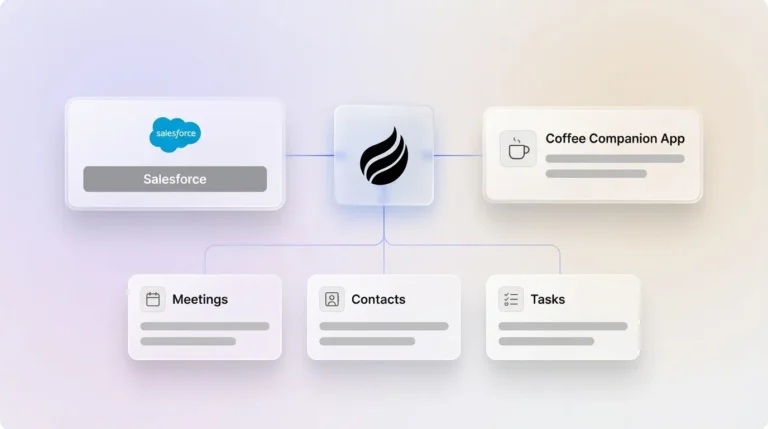
Coffee’s Companion App model solves this constraint in a different way. A simple authentication allows the Coffee Agent to sync data, enrich it, and write valuable insights, including meeting summaries, activity logs, and pipeline changes, back to the primary Salesforce or HubSpot instance. Improved summary templates released in November 2025 are customizable to match workflows and writable back to Coffee, HubSpot, or Salesforce, which gives RevOps teams a single agent that maintains data quality across whichever system of record the organization already uses.

Beyond CRM integration, teams often need to connect their sales stack to other business tools. For teams asking about broader tool connectivity, Coffee currently integrates via Zapier, with deeper roadmap integrations planned. This coverage addresses the majority of SMB and mid-market automation needs today while the native integration surface expands.
Weekly Time Savings From an Autonomous Sales Agent
Coffee’s agent saves sales reps 8–12 hours per week by eliminating manual data entry across contacts, activities, meeting notes, and pipeline updates. This figure aligns with broader industry measurement. HubSpot’s 2025 State of Sales Report found that 64% of sales professionals save between one and five hours every week using AI tools, with 84% reporting that AI saves time and streamlines their process overall. At the higher end of autonomous deployment, many practitioners have sharply reduced post-call admin time through AI note-taking and automated CRM updates.
Gartner reports that sellers spend a substantial amount of time each week on activities that could be delegated, automated, or simplified, while dedicating less time to high-impact commercial work. Coffee’s agent directly attacks that imbalance by automating both individual rep workflows and team-level pipeline management. At the individual level, meeting orchestration eliminates pre- and post-call admin.

- Meeting orchestration scenario: Before a call, the agent prepares a briefing with attendee roles and past interaction context. During the call, the AI meeting bot records and transcribes. After the call, the agent generates a structured summary, identifies next steps, and drafts a follow-up email in Gmail for one-click review and send. A rep who previously spent 30–45 minutes on pre- and post-call admin completes the same workflow in under five minutes.
At the team level, pipeline intelligence removes manual reporting overhead.
- Pipeline intelligence scenario: Instead of exporting CSVs and building weekly pipeline review decks, the agent surfaces week-over-week deal changes automatically via Pipeline Compare, highlighting progressed deals, stalled opportunities, and new additions. A RevOps leader who previously spent two hours preparing a pipeline review receives the same output in real time.
Durable time savings depend on data architecture. AI can achieve high accuracy in CRM data processing and extraction tasks compared to manual entry, which averages 96–99% accuracy, or a 1–4% error rate, at the field level. That range includes a 4.1% error rate reported for CRM systems, which compounds quickly across thousands of records.
Get started with Coffee and reclaim the hours your team currently loses to manual CRM work.
Best Clarify CRM Alternative for Startups and Mid-Market Teams
The right deployment model depends on company size, current stack, and tolerance for manual entry.
Teams with 1–20 employees seeking a new system of record are the primary fit for Coffee’s Standalone CRM. These teams have outgrown spreadsheets and Notion but view HubSpot and Pipedrive as expensive, manual chores. For small businesses, a standalone assistant covers the full workflow loop with one memory, producing more relevant follow-ups and costing less than multiple separate subscriptions. Coffee’s seat-based pricing, where the agent’s unlimited labor is included and there is no complex metering on LLM usage, keeps total cost of ownership predictable. Clarify is a viable consideration for this segment but lacks the data warehouse architecture and Salesforce or HubSpot write-back capabilities that Coffee provides.

Mid-market teams already committed to Salesforce or HubSpot are the primary fit for Coffee’s Companion App. These teams have invested heavily in their CRM infrastructure and cannot migrate, yet they struggle with low adoption, poor data quality, and fragmented point solutions for enrichment and conversation intelligence. Coffee’s Companion App deploys the agent as an intelligent layer that writes back to the existing system of record, which removes the need for separate ZoomInfo, Gong, and Fathom subscriptions.
Two common objections arise when mid-market teams evaluate an all-in-one agent versus their existing point solution stack. On data quality parity, Coffee’s enrichment provides data roughly on par with dedicated enrichment tools for most use cases, built into the product at no additional per-seat cost. This structure removes the cost argument for maintaining separate enrichment subscriptions. On compliance, Coffee is SOC 2 Type 2 and GDPR compliant, and customer data is not used to train public models, which addresses security review concerns for teams handling sensitive pipeline data.
Decision Checklist for Clarify CRM Alternatives
Use the following criteria to map your situation to the right solution:
- Team size is 1–20 and you have no existing CRM investment: Coffee Standalone CRM is the direct fit. The agent becomes your system of record from day one, with no legacy data entry habits to break.
- Team size is 20–500 and you are committed to Salesforce or HubSpot: Coffee Companion App is the direct fit. Authenticate once, and the agent begins writing enriched data back to your existing instance without a migration.
- You need Salesforce-native autonomous agents at enterprise scale (500+ seats): Salesforce Agentforce is the appropriate evaluation, with the caveat that Agentforce deployments require significant setup time and dedicated administrators to manage configuration, governance, and ongoing customization.
- You need visitor identification integrated with your CRM agent: Coffee is the only solution in this comparison that includes visitor identification, named individual inference, and Suggested Leads inside the same product, so no separate RB2B or Warmly subscription is required.
- Your tolerance for manual entry is zero and your team is under 20 people: Coffee Standalone CRM is the only solution in this comparison that eliminates manual entry at the architecture level rather than reducing it incrementally.
- You are evaluating Clarify specifically: Clarify is an early-stage platform whose main limitation for teams is the lack of multi-channel sequences or advanced dashboards comparable to Salesforce, and it does not support the complex integration requirements of established Salesforce or HubSpot stacks.
Frequently Asked Questions About Coffee as a Clarify Alternative
How long does Coffee implementation take?
For the Standalone CRM, implementation begins immediately after connecting Google Workspace or Microsoft 365. The Coffee Agent starts scanning emails and calendars to auto-create contacts, companies, and activity logs without manual configuration. Most teams have a populated, working CRM within the first business day. For the Companion App on Salesforce or HubSpot, a simple authentication connects the agent to the existing instance. The agent begins enriching records and writing summaries back to the CRM the same day. There is no multi-week onboarding, no dedicated administrator requirement, and no complex data migration for new deployments.
What is the migration effort from Clarify or legacy CRMs?
Migration effort depends on the volume and structure of existing data. For teams moving from Clarify or spreadsheet-based systems to Coffee Standalone, the agent handles contact and company creation automatically from connected email and calendar history, which significantly reduces the manual import burden. For teams adding Coffee as a Companion App to Salesforce or HubSpot, there is no migration at all, because the existing system of record remains in place and the agent layers on top of it. Teams migrating from legacy CRMs with large structured datasets should plan for a standard data export and import process, typically completed within one to two weeks depending on record volume.
What is Coffee’s pricing model?
Coffee uses seat-based pricing. You pay for the human seats on your team, and the agent’s labor, including data entry, enrichment, meeting orchestration, pipeline intelligence, and visitor identification, is included without additional per-action or per-process fees. There is no complex metering on LLM usage. This model keeps total cost of ownership predictable and directly comparable to the per-seat cost of legacy CRMs, without the hidden costs of separate enrichment tools, conversation intelligence platforms, and visitor identification subscriptions that Coffee replaces. Full pricing details are available at coffee.ai/pricing.
How does Coffee ensure data security and compliance?
As noted earlier, Coffee maintains SOC 2 Type 2 certification and GDPR compliance, with customer data never used to train public AI models. This approach keeps information that the agent captures from emails, calendars, and call transcripts private to each organization. For teams in regulated industries or those handling sensitive pipeline data, these certifications satisfy the baseline security review requirements that procurement and legal teams typically expect before deploying an agent with access to communication data. Teams with multi-year security review requirements or HIPAA obligations should evaluate whether Coffee’s current compliance posture meets their specific regulatory framework before deployment.
The Only Path to Reliable CRM Data Quality
Every CRM problem traces back to the same root cause: humans are unreliable data entry clerks, and legacy architectures assumed the opposite. 76% of CRM users report that less than half of their organization’s CRM data is accurate and complete, a quality gap that directly costs 37% of organizations measurable revenue. AI-assisted systems reduce the friction of data entry but do not eliminate the dependency on human input. Only an agentic architecture that captures, enriches, and structures data autonomously from the moment a connection is established breaks this cycle.
Coffee is the only solution in this comparison that delivers this architecture in two deployment models. Teams can use it as a standalone AI-first CRM when building a new system of record, or as a companion agent that writes back to existing Salesforce or HubSpot instances when migration is not an option. No other platform in the Clarify alternatives landscape offers both paths.
Get started with Coffee and put an agent to work on your pipeline today.