
Key Takeaways
- Revenue teams still lose significant selling time to manual CRM updates, scattered tools, and unreliable data in 2026.
- AI agents reduce administrative work by capturing activities, enriching records, and standardizing data without extra effort from sales reps.
- Automated meeting prep, notes, and follow-ups improve consistency across the sales process and support accurate qualification frameworks.
- Real-time pipeline views based on objective activity data lead to more effective forecasting and resource allocation.
- Coffee offers agent-led CRM automation with fast setup, measurable time savings, and a clear path to cleaner data and better pipeline visibility, and you can get started at Coffee pricing.
The Hidden Costs of Legacy CRM Automation for Revenue Teams
Legacy CRM automation often increases administrative work instead of removing it. Many tools still depend on manual entry and rigid rules that do not match how modern revenue teams operate.
The Manual Data Entry Burden: A Productivity Killer
Manual data entry remains one of the biggest drains on sales productivity. Market data shared by Coffee shows that 71% of sales reps say they spend too much time on data entry, leaving only 35% of their time for selling. This shift in focus turns CRMs from enabling tools into systems that block momentum.
Fragmented Workflows and Data Inconsistency
Modern revenue teams operate across multiple tools, including CRMs for records, enrichment platforms for data, outreach tools for communication, and recording software for meetings. Without an intelligent agent to unify information, customer data stays scattered, and reps move constantly between windows. This patchwork approach creates inconsistent records, higher software costs, and slower execution.
Poor Adoption and Outdated Architecture
Many legacy CRM platforms still rely on architectures built for a different era. Some systems carry technical constraints from decades ago, while others, such as HubSpot, did not begin as unified intelligence platforms. Reps often see these tools as chores rather than support, which leads to low adoption, incomplete data, and unreliable forecasts. Shadow CRMs in spreadsheets or personal notes then become the real system of record.
The Solution: Harnessing AI Agents for Superior CRM Automation
AI agents change CRM automation from a passive record system into an active teammate. Instead of asking humans to feed the CRM, agent-led automation captures and organizes information in the background.
Coffee’s Agent-Led Automation for Revenue Teams in 2026
Coffee uses an autonomous agent model to handle CRM work that previously required manual input. The agent focuses on data capture, enrichment, and analysis so revenue teams can rely on accurate information without extra effort.
Coffee delivers several core benefits for revenue teams:
- The agent handles data entry: It automatically creates and enriches contacts, companies, and activities, which commonly saves reps 8 to 12 hours per week.
- The agent manages meetings: It prepares briefings, captures meeting content, and drafts follow-up tasks and emails.
- The agent provides pipeline intelligence: It supports analysis with features such as Pipeline Compare for objective week-over-week views.
- The agent simplifies the tech stack: It covers CRM, enrichment, meeting recording, and forecasting functions in one platform.
- The agent improves the rep experience: It acts as an active partner instead of a static database.
Get started with Coffee to see how agent-led CRM automation can support your revenue team in 2026.
How Coffee’s AI Agents Improve Revenue Operations and Productivity
Coffee’s agent-led approach improves data quality, selling time, and pipeline visibility by automating work that previously depended on manual updates.
Remove Manual Data Entry with Intelligent Automation
Coffee’s agent connects to Google Workspace or Microsoft 365 to capture revenue activities in real time. The agent scans emails and calendars to create or update contacts and companies, linking each interaction to the correct records. It enriches those records with job titles, funding data, and LinkedIn profiles through licensed data partners, so teams do not need separate enrichment tools.

Smarter Meeting Management for Consistent Data and Follow-Ups
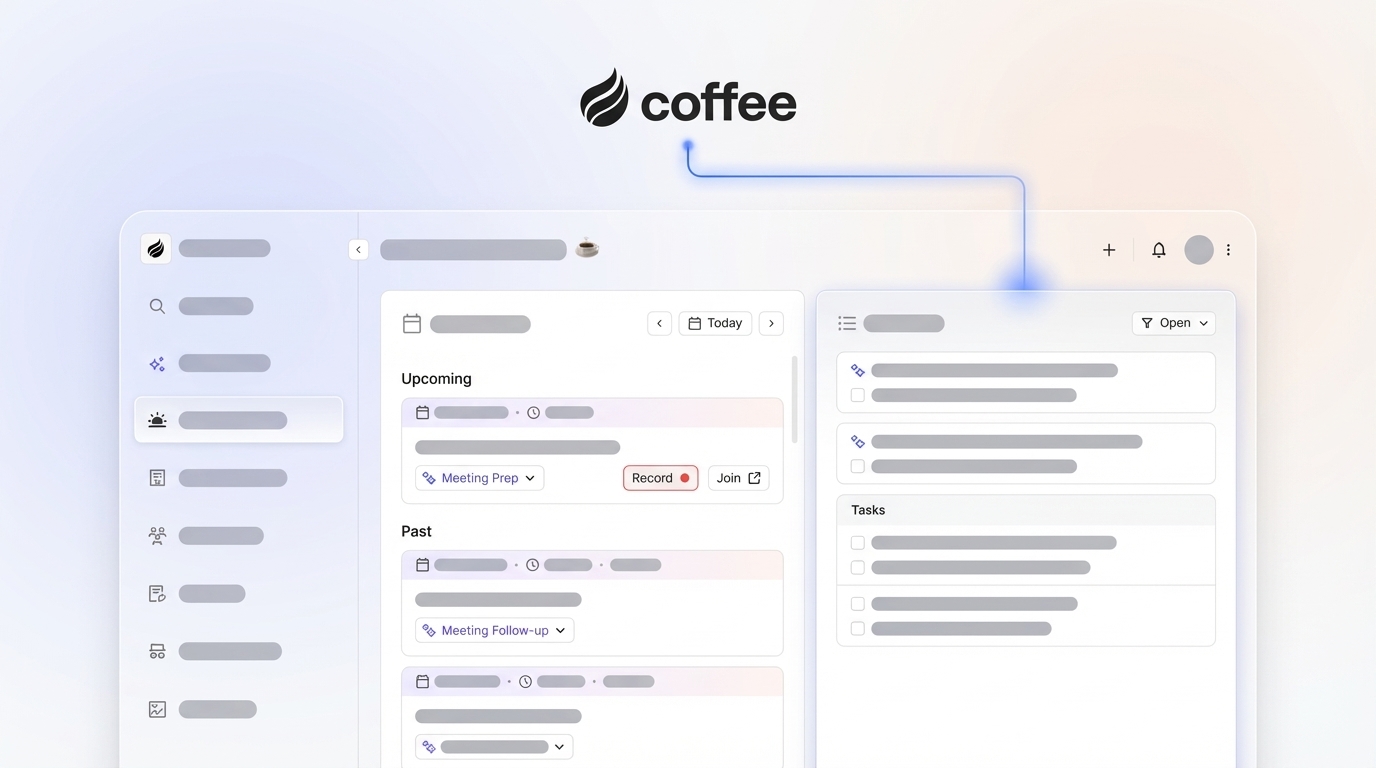
Coffee improves meeting workflows before, during, and after every conversation. Reps see a clear “Today” page with attendee details and recent context before each call. During meetings, Coffee’s AI Meeting Bot can join Zoom, Microsoft Teams, or Google Meet sessions to record and transcribe discussions. Afterward, the agent generates summaries, identifies next steps, and drafts follow-up emails in Gmail for rep review.
The agent also structures notes against frameworks such as BANT, MEDDIC, or SPICED, which support consistent qualification and make coaching easier for managers.

Real-Time Pipeline Intelligence for Better Decisions
Coffee’s Pipeline Compare feature gives revenue leaders clear, week-over-week views of deal movement, stalled opportunities, and new pipeline. This removes the need for manual spreadsheet exports and one-off reports. Pipeline reviews then focus less on debating data accuracy and more on next steps, risk, and resource allocation.
Consolidated Tech Stack for Simpler Sales Workflows
Coffee replaces several separate tools by combining CRM, enrichment, recording, and forecasting features into one platform. This reduces vendor management, lowers integration overhead, and gives revenue teams a single place to work and review performance.

Get started with Coffee to consolidate your revenue tools into a single agent-led platform.
Coffee vs. Traditional CRM Automation: A 2026 Comparison for Revenue Teams
A direct comparison between traditional CRM setups and Coffee’s AI agent shows how automation quality affects revenue performance.
|
Feature Category |
Traditional CRM Automation |
Coffee AI Agent |
Revenue Team Impact |
|
Data Input |
Manual entry with simple rules-based triggers |
Autonomous, activity-based capture |
Fewer human errors and more current data |
|
Data Quality |
Often incomplete and inconsistent |
Enriched, structured, and standardized by the agent |
More reliable analysis and reporting |
|
Rep Time on Admin |
High time cost for updates and logging |
Low, because the agent handles routine work |
More time for selling and customer conversations |
|
Pipeline Visibility |
Subjective, based on rep updates |
Objective, based on captured activity and AI analysis |
Stronger pipeline reviews and forecasting |
Get started with Coffee to apply AI-driven CRM automation to your revenue motion in 2026.
Conclusion: Make CRM Automation Work for Your Revenue Team in 2026
Legacy CRM automation often adds work for revenue teams through manual entry, scattered workflows, and low adoption. These issues limit the value of forecasting and slow pipeline progress.
Coffee’s agent-led approach offers a practical alternative. By automating data capture, enrichment, meeting workflows, and pipeline analysis, Coffee helps teams spend more time with customers and less time updating systems.
Organizations that shift from manual CRM maintenance to intelligent automation gain cleaner data, clearer visibility, and more consistent execution. To see how this can work for your team, explore Coffee’s AI agent for CRM automation and pipeline management. Get started with Coffee today and give your revenue team a more efficient way to run its CRM in 2026.
FAQ: Key Questions About CRM Automation
How does AI CRM automation improve data quality, and how is Coffee different?
AI CRM automation improves data quality by capturing information at the source instead of waiting for manual entry. Coffee’s agent collects data from emails, calendars, and meetings, then enriches and structures it in a consistent way. This reduces missing fields and conflicting records and gives leaders a more accurate view of accounts and opportunities.
Can Coffee’s agent-led CRM automation integrate with my existing Salesforce or HubSpot instance?
Yes. Coffee offers a Companion App that layers automation on top of Salesforce or HubSpot. The Coffee agent captures, enriches, and logs activities, then writes clean, structured data back into the primary CRM. Teams keep their existing system of record while shifting manual updates to the agent.
What time savings can revenue teams expect from Coffee?
Teams that adopt Coffee typically see sales reps save 8 to 12 hours per week that would have gone to CRM updates and note-taking. That time can move to prospecting, customer conversations, and deal strategy, which increases effective selling capacity without adding headcount.
How does Coffee support pipeline management for revenue teams in 2026?
Coffee supports pipeline management by keeping records current and then running autonomous pipeline analysis. Features such as Pipeline Compare help leaders track movement, risk, and coverage over time, using data that the agent maintains in the background.
What security measures does Coffee use for CRM automation?
Coffee is SOC 2 Type 2 and GDPR compliant and focuses on protecting sensitive revenue data. Customer data is not used to train public AI models, so proprietary sales information remains private to each organization.