
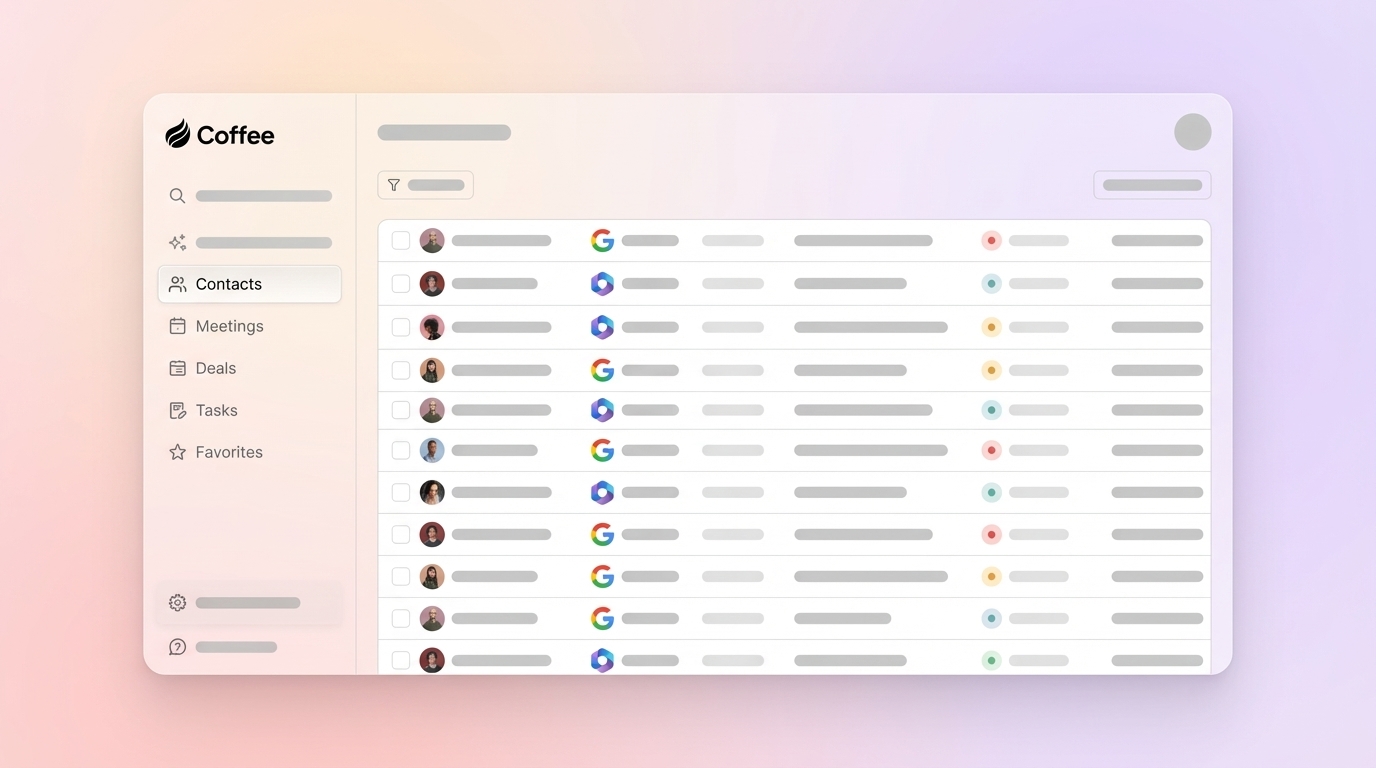
Key Takeaways
- Coffee leads as the #1 AI-powered free CRM for 2026 and removes manual data entry through autonomous agents that capture emails, enrich contacts, and manage pipelines automatically.
- Traditional free CRMs like HubSpot (1,000 contact limit) and Zoho (3-user cap) demand heavy manual work, which wastes sales reps’ time on admin tasks.
- Key evaluation factors for US small businesses include automation depth, setup under 30 minutes, Google Workspace and Zapier integrations, and CCPA and GDPR compliance.
- Coffee delivers unlimited agent labor with seat-based pricing, SOC2 compliance, and sub-5-minute setup, outperforming competitors in the comparison table.
- Upgrade to Coffee today to fully automate CRM tasks and reclaim hours of productivity for revenue growth.

How US Small Businesses Should Evaluate Free CRMs
Choose a free CRM for your US small business by focusing on limits, automation, integrations, and compliance. Start with user and contact caps, native integrations with Google Workspace and Microsoft 365, and setup time under 30 minutes. Look closely at how much data entry still falls on your team versus what the system automates. Confirm that the CRM can scale with your growth and supports CCPA and GDPR requirements. Sales reps spend 4.5 hours a week on tasks that could easily be automated, so automation depth becomes the key differentiator. Coffee’s AI agent tackles these pain points by handling data entry automatically, while traditional free CRMs still rely on extensive manual work.
Top 9 Free CRM Tools for US Small Businesses in 2026
1. Coffee: Best Overall AI CRM for 2026
Coffee operates as a truly autonomous AI agent CRM that removes manual data entry entirely. The platform captures and enriches contacts from emails and calendars, deploys meeting bots for call summaries, and delivers pipeline intelligence without human input. Its strengths include unlimited agent labor with simple seat-based pricing, SOC2 and GDPR compliance, and seamless Google Workspace and Zapier integrations. Coffee fits 1 to 20 employee US teams that want complete CRM automation instead of manual upkeep.

2. HubSpot CRM Free for US Teams
HubSpot CRM offers unlimited users with contact and deal management, email tracking, and basic marketing features, which keeps it popular among solopreneurs. Its strengths include robust email integration and clear pipeline management. The main drawbacks are manual data entry, a 1,000 contact cap, and branded emails on the free tier. The free version supports unlimited users but still requires significant manual maintenance.
3. Zoho CRM: Strong Free Option for Tiny Teams
Zoho CRM Free supports up to 3 users and includes custom fields, email templates, tasks, workflows, a mobile app, sales pipeline, basic lead scoring, and web forms. Its strengths include rich customization and an AI assistant. The strict 3-user cap and limited free storage restrict its use to very small teams. Growing teams often outgrow the free tier quickly.
4. Bitrix24 for Collaboration-Focused Teams
Bitrix24 Free offers unlimited users but limits storage to 5GB, which positions it as a collaboration-first solution. Its strengths include project management tools and team collaboration features in one workspace. The primary limitation is restricted storage, and many advanced capabilities sit behind paid plans.
5. Agile CRM for Marketing-Heavy Workflows
Agile CRM provides free access for 10 users and 1,000 contacts, along with marketing automation features. Its strengths include built-in marketing tools and generous user limits for a free plan. Contact caps and reduced functionality compared to paid tiers limit its long-term flexibility.
6. Insightly for Pipeline and Projects
Insightly centers on pipeline management and project integration for small teams. Its strengths include strong third-party integrations and detailed project tracking. Limitations include user caps on the free tier and restricted access to advanced features that many growing teams eventually need.
7. Freshsales Free for Communication Tools
Freshsales Free includes a built-in phone dialer, call logs and recordings, email sequences, AI suggestions, and mobile CRM, supporting up to 3 users. Its strengths include integrated calling tools and AI-powered suggestions for outreach. The 1,000 contact cap and user restrictions limit its appeal for larger or fast-growing teams.
8. Capsule for Simple Micro-Business Needs
Capsule focuses on simplicity with a 250 contact limit and a clean interface. Its strengths include ease of use and straightforward setup for very small teams. Severe contact restrictions and support for only 2 users make it a fit mainly for micro-businesses.
9. EngageBay Free for All-in-One Marketing
EngageBay Free provides a 500 contact limit with unified CRM, marketing automation, helpdesk, and live chat. Its strengths include an all-in-one marketing and support toolkit. Contact caps and fewer third-party integrations than specialized tools create tradeoffs for teams that rely on a broader app stack.
Side-by-Side CRM Comparison and Key Differences
|
Feature |
Coffee |
HubSpot |
Zoho |
Bitrix24 |
|
Contact Limits |
Seat-based |
1,000 |
Unlimited |
Unlimited |
|
User Limits |
Seat-based |
Unlimited |
3 users |
Unlimited |
|
Data Entry |
Fully automated |
Manual required |
Manual required |
Manual required |
|
Setup Time |
Under 5 minutes |
30+ minutes |
30+ minutes |
45+ minutes |
This comparison highlights Coffee’s core advantage for US small businesses. Traditional free CRMs still depend on extensive manual data entry, while Coffee’s AI agent handles data capture and enrichment automatically. 43% of businesses report that CRM software reduces employee workload by 5 to 10 hours per week when automation is configured correctly. A case study from a $10M+ firm showed that the team abandoned spreadsheets after Coffee’s agent removed their data entry bottleneck. Their sales reps then focused almost entirely on revenue-generating work.

Why Many Free CRMs Fall Short for US Teams
Most traditional free CRMs fail small 1 to 10 person teams because they rely on manual data entry. This requirement causes poor user adoption, inconsistent data quality, and a hidden total cost of ownership from wasted time. Sales reps spend 2 hours and 15 minutes per day on admin tasks, which equals nearly three months of lost productivity each year. Coffee removes these issues by deploying an AI agent that handles all administrative work automatically. Get started with Coffee and experience CRM management that runs itself.
CRM Setup, Data Migration, and Common Pitfalls
Successful CRM implementation for US small businesses starts with a clear setup plan. First, authenticate Google Workspace or Microsoft 365, which Coffee completes in under 5 minutes. Next, migrate existing data from spreadsheets or legacy systems into the new CRM. Then, define compliance processes that align with CCPA and GDPR requirements. Small businesses typically spend $5,000 to $15,000 for compliant processes, while Coffee includes SOC2 and GDPR compliance by default. Common pitfalls include picking systems that demand heavy manual entry and ignoring US tax and compliance integrations during setup, both of which Coffee’s agent-driven automation helps avoid.
Frequently Asked Questions
Is there a free CRM for small businesses?
Several free CRM options exist for small businesses, and Coffee stands out for its AI automation. Coffee removes manual data entry by automatically capturing contacts, enriching data, and managing the sales pipeline. Traditional free CRMs still require users to type in every detail. Coffee offers unlimited agent labor with simple seat-based pricing, which suits US small businesses that want full automation.
Which free CRM works best for US teams?
Coffee ranks as the top CRM for US teams because it eliminates manual data entry that drains sales reps’ time. HubSpot and Zoho provide solid free tiers but still rely on ongoing manual maintenance. Coffee’s AI agent creates contacts, enriches records, summarizes meetings, and manages pipelines automatically. It also maintains SOC2 and GDPR compliance for US businesses that must protect customer data.
What limits apply to HubSpot CRM Free?
HubSpot CRM Free supports unlimited users but caps contacts at 1,000 and requires manual data entry for customer information. The free tier includes branded emails and lacks advanced automation features that many teams expect. These limits mean sales reps still spend many hours on administrative work instead of selling.
Is Zoho CRM a good fit for small US businesses?
Zoho CRM Free works well for very small US teams that can operate within its 3-user limit. It offers feature-rich customization, including custom fields, workflows, and basic AI assistance. The strict user cap and manual data entry requirements restrict scalability. For growing teams, Coffee’s unlimited seats and automated data management deliver stronger long-term value.
What is the best free CRM for 2026?
Coffee stands as the leading CRM for 2026 because its AI agent model removes manual data entry entirely. Traditional options like HubSpot and Zoho still depend on human maintenance for contact creation and pipeline updates. Coffee automatically captures emails, enriches contacts, manages pipelines, and surfaces intelligent insights. The platform combines unlimited agent labor, SOC2 compliance, and seamless integrations, which makes it a clear choice for modern US small businesses.

Conclusion: Move From Manual CRM Work to Coffee Automation
Traditional free CRMs such as HubSpot and Zoho give small businesses a starting point but keep teams stuck in manual data entry cycles. These cycles drain selling time and reduce adoption. Coffee’s AI agent represents a different path by handling administrative tasks automatically while supporting unlimited scale and US-focused compliance features. Get started with Coffee today to experience automated CRM management and shift your time back to revenue-generating activities.