
Key Takeaways
- Sales reps lose 71% of their time to non-selling work, and AI automation can recover 15–20% of selling time by handling transcription, summaries, and CRM updates.
- Coffee leads as a top CRM agent with native Salesforce and HubSpot integration, sales methodology support like BANT and MEDDIC, and rich pipeline intelligence.
- Core evaluation criteria include CRM depth, sales-focused features, SOC 2 security, bot-free options, and simple setup across tools such as Fireflies, Gong, and Otter.ai.
- Enterprise tools like Gong and Chorus deliver advanced analytics at higher prices, while lighter tools like Fathom fit small teams with straightforward needs.
- Teams can implement AI meeting automation with secure OAuth setup and clear workflows to speed up deals, and Coffee’s free trial offers end-to-end sales automation.
How to Choose AI for Sales Meeting Notes That Actually Helps Reps Sell
The right AI meeting tool should update your CRM accurately, not just store transcripts. CRM integration depth determines whether the system creates contacts, updates deal stages, and maintains pipeline health without manual work. Sales-focused features such as BANT or MEDDIC templates, clear action item capture, and coaching insights separate true sales tools from generic note-takers.
Security and privacy standards like SOC 2 certification protect sensitive deal data and customer information. Setup effort and adoption rates directly affect ROI, because even powerful tools fail if reps avoid them. Free trials let teams test real workflows before paying, and bot-free or low-friction options help preserve a natural customer experience while still capturing accurate notes.
The 9 Best AI Tools to Automate Sales Meeting Notes
#1 Coffee: AI CRM Agent for End-to-End Sales Workflows
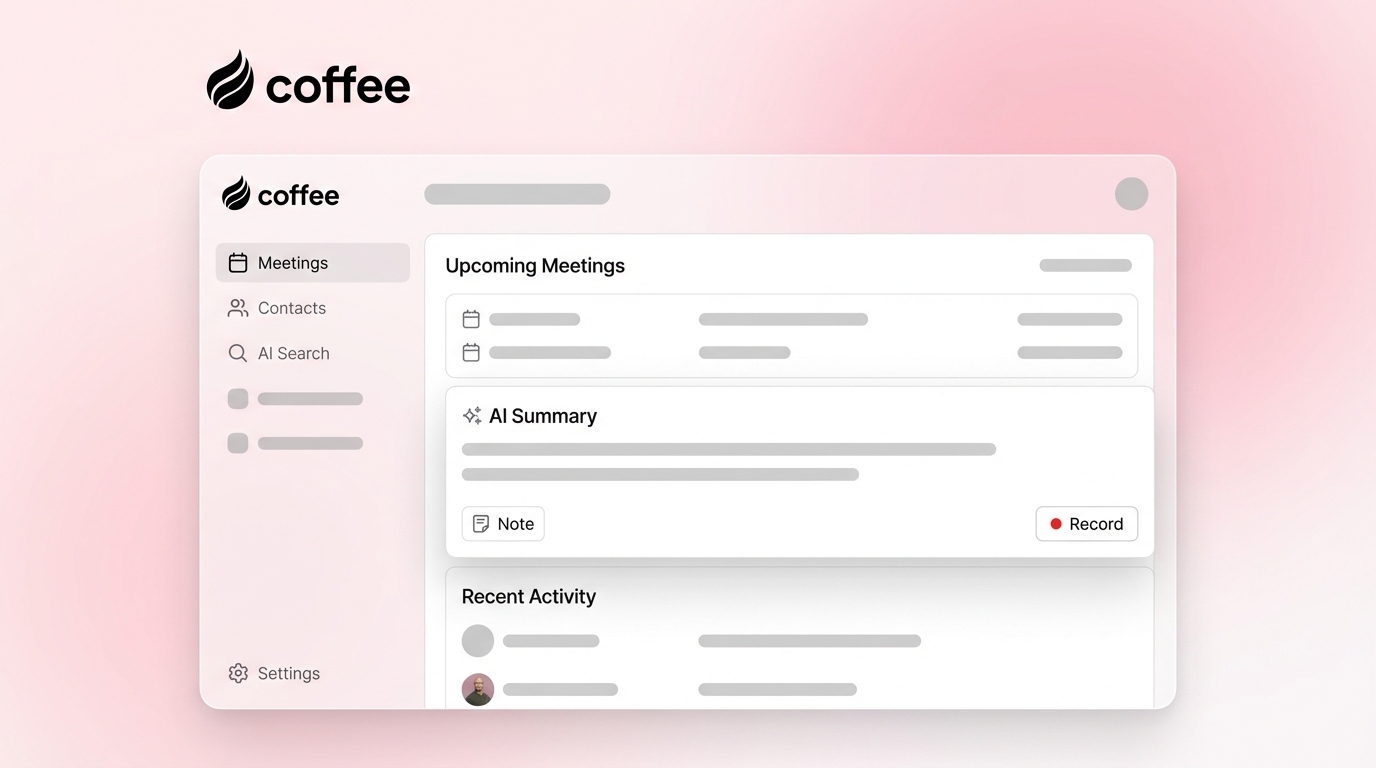
Coffee acts as a CRM agent instead of a passive transcription tool. The platform serves small and mid-sized businesses that want either a standalone CRM powered by an AI agent or a companion app that connects directly to Salesforce or HubSpot.
Key Strengths:
- Native Salesforce and HubSpot integration with automatic contact creation and deal updates
- AI meeting bot that joins Zoom, Teams, and Google Meet calls to record and transcribe
- AI-powered briefings that include prospect context and conversation history
- Built-in data warehouse for historical pipeline tracking and week-over-week comparisons
- Sales methodology support for BANT, MEDDIC, and SPICED with structured note templates
- SOC 2 Type 2 compliance for enterprise-grade security

Setup Process: Connect Google Workspace or Microsoft 365, authenticate CRM access, enable the meeting bot, set summary preferences, and turn on pipeline intelligence features.
Pricing: Seat-based pricing with a free trial and no usage metering on AI features.
#2 Fireflies.ai: Multiplatform Transcription with Strong Action Items
Fireflies.ai focuses on consistent transcription across more than 50 integrations. The platform earns a 5/5 rating for action item recognition and supports transcription in over 69 languages with accent recognition.
Key Strengths:
- Robust CRM integration with Salesforce and HubSpot workflow automation
- Advanced action item extraction and assignment tools
- Extensive language support with accent recognition
- Conversation analytics and sentiment analysis
Limitations: Accuracy can drop with technical terms, so complex sales calls often need manual review.
#3 Fathom: Simple AI Notes for Small Sales Teams
Fathom delivers streamlined meeting assistance with a focus on simplicity and user experience. The platform holds a 5/5 G2 rating from thousands of reviews and prioritizes ease of use over deep analytics.
Key Strengths:
- Straightforward transcription and summary creation
- Clean interface with a very short learning curve
- Basic CRM integration options
- Free tier that works well for small teams
Limitations: Limited sales-specific features and basic CRM sync without advanced field mapping.
#4 Gong: Conversation Intelligence for Large Sales Orgs
Gong focuses on conversation intelligence and sales coaching with deep CRM connections. The platform analyzes call patterns to surface deal risk and forecasting insights, which suits larger teams that track performance closely.
Key Strengths:
- Advanced conversation analytics and coaching tools
- Deep integrations with Salesforce, HubSpot, Outreach, and Salesloft
- Deal risk scoring and pipeline forecasting
- Comprehensive sales performance dashboards
Limitations: Higher pricing and complex setup that usually requires dedicated implementation support.
#5 Otter.ai: Real-Time Transcription with Searchable Archives
Otter.ai offers real-time transcription, AI summaries, and searchable call archives. OtterPilot for Sales adds speaker identification and keyword highlights along with detailed sales reports.
Key Strengths:
- Live transcription with clear speaker identification
- Automatic action item capture and assignment
- Searchable archives of past conversations
- Integrations with popular productivity tools
Limitations: General-purpose focus with limited sales-specific CRM depth and minimal pipeline intelligence.
#6 Chorus (ZoomInfo): Enterprise Conversation Intelligence
Chorus, now part of ZoomInfo, blends conversation intelligence with prospecting data. The platform targets enterprise sales teams that need advanced analytics and structured coaching programs.
Key Strengths:
- Direct connection to the ZoomInfo prospecting database
- Rich conversation analytics and deal insights
- Sales coaching and performance tracking tools
- Enterprise-level security and compliance
Limitations: High cost and complex implementation that fits large organizations better than small teams.
#7 Avoma: Revenue Intelligence with Follow-Up Automation
CRM-ready notes and follow-ups combine transcription with automated workflows for follow-up emails and CRM updates. AI scorecards support sales methodologies and automatic CRM field updates for structured qualification.
Key Strengths:
- Sales methodology scorecards and coaching insights
- Automated follow-up email generation
- Revenue intelligence that links conversation patterns to outcomes
- Talk pattern analysis for performance improvement
Limitations: Steeper learning curve and configuration work before teams see full value.
#8 Granola: Meeting Prep and Context for Sales Calls
Granola emphasizes meeting preparation and context gathering by pulling information from multiple sources before calls. The platform fits teams that care about workflow integration and reliable transcription.
Key Strengths:
- Thorough meeting preparation with context aggregation
- Integrations with productivity tools and CRM systems
- Automated briefing creation for upcoming calls
- Simple setup and intuitive experience
Limitations: Lighter post-meeting analytics compared with tools built specifically for sales.
#9 MeetGeek: Collaborative Meeting Notes for Growing Teams
MeetGeek supports meeting automation with a focus on collaboration and knowledge sharing. The platform captures calls and builds a searchable library that teams can use for training and reference.
Key Strengths:
- Collaboration features with shared meeting insights
- Searchable repository of conversations
- Basic CRM integration options
- Accessible pricing for small teams
Limitations: Limited sales-specific features and simple CRM sync without advanced automation.
Side-by-Side Comparison of Top AI Sales Note Tools
|
Tool |
CRM Integration |
Free Tier |
Sales Score |
|
Coffee |
Native Salesforce/HubSpot |
Yes (trial) |
10/10 |
|
Fireflies.ai |
Strong CRM integration |
Yes |
8/10 |
|
Fathom |
Limited integration |
Yes |
7/10 |
|
Gong |
Deep CRM connections |
No |
9/10 |
Coffee stands out for end-to-end sales automation with an agent-based model that manages structured and unstructured data while preserving deep native CRM integration.

Step-by-Step Guide to Implement Coffee for Sales Meeting Automation
Successful AI meeting automation follows five steps: choose a tool based on CRM needs, set up secure authentication, configure workflows, train the team, and monitor performance. OAuth authentication methods keep CRM access limited to authorized users.
For Coffee, start by connecting Google Workspace or Microsoft 365 for calendar and email access. Then authenticate Salesforce or HubSpot with secure OAuth. Turn on the meeting bot so it can join Zoom, Teams, and Google Meet automatically. Configure summary preferences, including BANT, MEDDIC, or SPICED formatting and action item rules.

Next, activate pipeline intelligence for week-over-week deal tracking and automated briefings. Bidirectional syncing and customizable field mapping keep data consistent across systems. Teams should avoid weak privacy settings, relying only on free tiers without sales features, or using intrusive bots that disrupt customer conversations.

Get started with Coffee to deploy SOC 2 compliant meeting automation with native CRM integration.
FAQs
What is the best free AI tool for sales meeting notes?
Fathom offers a strong free tier for basic transcription and summaries. Coffee’s free trial delivers more value for sales teams because it includes a full CRM agent, automatic contact creation, and pipeline intelligence that free tools do not provide. Teams that treat sales automation seriously can use the trial to test advanced workflows before upgrading.
Can AI handle specific sales methodologies like BANT or MEDDIC?
Coffee structures notes around established sales methodologies such as BANT, MEDDIC, and SPICED. The AI agent identifies key details in the conversation and assigns them to the right methodology fields. Reps get consistent qualification data across every call without manual formatting.
How does Coffee compare to Fireflies for CRM integration?
Coffee functions as a native CRM agent with deep Salesforce and HubSpot integration. It creates contacts, updates deal stages, and maintains historical context through a built-in data warehouse. Fireflies offers strong CRM integration and field mapping but does not match Coffee’s agent-based pipeline intelligence or warehouse capabilities. Coffee removes manual data entry for reps.
Are AI meeting tools secure for sensitive sales conversations?
Coffee follows SOC 2 Type 2 and GDPR standards with enterprise-level security controls. Data stays encrypted in transit and at rest, and strict access controls and audit logs protect sensitive information. Coffee also avoids using customer data to train public AI models, which keeps confidential sales conversations private.
What ROI can sales teams expect from AI meeting automation?
Sales teams usually reclaim 8–12 hours each week with AI meeting automation, which equals 15–20% more selling time according to McKinsey research. Coffee customers report faster deal cycles, higher CRM adoption, and more accurate pipelines. One company with tens of millions in revenue replaced manual spreadsheet reviews with automated weekly pipeline views and saw measurable gains in forecast accuracy and productivity.
Conclusion: Why Coffee Leads AI Sales Meeting Automation in 2026
Coffee delivers a complete solution for automating sales meeting notes in 2026 with a true CRM agent that manages end-to-end workflows. Traditional tools stop at transcription, while Coffee removes manual data entry, tracks pipeline health, and surfaces insights that help teams close more revenue.
Get started with Coffee today and shift your sales meetings from manual note-taking to automated, revenue-focused intelligence.