
Last updated: January 26, 2026
What You Will Get From This Guide
- Sales reps lose 71% of their time to data entry. The right tools automate prospecting, enrichment, and CRM updates so reps can sell.
- Coffee leads as the top agent-led platform. It runs end-to-end workflows without manual work and saves teams 8 to 12 hours each week.
- Traditional tools like ZoomInfo and Apollo offer strong data but still rely on manual effort, patchy integrations, and aging records.
- Key buying criteria include 95% or higher data accuracy, Salesforce and HubSpot sync, automation depth, and GDPR/SOC 2 compliance.
- You can consolidate your stack with Coffee’s agent-led automation and replace fragmented tools with one pipeline-focused platform.
How We Picked These Prospecting and Enrichment Tools
We focused on tools that move real sales metrics, not just feature lists. Each platform was evaluated on data accuracy rates above 95%, database size, automation depth, and whether it behaves like passive storage or a proactive agent.
We also checked native Salesforce and HubSpot integrations, pricing transparency, G2 user ratings, and GDPR plus SOC 2 compliance. About 70% of companies struggle with system integration, so smooth CRM connectivity matters.
Speed-to-lead performance carried extra weight. Teams that respond within one minute see 391% higher conversion rates. That level of speed requires automated workflows that remove manual delays.
Top 12 Prospecting and Data Enrichment Tools for 2026
1. Coffee: Agent-Led Automation for End-to-End Sales Workflows
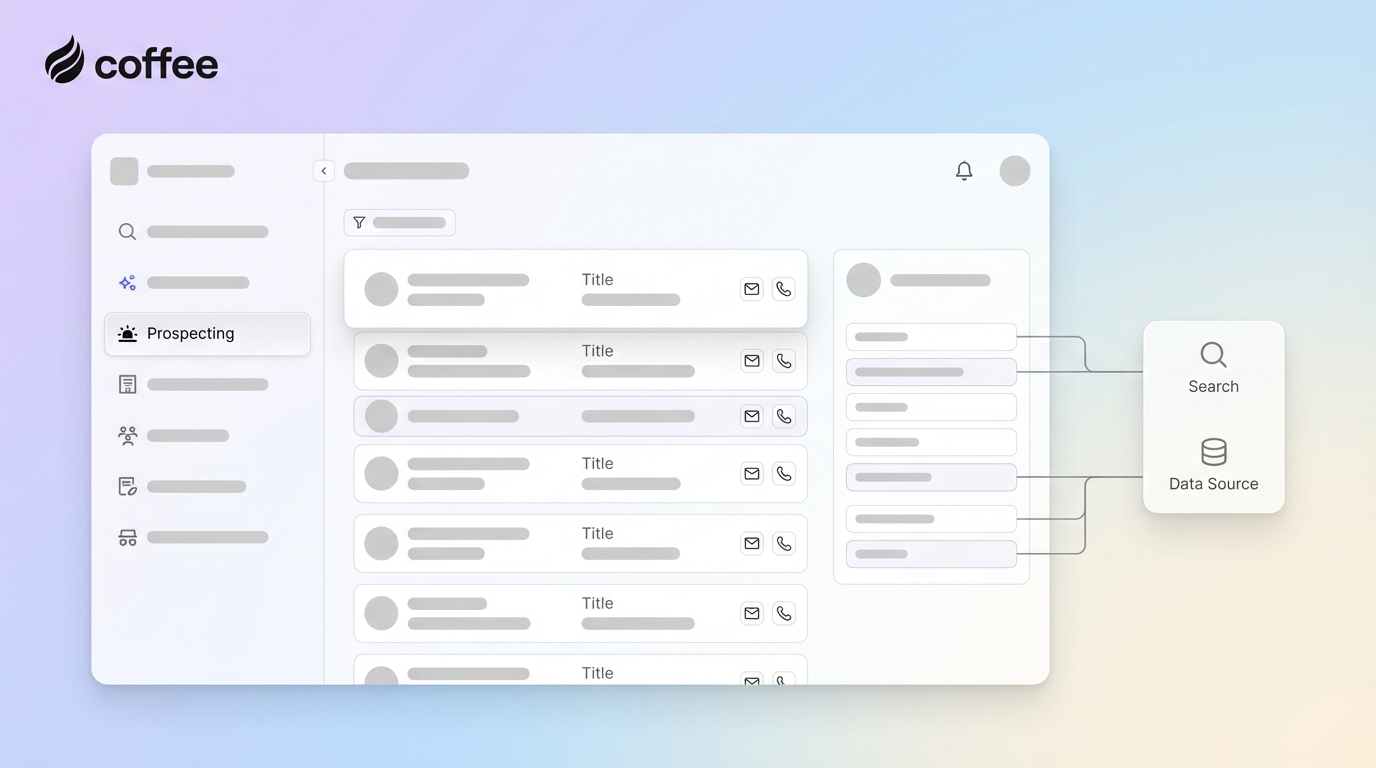
Coffee is the only agent-led solution on this list that runs data capture, enrichment, and CRM logging without human input. The agent scans Google Workspace or Microsoft 365, creates contacts automatically, enriches them with job titles, funding data, and LinkedIn profiles, then logs every interaction into Salesforce or HubSpot.

Pricing is seat-based and includes unlimited agent labor, so teams avoid confusing AI usage meters. Coffee holds SOC 2 Type 2 and GDPR compliance and delivers data quality comparable to ZoomInfo through licensed partners. Sales teams typically save 8 to 12 hours per week as the agent handles data entry, meeting briefings, call summaries, and follow-up emails.

One multi-million dollar AI services company replaced spreadsheet-driven sales tracking with Coffee. The team highlighted automatic contact creation from email threads and pipeline insights that removed weekly manual reviews. Reps can ask for lists in plain language, such as “Find VPs of Sales in North America at companies with over $10M in funding that use Salesforce,” and the agent runs targeted outbound workflows on its own.

2. Apollo.io: Budget-Friendly Prospecting and Sequences for SMBs
Apollo.io offers broad B2B prospecting with over 210 million contacts and a 4.7/5 G2 rating. It combines contact discovery, email sequences, and basic CRM integration at $49 per month, which suits smaller teams.
The platform works well for email-heavy outreach with built-in deliverability tools. Its automation still falls short of Coffee’s agent-led model for full data capture and CRM management. Many users report stale data and deliverability issues when verification fails. Apollo supports bidirectional CRM sync, yet teams often need to monitor data quality closely.
3. ZoomInfo: Enterprise-Grade Data and Buyer Intelligence
ZoomInfo delivers 95% or higher accuracy at about $995 per month, which positions it as a premium option for large enterprises. It offers deep company intelligence, intent data, and powerful search across more than 200 million profiles.
Drawbacks include opaque pricing that requires a demo, weaker European coverage after GDPR, and high costs for small teams. Users also report 15% to 20% bounce rates and outdated phone numbers. ZoomInfo functions as a passive database, so teams still need manual enrichment workflows, unlike Coffee’s agent-led approach.
4. Cognism: GDPR-First Prospecting for EMEA Markets
Cognism focuses on compliant European B2B data and offers Diamond Data® phone numbers starting at $588 per month. It emphasizes GDPR alignment and human-verified contacts, which suits companies selling into EMEA.
Cognism supports automation but stops short of Coffee’s fully agent-led consolidation. Teams still juggle separate tools for some prospecting and CRM tasks instead of running one continuous workflow.
5. Clay: Flexible Enrichment for Custom Data Pipelines
Clay delivers advanced enrichment at about $124 per month. Users can build custom waterfall enrichment flows and combine multiple data sources for niche use cases.
This flexibility introduces complexity for many sales teams. Users often describe Clay as powerful but expensive and hard to use. It handles enrichment well but still needs separate tools for prospecting and CRM, while Coffee unifies those steps under one agent.
6. Clearbit: Real-Time Enrichment Inside Your CRM
Clearbit specializes in real-time enrichment with deep HubSpot integration after its acquisition. It can add more than 100 verified attributes, including firmographics and contact details, directly into CRM records as they appear.
The platform shines when enriching existing records but offers limited prospecting. Teams usually pair Clearbit with other tools to find new leads, whereas Coffee covers discovery, enrichment, and CRM updates in one system.
7. Lusha: Chrome Extension for Fast Contact Lookups
Lusha provides contact enrichment through a Chrome extension at $29 per month with 5 free credits. It offers over 100 million contacts, 20 datapoints per lead, and a 4.3/5 G2 rating.
The browser-first model works well for quick, targeted lookups but does not cover full agent-led workflows. Users mention weaker global coverage than Cognism. Teams often need extra setup for CRM and sequence tools.
8. Seamless.AI: Live Contact Search With Mixed Quality
Seamless.AI focuses on real-time contact search with live verification at about $147 per month. It tracks job and company changes so reps can reach prospects at the right moment.
Despite this focus, users frequently report invalid emails and disconnected phone numbers. The platform also lacks Coffee’s agent-led automation and tight CRM sync.
9. LinkedIn Sales Navigator: Deep Prospecting Inside LinkedIn
LinkedIn Sales Navigator offers advanced search across LinkedIn at $79.99 per month with a 30-day trial. It supports InMail outreach, live updates, and CRM integrations for LinkedIn-centric workflows.
Its strength is also its limit. Prospecting stays inside LinkedIn and often requires manual exports to keep CRM data current. Teams still perform heavy lifting to turn LinkedIn activity into CRM records and follow-up sequences, while Coffee automates those steps.
10. SalesIntel: Human-Verified Contacts for Accuracy
SalesIntel offers human-verified contact data at about $79 per month. It focuses on accuracy through manual checks and provides 95% accuracy, unlimited HubSpot enrichment, and 90-day refresh cycles.
The platform delivers strong data and automation but still falls short of Coffee’s agent-led consolidation. Teams gain quality contacts yet continue to manage CRM workflows themselves.
11. LeadIQ: Prospecting Plus AI Email Writing
LeadIQ combines prospecting automation with AI-written emails at about $75 per month. It helps reps find contacts and send personalized outreach from one place.
Its automation focuses on top-of-funnel tasks. It does not extend into fully autonomous data capture, record maintenance, and CRM management like Coffee’s agent.
12. Hunter: Email Discovery and Verification at Scale
Hunter centers on email discovery and verification at $49 per month with 25 free searches. It finds emails tied to specific domains and checks deliverability to cut bounce rates.
Because Hunter focuses on email only, teams still need other tools for prospecting, enrichment, and CRM workflows. Coffee covers those needs in one integrated, agent-led platform.
Quick Comparison of Top Prospecting and Enrichment Tools
|
Tool |
Best For |
Data Accuracy |
Automation Level |
|
Coffee |
Agent-led automation |
On par with leading providers (partner-sourced) |
Proactive agent |
|
Apollo.io |
SMB sequences |
85%+ |
Automated features |
|
ZoomInfo |
Enterprise intelligence |
95%+ |
Passive database |
|
Cognism |
EMEA compliance |
90%+ |
Automated workflows |
The Real Cost of a Fragmented Sales Tool Stack
Fragmented prospecting workflows create expensive inefficiencies that grow over time. Sales reps waste 27.3% of their time on bad leads caused by outdated data, and 70% of companies struggle with CRM and marketing automation integration.
The impact goes beyond subscription fees. Manual data maintenance demands constant human oversight, and 30% to 50% of CRM data becomes outdated without automated refreshes. Gaps between prospecting tools, enrichment platforms, and CRMs create silos that hide pipeline risks.
Agent-led platforms like Coffee remove many of these costs by unifying prospecting, enrichment, and CRM management into one automated workflow. Get started with Coffee to replace scattered point solutions with a single system.
Why Agent-Led Platforms Outperform Point Solutions in 2026
AI has shifted the market from static databases to proactive agents. Traditional tools still rely on humans to run workflows. Agent-led platforms like Coffee handle data unification, enrichment, and CRM updates on their own.
Speed-to-lead benchmarks show why this matters. Leads contacted within five minutes are 21 times more likely to convert. Only automated workflows can consistently hit that response time.
Coffee keeps GDPR compliance through secure processing and built-in controls. Traditional tools often push compliance tasks onto the team, while Coffee’s agent manages data handling in a consistent and auditable way.
How to Pick the Right Prospecting and Enrichment Tool
Team size should guide your first filter. Small businesses with 1 to 20 employees usually gain more from integrated platforms like Coffee or Apollo that combine prospecting and enrichment. Mid-market teams with 20 to 200 employees should focus on native CRM integrations and automation that can handle rising volume.
Budget planning needs to include setup time and ongoing maintenance, not just license fees. Free tiers from tools like Hunter work for light use but lack CRM sync and automation. Enterprise tools like ZoomInfo demand higher upfront spend. Coffee’s seat-based pricing includes unlimited agent labor, which keeps costs predictable as the team grows.
CRM integration should remain a non-negotiable requirement. Coffee offers bidirectional sync with automatic enrichment, while many point solutions still rely on exports and imports that create data drift and extra admin work.
Frequently Asked Questions
What is the best prospecting tool for automated workflows?
Coffee stands out for automated prospecting because its agent handles prospect discovery, enrichment, and CRM logging without human input. Unlike passive databases that need manual workflows, Coffee manages the full lifecycle, including follow-up email creation. Teams typically reclaim 8 to 12 hours per week by removing manual data entry and cleanup.

Is there a free B2B data enrichment tool worth using?
Free tiers from Hunter and Lusha can work for occasional lookups but do not support consistent, high-volume prospecting. They usually cap searches and skip advanced features such as CRM sync and automation. Coffee’s unlimited agent labor model delivers more value by merging several tool functions into one platform with clear seat-based pricing.
How does Apollo compare to ZoomInfo for small sales teams?
Apollo costs about $49 per month, while ZoomInfo starts near $995 per month and targets enterprises. Small teams usually find Apollo more accessible. Both tools still behave as passive databases that require manual prospecting and CRM upkeep. Coffee goes further by automating prospecting, enrichment, and CRM integration through an agent, which reduces the need for extra tools.
Does Coffee’s data quality match ZoomInfo’s accuracy?
Coffee delivers data quality similar to ZoomInfo for most use cases through licensed partners and strong enrichment. The agent adds job titles, funding data, and LinkedIn profiles automatically. The main advantage is Coffee’s proactive automation. ZoomInfo still needs manual enrichment workflows, while Coffee keeps records fresh without human effort.
What integrations and compliance features does Coffee provide?
Coffee connects to Salesforce and HubSpot through simple authentication. The agent syncs data, enriches records, and writes insights back into the primary CRM. Coffee maintains SOC 2 Type 2 and GDPR compliance, and the agent handles data securely, which reduces risk compared with manual compliance processes.
Conclusion: Use Coffee to Automate Prospecting and Enrichment
Running separate tools for prospecting, enrichment, and CRM management slows teams and hides pipeline issues. Traditional platforms demand heavy manual work to keep data clean and workflows moving. Agent-led platforms like Coffee automate that journey from first touch to CRM update.
Coffee’s autonomous agent cuts the 71% time loss to data entry that many sales teams face. It delivers enterprise-grade automation with clear seat-based pricing, native CRM integrations, and strong GDPR controls. This combination suits small and mid-sized teams that want to simplify their stack without losing data quality.
Get started with Coffee and shift your prospecting from manual busywork to automated, always-on pipeline generation.