Written by: Doug Camplejohn, CEO & Co-Founder, Coffee | Last updated: June 26, 2026
Key Takeaways for 2026 CRM Buyers
- Clarify CRM offers a modern interface but still acts as a passive database that depends on manual data entry from reps, which creates incomplete records and unreliable forecasts.
- Coffee functions as an autonomous agent that automatically captures contacts, activities, and deal updates from email and calendar, removing the manual logging burden.
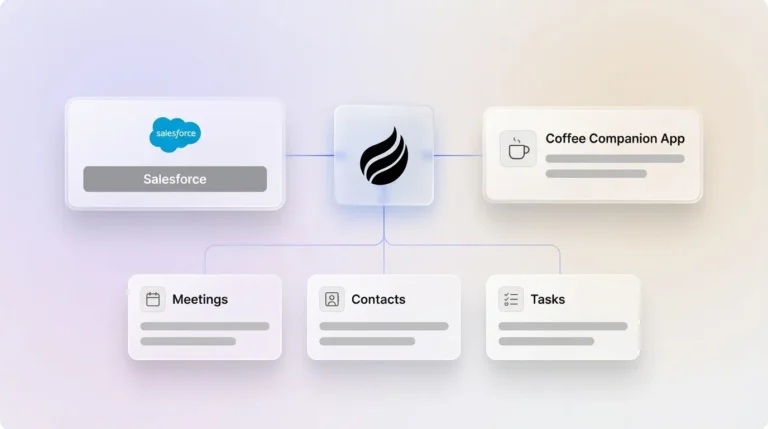
- Coffee provides deeper integration with existing Salesforce and HubSpot instances through its companion-app model, preserving established workflows while enriching data quality.
- Teams using Coffee save an estimated 8–12 hours per week on data entry, so reps can focus on selling instead of administrative tasks.
- Teams evaluating CRM options in 2026 can explore Coffee’s pricing and deployment flexibility to see how the autonomous agent model fits their stack.
How Clarify CRM Users Describe Their 2026 Experience
User feedback on Clarify CRM in 2026 centers on two themes: appreciation for its modern interface and frustration with the manual effort required to keep it accurate. Reps who migrate from Salesforce or HubSpot often describe Clarify as visually refreshing but operationally similar in one critical way. The CRM still depends on humans to log activities, update fields, and maintain contact records.
A representative sentiment from a G2-style review in early 2026 captures the pattern: “Clarify looks like what a CRM should look like in 2026, but I’m still spending 45 minutes a day updating it. The interface changed; the work didn’t.” A second recurring complaint surfaces in Reddit threads comparing modern CRM options: “We moved from HubSpot to Clarify hoping the AI would handle the logging. It doesn’t. It’s a prettier database, not an agent.”
These patterns reveal a gap between Clarify’s AI-native marketing and its underlying data-capture architecture, which still depends on rep input. For teams where reps are already stretched, this gap turns into incomplete pipeline data and unreliable forecasts. The manual data entry grind that plagues legacy CRMs does not disappear with a modern UI alone.
Integration limitations compound the problem. Users attempting to connect Clarify to established Salesforce or HubSpot instances report friction around required fields, quota structures, and forecasting hierarchies that Clarify’s integration layer does not fully accommodate.
These recurring pain points around manual data entry, integration friction, and incomplete pipeline visibility shape the evaluation framework below. Each criterion ties directly to a real deployment challenge that buyers report today.
Evaluation Criteria for Comparing Clarify and Coffee
Setup and onboarding speed: Time from sign-up to a populated, usable CRM determines how quickly a team realizes value and whether adoption stalls early.
Data capture and maintenance burden: The extent to which the system, rather than the rep, handles logging contacts, activities, and deal updates.
Usability for individual reps: Whether reps experience the CRM as a tool that serves them or a database they must constantly feed.
Pipeline visibility for managers: The accuracy and timeliness of deal-stage data available to sales leaders without manual extraction or spreadsheet work.
Integration depth with Salesforce and HubSpot: The ability to sync bidirectionally with existing CRM instances, including required fields, forecasting categories, and custom objects, so current workflows stay intact.
Total cost of ownership: Seat pricing plus the hidden cost of manual admin hours, point-solution sprawl, and data quality remediation.
Scalability: Whether the architecture supports a team growing from 5 to 50 reps without a disruptive re-platforming project.
Clarify vs Coffee: Side-by-Side Comparison Table
| Criteria | Clarify CRM | Coffee |
|---|---|---|
| Data capture model | Passive, requires manual rep input for contacts, activities, and deal updates | Autonomous agent captures contacts, activities, and deal state from email and calendar automatically |
| Salesforce / HubSpot integration | Limited, reported friction with required fields, quotas, and forecasting hierarchies | Deep companion-app model, agent writes enriched data back to existing Salesforce or HubSpot instance |
| Setup and onboarding | Modern UI reduces configuration time vs. legacy CRMs, data population still manual | Connects to Google Workspace or Microsoft 365, agent begins auto-populating records immediately |
| Pipeline visibility | Dependent on rep data entry quality, incomplete logging produces incomplete pipeline views | Pipeline Compare feature tracks week-over-week deal changes automatically from agent-captured data |
| Deployment model | Standalone CRM only | Standalone CRM or companion layer on Salesforce / HubSpot |
Every data point in this table reflects documented product architecture and publicly reported user experience patterns. Where direct benchmarks are unavailable, characterizations draw from company-published positioning and aggregated user sentiment.
Get started with Coffee and see how the autonomous agent model compares in your own stack.
Deep Dive: How Clarify and Coffee Perform by Category
Setup and Onboarding Experience
Clarify’s onboarding experience is faster than Salesforce or legacy HubSpot configurations because it carries less structural complexity. A clean interface, however, does not solve the data-population problem. A new Clarify instance starts empty and fills only as reps log interactions.
Coffee’s onboarding connects to Google Workspace or Microsoft 365 and immediately begins scanning emails and calendars to auto-create contacts, companies, and activity logs. The CRM becomes populated before a rep manually enters a single record.

Data Capture and Ongoing Maintenance
This category highlights the central architectural divide. Clarify operates as a passive container and holds whatever data humans put into it. Coffee operates as an active agent and ingests emails, calendar events, and call transcripts to maintain records without human input.

Coffee’s autonomous agent saves reps an estimated 8–12 hours per week that would otherwise go to manual logging. This time savings, referenced in the key takeaways above, returns directly to selling activity instead of administrative overhead.

See pricing and deployment options to understand how this model fits different team sizes.
Everyday Usability for Reps
Clarify scores well on interface design, and reps transitioning from Salesforce report a lower visual complexity. The behavioral problem remains, because reps who dislike data entry in Salesforce dislike it equally in Clarify. This pattern, noted in user reviews above, shows why interface improvements alone do not solve adoption problems when the underlying data-entry burden stays the same.
Coffee removes the chore entirely by delegating it to the agent. This shift changes the rep’s relationship with the CRM from obligation to utility.
Manager Visibility and Pipeline Reporting
Pipeline accuracy in any passive CRM depends on rep compliance. When reps under-log, which is the norm rather than the exception, managers see an incomplete picture. Forecasts then rest on partial or outdated information.
Coffee’s Pipeline Compare feature generates week-over-week deal movement reports from agent-captured data, not from rep-submitted updates. This approach removes the compliance variable from pipeline reviews and gives leaders a more reliable view of deal health.
Salesforce and HubSpot Integration Complexity
Clarify’s integration layer does not fully accommodate the structural complexity of established Salesforce or HubSpot instances. Required fields, quota hierarchies, forecasting categories, and custom objects create friction that many users describe as unresolved.
Coffee’s companion-app model was built specifically for this environment. A simple authentication allows the Coffee agent to sync, enrich, and write data back to the primary CRM while respecting its existing architecture.
Real Total Cost of Ownership
Clarify’s seat pricing may appear competitive at first glance. The hidden cost comes from the manual labor required to maintain data quality, which consumes hours that never appear on a software invoice but represent real revenue-generating time lost.
Coffee uses seat-based pricing with the agent’s labor included. It also consolidates functions that teams typically purchase separately, such as enrichment, call recording, meeting summaries, and pipeline tracking.
Best-Fit Use Cases by Company Stage
Early-stage teams (1–10 people): Companies that have outgrown spreadsheets but have no existing CRM investment are strong candidates for Coffee’s standalone model. The agent handles setup and ongoing maintenance, so founders and early sales hires can focus on pipeline instead of administration. Clarify can also work here if the team has strong data-entry discipline, though that discipline rarely survives rapid headcount growth.
Growing sales organizations (10–30 people): At this stage, pipeline visibility becomes a management priority and data quality gaps become expensive. Coffee’s autonomous capture model scales with headcount without requiring proportional increases in admin effort. Clarify’s passive model means data quality problems compound as the team grows.
Teams committed to Salesforce or HubSpot: This scenario creates the sharpest distinction between Clarify and Coffee. Clarify is a standalone system and does not function as a layer on top of an existing CRM. Coffee’s companion-app model fits teams that have invested in Salesforce or HubSpot infrastructure and need an agent to handle the data-in problem without replacing the system of record.
Operational Considerations, Risks, and Misconceptions
Change management: Switching CRMs at the 10-to-30-person stage carries real disruption risk. Historical data migration, rep retraining, and integration reconfiguration all require dedicated time. Coffee’s companion-app model mitigates this for Salesforce and HubSpot users because it does not require replacing the system of record. It adds an agent layer on top of it.
The “AI-native” misconception: Clarify and several newer CRM entrants market themselves as AI-native. That label usually describes interface design and feature set, not data architecture. A CRM that uses AI to surface insights from manually entered data still behaves as a passive database. The key architectural question is whether the system captures data autonomously or waits for humans to provide it.
Hidden manual work: Teams that adopt Clarify expecting automation of data entry will encounter the same compliance problem they had in their previous CRM. The manual work is relocated to a newer interface, not eliminated.
Integration gaps at scale: Clarify’s integration limitations with Salesforce and HubSpot affect any team with established forecasting workflows, required field configurations, or multi-stage pipeline structures. Teams should evaluate integration depth carefully before committing to a platform migration.
Overbuying risk: Coffee is not designed for large enterprises with complex custom workflows or heavily regulated industries that require multi-year security reviews. Teams in those categories should evaluate enterprise-tier platforms instead.
Decision Framework Summary Matrix
| Scenario | Recommended Path |
|---|---|
| No existing CRM; team of 1–20; wants zero admin overhead | Coffee Standalone |
| Existing Salesforce or HubSpot; data quality problems; low rep adoption | Coffee Companion App |
| No existing CRM; team values UI design; has strong data-entry discipline | Clarify (with realistic expectations on manual effort) |
| Committed to Salesforce/HubSpot; needs deep forecasting and quota management | Coffee Companion App (preserves existing infrastructure) |
| Large enterprise; complex custom workflows; regulated industry | Neither; evaluate enterprise-tier platforms |
Frequently Asked Questions
How long does Coffee take to set up?
Coffee connects to Google Workspace or Microsoft 365 via a standard authentication flow. Once connected, the agent begins scanning emails and calendars immediately and auto-populates contacts, companies, and activity logs without manual configuration. Most teams have a populated CRM within the first working day. The standalone model does not require a lengthy implementation project or professional services engagement.
What does migrating from Clarify to Coffee involve?
For teams using Clarify as a standalone CRM, migration involves exporting existing contact and deal records and importing them into Coffee. The Coffee agent then takes over ongoing data capture from that baseline. For teams that want to keep Salesforce or HubSpot as their system of record, Coffee’s companion-app model does not require a migration at all. The agent connects to the existing instance and begins enriching it.
How does Coffee handle Salesforce and HubSpot integration complexity?
Coffee’s companion-app model was built to accommodate the structural requirements of established Salesforce and HubSpot instances, including required fields, quota hierarchies, forecasting categories, and custom objects. Authentication uses a standard OAuth flow, and the agent writes enriched data back to the primary CRM in a format that respects its existing architecture. This capability is a documented differentiator from newer CRM entrants like Clarify, which do not offer a companion-layer model.
How does Coffee ensure data quality without human input?
The Coffee agent ingests structured data such as calendar events and email metadata, along with unstructured data such as email body text and call transcripts, to build and maintain contact and deal records. It augments records with job titles, funding data, and LinkedIn profiles via licensed enrichment partners. Because the agent captures ground-truth data from primary sources rather than relying on rep recollection, the resulting records are more complete and more current than those in manually maintained CRMs. Coffee is SOC 2 Type 2 and GDPR compliant, and data is not used to train public models.
Can Coffee support pipeline reporting without additional BI tools?
Yes. Coffee’s Pipeline Compare feature generates week-over-week deal movement reports directly from agent-captured data. It surfaces progressed deals, stalled opportunities, and new additions without requiring CSV exports, manual spreadsheet work, or third-party analytics tools. Because the underlying data is captured autonomously rather than entered by reps, the reports reflect actual deal state rather than rep-reported deal state, which improves forecast accuracy.
Conclusion: Choosing the Right Path Forward
The core trade-off in this comparison is architectural. Clarify CRM offers a modern interface and a cleaner experience than legacy platforms, but its data model remains passive and holds only what humans provide. For teams where rep time is scarce and pipeline accuracy is a strategic priority, that architecture produces the same data quality problems as the systems it replaces.
Coffee’s autonomous agent model addresses the root cause by removing humans from the data-entry loop entirely. Whether deployed as a standalone CRM for teams starting fresh or as a companion layer on existing Salesforce and HubSpot instances, the agent ensures that good data enters the system so that accurate insights come out of it. That dual-model flexibility is a practical differentiator for growth-stage sales teams evaluating their options in 2026.
Teams that have outgrown spreadsheets, tried a passive CRM, and now want a system that works for them rather than the other way around have a clear path forward. Explore Coffee’s autonomous agent model and put the data-entry grind behind you.