
Last updated: February 8, 2026
Key Takeaways
- SMB sales teams lose 8-12 hours weekly to manual data entry, and cloud-based AI tools give that time back for selling.
- Top tools must deliver autonomous data capture, meeting orchestration, pipeline intelligence, stack consolidation, and simple adoption.
- Coffee ranks #1 with autonomous CRM agent capabilities that remove manual input from emails, calls, and calendars.
- Alternatives like HubSpot, Pipedrive, Zapier, and Clay require more manual effort and lack fully autonomous workflow intelligence.
- Teams ready to automate sales workflows can get started with Coffee for immediate productivity gains.
How to Choose a Sales Workflow Automation Tool for SMBs
The right cloud-based sales workflow automation tool for SMBs fixes core workflow bottlenecks through intelligent automation. Autonomous data capture and enrichment remove the manual entry burden that drains sales representatives’ time. Advanced tools automatically populate CRM records from emails, calendars, and meeting transcripts instead of waiting for human input.
Meeting orchestration now serves as a key capability for modern teams. AI briefings prepare representatives before calls, and automated summaries record action items afterward. Pipeline intelligence extends beyond basic reporting and delivers historical tracking and predictive insights that guide strategic decisions. Stack consolidation reduces the cost and complexity of juggling multiple point solutions.

User adoption often determines success for SMB teams. Common complaints about sales automation tools include steep learning curves, complex implementations, and platforms that require technical expertise. Effective tools use intuitive interfaces and a light setup, so teams see value quickly instead of wrestling with long onboarding cycles.
Cost and scalability matter for growing businesses that plan ahead. Tools should provide clear seat-based pricing without surprise fees for core features. Strong integrations with Google Workspace, Microsoft 365, and popular CRM platforms allow teams to plug into existing workflows without disrupting current processes.
Top Cloud-Based Sales Workflow Automation Tools for SMBs
#1 Coffee: Autonomous CRM Agent for Small Teams
Coffee operates as an autonomous CRM agent built for SMBs with 1-20 employees that have outgrown spreadsheets but find traditional CRMs too manual and complex. Coffee manages data entry, enrichment, and workflow orchestration through intelligent automation instead of acting as a passive database.

Strengths:
- Autonomous data entry and enrichment from unstructured sources such as emails and call transcripts
- AI-powered meeting orchestration with pre-call briefings and automated post-call summaries
- Pipeline intelligence with historical tracking supported by built-in data warehouse architecture
- Flexible deployment as a standalone CRM or companion app for existing Salesforce or HubSpot instances
Limitations:
- Newer platform with an active roadmap for deeper native integrations beyond current Zapier connectivity
- Primary focus on SMB customers instead of large enterprise deployments
- Less customization than legacy platforms that have accumulated features over decades
Best for: Teams moving off spreadsheets or Notion, organizations with low CRM adoption, and SMBs that want to remove manual data entry without complex setup.
Pricing and Integrations: Coffee offers a simple seat-based pricing model with integrations for Google Workspace, Microsoft 365, Salesforce, HubSpot, and Zapier for extended workflows.

#2 HubSpot CRM: All-in-One Platform with Manual Workflows
HubSpot delivers an all-in-one CRM platform with workflow automation for sales, marketing, and service teams. HubSpot excels in aligning sales with marketing via workflows for leads, emails, and tasks, offering smooth onboarding and an intuitive UX with extensive integrations.
Strengths:
- Comprehensive workflow builder for lead nurturing and deal progression
- Strong marketing automation with lead scoring and qualification features
- Large app marketplace with many native integrations
- Free tier available for basic CRM needs
Limitations:
- Confusing pricing structure and limited AI customization options
- Manual data entry for most customer information
- Complex feature hierarchy spread across multiple pricing tiers
Best for: Teams that prioritize marketing and sales alignment, organizations that need detailed reporting dashboards, and companies with admin resources for setup and maintenance.
#3 Pipedrive: Visual Pipeline CRM with Basic Automation
Pipedrive is highlighted as a leading sales tool for SMBs in 2026, offering intuitive CRM with pipeline customization, unlimited contacts, and sales automation through Kanban-style pipelines. The platform focuses on visual deal management and straightforward workflows.
Strengths:
- Visual pipeline management with drag-and-drop deal progression
- AI-powered deal analysis and win probability notifications
- Smart Docs for trackable proposals and electronic signatures
- Simple automation for reminders and stage transitions
Limitations:
- Mostly manual input for customer data and basic workflow automation without cross-app sync or intelligence for unstructured data, such as emails
- Extensive integrations that still require configuration and management
- Basic reporting without advanced analytics
Best for: Visual learners who prefer Kanban-style deal views, teams with simple sales processes, and organizations that value ease of use over deep automation.
#4 Zapier: Integration Layer for Custom Sales Workflows
Zapier ranks as the best workflow automation tool for SMBs and marketing teams, offering 8,000+ integrations with multi-step automation flows. Zapier acts as the connectivity layer between sales tools and business applications, with CRM templates and Tables for basic data storage.
Strengths:
- An extensive integration library that connects almost any business application
- Multi-step workflow automation with conditional logic
- No-code interface that non-technical users can learn
- Flexible trigger and action combinations for custom workflows
Limitations:
- Manual setup and ongoing maintenance for automation workflows
- No complete standalone CRM functionality
- Task-based pricing that can become expensive for high-volume automation
Best for: Teams with an existing CRM that need custom integrations, organizations with diverse tech stacks, and SMBs with technical resources for workflow design.
#5 Clay: Prospecting and Enrichment Automation
Clay focuses on lead enrichment and prospecting automation with strong workflow capabilities. The platform emphasizes data quality, contact discovery, and automated sequences that extend beyond simple lead generation.
Strengths:
- Advanced lead enrichment with multiple data provider integrations
- Powerful list building with natural language queries
- High-quality contact data aggregation and verification
- Flexible data manipulation and export options
Limitations:
- Specialized tool that still needs integration with separate CRM systems
- Workflow automation centered on prospecting and enrichment tasks
- Higher learning curve for complex data operations
Best for: Sales development teams focused on prospecting, organizations that need high-quality lead data, and teams with established CRMs that want stronger enrichment.
Side-by-Side Comparison of Sales Automation Tools
|
Tool |
Automation Level |
Data Quality |
Time Saved |
SMB Fit |
|
Coffee |
Autonomous Agent |
Auto (Unstructured) |
8-12 hours/week |
High |
|
HubSpot |
Passive Workflows |
Manual-Heavy |
Minimal |
Medium |
|
Pipedrive |
Basic Triggers |
Manual Input |
2-4 hours/week |
Medium |
|
Zapier |
Integration Layer |
Depends on Sources |
Variable |
Medium |
|
Clay |
Enrichment Focused |
High (Structured) |
Significant (70%+ research time) |
Medium |
Coffee leads in autonomous workflow capabilities and handles both structured and unstructured data without manual work. 2026 AI trends emphasize semantic layers enabling AI agent collaboration, with orchestrator agents coordinating specialists for sales tasks like negotiations. This agent-first approach places Coffee ahead of legacy tools that depend on passive automation and human data entry.
Traditional platforms such as HubSpot and Pipedrive perform well in specific areas but still rely on heavy human involvement for data quality. Zapier delivers valuable connectivity but lacks the intelligence to process unstructured information autonomously. Clay provides strong data enrichment but functions as a specialized tool instead of a full workflow solution.
Why Coffee Fits SMB Sales Teams and How to Implement It
Coffee’s autonomous agent model solves the core weakness of legacy CRM systems, which rely on humans for data entry and maintenance. Traditional tools act as passive containers that need constant updates, while Coffee manages the full data lifecycle from capture to insights.
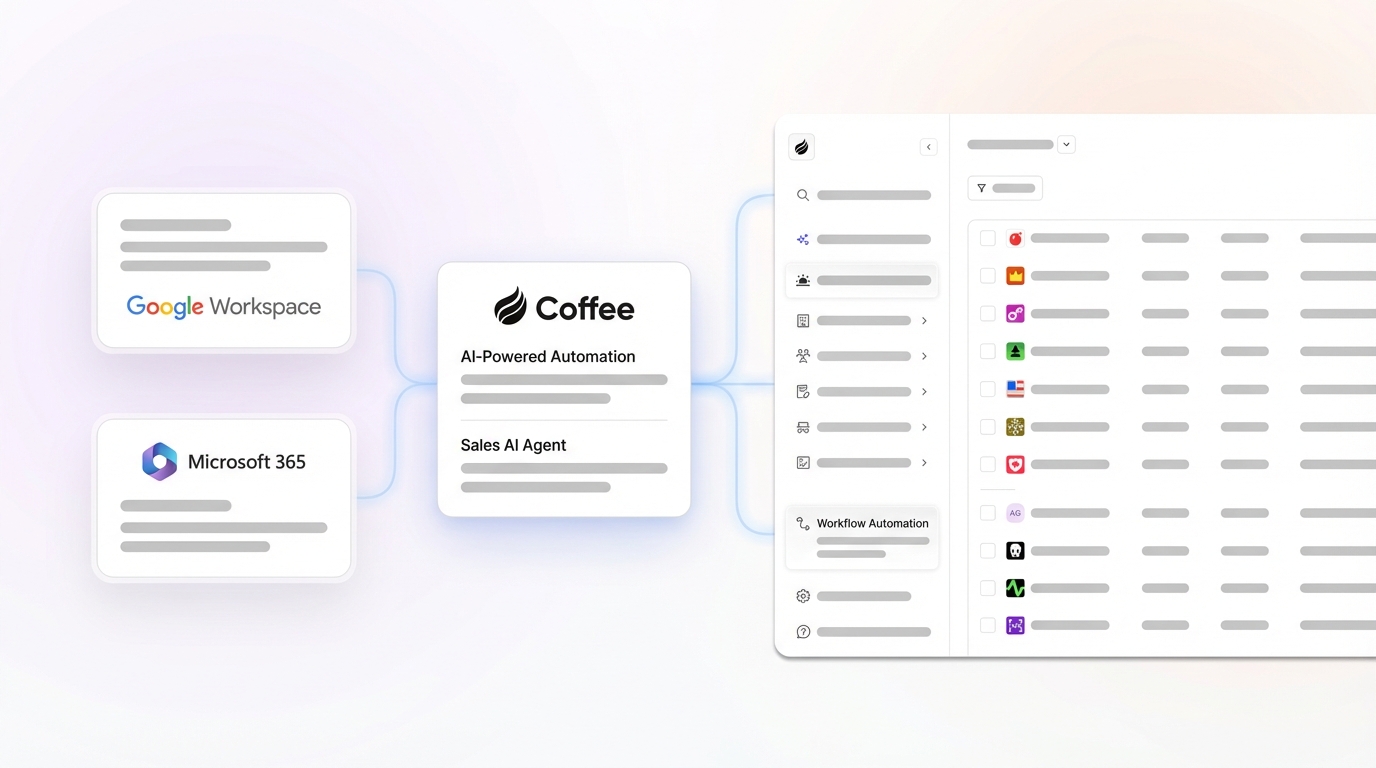
Implementation follows three clear steps. First, connect your Google Workspace or Microsoft 365 account. Second, allow the agent to auto-populate your CRM with existing contacts and companies. Third, review the AI-generated insights and briefings that appear as the system learns.
The agent immediately starts logging activities, enriching records, and preparing meeting summaries without extra configuration. Security concerns are addressed with SOC 2 Type 2 compliance and GDPR adherence, and Coffee never uses your data to train public models. Integration needs are covered through current Zapier connectivity and a roadmap for deeper native integrations. Teams can get started with Coffee and experience autonomous sales workflow automation built for growing SMBs.

Frequently Asked Questions
What is the best cloud-based sales workflow automation for small teams?
Coffee stands out as the best cloud-based sales workflow automation tool for small teams because it works as an autonomous agent instead of a passive database. Coffee automatically captures information from emails, calendars, and meeting transcripts, then enriches and organizes this data without human effort. This agent-first model saves SMB teams 8-12 hours per week per representative and keeps data accurate and consistent.
How can I automate sales data entry effectively?
Effective sales data entry automation uses tools that process both structured and unstructured data sources. Coffee’s agent connects to your Google Workspace or Microsoft 365 account and scans emails and calendar events to create and update contact and company records. The agent also processes meeting transcripts and call recordings to extract key details, which removes manual note-taking and CRM updates that usually consume hours of selling time.
How do autonomous agents compare to HubSpot for workflow automation?
Autonomous agents such as Coffee remove the manual configuration and maintenance required by HubSpot workflows. HubSpot asks users to build workflows, define triggers, and enter data by hand, while Coffee’s agent handles these tasks automatically. HubSpot excels at marketing automation and offers many features, yet its complexity often overwhelms small teams. Coffee focuses on sales workflow automation with minimal setup, which suits SMBs that want fast productivity gains without dedicated admins.
What advantages do CRM automation tools have over Pipedrive for SMBs?
Advanced CRM automation tools like Coffee provide major advantages over Pipedrive’s basic automation. Pipedrive offers visual pipeline management and simple triggers, but still depends on manual data entry for most customer information. Coffee’s autonomous agent captures and enriches data automatically, delivers AI-powered meeting orchestration, and supplies pipeline intelligence with historical tracking. This broader automation saves more time and delivers deeper insights than Pipedrive’s mostly manual system.
Can Zapier handle sales workflow automation independently?
Zapier works well as an integration layer, but cannot manage complete sales workflow automation on its own. It connects applications and triggers actions based on events, yet it lacks native CRM capabilities, robust data storage, and intelligence for unstructured information such as emails or call transcripts. Zapier performs best when paired with an autonomous agent like Coffee, which handles data processing and decisions while Zapier manages app connections.
Is Clay sufficient for automating sales data entry?
Clay excels at lead enrichment and prospecting but does not cover full sales data entry automation. It specializes in finding and enriching contact information from many data sources, then passes that data into a CRM. Clay manages the discovery phase effectively, while Coffee delivers end-to-end automation that includes meeting orchestration, activity logging, and pipeline intelligence that Clay does not provide.
Conclusion: Move from Manual CRM Work to Autonomous Sales Automation
The shift toward autonomous AI agents defines the future of sales workflow automation for SMB teams. Legacy tools such as HubSpot and Pipedrive still depend on manual processes, while Coffee’s agent-first approach removes the data entry burden that steals selling time. In 2026, AI sales tools integrate directly with CRM systems for data unification, automating data entry and follow-ups while providing predictive analytics for high-value opportunities.
SMB sales teams that want to eliminate manual workflows and focus on revenue can rely on Coffee for the autonomous intelligence required to scale. Get started with Coffee today and transform your sales workflow with practical, agent-driven automation.