
In today’s fast-paced sales environment, choosing the right CRM can make or break your team’s performance. The market for customer relationship management tools has evolved significantly, with businesses now prioritizing automation, data integration, and user-friendly designs to drive efficiency.
Sales leaders face a landscape crowded with options, each promising to address unique pain points like fragmented data, manual workloads, and poor adoption rates. Amidst this shift, AI has emerged as a game-changer, offering capabilities that go beyond traditional CRM functions to deliver predictive insights and streamlined workflows.
Against this backdrop, tools like Coffee and Close stand out as distinct approaches to solving modern sales challenges. This detailed comparison explores their features, benefits, and trade-offs to help you decide which aligns best with your team’s needs.
Key Factors for Selecting a Sales CRM
Evaluating a CRM means looking at how it addresses the specific hurdles your sales team faces. A well-chosen platform reduces inefficiencies and supports growth, so focus on these core aspects to guide your decision.
- Automation and AI Capabilities: Does the CRM use AI to handle repetitive tasks and provide actionable insights, or is it limited to basic rule-based features?
- Data Integration: Can it consolidate information from multiple sources, like email and calendars, into one reliable database?
- User Friendliness: Will your team adopt the tool easily, or does it feel like an added burden?
- Cost Efficiency: Does the platform offer value by reducing the need for additional tools and integrations?
- Future-Readiness: Is the CRM built with modern technology to adapt to evolving sales demands?
Close CRM: Communication and Process Management
Close CRM has built a reputation for simplifying sales workflows through a focus on communication tools. It offers features like lead management, pipeline tracking, analytics, and more. Close also provides automated logging of activities like calls and messages. Its sales sequences combine email, SMS, and tasks for follow-ups, although some steps may still need manual oversight.
This setup cuts down on the need to juggle multiple tools, easing the mental load on sales reps. It suits teams looking to enhance current sales processes rather than overhaul them, focusing on communication and outreach efficiency.
Coffee CRM: AI-Powered Automation for Modern Sales
Coffee introduces a new perspective on CRM by prioritizing AI at its core, aiming to eliminate manual tasks and unify scattered data. Designed with modern sales challenges in mind, it integrates automation and intelligence into every step of the sales process as part of a broader trend toward AI-native solutions.
Coffee automatically builds and updates contact and company records by pulling data from emails and calendars. This saves sales reps an estimated 8 to 12 hours weekly on data entry. Upon linking to Google Workspace or Microsoft 365, it scans communications to populate profiles with details like job titles and company information, enriched by external data partners for accuracy.
Before sales meetings, Coffee delivers detailed briefings with attendee backgrounds and past interaction summaries. During calls on platforms like Google Meet or Zoom, an AI bot records and transcribes discussions. Post-meeting, it creates summaries, identifies tasks, and drafts follow-up emails ready to send from Gmail.
Its “Pipeline Compare” feature stands out by using a built-in data warehouse to track pipeline changes over time. Sales leaders can view week-over-week progress, identifying new deals, closures, and bottlenecks without needing external reporting tools or manual data exports.
By combining CRM, data enrichment, call recording, and forecasting into one system, Coffee reduces the need for multiple subscriptions, cutting costs and complexity. Its design focuses on supporting sales reps directly, aiming for high adoption by making the tool a helpful partner rather than a chore.
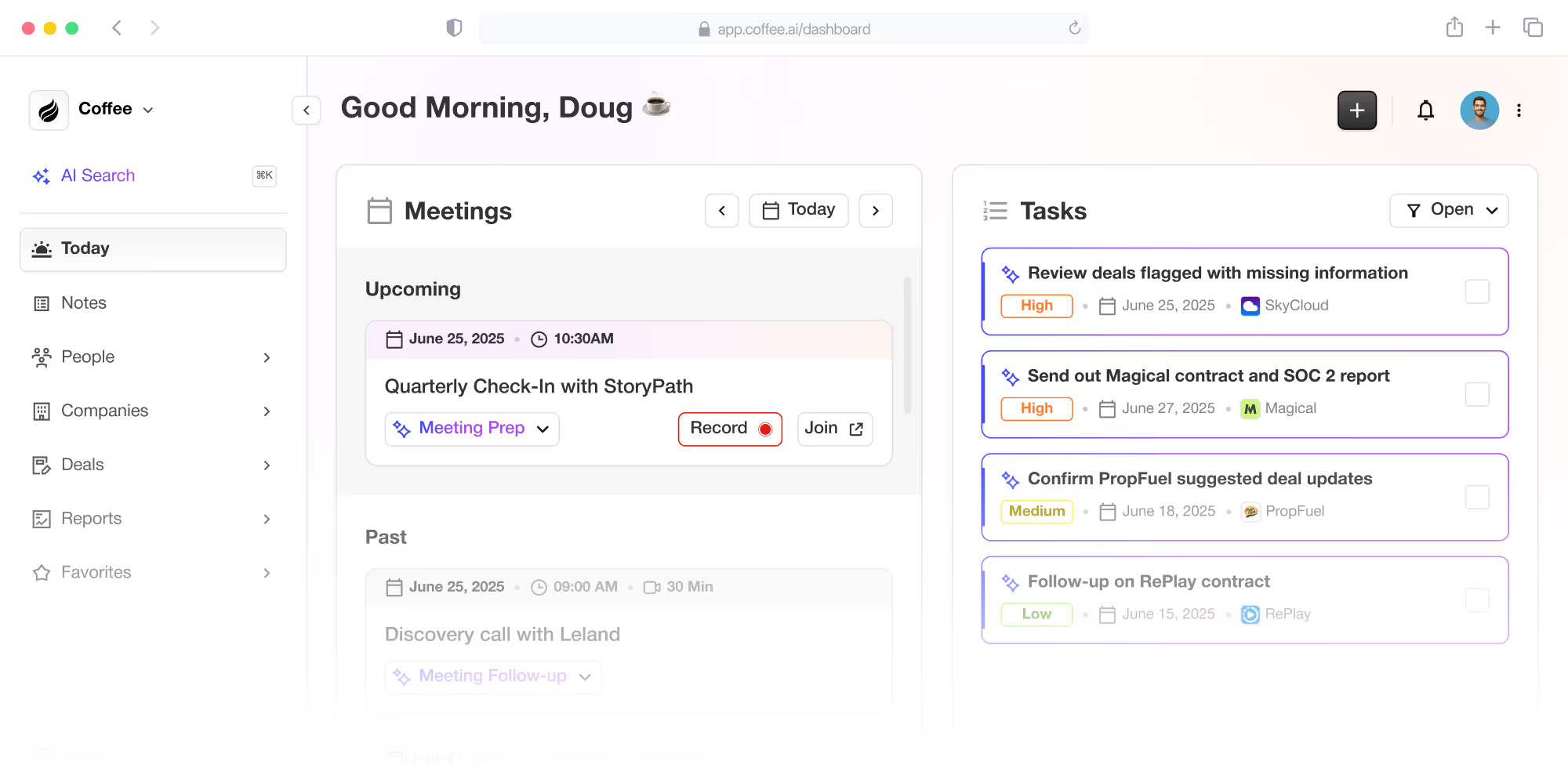
Ready to explore how Coffee can streamline your sales process? Request a personalized demo today.
Direct Comparison: Coffee and Close Features Side by Side
To clarify the differences, this section breaks down how Coffee and Close perform across key sales functions, highlighting their unique strengths for growing teams.
Feature Overview Table: Coffee vs. Close
|
Feature Area |
Coffee |
Close |
|
Primary Focus |
AI-driven automation and data unification |
Communication integration and process efficiency |
|
Data Management |
Automatic capture and enrichment from email/calendar, saving 8-12 hours per rep weekly |
Automatic capture and enrichment from email/calendar |
|
Automation Depth |
AI handles meeting prep, summaries, and follow-ups, with sales frameworks like BANT/MEDDIC |
Automation for sequences and reminders |
|
Pipeline Analysis |
Historical tracking via “Pipeline Compare” for week-over-week insights |
Visual pipeline with real-time deal tracking, less focus on a historical view |
|
Communication Tools |
Focuses on data extraction from communications |
Unifies calls, emails, and SMS to reduce tool-switching |
|
User Experience |
Built as a supportive tool for reps, prioritizing ease and utility |
Streamlined for setup and minimal training needs |
|
Tool Integration |
Combines CRM, enrichment, recording, and forecasting in one solution |
CRM with communication focus |
|
System Design |
AI-native architecture for real-time data and historical analysis |
Built for activity tracking, with plan-based feature limits |
Key Differences Explained in Detail
Automation Approach: Coffee leverages AI to manage data entry, meeting workflows, and follow-ups proactively, aiming to cut down manual effort significantly. Close offers automation for outreach sequences and reminders, supporting existing workflows.
Data Handling: Coffee captures and structures data from emails and calendars automatically, creating detailed records without extra work. Close logs activities like calls and messages well, but might require more work for a historical data view.
Team Adoption: Coffee aims to win over sales reps by reducing tedious tasks, positioning itself as a helpful tool. Close focuses on simplicity and transparency, making current processes smoother and encouraging use through efficiency gains.
Overall Cost: Coffee consolidates multiple tools into one platform, potentially lowering expenses related to separate subscriptions for enrichment or forecasting. Close provides strong communication features but might require additional tools for broader needs.
Deciding Between Coffee and Close: What Fits Your Team?
Your choice depends on your team’s priorities and operational goals. Use this guide to align the CRM with your specific challenges and long-term vision.
Coffee Suits Your Team If You Need:
- AI to automate repetitive tasks and consolidate scattered customer data.
- A tool that sales reps adopt willingly due to its supportive, task-reducing design.
- A single platform combining CRM, data enrichment, and analytics to simplify your tech stack.
- Detailed pipeline insights with historical data for strategic planning.
- A modern solution for small to mid-sized teams ready to scale with AI support.
Close Works Best If You Need:
- Integrated communication across calls, SMS, and email without switching apps.
- Support for established sales processes with effective outreach automation.
- Focus on current workflows rather than extensive AI or data integration.
Looking to boost your sales efficiency with AI? Request access to Coffee’s platform now.
Common Questions About Coffee and Close
How Does Coffee’s AI Differ From Close’s Automation?
Coffee embeds AI deeply into its system to manage data entry, meeting preparation, and follow-up drafting automatically, minimizing manual effort. Close provides automation for sequences and reminders to support sales workflows.
Can Coffee Work With Existing Tools?
Coffee offers flexible integration options. For Salesforce or HubSpot users, it acts as a companion app, enhancing functionality while keeping your primary CRM intact. Alternatively, Coffee can serve as a standalone CRM for teams ready to transition fully to its AI-driven model.
What Advantage Does Coffee’s Data Automation Offer Over Close?
Coffee scans connected email and calendar accounts to build and update records automatically, cutting down an estimated 8 to 12 hours of weekly data entry per rep. It enriches this data with professional and company details. Close logs call and message activities effectively.
How Does Coffee Enhance Pipeline Visibility Compared to Close?
Coffee uses a data warehouse to store pipeline history, enabling its “Pipeline Compare” feature to show changes over time, such as new deals or stalled prospects, with a single click. Close focuses on current pipeline status with visual tools, offering solid real-time tracking but less emphasis on historical trends.
Which CRM Provides Better Value for Smaller Sales Teams?
Value hinges on your team’s focus. Close offers an efficient setup for teams needing strong communication tools and quick deployment with a minimal learning curve. Coffee delivers value for teams aiming to reduce manual tasks and consolidate tools into one AI-powered system, potentially lowering overall costs.
Final Thoughts: Elevating Sales With the Right CRM
A CRM today serves as a critical tool for sales growth, not just a database. Close provides a proven option with its communication focus and workflow support, ideal for teams refining current practices. Coffee, as part of the rising trend of AI-native platforms, prioritizes eliminating manual work and delivering deep insights, offering a forward-looking solution for modern sales challenges.
Reflect on your team’s biggest obstacles. If data entry consumes too much time or customer information is spread across tools, Coffee’s integrated AI approach addresses these directly. For those focused on communication and process stability, Close remains a dependable choice.
Ready to enhance your sales strategy with AI efficiency? Request a personalized demo of Coffee today.