
In today’s competitive sales landscape, businesses face mounting pressure to optimize their operations with automation tools. The market for customer relationship management (CRM) and sales automation solutions has grown significantly, with global spending on CRM software projected to reach $114.4 billion by 2027. Yet, the decision to invest in a platform often hinges on more than just upfront pricing. Many organizations overlook the indirect costs tied to inefficiencies, fragmented systems, and poor user adoption, which can quietly erode budgets and hinder growth.
For sales leaders and revenue operations (RevOps) professionals, navigating this complex terrain means balancing functionality with financial impact. Traditional platforms like HubSpot have long been a staple, offering robust features but often requiring additional tools to meet modern needs. Meanwhile, newer AI-driven solutions, such as Coffee, are emerging as part of a broader trend toward integrated, intelligent systems that aim to reduce complexity and enhance productivity. This article explores the full scope of costs in sales automation, comparing legacy approaches with AI-first alternatives to help you make a decision that aligns with your team’s goals.
Understanding Sales Automation Costs: Looking Past Subscription Fees
Subscription fees are often the first consideration when selecting a sales automation tool, but they represent only a fraction of the total investment. Total Cost of Ownership (TCO) encompasses several less obvious expenses, including integration, training, data maintenance, and the productivity loss from inefficient processes. Focusing solely on monthly costs can lead to unexpected budget challenges down the line.
Older CRM systems, such as HubSpot, frequently rely on a patchwork of third-party tools to cover all sales functions. This creates a web of expenses for data enrichment, outreach, and analytics, each adding to the overall cost and complexity. In contrast, newer platforms aim to combine these functions into a single system, potentially lowering both financial and operational burdens. Evaluating TCO provides a clearer picture of what you’re truly paying for over time.
Curious about a streamlined alternative in this space? Explore Coffee’s approach with a direct look at its capabilities. Request access here.
Hidden Expenses in Traditional Sales Automation Systems
Fragmented Tools: The Burden of Multiple Systems
Many organizations using HubSpot as their core CRM still need separate tools for full sales automation. Common setups pair HubSpot with solutions like ZoomInfo for data enrichment, SalesLoft for outreach, and Fathom for call recording. Managing these disparate tools increases costs beyond their individual subscriptions.
Data doesn’t always sync smoothly across platforms, leading to silos that hinder visibility. Sales reps often waste time toggling between apps or manually transferring information, which lowers efficiency and raises the risk of errors. Maintaining these integrations also demands ongoing technical resources, an expense rarely accounted for in initial budgets.
Manual Workloads: Time Lost to Data Entry
Older CRM systems often depend heavily on manual input from sales teams. Reps spend hours logging notes, updating records, and entering contact details, time that could be spent engaging with prospects. Studies estimate that sales professionals dedicate up to 34% of their day to administrative tasks, significantly cutting into revenue-focused activities.
Adoption rates suffer as well. When CRMs feel like a burden, reps may resort to using personal spreadsheets or note apps, creating data gaps that undermine the system’s value. Managers, in turn, struggle with incomplete information, hampering their ability to forecast accurately or coach effectively.
Architectural Limits: Challenges with Older Platforms
Many traditional platforms were designed before the advent of advanced AI technologies, resulting in constraints on how they handle data. For instance, processing unstructured information from emails or call transcripts often requires additional tools, adding to costs. Historical data management can also be cumbersome, complicating pipeline analysis.
As companies scale, these systems may struggle to adapt without significant customization. Tailoring workflows or adding capacity often involves steep fees and extended training periods, pushing expenses beyond initial projections.
Maintenance Overhead: Managing a Complex Toolset
Overseeing multiple vendors adds administrative workload. Each tool comes with its own contracts, support channels, and security requirements. IT teams must stay proficient across platforms and resolve integration issues, diverting resources from other priorities.
Data security becomes harder to manage as information flows through various systems. Each additional tool introduces potential vulnerabilities, requiring separate compliance checks. Switching to a better solution later can also be costly due to vendor lock-in, limiting flexibility.
Revenue Impact: How Inefficiencies Affect the Bottom Line
Inefficient automation directly impacts sales outcomes. Administrative burdens slow down deal cycles and reduce conversion rates. Inaccurate data leads to missed opportunities and unreliable forecasts, while fragmented systems limit visibility into customer interactions, affecting relationship quality.
The opportunity cost of sticking with outdated tools can restrict a company’s ability to adapt to market shifts or outpace competitors. These factors collectively diminish the return on investment in sales automation.
Coffee’s Approach: Simplifying Sales Automation with AI
As part of the growing trend toward AI-driven solutions, Coffee offers a platform built to address the shortcomings of traditional sales automation. Designed with artificial intelligence at its core, it focuses on automating data capture, streamlining workflows, and providing actionable insights. This reduces many hidden costs while aiming to improve user engagement and adoption rates.
Coffee serves dual purposes, functioning as a standalone CRM for smaller teams or as a companion app that integrates with existing systems like HubSpot or Salesforce. This flexibility allows businesses to adopt AI capabilities without needing to overhaul their current infrastructure, meeting them where they are in their automation journey.
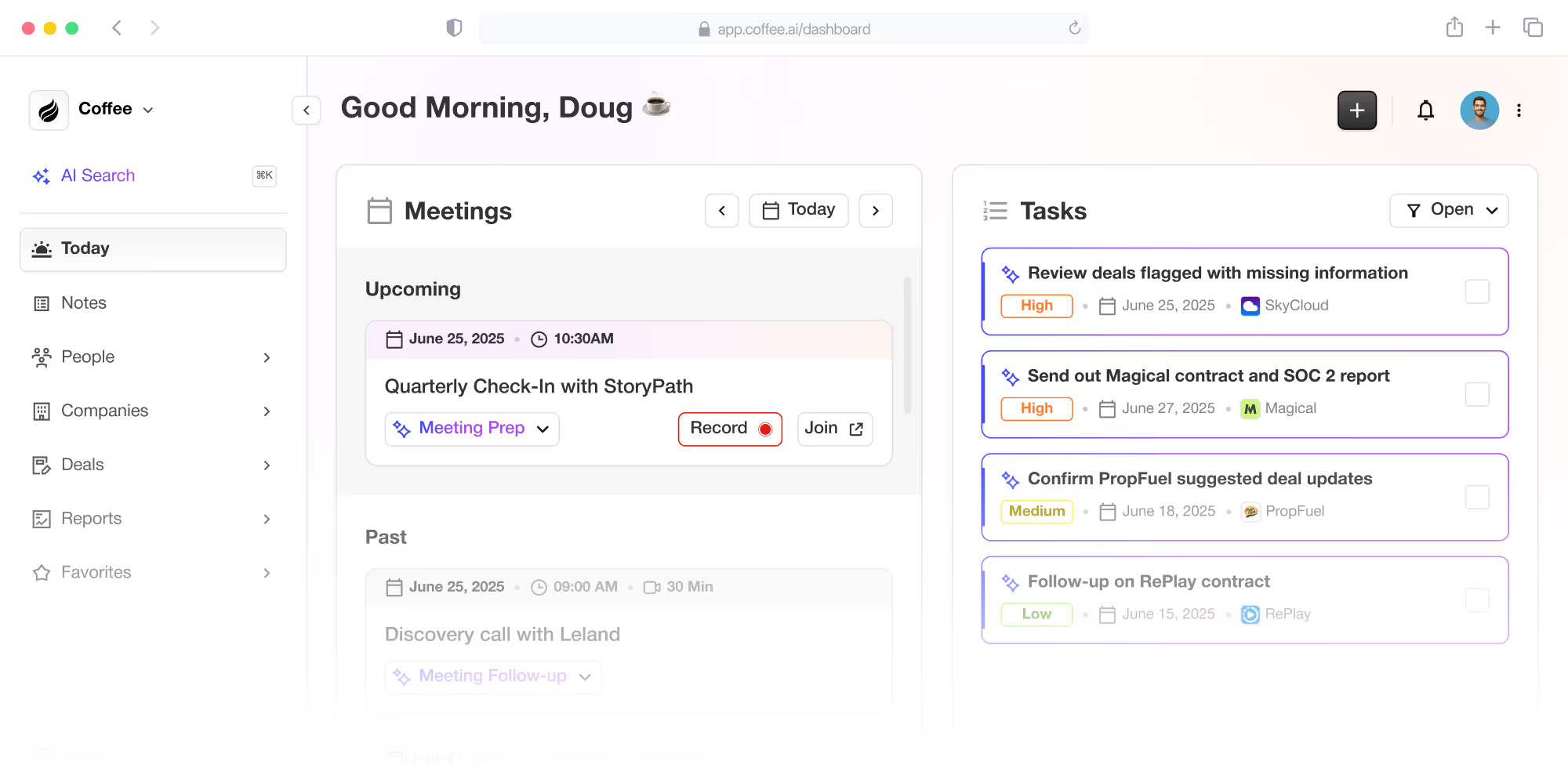
Unified Platform: Reducing Tool Overload
Coffee combines CRM features, data enrichment, call recording, meeting automation, and pipeline analytics into a single system. This consolidation cuts down on the need for multiple subscriptions and simplifies vendor management.
Data flows consistently across functions, avoiding sync issues common in multi-tool setups. Sales reps operate within one interface, minimizing distractions and boosting focus. For those using it alongside HubSpot or Salesforce, Coffee enriches data and delivers insights directly into the primary CRM without extra setup.
Automated Data Input: Freeing Up Sales Teams
By connecting to Google Workspace or Microsoft 365, Coffee automatically captures and updates information from emails and calendars. Contacts, companies, and activity logs populate without manual effort, saving significant time.
Its built-in enrichment feature pulls in details like job titles and company profiles from licensed data partners, reducing the need for standalone tools. Reps can save an estimated 8 to 12 hours weekly, allowing more time for building customer relationships.
Intelligent Workflows: Enhancing Meeting Efficiency
Coffee streamlines meeting processes from start to finish. Before calls, it compiles briefings with attendee backgrounds, company details, and past interaction summaries on a dedicated “Today” page.
During meetings, an AI bot records and transcribes across platforms like Google Meet, Microsoft Teams, and Zoom. Afterward, it creates summaries, highlights action items, and drafts follow-up emails for review, aligning with sales frameworks like BANT and MEDDIC.
Pipeline Insights: Deeper Data for Better Decisions
Coffee maintains historical pipeline data through a dedicated warehouse, enabling detailed analysis. Its “Pipeline Compare” feature tracks changes over chosen periods, highlighting progressed, stalled, or new deals to support review meetings.
This built-in capability removes the need for manual data exports or costly add-ons, providing managers with reliable information to refine processes and improve outcomes.
User Engagement: A Tool Reps Actually Use
Coffee prioritizes a design that sales reps find valuable, with automation and meeting preparation features encouraging consistent use. This naturally improves data quality as more interactions are captured accurately.
Its straightforward interface shortens onboarding time, helping teams see benefits quickly with minimal training. This high engagement creates a cycle of better data leading to sharper insights.
Interested in seeing how AI can enhance your sales process? Request access to Coffee now.
Comparing Features and Value: HubSpot with Add-Ons vs. Coffee
Looking at key aspects of sales automation shows how Coffee’s integrated AI platform stacks up against a traditional setup using HubSpot plus separate tools.
Data Handling and Enrichment
|
Aspect |
HubSpot with Add-Ons |
Coffee (Standalone or Companion) |
|
New Contact/Company Setup |
Manual or integration-dependent |
Automatic via email/calendar |
|
Data Enrichment |
Needs external tools like ZoomInfo |
Included with licensed data partners |
|
Activity Tracking |
Manual or plugin-based |
Automatic from connected sources |
Meeting Support and AI Tools
|
Aspect |
HubSpot with Add-Ons |
Coffee (Standalone or Companion) |
|
Meeting Preparation |
Manual lookup in CRM |
AI-driven briefings on “Today” page |
|
Call Recording/Transcripts |
Requires separate solutions |
Integrated AI meeting bot |
|
Post-Meeting Actions |
Manual or tool-dependent |
AI-drafted summaries and follow-ups |
Pipeline Analysis and Forecasting
|
Aspect |
HubSpot with Add-Ons |
Coffee (Standalone or Companion) |
|
Pipeline Tracking |
Manual exports or paid add-ons |
Included “Pipeline Compare” feature |
|
Historical Data Use |
Often complex to access |
Accessible via built-in warehouse |
User Experience and Adoption
|
Aspect |
HubSpot with Add-Ons |
Coffee (Standalone or Companion) |
|
Rep Engagement |
Often seen as a managerial task |
Built as a supportive co-pilot |
|
Data Accuracy |
Prone to human error |
Improved by automation |
System Consolidation
|
Aspect |
HubSpot with Add-Ons |
Coffee (Standalone or Companion) |
|
Tool Count |
Several for full coverage |
Unified into one platform |
|
Integration Effort |
High due to multiple vendors |
Minimal, cohesive design |
Deciding on Coffee: When It Fits Your Sales Needs
Choosing Coffee depends on your current challenges and future objectives. Its dual functionality as a standalone CRM or companion app offers adaptability for various business sizes and setups.
Best Use Cases for Coffee as a Standalone CRM
Small teams of 1 to 20 employees often find Coffee’s standalone CRM a good match. These businesses may have outgrown basic tools like spreadsheets but aren’t ready for the complexity or cost of traditional CRMs.
Founder-led teams benefit from its automation, freeing up time for strategic growth. Organizations looking for a modern, user-friendly tool also align well with Coffee’s design and capabilities.
Best Use Cases for Coffee as a Companion App
Mid-sized companies already using HubSpot or Salesforce, but facing issues with adoption or tool sprawl, can leverage Coffee’s companion app. It enhances existing systems without requiring a full replacement.
Teams with multiple separate tools can simplify their stack by adopting Coffee. RevOps professionals dealing with data inconsistencies often see improvements in accuracy and usability.
Key Benefits Coffee Delivers to Sales Teams
Coffee suits teams frustrated by manual data tasks, offering full automation to save time. Managers gain access to real-time pipeline insights without extra costs. Consolidating tools into one platform reduces complexity while maintaining robust functionality.
Common Questions About AI in Sales Automation
How Does Coffee Maintain Data Quality?
Coffee uses licensed partnerships to enrich data, matching the detail level of standalone tools for most scenarios. Its automated capture process cuts down on human error, keeping information accurate with less manual oversight.
Can Coffee Replace All Additional Tools Alongside HubSpot?
For essential sales functions like CRM management, data enrichment, meeting automation, and pipeline tracking, Coffee consolidates most needs into one platform. Some niche requirements might still call for specialized tools, though Coffee integrates effectively with broader systems.
Will Coffee Work with Our Current HubSpot Setup?
Yes, Coffee’s companion app connects to HubSpot and Salesforce through straightforward authentication. It adds AI-driven automation without major changes to your existing workflow, requiring little IT support for setup.
How Does Coffee Protect Sales Data?
Coffee adheres to SOC 2 Type 2 and GDPR standards, ensuring data privacy through transparent policies. Customer information isn’t used for general AI training, and enterprise-level security measures safeguard confidentiality.
Final Thoughts: Investing Wisely in Sales Automation
The real cost of sales automation goes well beyond monthly fees. Traditional systems paired with multiple tools often bring hidden expenses through integration challenges, manual workloads, and lost efficiency. As part of a wider shift toward AI solutions, Coffee stands out by uniting key functions into one platform, automating data tasks, meeting processes, and pipeline analysis to keep teams focused on driving revenue.
For businesses aiming to get the most from their automation investment, Coffee provides a practical option with strong user adoption and operational benefits. Whether used alone or alongside an existing CRM, it adapts to support growth at any stage.
Ready to explore how AI can improve your sales efficiency? Request access to Coffee today.