
Key Takeaways
- Automatic contact logging reduces manual data entry so sales teams can focus more time on selling.
- Continuous enrichment and activity tracking keep CRM records accurate, current, and useful for every interaction.
- Automated meeting prep, notes, and follow-ups improve call quality and ensure consistent next steps.
- Reliable data from an autonomous CRM agent strengthens pipeline reviews, forecasting, and team accountability in 2026.
- Coffee offers an AI CRM agent that handles contact logging, enrichment, and meeting workflows for you. Request access to Coffee to see it in action.

The Power of Autonomous Agents in CRM for Sales Productivity
1. Eliminate Manual Contact Creation for Cleaner Data
Manual contact and company creation slows reps and often leaves gaps in the CRM. Many teams face a tradeoff between thorough documentation and time spent selling, which leads to missed contacts and incomplete histories.
A CRM agent solves this by scanning work channels such as email and calendar to auto-create contact and company records. Every relevant person and organization involved in a deal enters the system with minimal effort from the rep.
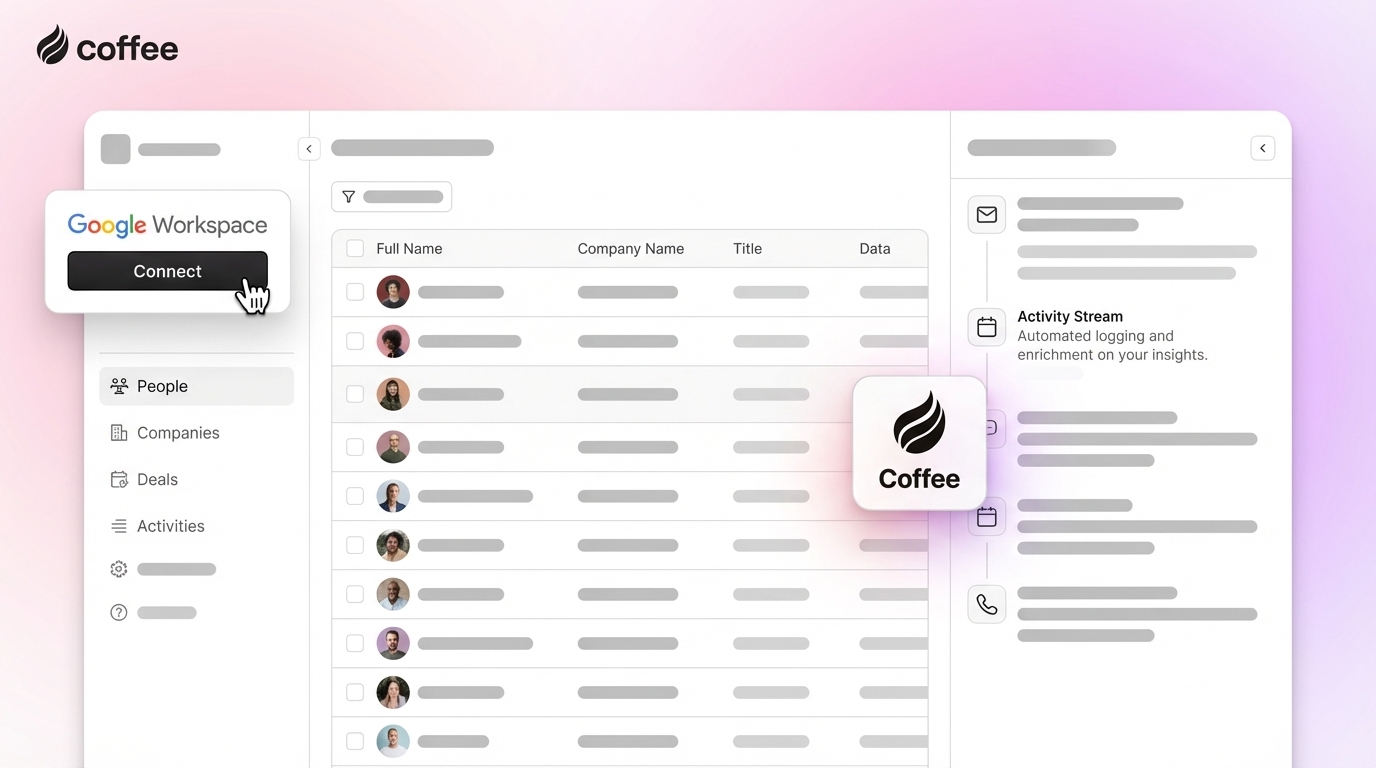
When you connect Coffee to Google Workspace or Microsoft 365, the Coffee Agent automatically creates contacts and companies and links notes and interactions to the right record. This approach reduces administrative overhead and lets reps stay focused on conversations and relationships.
2. Enrich Every Record With Context That Supports Targeted Outreach
Sales teams often work from basic contact details, which limits personalization and targeting. Researching job titles, company size, or recent funding for each account takes time that most reps do not have.
A CRM agent enriches contacts and companies with data from licensed partners, including roles, LinkedIn profiles, and company milestones. Reps receive the context they need in the same place they already manage opportunities.
Coffee uses trusted sources to keep records enriched and current, so teams can often reduce or eliminate separate enrichment tools. Reps see the information they need for better messaging, prioritization, and qualification directly inside their CRM workflow.
3. Automate Activity Logging to Keep Your Pipeline Current
Unlogged calls, emails, and meetings make pipeline views unreliable. Leadership ends up questioning both the forecast and the underlying data because the system does not reflect actual activity.
A CRM agent captures interactions automatically and keeps fields such as last activity and next activity up to date. Everyone sees an accurate timeline of engagement for each account and deal.
The Coffee Agent logs sales activity continuously, which turns the CRM into a reliable system of record. Managers gain a clearer view of pipeline health, and reps no longer spend time backfilling notes after a long day of meetings.
4. Streamline Meeting Prep, Notes, and Follow-Ups
Meeting preparation, note-taking, and follow-up creation often consume hours each week. Reps spend time gathering background information, writing summaries, and drafting emails instead of advancing new opportunities.
A CRM agent designed for automatic contact logging can also support the full meeting workflow. The agent prepares briefings with attendee details and history, joins calls to record and transcribe, and generates summaries with clear action items.
Coffee provides a daily “Today” view with upcoming meetings and key context, then produces post-call summaries, next steps, and draft follow-up emails directly in Gmail for review and sending. Request access to see how this level of meeting automation can fit into your sales process.

5. Turn Pipeline Reviews Into Strategic Conversations
Many pipeline reviews focus on fixing data rather than planning deals. Teams export spreadsheets, debate accuracy, and have limited time left for coaching or strategy.
Consistent automatic contact logging and activity capture give leaders a clearer, week-over-week view of pipeline changes. A CRM agent can highlight newly added deals, stalled opportunities, and stages that move faster or slower than expected.
Coffee’s Pipeline Compare feature surfaces meaningful changes inside your normal workflow. Reviews become more about risks, next steps, and resource allocation, and less about checking whether a contact or activity was entered correctly.
6. Consolidate Your Sales Tech Stack and Reduce Tool Sprawl
Using separate tools for CRM, enrichment, call recording, and forecasting increases complexity and cost. Reps switch contexts throughout the day, and teams often struggle with duplicate data and partial integrations.
A capable CRM agent can handle several of these functions in one environment. Contact logging, enrichment, recording, and pipeline insights all draw from the same underlying data, which reduces manual work and data reconciliation.
One company generating tens of millions in revenue moved from spreadsheet-based sales management to Coffee. The Coffee Agent now automates data entry and pipeline views, helping the team run a more efficient process from a single, unified solution.
7. Improve CRM Adoption by Reducing Administrative Friction
Low CRM adoption often stems from the perception that CRM use is an administrative task. When reps feel they spend more time updating fields than moving deals forward, they avoid the system and data quality declines.
An autonomous CRM agent takes on much of this work by handling automatic contact logging and related data entry. The system supports the rep instead of requiring constant manual updates.
With Coffee acting as a sales copilot, reps gain accurate records without extra effort. Over time, they rely on the CRM as a helpful assistant rather than a mandatory chore, which strengthens both adoption and data quality.

Frequently Asked Questions (FAQ) About CRM Agents for Automatic Contact Logging
CRM Agent vs. Traditional CRM: What’s the Key Difference in Automatic Contact Logging?
A traditional CRM acts as a passive database that depends on reps to enter contacts, log activities, and update records. A CRM agent such as Coffee operates as an active AI layer that captures data from email, calendars, and meetings, then creates contacts, logs activities, and enriches records automatically. Teams gain better data and more reliable insights without adding manual steps.
How Secure Is My Data With a CRM Agent for Automatic Contact Logging?
Security should be central for any autonomous CRM tool. Coffee is SOC 2 Type 2 and GDPR compliant, and customer data is not used to train public AI models. These controls help protect sensitive sales information while you benefit from automation.
Can a CRM Agent for Automatic Contact Logging Integrate With My Existing Tech Stack?
Modern CRM agents typically work alongside existing systems. Coffee offers a Companion App for Salesforce and HubSpot that adds automatic contact creation, activity logging, and enrichment, then writes structured data back into the primary CRM. Coffee also connects through Zapier for additional integrations across your sales and marketing tools.
What Sales Activities Can an Agent Automate Beyond Contact Logging?
Beyond automatic contact logging, a CRM agent can support meeting briefings, call recording and transcription, post-call summaries, and follow-up drafts. It can also track pipeline changes, help build targeted prospect lists from natural language prompts, and provide real-time analytics on deal progress.
How Quickly Can I See ROI From Implementing a CRM Agent for Automatic Contact Logging?
Teams often see time savings as soon as the agent starts capturing contacts and activities. Many organizations recover several hours per rep each week, which can then shift to prospecting and deal work. Better data quality also contributes to more dependable forecasts and more efficient coaching.
Conclusion: Prepare Your Sales Organization for the Future of CRM
Sales teams in 2026 face rising expectations for speed, personalization, and accurate forecasting. Manual CRM data entry and scattered tools make these goals harder to reach.
A CRM agent for automatic contact logging helps create a cleaner and more complete system of record, improves meeting execution, and strengthens pipeline visibility. The result is a CRM that supports daily work instead of slowing it down.
To see how an autonomous agent can handle contact logging, enrichment, and meeting workflows for your team, request access to Coffee and explore what this approach could mean for your sales process.