Written by: Doug Camplejohn, CEO & Co-Founder, Coffee
Executive summary
- Traditional CRMs often reduce sales ROI when they depend on manual data entry, fragmented tools, and low user adoption.
- AI-powered CRM agents shift CRMs from passive databases to active systems that capture, enrich, and organize data with minimal human effort.
- CRM agent ROI extends beyond cost savings to include sales productivity, forecast accuracy, pipeline velocity, team morale, and decision quality.
- Coffee uses an agent-led model to automate data capture, meeting workflows, and pipeline intelligence, operating as either a standalone CRM or a companion to existing systems.
- Sales leaders can maximize agent ROI by planning implementation, aligning on change management, protecting data privacy, and consolidating the tech stack where it makes sense.
- Avoiding common pitfalls, such as ignoring data quality or focusing only on features instead of outcomes, helps ensure CRM agents deliver lasting value.
Traditional CRMs can become demanding tools rather than strategic assets when they require excessive manual effort from busy sales reps. In those cases, CRMs can turn sales professionals into data entry clerks instead of strategic sellers. The emergence of intelligent CRM agents represents a shift from passive software to active, autonomous systems that address the core problems facing modern sales organizations. By adopting agent-led technology like Coffee, sales leaders can turn their CRM from a data graveyard into a dynamic asset where good data in drives good data out for measurable outcomes.
Sales leaders who want to see how an intelligent CRM agent can improve sales outcomes can request early access to Coffee. Request access to review the platform in detail.
Why Some CRMs Hinder Sales Team ROI
How Traditional CRM Systems Limit Sales ROI
Customer Relationship Management software was originally designed to centralize customer data and support sales growth. Many sales organizations now experience a different reality. Some CRMs have evolved into complex systems that depend on significant human intervention instead of providing the intended automation and insights.
The main weakness in many CRM architectures is their reliance on humans to maintain data quality. These systems often assume that busy sales professionals will consistently and accurately input information. In practice, that assumption breaks down. Instead of acting as productivity multipliers, such CRMs can become productivity drains when they demand ongoing manual effort.
Modern sales teams can end up in a cycle where poor data input leads to unreliable output. Reps then build shadow CRMs in spreadsheets and note-taking apps that become the real workspace. This fragmentation undermines the core promise of centralized customer relationship management and weakens the overall value of the system.
Common CRM Challenges That Reduce ROI
Several recurring issues limit the impact of traditional CRMs on sales performance.
- Fragmented data and workflow complexity: Without an intelligent agent to unify information, customer data often spreads across several tools. Reps may shift between core CRM records, enrichment platforms, sales engagement tools, and recording platforms for meeting intelligence. This manual stitching of tools adds complexity, raises costs, and introduces more chances for data gaps and errors.
- Manual data entry workload: Market data shared by Coffee indicates that 71% of sales reps feel they spend too much time on data entry, leaving only 35% of their time for selling. This imbalance directly affects revenue generation and reduces morale.
- Architectural gaps for unstructured data: Some CRM architectures struggle to manage unstructured data such as email content and call transcripts when they are not configured or integrated properly. This limitation makes it harder to maintain comprehensive data insights if automation and advanced features are not fully in place.
- Poor user experience and low adoption: When sales reps see their CRM as a chore rather than a useful tool, adoption drops. Low adoption leads to the familiar garbage in, garbage out pattern where management receives unreliable data for strategic decisions. Over time, the CRM becomes less useful, and teams turn to unofficial workarounds that fragment data even further.
How AI Agents Change Sales Workflows
Recent advances in AI have created an inflection point in sales technology. Instead of adding more complex passive software, leading teams are now deploying active, intelligent agents that can complete work on their own. These agents do more than store data. They capture, process, and organize information to support better outcomes.
AI-powered CRM agents represent a shift from software that consumes human labor to systems that provide human leverage. By handling the busywork that consumes sales professionals’ time, these agents free teams to focus on strategic selling, relationship building, and revenue activities that move the business forward.
Understanding CRM Agent ROI: A New Framework for Sales Growth
CRM Agent ROI Beyond Traditional Metrics
Traditional CRM ROI calculations often focus on cost savings or simple productivity metrics. CRM agent ROI covers a broader range of value that goes beyond efficiency. Key measures of agent-led CRM success include improvements in sales velocity, forecast accuracy, team morale, and the quality of strategic decisions.
CRM agent ROI works across several dimensions, including operational efficiency, revenue acceleration, strategic intelligence, and organizational capability building. Unlike systems that act only as data repositories, intelligent agents like Coffee contribute directly to revenue generation by automating workflows, enriching data, and providing actionable insights that shape sales outcomes.
Key ROI Metrics Driven by CRM Agents
- Increased sales productivity and efficiency: Automation through CRM agents like Coffee reduces time spent on data entry and administrative tasks. This shift creates more capacity for revenue-generating activities. Coffee typically saves reps 8 to 12 hours per week through automated data capture and enrichment.
- Improved sales forecast accuracy: Higher-quality data input driven by intelligent agents supports more reliable forecasts. Coffee’s agent improves the data captured in the system, which supports better analysis, planning, and resource allocation.
- Higher lead conversion and shorter sales cycles: Intelligent automation and data enrichment from Coffee’s agent can improve pipeline velocity by giving reps better context and more time to focus on high-impact work. This often leads to faster deal progression and earlier revenue realization.
- Reduced customer acquisition cost (CAC): Better data and automated workflows through Coffee can improve acquisition economics by consolidating multiple tools into one agent-led solution and lowering time spent on low-value tasks.
- Higher sales team morale and CRM adoption: When CRM systems act as helpful co-pilots instead of administrative burdens, adoption improves. Coffee’s agent-led model creates a useful cycle where better data drives better insights, which encourages more usage and more value over time.
The Agent Inflection Point for Faster ROI
AI-powered CRM agents are changing the economics of CRM investment by delivering faster, measurable returns through automation. Coffee’s agent begins creating value quickly by capturing data, enriching records, and surfacing insights with little to no manual work required from the team.
How Coffee Accelerates CRM Agent ROI
Coffee’s Agent-Led Philosophy: Good Data In, Good Data Out
Coffee operates on a simple principle: effective AI depends on high-quality data. As a CRM agent, Coffee addresses a long-standing CRM challenge, which is keeping data accurate and complete without relying on constant manual entry from users.
The Coffee agent acts like a member of the team that captures, enriches, and structures information from emails, calendars, and meeting transcripts. Over time, the CRM becomes a dependable source of truth instead of a partial or outdated database.
This agent-led approach reshapes how sales teams work with their CRM. Instead of serving the software through ongoing data entry, sales professionals receive assistance from an intelligent system that anticipates their needs and delivers relevant insights with minimal manual effort.
How Coffee Drives ROI Through Intelligent Automation

- Eliminates manual data entry: Coffee automatically creates and enriches contacts, companies, and activities by scanning connected email and calendar systems. This automation typically saves sales reps 8 to 12 hours per week and lets them focus on strategic selling activities that drive revenue. The agent captures every interaction and links it to the right records without extra work from the rep.
- Unifies fragmented data: Coffee acts as a central intelligence layer that brings together information from across the tech stack. Instead of forcing reps to switch between many tools, the agent builds a unified view that reduces context switching and the complexity that often hurts CRM adoption.
- Orchestrates meetings efficiently: The Coffee agent provides pre-call briefings with context about attendees and past interactions. During meetings, the AI meeting bot records and transcribes conversations. After the call, the agent generates summaries, highlights next steps, and drafts follow-up emails for the rep to review and send.

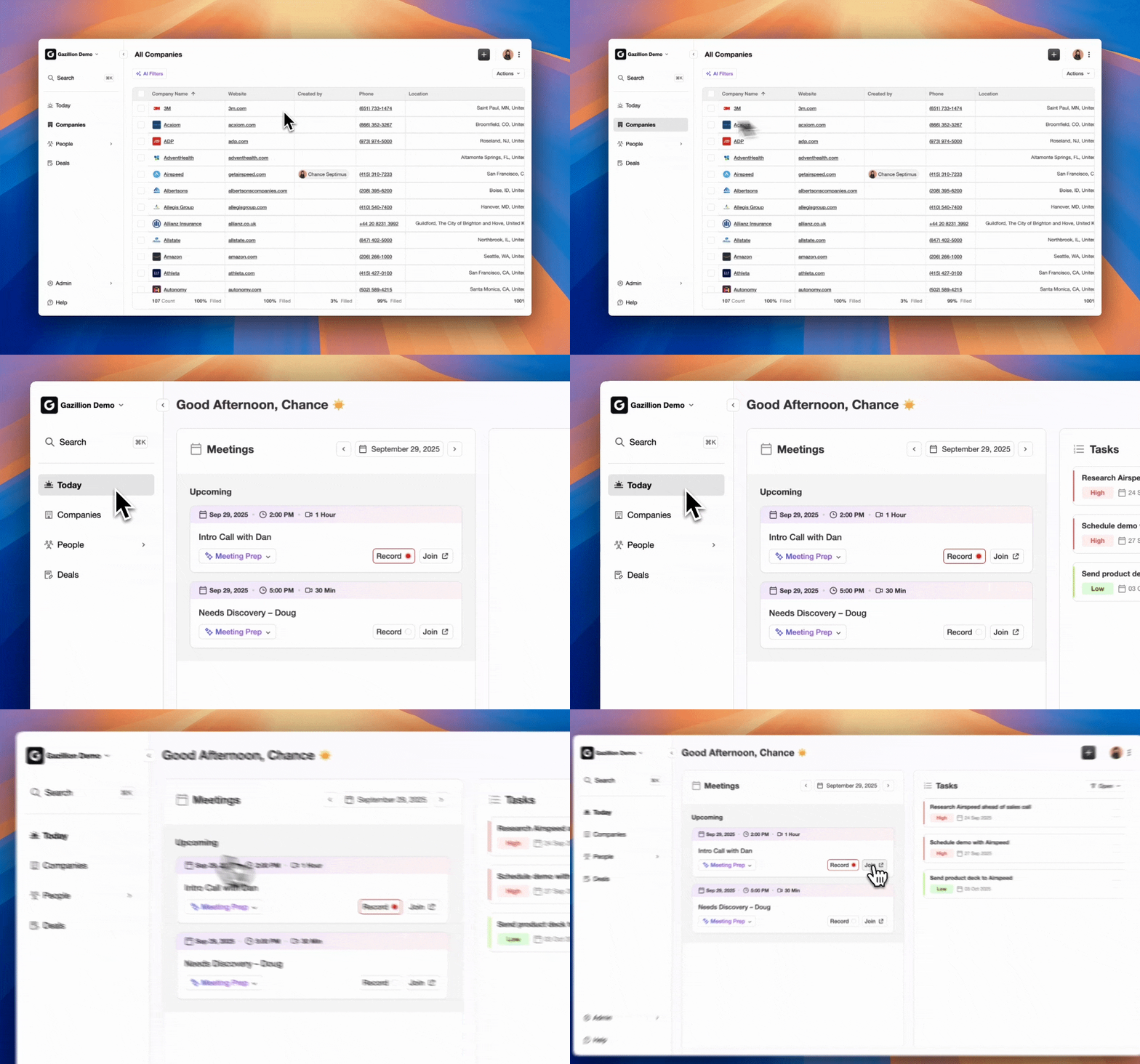

- Delivers accurate pipeline intelligence: Because Coffee improves data capture and structure, it can provide reliable, timely insights about pipeline health and deal progression. The agent reduces the need for manual CSV exports and extra analytics tools by providing real-time views such as Pipeline Compare, which shows week-over-week changes, progressed deals, and stalled opportunities.
Coffee’s Dual-Model Strategy for Maximum Flexibility and ROI

- Standalone AI-first CRM: Companies with smaller or growing sales teams, often around 1 to 20 employees, can move beyond spreadsheets without taking on the administrative load of a traditional CRM. Coffee’s standalone platform provides a modern, agent-powered alternative that supports fast deployment and quick value.
- Companion app for existing CRMs: Small to mid-market organizations already invested in a CRM can use Coffee as an intelligent layer that improves data quality and adoption. The agent manages the data in process so the existing system of record stays accurate and useful without constant manual updates.
This dual model allows organizations with different tech stacks and constraints to use Coffee’s automation without major workflow disruption or complex migrations.
Sales leaders who want their CRM to operate as a revenue asset rather than a data graveyard can evaluate Coffee in a live environment. Request access to see how an agent-led CRM works in practice.
Strategic Considerations for Successful CRM Agent Implementation
Implementation Strategy for CRM Agent ROI
- Assess organizational readiness: Successful CRM agent implementation starts with an honest view of current processes, data quality, and openness to automation. Teams that see AI agents as partners that support their work tend to adopt the technology faster and gain more benefit.
- Use a build versus buy framework: Some organizations consider building custom AI solutions. Dedicated agent platforms like Coffee offer advantages in speed, reliability, and ongoing improvements because they concentrate best practices into a single, focused product.
- Plan integration and tech stack consolidation: CRM agents can consolidate functions from multiple tools and reduce overall tech stack complexity and cost. Coffee can replace or simplify existing point solutions through agent-led automation, which often improves both efficiency and data consistency.
- Manage change and drive adoption: Clear communication about how AI will help the team is essential. Coffee often proves its value quickly through time savings and better insights, which helps build trust and encourage regular use.
- Protect data security and privacy: Enterprise-grade CRM agents such as Coffee maintain SOC 2 Type 2 and GDPR compliance. Strong compliance and clear internal policies help teams adopt automation with confidence in how data is handled and protected.
Common Mistakes to Avoid in CRM Agent Adoption
Key Pitfalls Experienced Teams Overlook
- Underestimating the human element in automation: Effective CRM agent rollouts recognize that agents support sales reps rather than replace them. Coffee focuses on handling routine tasks so professionals can spend more time on strategic selling and relationship building that require human judgment.
- Focusing on features instead of outcomes: Many teams evaluate tools based on long feature lists. A more effective approach prioritizes agents like Coffee that show clear impact on productivity, data quality, insight generation, and revenue outcomes.
- Ignoring data quality at the start: Deploying an agent on top of poor legacy data can magnify existing issues. Coffee emphasizes good data in so that clean, accurate information is captured from day one and supports reliable outputs.
- Measuring the wrong metrics: Beyond top-line sales numbers, leaders should track productivity gains, time savings per rep, improvements in data completeness and accuracy, and rep satisfaction. Coffee’s analytics help teams monitor these early signals of success and refine their approach.
CRM Agent ROI Comparison: Coffee vs. Non-Agent CRMs
|
Feature or benefit |
Coffee (Agent-led CRM) |
Non-agent CRM (without agent) |
ROI impact |
|
Data entry |
Automated, intelligent capture |
Manual, time-consuming |
Saves 8 to 12 hours per week per rep |
|
Data accuracy |
High, good data in = good data out |
Prone to human error, garbage in = garbage out |
Improved forecasting reliability |
|
Rep productivity |
Automated tasks free 8 to 12 hours per week |
Reps spend significant time on non-selling work |
More time for strategic selling |
|
Sales forecast accuracy |
High, real-time, AI-driven insights |
Often inaccurate or stale data |
Better strategic planning |
|
User adoption |
Higher, reps view system as a co-pilot |
Lower, reps view system as a chore |
Stronger insights from higher usage |
|
ROI potential |
Meaningful value from automation and consolidation |
Lower, and often offset by manual overhead |
Significant time and cost savings |
Frequently Asked Questions About CRM Agent ROI
How quickly can I expect to see ROI from a CRM agent like Coffee?
Most organizations begin to see measurable benefits from Coffee shortly after deployment. Automated data entry and meeting orchestration reduce administrative workload immediately, which translates into faster time savings and earlier justification of the investment.
Will a CRM agent replace my sales team?
No. Coffee’s CRM agent is designed to work as a co-pilot and assistant that extends human capabilities. The agent manages tasks such as data entry, meeting scheduling, note-taking, and administrative follow-ups. Sales teams keep responsibility for high-value activities such as discovery, negotiation, and relationship management.
How does an intelligent CRM agent improve data quality and why is that critical for ROI?
An intelligent CRM agent like Coffee improves data quality by capturing, enriching, and structuring information from sources such as email, calendars, and meeting transcripts. Traditional systems depend on manual entry, which can be inconsistent. Automated capture creates more complete and accurate records, which supports better pipeline visibility, more reliable forecasts, and higher-confidence decisions.
What integration challenges should I expect when implementing a CRM agent?
Coffee is built to integrate with common business systems, including Google Workspace and Microsoft 365 for email and calendar data, as well as existing CRM platforms through its companion app. In many cases, integration involves straightforward authentication steps, after which Coffee begins capturing and enriching data and consolidating functionality from multiple tools.
How do I measure and track CRM agent ROI effectively?
Measuring CRM agent ROI with Coffee involves tracking time saved per rep, changes in data completeness and accuracy, user adoption rates, and pipeline health indicators such as win rates and cycle times. Coffee provides built-in analytics that help leaders monitor these metrics and adjust their agent-led CRM strategy over time.
The Future of Sales Is Agent-Led: Strengthen Your Position on CRM Agent ROI
Sales technology is moving from passive software toward intelligent agents that complete work on behalf of the team. Organizations that continue to rely on systems requiring constant manual maintenance risk weakening their competitive position over time.
Coffee’s agent-led approach addresses core CRM issues such as poor data quality, low user adoption, fragmented workflows, and excessive administrative effort. By improving data capture through automation, Coffee enables better insights, more accurate forecasts, and more focused selling time.
Coffee helps sales teams build a more productive relationship with technology. Instead of serving complex software, teams gain a practical assistant that handles routine work and supports higher-value activities that drive growth.
Manual CRM processes can limit your sales team’s results and reduce the return on CRM investment. Sales leaders who want to explore an agent-led alternative can review Coffee in action. Request access to Coffee and take the first step toward an agent-led sales workflow.