
Executive summary
- Sales and RevOps leaders often struggle to realize full Salesforce value because of manual data entry, fragmented tools, and low CRM adoption.
- Manual and point-solution-heavy workflows reduce selling time, create inconsistent data, and make forecasting less reliable.
- Coffee acts as an AI CRM agent that automates data entry, enrichment, meeting workflows, and pipeline insights inside Salesforce.
- Coffee reduces administrative work, improves data quality, and consolidates tools so sales teams can spend more time selling.
- Organizations that adopt Coffee see gains in productivity, cleaner data for decision-making, and more predictable revenue operations.
The State of Salesforce in 2025: Why Traditional CRM Approaches Fail Your Sales Team
Sales teams continue to face operational challenges that limit the value of their CRM investment. The promise of streamlined workflows and accurate forecasting weakens when manual processes and system complexity shape daily behavior.
The Cost of Manual Data Entry & Administrative Burden
The most pervasive challenge facing sales organizations today is the burden of administrative tasks that steal valuable selling time. Based on market data shared by Coffee, 71% of sales reps say they spend too much time on data entry, leaving only 35% of their time for actual selling activities. This inverted priority structure undermines the purpose of having a sales team.
The manual data entry grind includes contact creation, company profile updates, activity logging, and opportunity management. These tasks require human attention but generate no direct revenue. Sales reps often act as data entry clerks rather than revenue generators, which leads to frustration and reduced productivity.
This administrative burden reaches beyond simple data entry. Sales reps must research prospects, update deal stages, create follow-up tasks, and maintain accurate pipeline information. Each activity diverts attention from relationship building and closing deals.
Fragmented Tech Stacks & Workflow Inefficiencies
Modern sales organizations often rely on specialized tools, which creates a complex ecosystem of point solutions that work against each other. A typical sales tech stack might include Salesforce for CRM, data enrichment platforms, SalesLoft for outreach, and Fathom for meeting recording. Without an agent to unify information, customer data is scattered, and sales reps toggle between tools, which is complex, expensive, and inefficient.
This complexity also creates training challenges and workflow confusion. New team members must navigate a maze of applications, each with its own interface and data requirements. This fragmentation slows onboarding, reduces productivity, and increases the likelihood of errors or missed opportunities.
Low CRM Adoption & ‘Garbage In, Garbage Out’ Data Quality
A damaging aspect of traditional Salesforce implementations is the cycle of poor user experience leading to low adoption, which results in poor data quality. When sales reps view the CRM as a chore, they minimize interaction with it, leading to incomplete records and outdated information. The resulting ‘garbage in, garbage out’ scenario means that management decisions based on CRM data are often flawed.
Low adoption also creates visibility issues, as sales managers struggle to maintain insight into their team’s activities and pipeline health. Without accurate data, sales leaders turn to shadow systems such as spreadsheets, which further undermines the official system’s value.
Analysis Paralysis: Overwhelming Data Without Actionable Insights
Sales teams often face an abundance of data in modern Salesforce implementations, which can reduce decision-making effectiveness. Sales reps and managers spend many hours trying to extract meaningful insights and identify key metrics. This manual process consumes time that could be better spent on customer-facing activities or strategic planning.
Request access to see how Coffee’s AI agent addresses these traditional CRM pain points through intelligent automation.
Introducing Coffee: The AI CRM Agent Companion App for Salesforce That Works for You
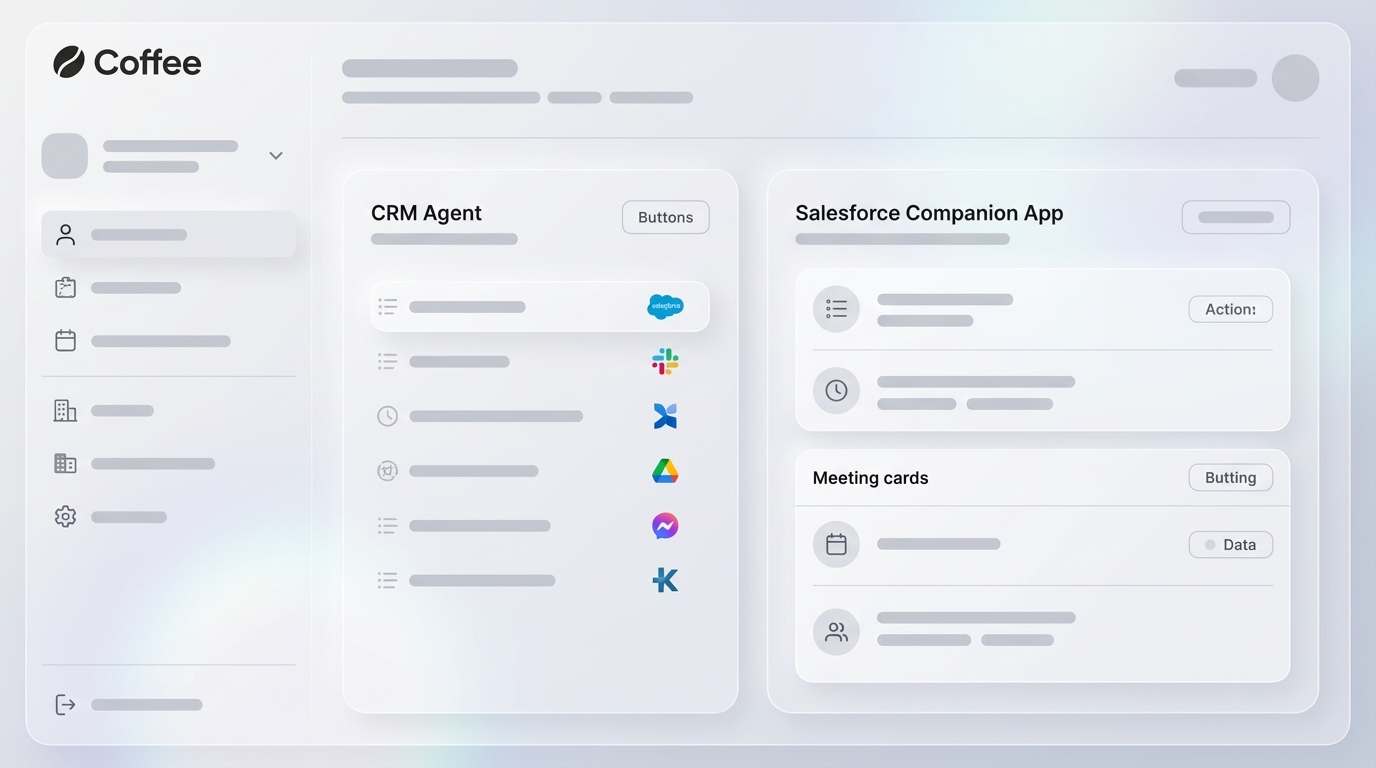
Coffee shifts Salesforce from passive CRM software to an active, intelligent agent that handles busywork while your team focuses on selling. Traditional Salesforce implementations require constant human maintenance. Coffee’s AI agent proactively manages data entry, enrichment, and analysis, turning your Salesforce instance into a more strategic asset.

Automating Data Entry and Enrichment
Coffee’s AI agent removes the manual data entry grind by autonomously creating contacts, companies, and activities based on your email and calendar interactions. After connecting to Google Workspace or Microsoft 365, the agent scans communications to populate the CRM with people and organizations, and it associates every interaction with the right record automatically.
The agent also enriches records with job titles, company funding information, and LinkedIn profiles via licensed data partners. This built-in capability gives every contact in your Salesforce instance complete, accurate information.

AI-Powered Meeting Management & Intelligent Workflows
Coffee turns meeting management into an automated workflow. The agent provides briefings before each meeting through a “Today” page, summarizing attendee backgrounds and past context to keep you prepared.

During meetings, Coffee’s AI bot joins calls on Zoom, Teams, or Google Meet to record and transcribe conversations, which removes the need for manual note-taking.

After meetings, the agent generates summaries, identifies next steps, and drafts follow-up emails in Gmail for review and sending. The agent can structure its notes according to sales methodologies such as BANT, MEDDIC, or SPICED, which keeps qualification data consistent across your sales process.

Real-Time Pipeline Intelligence & Strategic Insights
Coffee’s agent improves data quality in your Salesforce instance, and that foundation enables accurate pipeline intelligence. The Pipeline Compare feature visualizes week-over-week changes, highlighting progressed deals, stalled opportunities, and new additions without manual report generation.
This automated pipeline intelligence shifts sales reviews toward more strategic discussions. Coffee keeps pipeline data current so leaders can make decisions based on reliable information.
Consolidating Your Sales Tech Stack
Coffee performs the functions of multiple specialized tools within a single platform. The product combines data enrichment, meeting intelligence, activity tracking, and pipeline analytics. This approach reduces both the complexity and cost of maintaining multiple point solutions and simplifies your overall sales technology architecture.
See Coffee in action with a Salesforce companion app demo.
CRM Agent Comparison: Coffee vs. Traditional Salesforce & Generic Point Solutions
Sales and RevOps leaders need a clear view of the differences between Coffee’s agent-led approach and traditional CRM management methods. The comparison below highlights key differences in capability and user experience.
Comparison: Coffee vs. Traditional & Point Solutions
|
Feature/Benefit |
Traditional Salesforce (Manual) |
Generic Point Solutions |
Coffee (Our Product) |
|
Data Entry & Contact Creation |
Manual, time-consuming, prone to errors |
Basic automation, often fragmented |
Fully automated via AI agent |
|
Meeting Management (Prep, Recording, Summaries) |
Manual notes, separate recording tools |
Limited functionality, siloed data |
AI-powered: briefings, bot, summaries, follow-ups |
|
Data Enrichment (Contact & Company) |
Manual research or additional integrations |
Often relies on external integrations |
Built-in, real-time enrichment |
|
Pipeline Intelligence & Change Tracking |
Manual updates, static reports |
Limited visibility, often manual export |
Automated Pipeline Compare, real-time insights |
|
Sales Methodology Integration (BANT, MEDDIC) |
Manual fields, inconsistent application |
Rudimentary support, requires input |
AI structures notes per methodology |
|
Tech Stack Consolidation |
Requires multiple tools, high complexity |
Adds another tool to the stack |
Consolidates functions of multiple tools |
|
User Adoption & Rep Experience |
Low adoption due to burden |
Can add complexity to workflows |
Higher adoption as agent handles chores |
Real-World Impact: How Coffee Transforms Your Salesforce Investment
The benefits of an AI CRM agent become tangible when applied to real-world sales operations. Coffee’s impact extends beyond task automation and reshapes how sales teams interact with their CRM.
Empowering Sales Reps to Focus on Selling
Coffee reduces the data entry burden so sales reps can dedicate their attention to prospect research, relationship building, and deal progression. Coffee saves reps an estimated 8 to 12 hours per week on administrative tasks, time that shifts toward revenue-generating activities.
Ensuring Data Quality and Driving CRM Adoption
Coffee addresses the problem of CRM adoption by handling data entry and maintenance tasks. The agent follows a “good data in, good data out” principle and keeps data quality high. Better data creates a positive feedback loop of improved user satisfaction and system value.
Delivering Actionable Insights for Strategic Decision-Making
High-quality data maintained by Coffee’s agent enables actionable analytics. The Pipeline Compare feature provides visual analysis of pipeline changes so sales leaders can identify trends and make informed decisions.
Achieving Operational Efficiency Through Tech Stack Consolidation
Organizations see benefits from Coffee through reduced software complexity. Tech stack consolidation lowers operational overhead and training requirements, which streamlines onboarding and improves team efficiency.
Request access to explore how Coffee can improve the return on your Salesforce investment.
Frequently Asked Questions About the CRM Agent Salesforce Companion App
Coffee data security and privacy for Salesforce
Coffee maintains enterprise-grade security standards with SOC 2 Type 2 and GDPR compliance certifications. Your data remains secure and is not used to train public AI models. The integration with Salesforce uses industry-standard authentication methods.
How Coffee improves user adoption for sales reps
Coffee changes the relationship between sales reps and their CRM by removing much of the administrative burden. The agent handles data entry and maintenance tasks, so the CRM functions more like a co-pilot than a chore, which supports stronger adoption.
Coffee compared with existing point solutions
Coffee consolidates your sales tech stack by providing functionality that matches specialized tools. The agent’s integration ensures that enrichment and activity tracking flow directly into your Salesforce instance, which reduces costs and complexity.
Using Coffee with sales methodologies like MEDDIC or BANT
Coffee’s AI agent structures data capture and note-taking according to sales methodologies such as BANT, MEDDIC, or SPICED. The agent organizes meeting notes and opportunity data to support consistent application across your sales team.
Expected ROI from Coffee as a Salesforce companion app
Organizations see ROI from Coffee through cost savings from consolidated tools and increased sales productivity. Sales reps save an estimated 8 to 12 hours per week on administrative tasks, and improved data quality supports better decision-making and pipeline predictability.
Conclusion: Upgrade Your Salesforce with an AI CRM Agent Companion App Today
The choice between continuing with manual Salesforce processes and adopting an AI-powered CRM agent shapes the future of your sales organization. Coffee’s AI agent automates data entry, enriches records, manages meetings, and provides pipeline intelligence so sales reps can focus on closing deals.
For Head of Sales and RevOps leaders, Coffee’s companion app for Salesforce offers enterprise-grade security and a direct path to improving sales performance.