Written by: Doug Camplejohn, CEO & Co-Founder, Coffee
In today’s fast-paced sales environment, efficiency and adaptability are key to staying competitive. Traditional CRM systems, once seen as indispensable tools, often fall short by burdening sales teams with repetitive tasks and disjointed data.
Meanwhile, the rise of AI-driven solutions reflects a broader shift in the market toward automation and actionable insights. Platforms like Coffee exemplify this trend, offering a fresh perspective on customer management by prioritizing sales productivity through intelligent automation.
Let’s explore the challenges of legacy systems, the evolving landscape of sales technology, and how AI-first tools address real-world needs for sales teams. Ready to see how AI can streamline your sales process?
Why Traditional CRM Systems Struggle to Support Sales Teams
Many sales teams find traditional CRM systems more of a hindrance than a help. Issues like time-consuming data entry, scattered information, and poor integration limit their effectiveness, impacting overall performance. Understanding these problems helps sales leaders identify better solutions.
Manual Data Entry Drains Valuable Time
Sales reps often spend hours logging interactions, updating records, and entering contact details in traditional CRMs. Even with some built-in automation, these tasks eat into time better spent on customer engagement. Studies suggest reps can lose up to 20% of their week on administrative work, directly cutting into sales opportunities due to manual data entry burdens.
Fragmented Data Creates Inefficiency
Modern sales teams rely on various tools for CRM, outreach, and analytics, often resulting in data silos. Managing separate platforms for data enrichment or call recording adds complexity and cost. Without a unified view of customer information, reps struggle to make informed decisions quickly, slowing down the sales cycle.
Integration Issues Lead to Low Adoption
Traditional CRMs often fail to integrate smoothly with newer technologies, creating a clunky user experience. When systems feel cumbersome, sales reps avoid using them, leading to incomplete data. This often forces teams to rely on unofficial tools like spreadsheets, further fragmenting information and reducing visibility for managers.
How These Challenges Hurt Sales Performance
Administrative overload means less time for selling. Scattered data obscures customer insights, while low adoption rates degrade data quality, making accurate forecasting nearly impossible. Together, these issues create a cycle of inefficiency that impacts revenue and team morale.
How AI-First CRM Solutions Like Coffee Solve These Problems
Coffee represents a growing wave of AI-first CRM platforms built to prioritize automation and data quality over manual processes. Unlike legacy systems adapted with AI as an afterthought, Coffee is designed from the start for intelligent customer management. I
t aims to let sales reps focus on building relationships while the platform handles routine tasks. Request access to Coffee and see what modern customer management looks like in practice.
Standalone CRM for Small Businesses
For teams of 1 to 20 employees moving beyond basic tools, Coffee’s standalone CRM offers a simple, effective solution. By connecting to Google Workspace or Microsoft 365, it automatically imports customer data, providing immediate value without a steep learning curve.
Companion App for Salesforce and HubSpot Users
Companies already using Salesforce or HubSpot can integrate Coffee’s Companion App with minimal setup. It syncs data to its AI platform and allows users to select which insights or enriched information to send back to their primary CRM, adding value without disruption.
Key Benefits That Improve Sales Efficiency
Coffee tackles common CRM pain points with targeted features. Here’s how it helps:
- Automatic data capture from emails and calendars cuts down on manual entry.
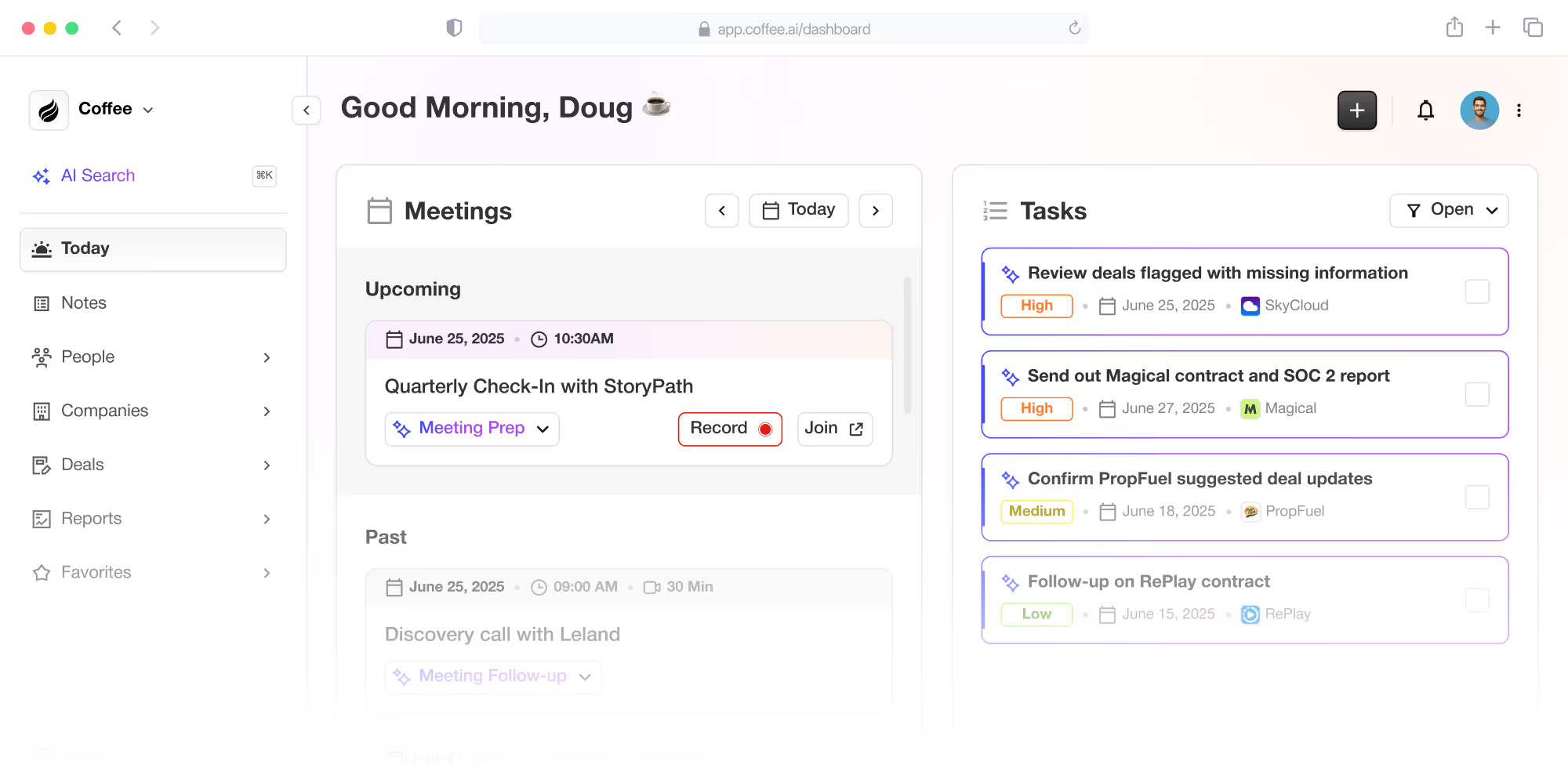
- AI-driven meeting tools provide prep summaries and post-call action items.
- Real-time pipeline insights replace manual reporting with instant analysis.
- A unified platform reduces the need for multiple tools, saving time and money.
- User-friendly design encourages adoption by prioritizing reps’ daily needs.
Specific Ways AI CRMs Enhance Customer Relationship Management
Automating Data Entry for Better Profiles
Coffee pulls customer information directly from emails, calendar events, and meetings when linked to Google Workspace or Microsoft 365. It creates and updates records automatically, adding details like job titles through data partners. This can save reps an estimated 8 to 12 hours weekly on data tasks based on typical administrative time savings.
Streamlining Meetings with AI Support
Before a meeting, Coffee’s ‘Today’ page offers a snapshot of attendees, company details, and past interactions. During virtual calls on platforms like Zoom or Teams, its AI records and transcribes discussions. Afterward, it summarizes key points, identifies next steps, and drafts follow-up emails tailored to sales frameworks like BANT.
Delivering Instant Pipeline Visibility
With a data warehouse setup, Coffee tracks pipeline changes over time. Its ‘Pipeline Compare’ feature shows week-to-week shifts in deals, such as new opportunities or stalled progrès, in a single view. This eliminates the need for manual exports or extra tools, simplifying reviews for managers and reps alike.
Reducing Tech Stack Costs
By combining CRM, data enrichment, call recording, and forecasting into one system, Coffee cuts down on subscriptions to multiple tools. This not only lowers expenses but also simplifies training and reduces data inconsistencies across platforms.
Designing a CRM Reps Actually Use
Coffee focuses on features that directly support sales reps, making the CRM feel like a helpful tool rather than a burden. Its intuitive layout and quick access to insights encourage consistent use, leading to better data for the whole team.
Comparing Coffee to Traditional CRMs
|
Feature |
Traditional CRM |
Coffee AI-First CRM |
|
Data Entry |
Mostly manual, with limited automation taking significant time |
Automated via email and calendar integration, saving 8-12 hours weekly |
|
Data Quality |
Inconsistent due to errors and low usage |
High accuracy with auto-enrichment from reliable sources |
|
Administrative Load |
Heavy with frequent updates and reporting |
Lightened by automation of repetitive tasks |
|
User Adoption |
Often low, viewed as a management tool |
High, designed as a productivity aid for reps |
|
Tech Stack |
Multiple tools lead to fragmented data |
Single platform with integrated features |
|
Pipeline Insights |
Manual analysis or extra paid features needed |
Automated, one-click comparison of changes |
Curious about the impact of AI-first customer management? Request access to Coffee and see how it can improve your team’s workflow.
Common Questions About AI CRM for Sales
How AI-First CRM Differs from Add-On AI Features?
Platforms like Coffee are built with AI at their core, focusing every feature on automation and data accuracy. Many traditional CRMs add AI later, which can lead to patchy integration and weaker results due to underlying system limitations. Coffee ensures data quality from the start for more effective automation.
Is there Integration with Existing Salesforce or HubSpot Systems?
Coffee’s Companion App connects easily to Salesforce or HubSpot through basic authentication. It pulls data into its AI platform and lets users decide what enriched information to sync back, adding value to current setups without requiring changes.
Does It Support Reps to Focus on Selling?
Coffee handles data entry, meeting preparation, and follow-up tasks automatically, freeing up an estimated 8 to 12 hours per week for reps. This extra time allows them to prioritize prospecting and customer conversations, boosting both productivity and job satisfaction.
How to Maintain Data Quality for Reliable Insights?
Coffee operates on the idea that accurate AI depends on accurate data. It captures information from emails, calendars, and call transcripts to minimize errors. Additional details from data partners keep profiles up to date, supporting trustworthy AI-driven insights.
Conclusion: Reimagining CRM for Sales Success
Legacy CRM systems often weigh sales teams down with manual work and disconnected data, limiting their potential. As part of a broader move toward automation, AI-first platforms like Coffee offer a practical way forward by streamlining processes, delivering real-time insights, and unifying tools.
Whether as a standalone CRM for smaller teams or a Companion App for established systems like Salesforce and HubSpot, Coffee helps sales professionals focus on what they do best: selling.
Don’t let outdated tools hold your team back. Take a step toward modern sales technology. Request access to Coffee and learn how it can reshape customer management for your business, and for real.