
The sales technology market stands at a pivotal moment. Over the past decade, customer relationship management (CRM) systems have been sold as the ultimate solution for organizing customer data and driving revenue. Yet, for many organizations, these platforms have morphed into cumbersome tools that fragment information, sap productivity, and fail to deliver on their promises. Sales teams often grapple with outdated or incomplete data, while executives struggle to extract actionable insights from systems that prioritize storage over intelligence. This gap between expectation and reality has created a pressing need for innovation, especially as customer expectations rise and competition intensifies. Research indicates that poor data quality costs businesses an average of $12.9 million annually, underscoring the strategic importance of addressing these challenges head-on Gartner.
Enter AI-powered CRM data management, a shift that redefines how sales organizations capture, analyze, and act on customer information. Unlike traditional systems, AI-driven platforms integrate automation and intelligence to turn data into a competitive asset. They address long-standing issues like manual data entry and low user adoption while enabling real-time decision-making. This guide offers sales leaders and executives a clear framework to understand these advancements, weigh their options, and implement solutions that enhance performance. As part of this evolving landscape, tools like Coffee exemplify how AI can elevate CRM capabilities, whether as a standalone system for growing businesses or as a companion to established platforms like Salesforce and HubSpot. Request access to explore how Coffee can refine your sales data strategy.
Why AI Is Critical for CRM Data in Sales
CRM data quality directly impacts sales outcomes. Inaccurate or incomplete data disrupts workflows, leading to missed opportunities, misaligned messaging, and inefficient handoffs between teams. When sales reps lack a clear picture of customer interactions, every touchpoint becomes a gamble, risking trust and revenue.
These issues compound across the organization. Duplicate outreach frustrates prospects, while reps enter meetings without prior context, hindering meaningful connections. Meanwhile, unreliable pipeline data skews forecasts, making strategic planning difficult. Companies using AI to address these data challenges gain an edge, as they can respond quickly to customer needs and market shifts McKinsey.
Manual data entry worsens the problem, pulling sales reps away from closing deals to handle administrative tasks. Many view CRMs as a burden, leading to low adoption rates. As a result, critical information often ends up in personal spreadsheets or notes, leaving the official system incomplete and less useful for other teams like marketing or customer success.
Older CRM architectures add another layer of difficulty. Designed for structured data storage, they often struggle with real-time analytics or unstructured inputs like emails and call transcripts. This creates gaps in understanding customer behavior, a critical flaw in today’s fast-paced sales environment.
What Defines AI-Powered CRM Data Management?
AI-powered CRM data management focuses on turning raw information into actionable insights. It rests on a few core ideas that set it apart from older systems and pave the way for better sales performance.
First, it unifies all customer data, combining structured details like contact information and deal stages with unstructured content from emails, calls, and meetings. This creates a complete view of each customer, helping sales teams spot trends and make informed decisions.
Second, automation removes the burden of manual data entry. These systems capture interactions from everyday tools like email and calendars, enriching records with external information to keep them accurate and up to date without extra effort from users.
Finally, proactive intelligence sets these platforms apart. Instead of waiting for users to pull reports, AI analyzes data to highlight opportunities, flag risks, and suggest next steps, enabling faster, smarter responses to customer needs.
How AI CRMs Differ from Traditional Systems
AI-driven CRMs outperform traditional systems due to fundamental differences in design and capability. Legacy platforms often use relational databases built for storing structured data, which can limit their ability to handle real-time analysis or complex queries needed for modern sales.
In contrast, many AI-powered systems rely on data warehouse architectures. These preserve historical data and support rapid trend analysis, offering a clearer view of sales cycles and improving forecast accuracy. They also handle unstructured data more effectively, processing emails and meeting notes to uncover insights that might otherwise be missed.
Another key difference lies in user experience. Traditional CRMs often require extensive manual input, while AI platforms automate data capture within existing workflows. This reduces errors, saves time, and encourages consistent use by delivering value directly to sales reps.
|
Feature/Approach |
Coffee (AI-Driven CRM) |
Traditional CRM |
|
Data Architecture |
Data warehouse with historical preservation and real-time AI processing |
Relational database, sometimes limited in historical data and real-time analysis |
|
Data Entry Automation |
Automatic capture from emails, meetings, and other communications |
Often relies on manual input for interactions and updates |
|
Data Enrichment |
AI-driven enrichment with integrated external data sources |
May need additional tools for complete data enrichment |
|
Pipeline Intelligence |
Instant pipeline comparisons and historical insights with minimal effort |
Advanced analysis often requires extra tools or manual work |
Key Benefits of AI CRM Data Management with Coffee
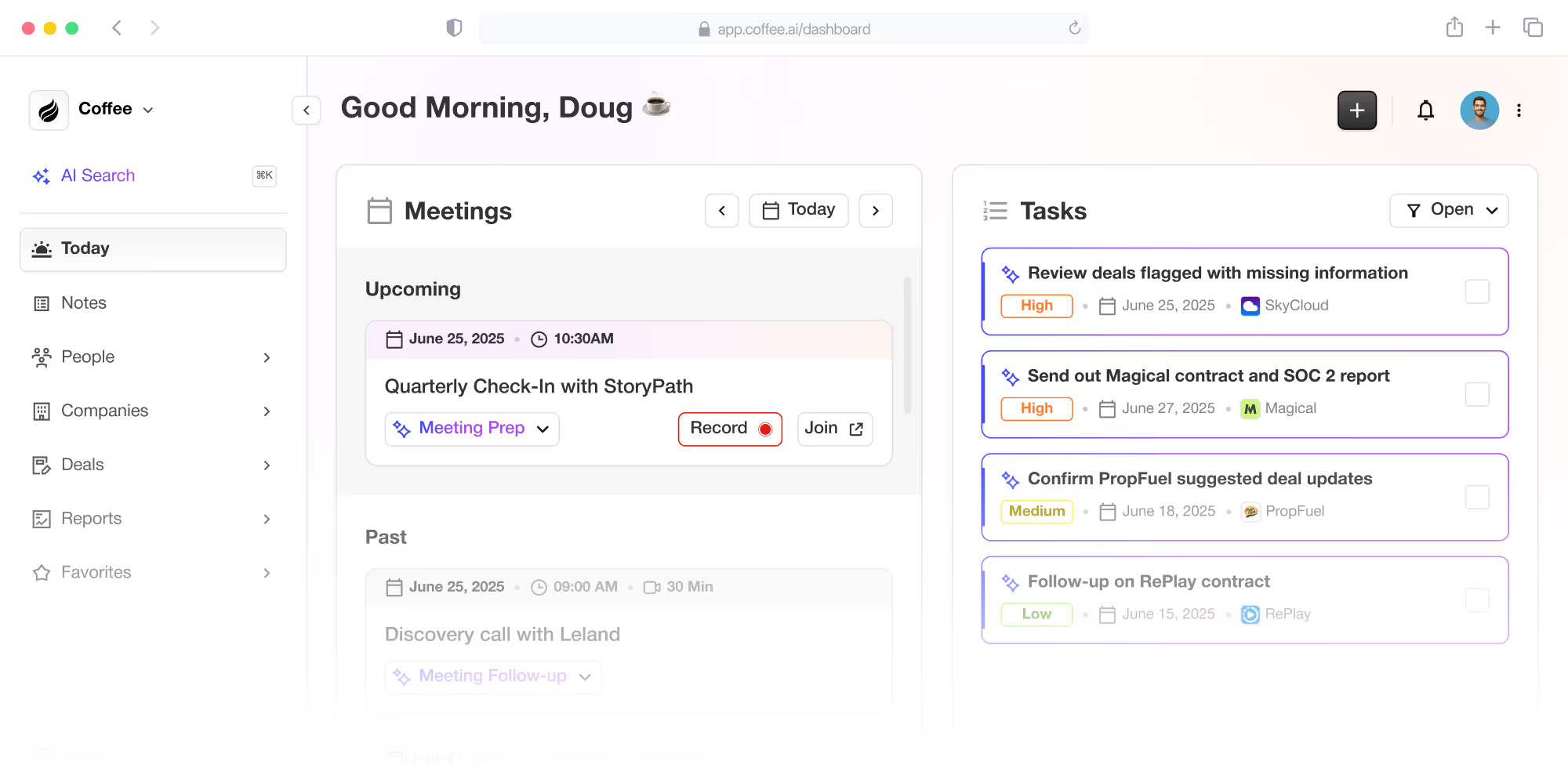
Coffee stands out as a practical example of how AI can address common CRM pain points. Its platform automates data capture by connecting to Google Workspace or Microsoft 365, pulling contacts and companies from emails and calendar invites. It then enriches this data with details like job titles, company information, and LinkedIn profiles, saving sales reps hours of manual research.
Workflow automation is another strength. Coffee prepares meeting briefs with attendee details and past interaction summaries, records calls via integrations with Google Meet, Microsoft Teams, or Zoom, and generates post-meeting summaries with action items. This streamlines preparation and follow-up, letting reps focus on customers rather than note-taking.
For pipeline management, Coffee offers a feature that compares historical snapshots, showing week-over-week changes in deal progress. Sales leaders can quickly identify trends and prioritize critical opportunities, turning pipeline reviews into strategic discussions instead of manual tasks.
Additionally, Coffee consolidates multiple tools into one platform, covering CRM, data enrichment, call recording, and forecasting. This reduces costs and simplifies operations by eliminating data silos, providing a single, reliable source for customer information.
User adoption also improves with Coffee’s design. By automating repetitive tasks and delivering relevant insights, it offers immediate value to sales reps, encouraging consistent use without forcing compliance. Request access to see how Coffee can enhance your team’s efficiency.
Factors to Consider When Adopting an AI-Driven CRM
Deciding on an AI CRM involves weighing your organization’s size and current systems. Smaller teams, often with 1 to 20 members, may find a standalone solution like Coffee ideal, as it delivers value quickly without the complexity of larger platforms.
Mid-sized companies already using Salesforce or HubSpot might opt for Coffee as a companion app. This approach adds AI capabilities without disrupting established processes, offering a low-risk way to test the benefits of automation.
Measuring the return on investment is essential. Track metrics like time spent on selling versus admin tasks, pipeline forecast accuracy, and data completeness to gauge impact. These indicators help confirm whether the system saves time and improves outcomes.
Change management poses another hurdle. Resistance often comes from past frustrations with CRMs. Focus initial training on tangible benefits, such as reduced workload and better meeting prep, to win over users. Leadership support and clear communication of early successes can sustain momentum.
Common Questions About AI-Driven CRM Data Management
AI-first CRMs like Coffee maintain data quality through automated updates and enrichment from external sources. This keeps information current without requiring manual effort from sales reps, unlike traditional systems that depend on user input.
These platforms can also reduce reliance on multiple tools. Coffee integrates data enrichment and meeting intelligence, cutting the need for separate prospecting or recording software. This simplifies workflows for small and mid-sized teams while lowering expenses.
Security remains a priority. Coffee adheres to standards like SOC 2 Type 2 and GDPR, using encryption and access controls to protect data. Customer information isn’t used for AI training, and additional compliance support is available for regulated industries.
High user adoption comes from delivering clear value. Coffee automates tedious tasks and offers actionable insights, making it a tool reps want to use. Hands-on demos during rollout can highlight these advantages, building enthusiasm among early users.
The data warehouse design in Coffee provides a distinct advantage. It stores historical records for trend analysis and supports real-time AI processing, enabling features like instant pipeline comparisons without performance delays.
Conclusion: Elevate Sales Performance with AI-Driven CRM
Moving to an AI-powered CRM is no longer optional for organizations aiming to stay competitive. Platforms like Coffee tackle persistent issues such as fragmented data and manual processes, turning CRM into a strategic asset through automation and insight.
Investing in this technology addresses immediate inefficiencies while preparing your team for future growth. Coffee offers flexible options, from a standalone system for smaller businesses to a companion app for Salesforce and HubSpot users, ensuring measurable improvements in data management.
Request access to Coffee now and see how AI can turn your sales data into a driver of consistent growth.