
In today’s competitive landscape, small businesses face immense pressure to optimize their sales processes while managing limited resources. The customer relationship management (CRM) market, valued at over $50 billion in 2023, reflects a growing demand for tools that promise efficiency and growth.
Yet, many small businesses struggle with conventional CRM systems that often add complexity instead of reducing it. These legacy tools, built on outdated frameworks, frequently burden sales teams with manual tasks and fragmented data, pulling focus away from what matters most: building customer relationships and closing deals.
As artificial intelligence reshapes industries, AI-driven CRMs are emerging as a practical alternative, automating tedious work and delivering actionable insights.
This article explores the persistent challenges of traditional CRMs, evaluates the benefits and trade-offs of AI-powered solutions, and highlights platforms like Coffee as part of a broader shift toward smarter sales technology.
Why Traditional CRMs Frustrate Small Businesses
Small businesses often rely on CRM systems to organize customer data and streamline sales, but these tools can become obstacles instead of enablers. With constrained budgets and small teams, every inefficiency directly impacts growth. Here are the main issues holding businesses back.
- Time lost to manual data entry reduces selling opportunities for lean sales teams.
- Disconnected tools create data silos, obscuring a clear view of customers.
- Outdated system designs struggle to scale with growing data and team needs.
- Unintuitive interfaces discourage consistent use, leading to incomplete records.
Manual Data Entry Eats Up Selling Time
Sales reps in small businesses often spend a significant portion of their day on administrative tasks. Studies estimate that up to 71% of their time goes to data entry instead of engaging with prospects or closing deals. This could mean losing most hours logging emails, updating records, and noting call outcomes; time that could directly generate revenue.
This focus on manual input leads to errors, inconsistent data, and frustration. Reps often see the CRM as a chore rather than a helpful tool, which further impacts data quality and limits the system’s overall value.
Fragmented Tools Create Data Chaos
Many small businesses use a mix of tools like HubSpot for CRM, ZoomInfo for data enrichment, and Gong for call analysis. Without proper integration, customer information gets scattered across platforms. Sales teams waste time switching between apps or manually syncing data, increasing the risk of outdated or conflicting records.
This setup also inflates costs. Managing multiple subscriptions strains budgets, forcing tough choices about which tools to prioritize. The added complexity often outweighs the benefits for smaller teams without dedicated tech support.
Outdated Systems Limit Growth
Legacy CRMs, designed before modern cloud and AI technologies, often struggle with performance as data and user numbers grow. Small businesses planning for expansion may face slowdowns or need expensive upgrades. These systems lack the flexibility to adapt to current needs, creating long-term risks for scalability.
Poor Design Discourages Team Adoption
User experience in many traditional CRMs feels clunky, prioritizing management reporting over sales team needs. When reps find the system hard to navigate, adoption drops. Small businesses, lacking resources for extensive training or customization, often see teams revert to spreadsheets or other workarounds, undermining the CRM’s purpose.
How AI CRM Addresses Small Business Pain Points
AI-powered CRMs offer a fresh approach by automating repetitive tasks and unifying data. These tools aim to free up sales teams for high-value work while providing insights that traditional systems can’t match.
As part of this trend, platforms like Coffee stand out by focusing on small business needs, integrating AI from the ground up to simplify sales operations.
Coffee redefines CRM by prioritizing automation and ease of use. It captures interactions from email and calendars automatically, builds detailed customer profiles without manual input, and offers insights to guide sales decisions.
This saves reps an estimated 8 to 12 hours per week on administrative tasks, directly boosting productivity. With a design that encourages team adoption, Coffee acts as a supportive tool rather than a burden.
Beyond Coffee, the wider adoption of AI in CRMs signals a shift toward smarter sales tech. While these solutions require solid internet access and some initial setup, their ability to reduce manual workload and consolidate tools often outweighs such drawbacks for small businesses.
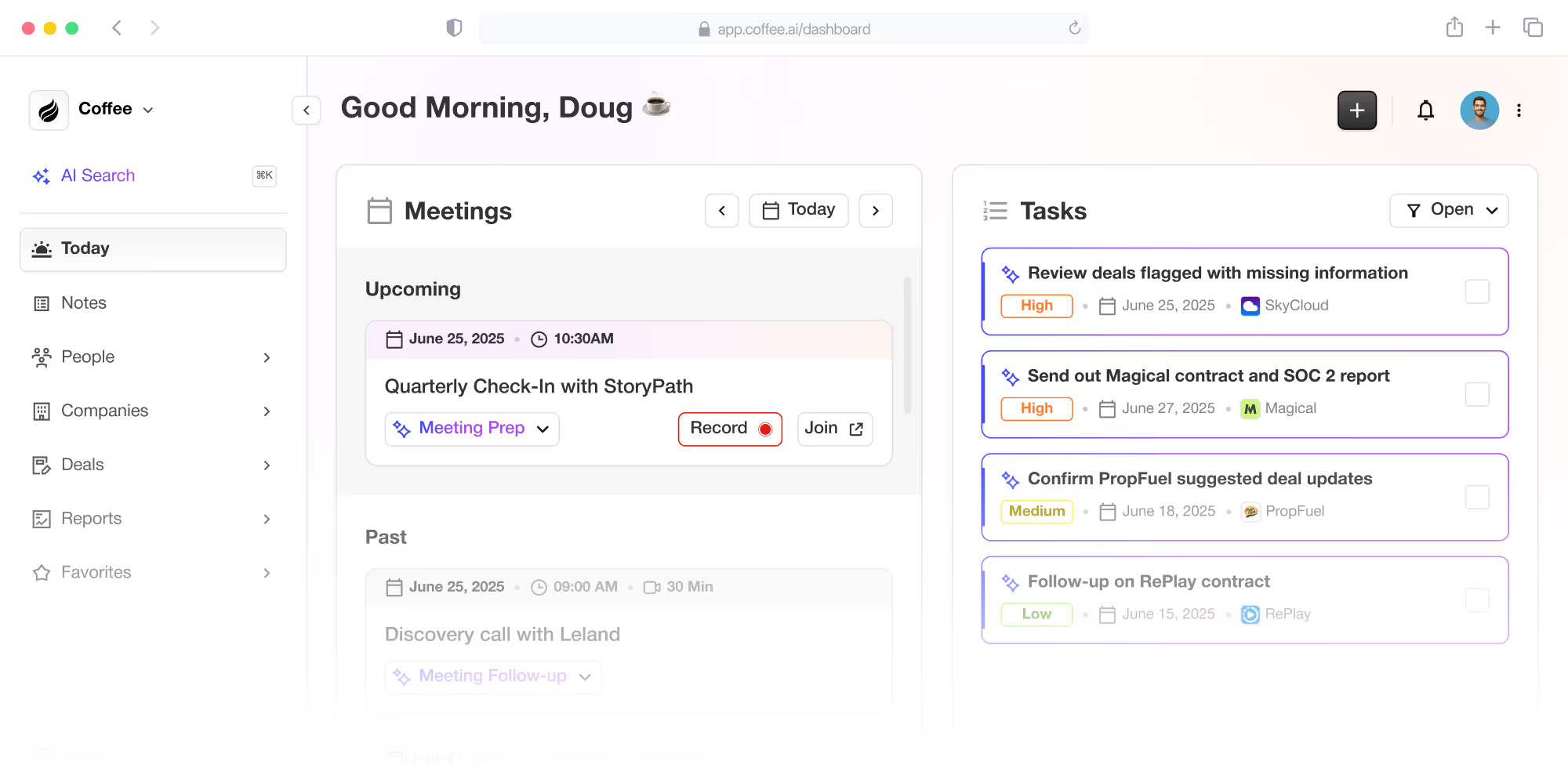
Example: The Benefits of Coffee AI CRM for Small Businesses
Automates Data Entry for Accurate Records
Coffee connects to Google Workspace or Microsoft 365 to instantly pull data from emails and calendars. It creates and updates contact records without manual effort, associating every interaction with the right person or company. The system also enriches data with details like job titles and company info from licensed partners, eliminating the need for separate tools like ZoomInfo.
This automation keeps records current and consistent, letting reps focus on engaging clients rather than updating fields. Small teams benefit from reliable data without the time sink of manual updates.
Simplifies Meeting Prep and Follow-Up
Before meetings, Coffee’s “Today” page compiles attendee details, company backgrounds, and past interaction summaries. During calls on Google Meet, Microsoft Teams, or Zoom, its AI bot records and transcribes discussions. Post-meeting, it drafts summaries and follow-up emails tailored to sales frameworks like BANT or MEDDIC.
For small businesses, this means walking into every meeting informed and following up efficiently. It saves hours while ensuring key points and action items aren’t missed.
Delivers Clear Pipeline Insights
Coffee’s built-in data warehouse tracks pipeline changes over time. A single click reveals week-over-week shifts, showing new deals, progress, or stalls. Unlike traditional CRMs that require manual exports and spreadsheet work, this feature provides instant visibility for quick strategy adjustments, ideal for small teams with limited analytical resources.
Reduces Tool Overload and Costs
Coffee combines CRM, data enrichment, call analysis, and pipeline tracking into one platform. This cuts the need for multiple subscriptions, simplifying workflows and reducing expenses.
Here’s a comparison of key areas:
|
Feature Area |
Traditional CRMs (with add-ons) |
Coffee AI CRM |
|
Data Entry |
Manual, Time-Intensive |
AI-Automated |
|
Data Enrichment |
Separate Tools Needed |
Integrated with Partners |
|
Meeting Support |
Manual Notes and Prep |
AI Briefings and Summaries |
|
Pipeline Analysis |
Manual Reports |
Instant Comparison Tool |
Simplify your sales tech and save on costs. Request access to Coffee’s all-in-one AI CRM platform.
What Sets Coffee Apart for Small Business Success
Coffee focuses on quick setup and immediate value for small to mid-sized teams. Unlike complex enterprise CRMs, it requires minimal customization. Integrations via Zapier connect it to other business apps, with plans for deeper links ahead. Its straightforward design ensures high team adoption, addressing a common failure point of traditional systems.
Real Results: Coffee in Action for Small Businesses
Consider a mid-sized company building AI solutions for large enterprises, previously managing sales via spreadsheets. After evaluating Salesforce, HubSpot, and newer options like Attio, they chose Coffee for its intuitive interface, automatic contact creation from Google Workspace, easy pipeline reviews, and API access for custom data use. This switch streamlined their operations, showcasing how Coffee supports growing businesses effectively.
Getting Started with Coffee AI CRM
Implementation with Coffee is straightforward. Connect your Google Workspace or Microsoft 365 account, and it automatically pulls in contacts and interaction history.
The intuitive layout minimizes training needs, while AI features handle data tasks in the background. Small businesses can start seeing time savings and better data organization from day one.
Ready to simplify your sales process? Request access to Coffee AI CRM and focus on growth.
Common Concerns About AI CRM for Small Businesses
What Challenges Do Small Businesses Face with Traditional CRMs?
Small businesses often deal with time-consuming data entry, scattered customer data across tools, rigid system designs that don’t scale, and interfaces that discourage regular use by sales teams.
How Does Coffee Improve Data Accuracy Over Older CRMs?
Coffee automatically captures information from emails, calendars, and meetings, reducing human error. It also pulls in verified details from data partners, ensuring records stay complete and up to date without manual effort.
Can Coffee Support Growth as My Business Expands?
Coffee’s modern design handles increasing data and team sizes through automation and unified systems. It supports small to mid-sized businesses, providing consistent value as needs evolve.
What Makes Coffee Unique Among CRM Options?
Coffee stands out with its AI-driven focus, eliminating manual tasks and consolidating customer data. It supports sales reps with automated meeting prep, follow-ups, and pipeline insights while reducing tool sprawl and costs.
How Soon Can Results Be Seen After Adopting Coffee?
Businesses notice benefits like time savings and automated data handling within the first week of using Coffee. Over time, improved pipeline clarity and data quality further enhance sales effectiveness.
Final Thoughts: Elevate Your Sales with AI Automation
Small businesses no longer need to struggle with cumbersome CRMs that drain time and resources. AI-driven platforms mark a new direction, automating routine tasks and unifying data to empower sales teams. Coffee exemplifies this change, offering a practical way to shift focus back to customer relationships and deal-closing.
Every hour saved on admin work is an hour gained for growth. Embrace this shift to smarter sales tech. Request access to Coffee AI CRM and see how automation can drive your small business forward.