
Key Takeaways
- Manual data entry, fragmented tools, and stale records limit the impact of traditional CRM platforms on revenue growth.
- CRM platforms with built-in data enrichment reduce administrative work, improve data quality, and keep records complete and current.
- Richer profiles from integrated enrichment support better lead qualification, personalization, and more accurate pipeline forecasts.
- Consolidated platforms simplify tech stacks, lower costs, and encourage higher CRM adoption across sales teams.
- Coffee offers built-in enrichment and an AI CRM agent that automates data capture and workflows, helping teams grow revenue faster. Get started with Coffee.

The Problem with Traditional CRM Platforms and Data
Most legacy CRMs rely on humans to create, update, and maintain data. This approach turns CRM into ongoing busywork instead of a system that helps teams sell.
Sales representatives spend a large share of their week on administrative tasks instead of selling. Coffee market data shows that 71% of reps feel they spend too much time on data entry, which leaves only 35% of their time for selling. Poor data quality then leads to weak forecasts, missed opportunities, and shadow systems in spreadsheets or docs where real work happens.
Traditional CRMs also treat records as static fields instead of living, connected data. Information sits across multiple tools for enrichment, outreach, and call recording. Teams jump between a CRM, enrichment databases, sales engagement platforms, and meeting tools. The result is higher cost, more complexity, and inconsistent data.
Older CRM architectures compound the issue. Simple relational databases overwrite history when fields change and struggle with unstructured data like email threads or call transcripts. A modern platform like Coffee uses an AI agent to unify, enrich, and interpret this data at scale. Get started with a CRM designed for enriched, always-current data.
7 Ways Integrated Data Enrichment Improves Revenue Operations
1. Eliminate Manual Data Entry and Boost Sales Productivity
Integrated enrichment captures and fills in data automatically so reps do not have to. Contact and company details, activity logs, and relationships update in the background, which saves many hours each week that once went to manual updates.
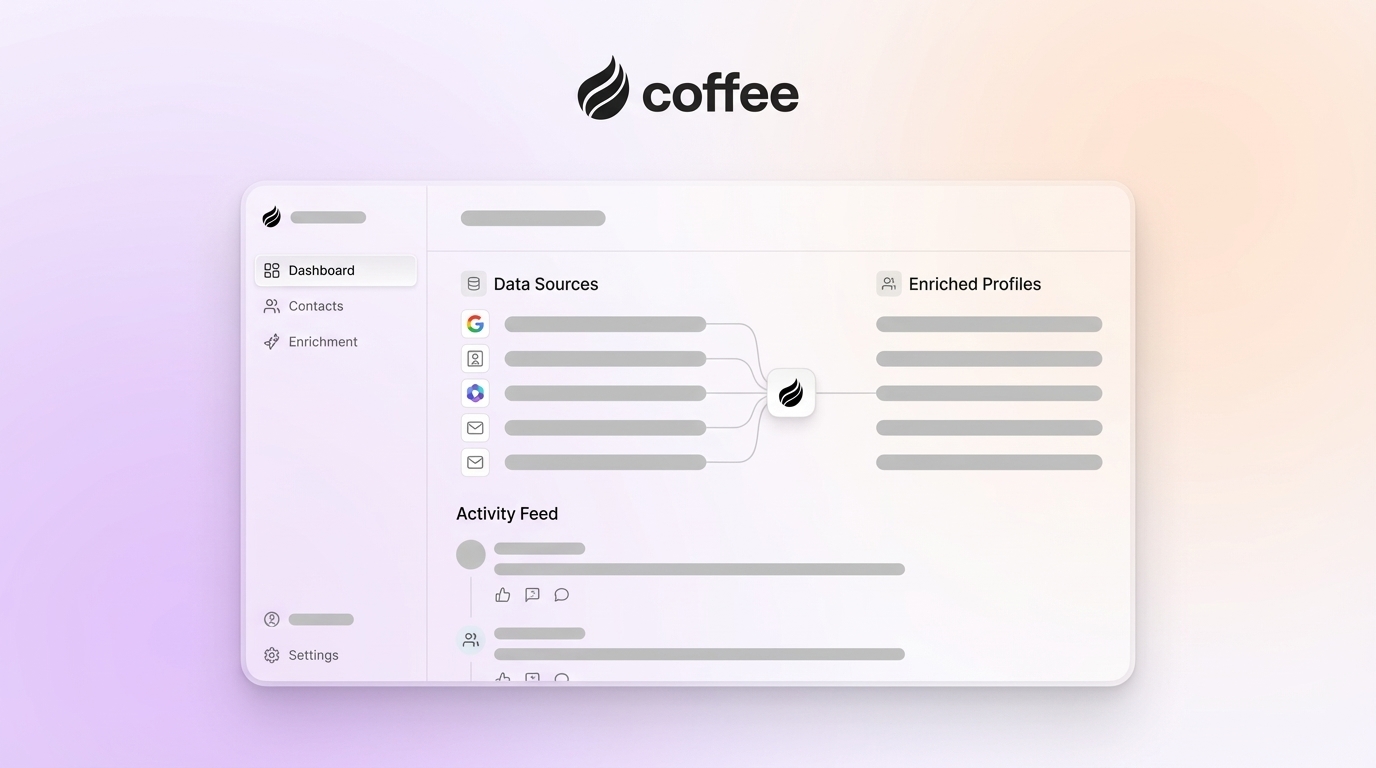
Coffee’s AI agent scans emails and calendars to auto-create contacts and accounts, then enriches them with titles, company information, and LinkedIn profiles from licensed partners. New contacts that appear in an inbox or calendar invite become enriched records within moments, without manual typing.
The platform also logs activity automatically. Email and calendar integrations keep “last activity” and “next activity” current so deal stages stay accurate. This continuous capture helps prevent the stale CRM data that slows reviews and reporting.
2. Improve Data Accuracy and Completeness
Accurate, complete data gives sales and marketing teams a stronger base for decisions. Built-in enrichment keeps records updated as people change roles, companies raise funding, or organizations grow.
Coffee’s agent monitors connected systems like Google Workspace and Microsoft 365 and refreshes records with relevant details from enrichment partners. This continuous process reduces data decay and lowers the need for separate tools such as standalone enrichment platforms.
3. Automate Lead Qualification and Prioritization with Rich Profiles
Richer data makes it easier to focus effort on the right accounts and people. Firmographic and role data support more precise lead scoring and qualification rules, which points reps at the best opportunities faster.
Coffee’s natural language list builder highlights this benefit. A manager can say, “Find VPs of Sales in North America at companies with $10M+ funding using Salesforce.” The agent uses integrated enrichment to assemble a targeted list that matches this description, combining filters across funding, region, role, and tech stack.

4. Personalize Customer Interactions for Higher Conversion Rates
Context-rich data supports more relevant conversations. When reps understand a prospect’s role, company stage, and recent history with your team, outreach can speak directly to current priorities.
Coffee provides this context in one place, including previous meetings, emails, and key notes. Reps can enter calls with a brief that highlights what was discussed last time and what matters most to the buyer. Opening a conversation with a specific reference from a prior meeting helps build trust and keeps the focus on the prospect’s goals. Get started with personalized outreach that uses every data point you already have.
5. Forecast Pipeline with More Confidence
Stronger data leads to better forecasts. When deal records are accurate and complete, leaders can rely more on the numbers and spend less time questioning them.
Coffee tracks changes to deals and related activities in real time. The Pipeline Compare view shows how the pipeline has shifted week over week, including deals that moved stages, stalled, or entered the funnel. This view relies on the agent’s automatic capture of emails, meetings, and updates so history and current status remain visible.
Pipeline reviews then shift from correcting CRM data to discussing strategy, coaching on deals, and planning next steps.
6. Streamline Sales Workflows and Simplify Your Tech Stack
Built-in enrichment reduces the need for separate enrichment databases, call recorders, and forecasting add-ons. Fewer tools mean lower cost, simpler administration, and less switching for reps.
Coffee combines CRM, enrichment, call recording, and pipeline analytics in one platform or as a companion layer on top of Salesforce and HubSpot. Data flows across these functions without extra integrations or sync jobs.
|
Feature |
Coffee (Built-in) |
Legacy CRM + Standalone |
|
Manual Data Entry |
Low, AI-driven capture |
High, rep-driven updates |
|
Data Accuracy |
Continuous and enriched |
Stale and manual |
|
Tech Stack Complexity |
Consolidated platform |
Multiple point tools |
7. Turn CRM from a Chore into a Co-Pilot Your Team Uses Daily
Reps often see traditional CRMs as inspection tools rather than support tools. When every update requires manual work, adoption drops and data quality declines with it.
This automation of the “dirty work” of data management shifts the experience. Coffee assigns repetitive tasks to its agent, which prepares meeting briefings, suggests follow-ups, and maintains records in the background. Reps gain a system that helps them plan their day, remember context, and move deals forward instead of a system that only asks for updates.
Higher adoption then feeds a positive cycle. Better usage produces better data, which leads to better insights and results, which in turn give reps more reason to keep using the platform. Get started with a CRM that fits into your team’s daily workflow.

Frequently Asked Questions: CRM Data Enrichment and Coffee
How does Coffee ensure the accuracy of enriched data?
Coffee uses its AI agent to pull data from connected systems such as Google Workspace and Microsoft 365 and enriches it with information from licensed partners. The agent monitors records for changes and refreshes fields over time to keep information accurate for most sales and marketing use cases.
What is the difference between standalone enrichment tools and Coffee’s built-in enrichment?
Standalone tools sit outside the CRM and often require complex integrations and periodic sync jobs. This setup can lead to delays and mismatched records. Coffee handles enrichment inside the CRM itself or as a companion layer for Salesforce and HubSpot, which keeps contact, account, and activity data aligned without manual transfers.
Is Coffee’s data enrichment compliant with privacy regulations such as GDPR?
Coffee maintains SOC 2 Type 2 and GDPR compliance and does not use customer data to train public models. Teams should still confirm requirements with their own security and legal stakeholders, but the platform is designed for secure, compliant handling of customer information.
Can Coffee’s built-in data enrichment support outbound prospecting?
Yes. Coffee’s list-building capabilities use enriched firmographic and contact data to create targeted prospect lists. Users can define detailed criteria, and the agent assembles lists that match those filters so teams can run focused, personalized outbound programs.
How quickly can teams see results from Coffee’s enrichment features?
Teams typically see early gains as soon as Coffee connects to calendars and email. Automatic contact creation and activity capture reduce manual work within days. Over time, richer data and better capture improve forecast accuracy, territory planning, and campaign performance.
Conclusion: Let an AI Agent Keep Your CRM Accurate
CRM platforms with built-in data enrichment change the role of CRM from a static database to an active system that supports revenue work. Automated capture and enrichment reduce manual entry, keep records fresh, and unlock better forecasting and personalization.
Coffee brings these capabilities together in one platform, pairing CRM features with an AI agent that handles routine data tasks and meeting prep. Sales teams gain more time for conversations and strategy, while leaders gain a clearer view of the pipeline.
Teams that want a CRM that keeps itself accurate and useful can adopt this approach today. Get started with Coffee and see how built-in enrichment supports your revenue goals.