Written by: Doug Camplejohn, CEO & Co-Founder, Coffee
Key takeaways from this guide on CRM software with automated data entry from email:
- Manual CRM updates from email drain sales capacity and reduce data quality.
- Automated data capture from email creates more accurate and complete customer records with less effort.
- AI-first tools like Coffee connect email, calendar, and CRM data so sales reps can spend more time selling.
- Implementation focuses on low-friction integrations, user adoption, and clear success metrics.
- Teams see gains in productivity, forecast reliability, and revenue when email data flows directly into the CRM.
The Problem: Manual CRM Data Entry from Email Is Draining Your Sales Team
CRM systems were designed to centralize customer interactions and give sales teams clear visibility into their pipelines. In many organizations, legacy CRMs now slow teams down, because reps spend large portions of their day entering data instead of selling. The most critical bottleneck is email communications, which remain only partly connected to CRM records and leave gaps in customer history.
The Hidden Costs of Manual Data Entry
The impact of manual data entry extends far beyond the time spent typing. Manual data entry introduces frequent human errors, which leads to inaccuracies in CRM records and operational inefficiencies. These errors compound over time and create unreliable customer profiles that undermine sales strategies and forecasting accuracy.
Inconsistent data entry makes it difficult to segment and personalize communication. When sales reps manually enter email interactions, they often use different formats, abbreviations, or levels of detail. This inconsistency makes it harder to extract meaningful insights or patterns from customer data.
The financial implications are significant. For a sales team of 10 representatives, if each spends just two hours daily on manual CRM updates, that is 100 hours per week. This is equivalent to 2.5 full-time employees focused on data entry instead of selling.
Productivity Drain: Sales Reps Swamped by Admin Tasks
Manual email data entry turns sales professionals into data entry clerks. When you factor in the context switching between email platforms and CRM systems, the productivity loss becomes even more pronounced.
Sales representatives often report that by the time they finish updating their CRM with the day’s email conversations, they have lost momentum on active deals and missed opportunities for timely follow-ups.
This administrative burden creates a cycle of avoidance. As sales reps grow frustrated with manual processes, they begin to cut corners by logging abbreviated notes, skipping entries for quick emails, or creating informal tracking systems outside the official CRM. This behavior leads to the creation of shadow CRMs in tools like Notion or spreadsheets, where the real customer relationship data lives while the official system remains incomplete.
Fragmented Data and Missed Opportunities
Email communications contain some of the richest customer intelligence available to sales teams, including pain points, budget constraints, decision-making timelines, and relationship dynamics. In many organizations, this information remains trapped in email inboxes and disconnected from the broader customer profile in the CRM.
When email data is not automatically captured, sales managers lack visibility into the true status of deals, marketing teams cannot effectively nurture leads based on sales conversations, and customer success teams miss critical context when onboarding new clients.
This fragmentation has direct revenue implications. If a prospect mentions budget approval timing in an email and that information is not logged in the CRM because the sales rep is rushing to the next meeting, the follow-up sequence may continue on the wrong timeline and miss the best closing window. These missed opportunities multiply across every deal, every rep, and every day that email intelligence remains disconnected from your CRM strategy.
The Solution: Embracing CRM Software with Automated Data Entry from Email
The evolution of artificial intelligence now makes it possible to address the manual data entry workload that has affected sales organizations for decades. CRM software with automated data entry from email, such as Coffee, shifts teams from reactive data management to proactive intelligence gathering and changes how sales teams capture, organize, and act on customer information.
What Is Automated Data Entry from Email?
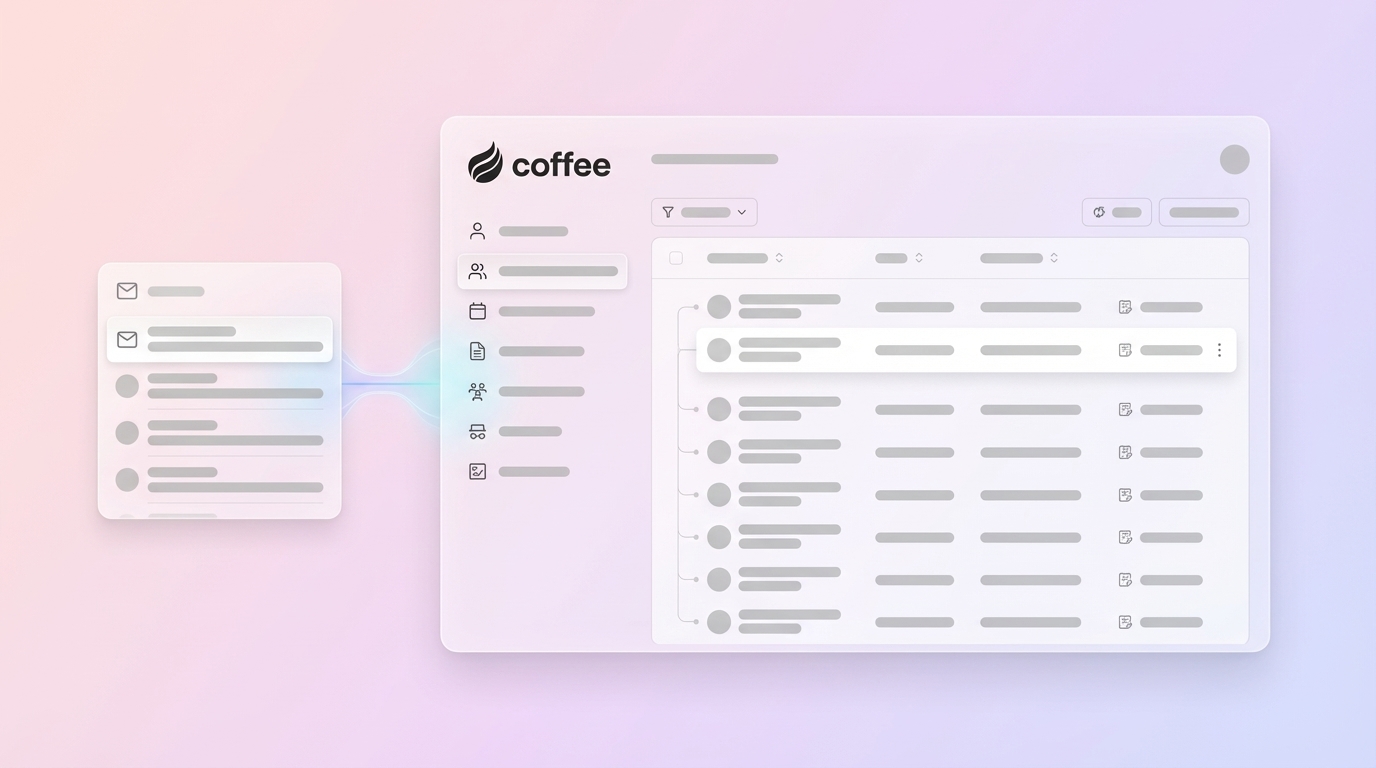
CRM software with automated data entry from email uses AI models to continuously monitor email communications and extract relevant customer information. Unlike simple email sync features that only display emails within a CRM interface, automated data entry interprets the content and context of email conversations to populate CRM fields, create new records, and update existing customer profiles without manual effort.
Core Benefits of Automation
Automated data entry improves accuracy and real-time data updating, which boosts sales productivity. This productivity gain comes from several sources: reduced manual entry time, less context switching between applications, and better data accuracy that prevents time-wasting errors. Most importantly, sales reps can maintain momentum on deals instead of getting pulled into administrative tasks.
Accuracy improves because automated systems apply consistent logic and formatting rules. Human data entry is vulnerable to fatigue, distraction, and inconsistent interpretation, which leads to uneven records.
Real-time data updating keeps customer information current and supports more responsive sales strategies. When a prospect mentions a budget increase in an email, that information can be immediately available to the entire sales team through a system like Coffee, which allows for faster strategy adjustments.
Request access to see how automated data entry can improve your sales team’s productivity and data accuracy.
Coffee: Your AI-First CRM Software for Automated Data Entry from Email
Coffee is an AI-first CRM designed to reduce manual data entry and improve data quality. The platform relies on artificial intelligence to handle data capture and organization so sales teams can focus on conversations, follow-ups, and closing deals.
Unlike legacy systems built around manual input, Coffee’s architecture treats automated data capture as a core capability. This design supports features that address the main challenges of traditional CRM approaches.
How Coffee Delivers Automated Data Entry from Email
Coffee’s automated data entry from email capabilities provide a structured response to the productivity and accuracy challenges that many sales teams face:
- Auto-create Contacts and Companies: After connecting your Google Workspace or Microsoft 365 account, Coffee scans your email and calendar invites to automatically populate your CRM with contacts and companies you have interacted with. Every email you send and every meeting your team has is associated with the right contacts and companies.
- Data Enrichment: Coffee enhances records with information such as job titles, company details, funding, LinkedIn profiles, and location, sourced from licensed data partners. This reduces the need for separate tools like ZoomInfo or Apollo for many users.
- Activity Logging: Coffee automatically logs “last activity” and “next activity” by pulling data directly from email and calendar, which keeps deal information up to date without manual input.
- AI-Powered Meeting Management: Coffee supports sales meetings by providing briefings, recording and transcribing calls on Google Meet, Microsoft Teams, and Zoom, generating summaries, identifying action items, and drafting follow-up emails.
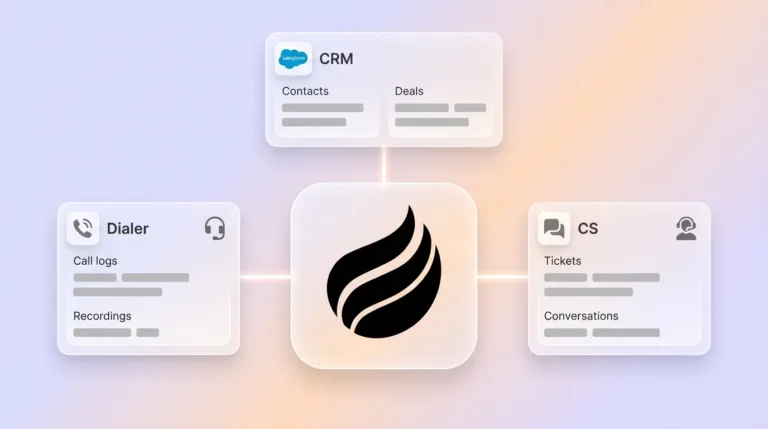
Coffee operates on a dual-model strategy to serve different organizational needs. For small to mid-sized businesses, Coffee’s standalone AI-first CRM offers a modern alternative to traditional CRMs. For organizations using Salesforce or HubSpot, Coffee’s Companion App integrates into existing setups and adds intelligent automation without requiring teams to abandon current workflows.
Improve Your Sales Pipeline with Automated Data Entry from Email
The impact of implementing CRM software with automated data entry from email extends beyond time savings. Automated capture of email data changes how sales teams operate, how they understand customer relationships, and how they plan for revenue.
Empower Sales Reps to Focus on Selling
Coffee’s automated data entry capabilities save sales representatives an estimated 8–12 hours per week, time that can be redirected to revenue-generating activities. When sales reps are not responsible for constant CRM updates, they can focus on deal progression and customer relationship building.
Build an Accurate, Comprehensive Customer View
Automated data entry from email keeps customer profiles current without ongoing manual effort. Every email exchange adds structured intelligence to customer records and helps create a more complete customer view that many legacy CRMs struggle to maintain.
Drive Smarter Decisions with True Pipeline Intelligence
Coffee’s Pipeline Compare feature allows users to see week-over-week pipeline changes with a single click and highlights deals that have progressed, stalled, or closed. This clarity helps pipeline review meetings move from status updates to focused planning sessions.
The ROI of Consolidating Your Tech Stack
Coffee’s comprehensive approach combines the functionality of multiple tools, including CRM, data enrichment, call recording, and forecasting, into one platform. This consolidation can reduce both cost and operational complexity.
Request access to learn how Coffee’s integrated approach can streamline your sales technology stack while improving data quality and team productivity.
Comparison: Legacy CRM Manual Entry vs. Coffee’s Automated Data Entry from Email
The differences between traditional CRM approaches and Coffee’s automated data entry from email are clear:
|
Feature |
Legacy CRM (Manual Entry) |
Coffee (Automated Data Entry from Email) |
|
Contact/Company Creation |
Manual input, prone to omissions and delays |
Automated from email and calendar interactions |
|
Data Accuracy |
High risk of human error and inconsistencies |
AI-driven validation with high consistency |
|
Time Spent on Data Entry |
Significant (8–12 hours per week per rep) |
Minimal, largely automated |
|
Data Enrichment |
Requires separate tools or manual lookup |
Built-in, automatic, and real-time |
Implementation Strategy for CRM Software with Automated Data Entry from Email
Transitioning to CRM software with automated data entry from email works best with a clear implementation plan that minimizes disruption. The implementation process with Coffee focuses on configuring intelligent automation that runs in the background and supports existing workflows.
Integration and Connectivity
Coffee integrates with Google Workspace and Microsoft 365 to access email communications and calendar data for comprehensive data capture.
For organizations using Coffee as a Companion App with Salesforce or HubSpot, integration involves secure authentication, which allows Coffee to enhance existing records with automated data entry intelligence.
User Adoption and Change Management
Coffee is designed to shorten the learning curve for sales teams by creating a CRM experience that aligns with how reps already work. This focus improves adoption because the platform delivers immediate value through better customer insights and reduced administrative work.
Measuring Success with Automated Data Entry from Email
The impact of implementing CRM software with automated data entry from email can be measured across several dimensions related to sales performance and efficiency.
Productivity Metrics
The most immediate benefit is the reduction in time spent on manual data entry. Organizations using Coffee often see sales representatives redirect 8–12 hours per week from administrative tasks to selling activities.
Data Quality Improvements
Automated data entry improves data completeness and consistency, which strengthens the reliability of sales forecasts and the effectiveness of marketing campaigns that rely on CRM data.
Revenue Impact
Productivity and data quality improvements support higher revenue. Coffee’s automated data entry helps teams follow up more consistently, understand deal status more clearly, and improve close rates.
Request access to see how Coffee’s automated data entry capabilities can contribute to measurable improvements in sales performance and data quality.
Frequently Asked Questions about CRM Software with Automated Data Entry from Email
How does CRM software with automated data entry from email connect with my existing email provider?
Coffee integrates with Google Workspace and Microsoft 365 through secure API connections. Once authenticated, Coffee automatically begins monitoring email communications and calendar activities to extract relevant customer information without disrupting existing workflows.
Will using CRM software with automated data entry from email lead to junk data or privacy concerns?
Coffee’s AI is designed to distinguish between business-relevant communications and irrelevant emails. The platform maintains high security standards with SOC 2 Type 2 and GDPR compliance, keeps data secure and private, and does not use company data to train AI models.
Is automated data entry from email suitable for both small businesses and larger teams?
Yes. Coffee’s dual-model approach scales across organization sizes. The standalone AI-first CRM serves small businesses, while the Companion App integrates with Salesforce or HubSpot for larger teams, supported by simple seat-based pricing.
Can CRM software with automated data entry from email help standardize data formatting across my organization?
Yes. Coffee applies consistent data formatting and validation rules, which helps maintain uniform data quality across the customer database and improves reliability and usability.
How quickly can we see results from implementing automated data entry from email?
Organizations using Coffee see benefits soon after email integration is activated. Manual CRM updates drop in the first week, and the impact grows over the first month as data quality and completeness improve.
Conclusion: Reduce Manual Work with Modern CRM Software with Automated Data Entry from Email
Sales teams can continue to spend valuable time on manual data entry, or they can move to CRM software with automated data entry from email and shift that time toward selling. Coffee enables this shift by using AI to handle data capture and organization so sales professionals can focus on customer outcomes.
To empower your sales team and modernize your data strategy, request access to Coffee and put automated data entry from email at the center of your CRM.