Written by: Doug Camplejohn, CEO & Co-Founder, Coffee | Last updated: July 23, 2026
Why Small Teams Are Replacing Salesforce for Support
- Autonomous ticket resolution, automatic data capture, and zero-human data entry define real customer support automation in 2026.
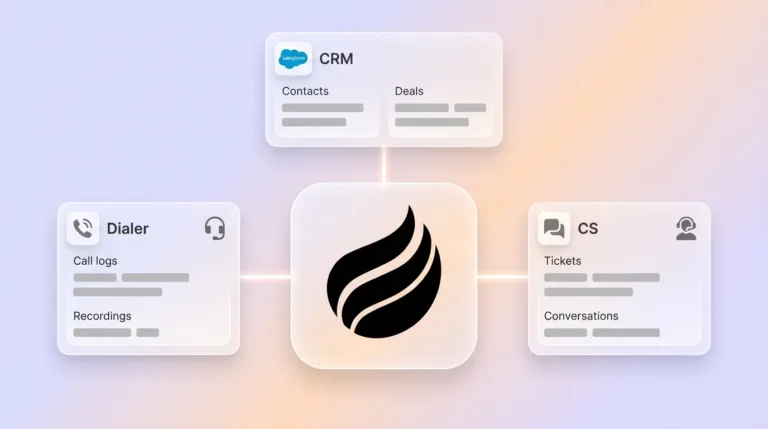
- Coffee is the only solution in this comparison that delivers all three by ingesting emails, calls, and chat transcripts without human help.
- Traditional helpdesks like Zendesk, Freshdesk, and HubSpot still rely on people for triage, record updates, and data entry even with AI enabled.
- Agentic AI platforms that connect directly to backend systems achieve 70–85% automated resolution rates, far above the 20–40% range of rule-based chatbots.
- Get started with Coffee to remove manual data entry from your support stack today.
Salesforce Alternatives That Fit Small Business Support Teams
Salesforce Service Cloud targets enterprise teams with custom pricing that typically starts around $75 per user per month, plus implementation costs. For a 5-to-50-person company, that architecture is heavy and still depends on humans to triage, update records, and close tickets manually.
The six tools below represent the realistic evaluation set for small businesses in mid-2026. The table compares them on setup time, starting price (July 2026), omnichannel coverage, and manual data-entry hours saved per week. As you review it, focus on the manual data-entry column, because that metric shows which tools truly remove admin work instead of shifting it.
| Tool | Setup Time | Starting Price (July 2026) | Omnichannel Coverage | Manual Data-Entry Hours Saved/Week |
|---|---|---|---|---|
| Coffee | Rapid setup with guided onboarding | Seat-based; agent labor included, contact for pricing | Email, calls, chat transcripts ingested automatically | 8–12 hours saved per rep |
| Zendesk Suite | Several weeks depending on team size | $55/agent/month (Suite Team, annual); Copilot add-on +$50/agent/month | Email, social, web widgets, phone, chatbots on Suite plans | Manual triage still required, saves ~45 seconds per ticket vs. manual |
| Freshdesk (Freshworks) | Typically an afternoon to a few days of configuration | $29/agent/month (Growth); Freddy AI billed separately at $100/1,000 sessions | Email, social, messaging, phone on Omnichannel plans from $29/agent/month | Routing automated, record updates still manual without add-ons |
| HubSpot Service Hub | 1–2 weeks basic; full AI agent 3–5 weeks | $20/user/month Starter; Professional $90/seat/month + $1,500 onboarding fee | Ticketing, live chat, messaging with HubSpot CRM data; free to ~$150/agent/month | CRM data entry still required, no autonomous record capture |
| Intercom (Fin) | Hours to days for AI agent layer | $0.99/resolution (Fin); Starter plan from $74/month for very small teams | Omnichannel deployment included; native helpdesk optional | Resolution-focused but per-resolution costs scale steeply at volume |
| Gorgias | Hours to days | $40/month (Helpdesk $10/mo + AI Agent $30/mo) for 50 tickets | Native Shopify, Magento, BigCommerce; email, live chat, social | Strong for ecommerce order actions, limited outside retail workflows |
Coffee’s agent-led architecture is the only option in this table that captures data from every channel, including email, calls, and chat, without asking a human to log, tag, or update a record afterward.
Why Agentic AI Tools Are in Demand Now
The 2026 market has shifted away from rule-based bots toward agentic AI that executes real actions. True agentic AI interprets a customer request and performs actions such as issuing a refund, creating a service ticket, or triggering a workflow, instead of following fixed scripts.
Autonomous AI agents are replacing legacy chatbots in 2026, with LLM-powered agents handling context, judgment calls, and complex multi-step issues. Basic chatbots usually reach 20–40% automated resolution by answering FAQs, while true agentic platforms routinely reach 70–85% by connecting to backend systems and executing actions.
Coffee’s AI Agent operates in this agentic tier. Production deployments report strong autonomous resolution on structured customer service workflows. Coffee benchmarks competitively on these workflows and also captures every interaction as structured data, so teams avoid a separate human data-entry step.
Companies deploying AI agents report 40% faster response times, 45% fewer escalations to human agents, 60% ticket deflection rates, and 20–40% lower support operating costs compared to rule-based chatbots. For a 5-to-50-person team, those gains translate into many hours returned to higher-value work each week.
What AI Customer Support Costs in 2026
Pricing across these six tools varies widely, so cost comparisons only make sense when you anchor them to team size and ticket volume.
The per-resolution model dominates among AI-native tools:
- Intercom Fin charges $0.99 per resolution
- Freshworks Freddy AI Agent runs $100 per 1,000 sessions ($0.10 per session)
- Salesforce Agentforce launched at $2 per conversation, with Flex Credits at $0.10 per action, on top of a Service Cloud subscription starting at $25–$300+ per user per month
Per-seat models remain standard for traditional helpdesks:
- Zendesk Suite Team starts at $55/agent/month (annual); adding Copilot for a 5-agent team brings the total to about $595/month
- Freshdesk Growth starts at $29/agent/month
- HubSpot Service Hub starts at $20/user/month, with Professional at $90/seat/month plus a $1,500 onboarding fee
Coffee uses simple seat-based pricing. You pay for human seats, and the agent’s unlimited labor for data capture, ticket handling, and record enrichment is included. There is no per-resolution meter and no surprise add-ons when ticket volume spikes.
Get started with Coffee and see how seat-based pricing scales for your team size.
How AI Agents Close Tickets Without Human Help
AI agents can close tickets without a human when the architecture supports true resolution. The key distinction is between deflection and resolution. Resolution rate measures how often AI fully solves a customer’s problem without human intervention, while deflection measures how often a bot contains a ticket without fixing the root issue. The gap between these metrics can exceed 30 percentage points on the same ticket set.
Coffee’s resolution-first approach means the agent reads the inbound request, pulls context from every connected channel, executes the required action, updates the record, and closes the ticket. Routine interactions complete without a human in the loop.
2026 AI Agent Reality Check
Not all AI agents operate at the same level, and the architecture determines how much work they can truly handle.
Legacy rule-based bots sit at the bottom and usually reach only 20–40% automated resolution, because they mainly act as intake and routing layers. Standard AI assistants without backend integration improve on that baseline and reach 40–60% resolution, but they mostly retrieve information instead of executing actions. Agentic platforms with backend integration represent the next tier and achieve the 70–85% resolution rates discussed earlier by processing refunds, updating records, and triggering workflows without human help. Coffee’s AI Agent operates in this agentic tier and adds automatic data capture, so every resolved ticket writes clean, structured data back to the record with no human input.
Companies deploying AI agents for customer service report 40% faster response times, 60% ticket deflection rates, and 20–40% lower support operational costs. Teams at the high end of those ranges use agentic architectures, not rule-based bots rebranded as AI.
Decision Guide: Match Your Team and Volume to a Tool
This framework helps you pick a tool based on team size and monthly ticket volume. Each recommendation assumes your team wants to cut manual work, not just hide tickets.
- 1–10 employees, under 500 tickets/month, ecommerce-first: Gorgias. Native Shopify integration and ticket-based pricing keep costs predictable at low volume. The Starter plan is $40/month (Helpdesk $10/mo + AI Agent $30/mo) for 50 tickets.
- 5–20 employees, 500–2,000 tickets/month, SaaS or services: Intercom Fin or HubSpot Service Hub Starter. Both offer fast setup and workable per-resolution economics at this volume. HubSpot Starter is $20/user/month, and Fin is $0.99 per resolution.
- 10–50 employees, 2,000+ tickets/month, omnichannel needs: Zendesk Suite or Freshdesk Omnichannel. Both handle scale and channel breadth, although manual data-entry overhead remains. Zendesk Suite Team starts from $55/agent/month on annual billing.
- 5–50 employees, any volume, zero manual data entry required: Coffee. This is the only tool here that autonomously captures data from emails, calls, and chat transcripts and closes tickets without human input. Seat-based pricing includes unlimited agent labor.
Frequently Asked Questions
How long does Coffee implementation take?
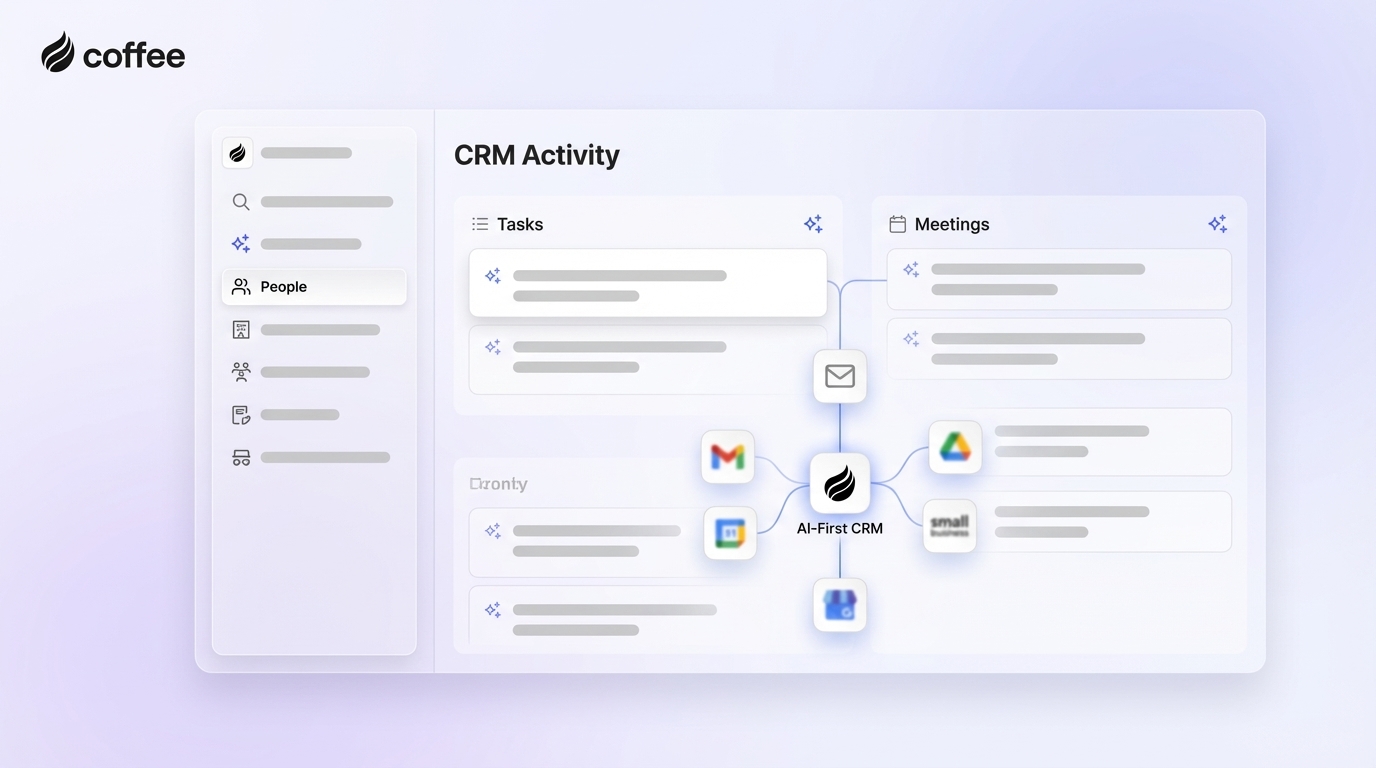
Coffee connects to Google Workspace or Microsoft 365 through a simple authentication step. After connection, the agent immediately begins scanning emails and calendars to populate records and log activity. Most teams become operational quickly. No dedicated engineering team is required, and configuration stays light. The agent handles onboarding tasks so the software, not your staff, carries the setup burden.
Is Coffee SOC 2 compliant?
Coffee is SOC 2 Type 2 and GDPR compliant. Customer data does not train public AI models. For small businesses in regulated-adjacent industries such as legal services, financial advisory, and professional services, Coffee meets baseline security requirements without a multi-year security review.
Does Coffee integrate with Shopify and QuickBooks?
Coffee integrates with QuickBooks through Zapier but currently has no documented Shopify integration via Zapier. Deeper native integrations are on the roadmap. For teams that need Shopify order data surfaced directly inside support tickets today, Gorgias remains the strongest native option for that workflow. Coffee’s advantage is the agent layer that captures and structures data from every interaction, regardless of the source system.
What is the migration effort from Salesforce Service Cloud?
Coffee offers two deployment models that reduce migration friction. The Standalone CRM replaces Salesforce entirely and suits teams that have outgrown spreadsheets or find legacy CRMs too maintenance-heavy. The Companion App deploys Coffee’s agent as an intelligent layer on top of an existing Salesforce instance, where the agent handles data capture and enrichment while Salesforce stays the system of record. Teams that are not ready to migrate can start with the Companion App and gain data-quality benefits immediately without a full rip-and-replace project.
Conclusion: Coffee Removes Both Manual Tickets and Manual Data Entry
Manual data entry and manual ticket handling drain separate pools of time from your team. Most tools in this comparison remove one or partially reduce the other. Coffee removes both. The agent ingests every email, call, and chat transcript automatically, structures the data without human input, and closes routine tickets end-to-end on simple seat-based pricing that includes unlimited agent labor.
For a 5-to-50-person team comparing Zendesk, Freshworks, or HubSpot, the real decision centers on which tool stops forcing your people to act as data entry clerks. Get started with Coffee and put the agent to work instead.